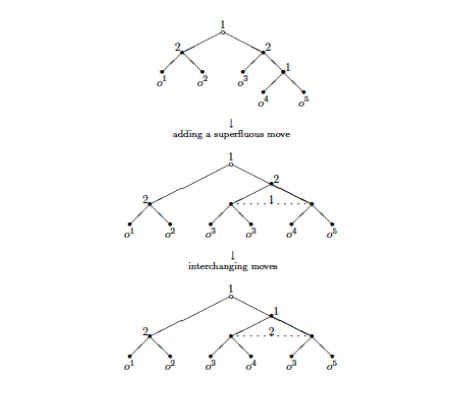
Explain(in words) why these extensive-form games are equivalent
Homework Answers
The three games are equivalent to each other because if you compare the first game with the second, it is the same except for the new superfluous move that is added in the last node of player 2. Despite adding two branches when player 2 O3, the action on both branches is still O3 hence it would not change anything. In comparing with the third game, the players have swapped their positions but the moves are also adjusted accordingly and hence practically nothing changes from game 1 to game 3 as well. Player 2 still has a choice between 3 and 4 or 5
Consider the following extensive form game P1 RP:2 L2 R2 L1 R1 (2,2) (0,3) 1. How many sub-games are there in this game...
 Consider the following extensive form game P1 RP:2 L2 R2 L1 R1 (2,2) (0,3) 1. How many sub-games are there in this game? What is the Subgame Perfect Equilibrium? 2. Represent this game as a Normal form game and find all pure strategy Nash Eq. Is there a mixed Nash eq. in this game? If yes, show one. If not, argue why not 3. Now assume that P2 cannot observe P1's action before he makes his move. As such, he...
Consider the following game among 4 players. Whenever a player gets to move, she chooses between...
Consider the following game among 4 players. Whenever a player gets to move, she chooses between two actions {L, R}. Player 1 plays first, then player 2, then 3, and player 4 plays last. Player 2 moves knowing 1’s choice. Player 3 moves without knowing 2’s choice but knowing 1’s choice. Player 4 knows 2’s and 3’s choices but does not know the choice of 1. Write an extensive form that represents this information structure (allow for sufficient space and...
Homework #1 Consider a 3-player setting in which player 1 moves first by choosing among three...
 Homework #1 Consider a 3-player setting in which player 1 moves first by choosing among three actions: a, b, and c. After observing the choice of player 1, player 2 chooses among two actions: x and y. 1. Consider the following three variants as to what player 3 can do and what she knows when she moves: If player 1 chose a, then (after player 2 made his choice) player 3 selects among two actions: high and low. Player 3...
7. Consider a setting where player 1 and player 2 can each take on of two...
7. Consider a setting where player 1 and player 2 can each take on of two action: put a coin in player 3’s box or not. Player 3 then can either open the box or not. Consider the following variants of the game: a. Player 1 moves first, player 2 sees player 1’s choice and moves second, player 3 sees both choices then acts. Write down the extensive form of this setting. (You can ignore payoffs) b. Player 1 and...
So far, we have two ways to write a game: extensive form and strategic form. One...
So far, we have two ways to write a game: extensive form and strategic form. One of these is more suited to sequential games, and one is more suited to simultaneous games. Explain why, with reference to a simple game that could be played sequentially or simultaneously.
Games theory : Inside Oligopoly
Consider a two-player, sequential-move game where each player can choose to play right or left. Player 1 moves first. Player 2 observes player 1’s actual move and then decides to move right or left. If player 1 moves right, player 1 receives $0 and player 2 receives $25. If both players move left, player 1 receives –$5 and player 2 receives $10. If player 1 moves left and player 2 moves right, player 1 receives $20 and player 2 receives...
King in N moves. In chess, a king can move one space in any of the...
King in N moves. In chess, a king can move one space in any of the 8 directions (2 vertical, 2 horizontal, 4 diagonals). Suppose our chessboard is infinite in every direction, and a king starts on a particular square. (a) How many different squares are possible locations for the king after N or fewer moves? (b) Answer the same question for a “crippled king” that can only move horizontally and vertically (no diagonal moves allowed). For both parts, show...
charges move in an electric field due to the Coulomb force. Some unknowns charge moves in...
 charges move in an electric field due to the Coulomb force.
Some unknowns charge moves in a direction perpendicular to the
direction of the electric field
TakeTutorialA Home Student: amaile7 Esam 1 PRACTICE Begin Date: 3/19/2019 1201.00 AM-Due Date: 3/20/2019 11 59.00 PM End Date: 3/20/2019 11 59.00 PM a3%) Problem 2: Charges move in an electric field due to the Coulomb force. moves in a direction perpendicular to the direction of the electric field lines. We can conctade that...
charges move in an electric field due to the Coulomb force.
Some unknowns charge moves in a direction perpendicular to the
direction of the electric field
TakeTutorialA Home Student: amaile7 Esam 1 PRACTICE Begin Date: 3/19/2019 1201.00 AM-Due Date: 3/20/2019 11 59.00 PM End Date: 3/20/2019 11 59.00 PM a3%) Problem 2: Charges move in an electric field due to the Coulomb force. moves in a direction perpendicular to the direction of the electric field lines. We can conctade that...
2. consider the following simultaneous move game. Player B LEFT RIGHT Player A UP 4,1 1,4...
2. consider the following simultaneous move game. Player B LEFT RIGHT Player A UP 4,1 1,4 DOWN 2,3 3,2 a. If there is a Nash equilibrium in pure strategies, what is it and what are the payoffs? b. If there is a Nash equilibrium in mixed strategies, what is it and what are the expected payoffs? 3. Continue with the previous game but suppose this was a sequential game where Player A got to go first. a. Diagram the game...
2. Determinant function onM 2 (a) Take A E M2. Consider the mapping volA: R2 x R2 - R, which is g...
 ANSWER c d e ONLY! No need to answer a and b
Thanks
2. Determinant function onM 2 (a) Take A E M2. Consider the mapping volA: R2 x R2 - R, which is given by volA(v1, v2) olvA, 2A), for every v1, 02 E R2. Explain why volA is also a volume form (b) Explain why (use section (c) from question 1 above) there is a scalar α(A) E R such that VOLA-α(A) . voi We denote the scalar...
ANSWER c d e ONLY! No need to answer a and b
Thanks
2. Determinant function onM 2 (a) Take A E M2. Consider the mapping volA: R2 x R2 - R, which is given by volA(v1, v2) olvA, 2A), for every v1, 02 E R2. Explain why volA is also a volume form (b) Explain why (use section (c) from question 1 above) there is a scalar α(A) E R such that VOLA-α(A) . voi We denote the scalar...
 Consider the following extensive form game P1 RP:2 L2 R2 L1 R1 (2,2) (0,3) 1. How many sub-games are there in this game? What is the Subgame Perfect Equilibrium? 2. Represent this game as a Normal form game and find all pure strategy Nash Eq. Is there a mixed Nash eq. in this game? If yes, show one. If not, argue why not 3. Now assume that P2 cannot observe P1's action before he makes his move. As such, he...
 Homework #1 Consider a 3-player setting in which player 1 moves first by choosing among three actions: a, b, and c. After observing the choice of player 1, player 2 chooses among two actions: x and y. 1. Consider the following three variants as to what player 3 can do and what she knows when she moves: If player 1 chose a, then (after player 2 made his choice) player 3 selects among two actions: high and low. Player 3...
 charges move in an electric field due to the Coulomb force.
Some unknowns charge moves in a direction perpendicular to the
direction of the electric field
TakeTutorialA Home Student: amaile7 Esam 1 PRACTICE Begin Date: 3/19/2019 1201.00 AM-Due Date: 3/20/2019 11 59.00 PM End Date: 3/20/2019 11 59.00 PM a3%) Problem 2: Charges move in an electric field due to the Coulomb force. moves in a direction perpendicular to the direction of the electric field lines. We can conctade that...
charges move in an electric field due to the Coulomb force.
Some unknowns charge moves in a direction perpendicular to the
direction of the electric field
TakeTutorialA Home Student: amaile7 Esam 1 PRACTICE Begin Date: 3/19/2019 1201.00 AM-Due Date: 3/20/2019 11 59.00 PM End Date: 3/20/2019 11 59.00 PM a3%) Problem 2: Charges move in an electric field due to the Coulomb force. moves in a direction perpendicular to the direction of the electric field lines. We can conctade that...
 ANSWER c d e ONLY! No need to answer a and b
Thanks
2. Determinant function onM 2 (a) Take A E M2. Consider the mapping volA: R2 x R2 - R, which is given by volA(v1, v2) olvA, 2A), for every v1, 02 E R2. Explain why volA is also a volume form (b) Explain why (use section (c) from question 1 above) there is a scalar α(A) E R such that VOLA-α(A) . voi We denote the scalar...
ANSWER c d e ONLY! No need to answer a and b
Thanks
2. Determinant function onM 2 (a) Take A E M2. Consider the mapping volA: R2 x R2 - R, which is given by volA(v1, v2) olvA, 2A), for every v1, 02 E R2. Explain why volA is also a volume form (b) Explain why (use section (c) from question 1 above) there is a scalar α(A) E R such that VOLA-α(A) . voi We denote the scalar...
Most questions answered within 3 hours.
-
Where is the error in this code sequence?
String s1 = "Hello";
String s2 = "ello";...
asked 11 months ago -
Financial data for Joel de Paris, Inc., for last year
follow:
Joel de Paris, Inc.
Balance...
asked 11 months ago -
Consider this reaction:
Al2(SO4)3 (aq)+ BaCl3
(aq) Al2Cl6 (aq)- +
3BaSO4(s) . What is the...
asked 11 months ago -
Suppose that Savneet is considering increasing her
recent random sample from 20 car rentals to 40...
asked 11 months ago -
Trucks arrive at an unloading terminal at an average rate of 120
per hour.
Trucks arrive...
asked 11 months ago -
Why are methanol and ethanol completely soluble in water while
octanol is not very little soluble....
asked 11 months ago -
A facilities manager at a university reads in a research report
that the mean amount of...
asked 11 months ago -
When the CuSO4 is rehydrated by adding water to the anhydrous
compound, is this an endothermic...
asked 11 months ago -
A ray of sunlight is passing from diamond into crown glass; the
angle of incidence is...
asked 11 months ago -
A block of mass 0.249 kg is placed on top of a light, vertical
spring of...
asked 11 months ago -
how do the kidneys compensate in the presences of acidosis
a) trigger hyperventilate
b) reserve acid...
asked 11 months ago -
Question 501 pts
The rental rate of capital to the firm increases. Which of the
following...
asked 11 months ago