
Homework Answers
Add Answer to:
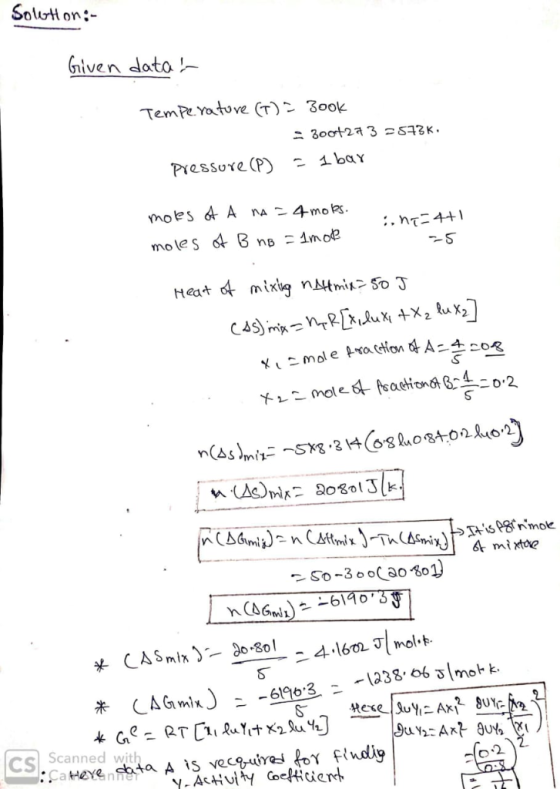
Mixing 4 moles A and 1 mole B results in absorption of 50 J (ie, heat of mixing, n△Hmix) at const...
moles of h3o neutralized with oh and heat of neutralization per mole of h3o neutralized Lab...
 moles of h3o neutralized with oh and heat of neutralization
per mole of h3o neutralized
Lab 6 Chemistry 117 University of Massachusetts Boston Part 2: Heat of Neutralization Data a. Exact volume of 1.00 M HCl(aq) (-50 mL) b. Exact volume of 1.00 M NaOH(aq) to be added (30-40 mL) c. Moles of NaOH d. Assuming 1.00 mL = 1.00 g, mass of solution produced on mixing e. Heat capacity of calorimeter, Coal f. Initial temperature, Ti g. Final temperature,...
moles of h3o neutralized with oh and heat of neutralization
per mole of h3o neutralized
Lab 6 Chemistry 117 University of Massachusetts Boston Part 2: Heat of Neutralization Data a. Exact volume of 1.00 M HCl(aq) (-50 mL) b. Exact volume of 1.00 M NaOH(aq) to be added (30-40 mL) c. Moles of NaOH d. Assuming 1.00 mL = 1.00 g, mass of solution produced on mixing e. Heat capacity of calorimeter, Coal f. Initial temperature, Ti g. Final temperature,...
1. a 10 mol sample of ideal gas whose heat capacities are Cv= 20.8 J/K Mole...
1. a 10 mol sample of ideal gas whose heat capacities are Cv= 20.8 J/K Mole and Cv = 29.1 J/K Mole a. Undergoes a reversible constant volume cooking from 49.3 L, 300 K, and 5.00 atm to 150 K. Calculate q, w, and ΔU. b. the same gas then underwent a reversible constant pressure expansion from 150 K and 2.50 atm to 98.6 L. Calculate q , w, and ΔU. You'll need the ideal gas law to calculate T-final...
part a. The air in an inflated balloon (defined as the system) is warmed over a toaster and absorbs 110 J of heat. As it...
part a. The air in an inflated balloon (defined as the system) is warmed over a toaster and absorbs 110 J of heat. As it expands, it does 79 kJ of work. What is the change in internal energy for the system? Express the energy in kilojoules to two significant figures. part b. When fuel is burned in a cylinder equipped with a piston, the volume expands from 0.235 L to 1.350 L against an external pressure of 1.02 atm...
One mole of a gas at a temperature of 25 degree C and a pressure of...
 One mole of a gas at a temperature of 25 degree C and a pressure of 1 bar (the initial state)is to be heated and compressed in a frictionless piston and cylinder to 300 degree C and 10 bar (the final state). a) Sketch the PV diagram and (b) compute the internal energy change, the entropy change and the heat and work required along each of the following paths: Path A: Isothermal compression to 10 bar, and then isobaric heating...
Question 11: (1 point) One mole of N2(g) undergoes the following change in state. N2(g, 309...
Question 11: (1 point) One mole of N2(g) undergoes the following change in state. N2(g, 309 K, 4.03 bar) ⟶ N2(g, 259 K, 6.57 bar) What is ΔS for the gas? Assume ideal gas behaviour. The constant pressure molar heat capacity for N2(g) is Cp,m = 29.10 J K−1 mol−1. Enter your answers in the specified units with three or more significant figures . Do not include units as part of your answer. ΔS = ____________ J K−1 Question 12: (1...
NA 6.022 x 10³ molecules/mole k 1.381 x 10²³ J/K c 2.997 x 10⁸ m/s 1...
 NA 6.022 x 10³ molecules/mole k 1.381 x 10²³ J/K c 2.997 x 10⁸ m/s 1 cal 4.186 J mp 1.673 x 1027 kg 1 atm 1.013 bar h 6.626 x 10⁻³⁴ Js R 8.315 J/(mol K) 1 bar 10% Pa 1. (15 points) 2.0 moles of a monatomic ideal gas undergo a 3 step cyclic process. The process begins in state A at 1.00 atm, 297 K. The gas is heated slowly at constant pressure until it reaches state...
ReviewI Constants1 Periodic Table Part A A calorimeter is an insulated device in which a chemical reaction is contained By measuring the temperature change. ΔΤ, we can calculate the heat released or...
 ReviewI Constants1 Periodic Table Part A A calorimeter is an insulated device in which a chemical reaction is contained By measuring the temperature change. ΔΤ, we can calculate the heat released or absorbed during the reaction using the following equation: A calorimeter contains 35.0 mL of water at 13.5 °C . when 1.20 g of X (a substance with a molar mass of 61.0 g/mol) is added, it dissolves via the reaction X+20)-X(ag) and the temperature of the solution increases...
please solve this on paper wiyh the steps thank u Q.1) A mole of X reacts...
 please solve this on paper wiyh the steps thank u
Q.1) A mole of X reacts at a constant pressure of 43.0 atm via the reaction: X(g) + 4Y(g) + 2/(g) AH° = -75.0 kJ Before the reaction, the volume of the gaseous mixture was 5.00 L. After the reaction, the volume was 2.00 L. Calculate the value of the total energy change, AE, in kilojoule. Show your work, express your answer to three significant figures, and include the appropriate...
please solve this on paper wiyh the steps thank u
Q.1) A mole of X reacts at a constant pressure of 43.0 atm via the reaction: X(g) + 4Y(g) + 2/(g) AH° = -75.0 kJ Before the reaction, the volume of the gaseous mixture was 5.00 L. After the reaction, the volume was 2.00 L. Calculate the value of the total energy change, AE, in kilojoule. Show your work, express your answer to three significant figures, and include the appropriate...
1. The standard enthalpy change for the combustion of mole of propane is -2043.0 kJ. CH_(g)...
 1. The standard enthalpy change for the combustion of mole of propane is -2043.0 kJ. CH_(g) +5 0 (g) →3002(g) + 4H2O(g) Calculate Hº for propane based on the following standard molar enthalpies of formation. molecule CO (9) H2O(g) AH (kJ/mol-rxn) -393.5 -241.8 a. +1407.7 kJ/mol-rxn b. +104.7 kJ/mol-rxn c.-104.7 kJ/mol-rxn d -4190.7 kJ/mol-rxn e. -1407.7 kJ/mol-rxn 2. Which of the following statements is/are CORRECT? 1. If a reaction occurs at constant pressure, 4-AH. 2. The change in energy for...
Font Open the Le Chatler's Principle Activity found in your textbook, Interactive General Chemistry. (Section 15.6,...
 Font Open the Le Chatler's Principle Activity found in your textbook, Interactive General Chemistry. (Section 15.6, Figure 15.9), run the simulation and complete the following questions. 1. Start with the default settings where K = 1.00. a. Write the expression based on the chemical equation in the upper right corner. b. Under the initial conditions of (A) = 2.00 M, and (B) = 4.00 M, is the reaction at equilibrium? How can you tell? c. Compare how Q is affected...
 moles of h3o neutralized with oh and heat of neutralization
per mole of h3o neutralized
Lab 6 Chemistry 117 University of Massachusetts Boston Part 2: Heat of Neutralization Data a. Exact volume of 1.00 M HCl(aq) (-50 mL) b. Exact volume of 1.00 M NaOH(aq) to be added (30-40 mL) c. Moles of NaOH d. Assuming 1.00 mL = 1.00 g, mass of solution produced on mixing e. Heat capacity of calorimeter, Coal f. Initial temperature, Ti g. Final temperature,...
moles of h3o neutralized with oh and heat of neutralization
per mole of h3o neutralized
Lab 6 Chemistry 117 University of Massachusetts Boston Part 2: Heat of Neutralization Data a. Exact volume of 1.00 M HCl(aq) (-50 mL) b. Exact volume of 1.00 M NaOH(aq) to be added (30-40 mL) c. Moles of NaOH d. Assuming 1.00 mL = 1.00 g, mass of solution produced on mixing e. Heat capacity of calorimeter, Coal f. Initial temperature, Ti g. Final temperature,...
 One mole of a gas at a temperature of 25 degree C and a pressure of 1 bar (the initial state)is to be heated and compressed in a frictionless piston and cylinder to 300 degree C and 10 bar (the final state). a) Sketch the PV diagram and (b) compute the internal energy change, the entropy change and the heat and work required along each of the following paths: Path A: Isothermal compression to 10 bar, and then isobaric heating...
 NA 6.022 x 10³ molecules/mole k 1.381 x 10²³ J/K c 2.997 x 10⁸ m/s 1 cal 4.186 J mp 1.673 x 1027 kg 1 atm 1.013 bar h 6.626 x 10⁻³⁴ Js R 8.315 J/(mol K) 1 bar 10% Pa 1. (15 points) 2.0 moles of a monatomic ideal gas undergo a 3 step cyclic process. The process begins in state A at 1.00 atm, 297 K. The gas is heated slowly at constant pressure until it reaches state...
 ReviewI Constants1 Periodic Table Part A A calorimeter is an insulated device in which a chemical reaction is contained By measuring the temperature change. ΔΤ, we can calculate the heat released or absorbed during the reaction using the following equation: A calorimeter contains 35.0 mL of water at 13.5 °C . when 1.20 g of X (a substance with a molar mass of 61.0 g/mol) is added, it dissolves via the reaction X+20)-X(ag) and the temperature of the solution increases...
 please solve this on paper wiyh the steps thank u
Q.1) A mole of X reacts at a constant pressure of 43.0 atm via the reaction: X(g) + 4Y(g) + 2/(g) AH° = -75.0 kJ Before the reaction, the volume of the gaseous mixture was 5.00 L. After the reaction, the volume was 2.00 L. Calculate the value of the total energy change, AE, in kilojoule. Show your work, express your answer to three significant figures, and include the appropriate...
please solve this on paper wiyh the steps thank u
Q.1) A mole of X reacts at a constant pressure of 43.0 atm via the reaction: X(g) + 4Y(g) + 2/(g) AH° = -75.0 kJ Before the reaction, the volume of the gaseous mixture was 5.00 L. After the reaction, the volume was 2.00 L. Calculate the value of the total energy change, AE, in kilojoule. Show your work, express your answer to three significant figures, and include the appropriate...
 1. The standard enthalpy change for the combustion of mole of propane is -2043.0 kJ. CH_(g) +5 0 (g) →3002(g) + 4H2O(g) Calculate Hº for propane based on the following standard molar enthalpies of formation. molecule CO (9) H2O(g) AH (kJ/mol-rxn) -393.5 -241.8 a. +1407.7 kJ/mol-rxn b. +104.7 kJ/mol-rxn c.-104.7 kJ/mol-rxn d -4190.7 kJ/mol-rxn e. -1407.7 kJ/mol-rxn 2. Which of the following statements is/are CORRECT? 1. If a reaction occurs at constant pressure, 4-AH. 2. The change in energy for...
 Font Open the Le Chatler's Principle Activity found in your textbook, Interactive General Chemistry. (Section 15.6, Figure 15.9), run the simulation and complete the following questions. 1. Start with the default settings where K = 1.00. a. Write the expression based on the chemical equation in the upper right corner. b. Under the initial conditions of (A) = 2.00 M, and (B) = 4.00 M, is the reaction at equilibrium? How can you tell? c. Compare how Q is affected...
Most questions answered within 3 hours.
-
Where is the error in this code sequence?
String s1 = "Hello";
String s2 = "ello";...
asked 11 months ago -
Financial data for Joel de Paris, Inc., for last year
follow:
Joel de Paris, Inc.
Balance...
asked 11 months ago -
Consider this reaction:
Al2(SO4)3 (aq)+ BaCl3
(aq) Al2Cl6 (aq)- +
3BaSO4(s) . What is the...
asked 11 months ago -
Suppose that Savneet is considering increasing her
recent random sample from 20 car rentals to 40...
asked 11 months ago -
Trucks arrive at an unloading terminal at an average rate of 120
per hour.
Trucks arrive...
asked 11 months ago -
Why are methanol and ethanol completely soluble in water while
octanol is not very little soluble....
asked 11 months ago -
A facilities manager at a university reads in a research report
that the mean amount of...
asked 11 months ago -
When the CuSO4 is rehydrated by adding water to the anhydrous
compound, is this an endothermic...
asked 11 months ago -
A ray of sunlight is passing from diamond into crown glass; the
angle of incidence is...
asked 11 months ago -
A block of mass 0.249 kg is placed on top of a light, vertical
spring of...
asked 11 months ago -
how do the kidneys compensate in the presences of acidosis
a) trigger hyperventilate
b) reserve acid...
asked 11 months ago -
Question 501 pts
The rental rate of capital to the firm increases. Which of the
following...
asked 11 months ago