
Homework Answers

Add Answer to:
Problem 2: Show that the magnetic dipole moment μ of an electron orbiting the proton nucleus of a...
4. Orbital Magnetic Moment - In the derivation of the orbital magn etic dipole moment in...
 4. Orbital Magnetic Moment - In the derivation of the orbital magn etic dipole moment in the notes, we assumed a single electron orbiting a nucleus to obtain the magnetic moment. From a quantum mechanical point of view this is strange because the electron's position is uncertain. Instead of the single charge consider the cases below. Follow the analysis th rough and determine if a different result would have been obtained for the magnetic moment. Consider the electrons charge and...
4. Orbital Magnetic Moment - In the derivation of the orbital magn etic dipole moment in the notes, we assumed a si...
 4. Orbital Magnetic Moment - In the derivation of the orbital magn etic dipole moment in the notes, we assumed a single electron orbiting a nucleus to obtain the magnetic moment. From a quantum mechanical point of view this is strange because the electron's position is uncertain. Instead of the single charge consider the cases below. Follow the analysis th rough and determine if a different result would have been obtained for the magnetic moment. Consider the electrons charge and...
The distance between proton and electron or a molecule of dipole and electron molecule of dipole...
 The distance between proton and electron or a molecule
of dipole and electron molecule of dipole moment is 7.2D:
(q=1.10^-19C and 1D= 3.34x10^-30C.m)
a 140 pm
b 135 pm
c 155 pm
d 150 pm
e 130 pm
need answer asap
The distance between proton and electron of a molecule of dipole moment 7.2 D is: * (3 Points) (q = 1.10- C and ID = 3.34 x 10⁻³⁰ C.m) 140 pm 135 pm 155 pm 150 pm 130 pm
The distance between proton and electron or a molecule
of dipole and electron molecule of dipole moment is 7.2D:
(q=1.10^-19C and 1D= 3.34x10^-30C.m)
a 140 pm
b 135 pm
c 155 pm
d 150 pm
e 130 pm
need answer asap
The distance between proton and electron of a molecule of dipole moment 7.2 D is: * (3 Points) (q = 1.10- C and ID = 3.34 x 10⁻³⁰ C.m) 140 pm 135 pm 155 pm 150 pm 130 pm
Problem 10: The potassium bromide (KBr) molecule has an electric dipole moment of 3.50 × 10...
Problem 10: The potassium bromide (KBr) molecule has an electric dipole moment of 3.50 × 10 -29 C⋅m. The molecule has a dipole moment because the lone 4s electron of the potassium atom spends much of its time orbiting the bromine nucleus (and thereby filling the 4p shell of bromine) – leaving the potassium atom positively charged and the bromine atom negatively charged (this is called “ionic bonding”). (a) Assuming for the moment that the potassium 4s electron spends all...
Calculate the electric dipole moment of an electron and a proton 4.30 nm apart?
Calculate the electric dipole moment of an electron and a proton 4.30 nm apart?
An electron and a proton are 0.53 x 10^-10 m apart. Calculate their dipole moment if they...
An electron and a proton are 0.53 x 10^-10 m apart. Calculate their dipole moment if they are at rest. Using your dipole moment calculation, find the electric potential at a point 1.1 x 10^-9 m away when this point is along the axis of the dipole nearer the positive charge and when this point is 45o left of the axis but nearer the negative charge.
4. Magnetic Dipole Moment on a PEC Sphere: In HW 4-Problem 5, you found the electric dipole momen...
 4. Magnetic Dipole Moment on a PEC Sphere: In HW 4-Problem 5, you found the electric dipole moment for a metal sphere of radius a in a uniform electric field. In this problem you will find the magnetic dipole moment for the same metal sphere but now in a uniform magnetic field, Hext-Hext2. Note:Assume that the sphere is centered at the origin of a spherical coordinate system. Express Hext in spherical coordinates. To find the magnetic field that is induced...
Intro to Quantum Mechanics Problem: An electron under the influence of a uniform magnetic field By...
 Intro to Quantum Mechanics Problem:
An electron under the influence of a uniform magnetic field By in the y-direction has its spin initially (at 0) pointing in the positive x-direction. That is, it is in an eigenstate of S with eigenvalue +,S h. The Hamiltonian H--μ . B-γ By Sy consists of the interaction of the magnetic dipole moment μ due to spin and the magnetic field B. Show that the probability of finding the electron with its spin pointing...
Intro to Quantum Mechanics Problem:
An electron under the influence of a uniform magnetic field By in the y-direction has its spin initially (at 0) pointing in the positive x-direction. That is, it is in an eigenstate of S with eigenvalue +,S h. The Hamiltonian H--μ . B-γ By Sy consists of the interaction of the magnetic dipole moment μ due to spin and the magnetic field B. Show that the probability of finding the electron with its spin pointing...
3. Show that the units of the magnetic moment,μ , are Aem2 (ampere meter).
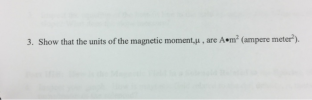 3. Show that the units of the magnetic moment,μ , are Aem2 (ampere meter).
Determine the magnitude of the force between an electric dipole with a dipole moment of 2...
Determine the magnitude of the force between an electric dipole with a dipole moment of 2 ✕ 10-29 C m and an electron. The electron is positioned r = 24 nm from the centre of the dipole, along the dipole axis. Hint: Assume that r >> d, with d the charge separation distance in the dipole.
 4. Orbital Magnetic Moment - In the derivation of the orbital magn etic dipole moment in the notes, we assumed a single electron orbiting a nucleus to obtain the magnetic moment. From a quantum mechanical point of view this is strange because the electron's position is uncertain. Instead of the single charge consider the cases below. Follow the analysis th rough and determine if a different result would have been obtained for the magnetic moment. Consider the electrons charge and...
 4. Orbital Magnetic Moment - In the derivation of the orbital magn etic dipole moment in the notes, we assumed a single electron orbiting a nucleus to obtain the magnetic moment. From a quantum mechanical point of view this is strange because the electron's position is uncertain. Instead of the single charge consider the cases below. Follow the analysis th rough and determine if a different result would have been obtained for the magnetic moment. Consider the electrons charge and...
 The distance between proton and electron or a molecule
of dipole and electron molecule of dipole moment is 7.2D:
(q=1.10^-19C and 1D= 3.34x10^-30C.m)
a 140 pm
b 135 pm
c 155 pm
d 150 pm
e 130 pm
need answer asap
The distance between proton and electron of a molecule of dipole moment 7.2 D is: * (3 Points) (q = 1.10- C and ID = 3.34 x 10⁻³⁰ C.m) 140 pm 135 pm 155 pm 150 pm 130 pm
The distance between proton and electron or a molecule
of dipole and electron molecule of dipole moment is 7.2D:
(q=1.10^-19C and 1D= 3.34x10^-30C.m)
a 140 pm
b 135 pm
c 155 pm
d 150 pm
e 130 pm
need answer asap
The distance between proton and electron of a molecule of dipole moment 7.2 D is: * (3 Points) (q = 1.10- C and ID = 3.34 x 10⁻³⁰ C.m) 140 pm 135 pm 155 pm 150 pm 130 pm
 4. Magnetic Dipole Moment on a PEC Sphere: In HW 4-Problem 5, you found the electric dipole moment for a metal sphere of radius a in a uniform electric field. In this problem you will find the magnetic dipole moment for the same metal sphere but now in a uniform magnetic field, Hext-Hext2. Note:Assume that the sphere is centered at the origin of a spherical coordinate system. Express Hext in spherical coordinates. To find the magnetic field that is induced...
 Intro to Quantum Mechanics Problem:
An electron under the influence of a uniform magnetic field By in the y-direction has its spin initially (at 0) pointing in the positive x-direction. That is, it is in an eigenstate of S with eigenvalue +,S h. The Hamiltonian H--μ . B-γ By Sy consists of the interaction of the magnetic dipole moment μ due to spin and the magnetic field B. Show that the probability of finding the electron with its spin pointing...
Intro to Quantum Mechanics Problem:
An electron under the influence of a uniform magnetic field By in the y-direction has its spin initially (at 0) pointing in the positive x-direction. That is, it is in an eigenstate of S with eigenvalue +,S h. The Hamiltonian H--μ . B-γ By Sy consists of the interaction of the magnetic dipole moment μ due to spin and the magnetic field B. Show that the probability of finding the electron with its spin pointing...
 3. Show that the units of the magnetic moment,μ , are Aem2 (ampere meter).
Most questions answered within 3 hours.
-
Where is the error in this code sequence?
String s1 = "Hello";
String s2 = "ello";...
asked 11 months ago -
Financial data for Joel de Paris, Inc., for last year
follow:
Joel de Paris, Inc.
Balance...
asked 11 months ago -
Consider this reaction:
Al2(SO4)3 (aq)+ BaCl3
(aq) Al2Cl6 (aq)- +
3BaSO4(s) . What is the...
asked 11 months ago -
Suppose that Savneet is considering increasing her
recent random sample from 20 car rentals to 40...
asked 11 months ago -
Trucks arrive at an unloading terminal at an average rate of 120
per hour.
Trucks arrive...
asked 11 months ago -
Why are methanol and ethanol completely soluble in water while
octanol is not very little soluble....
asked 11 months ago -
A facilities manager at a university reads in a research report
that the mean amount of...
asked 11 months ago -
When the CuSO4 is rehydrated by adding water to the anhydrous
compound, is this an endothermic...
asked 11 months ago -
A ray of sunlight is passing from diamond into crown glass; the
angle of incidence is...
asked 11 months ago -
A block of mass 0.249 kg is placed on top of a light, vertical
spring of...
asked 11 months ago -
how do the kidneys compensate in the presences of acidosis
a) trigger hyperventilate
b) reserve acid...
asked 11 months ago -
Question 501 pts
The rental rate of capital to the firm increases. Which of the
following...
asked 11 months ago