You have a 5 meter length of copper wire. The diameter of the wire is 0.5 mm Copper has a resisti...
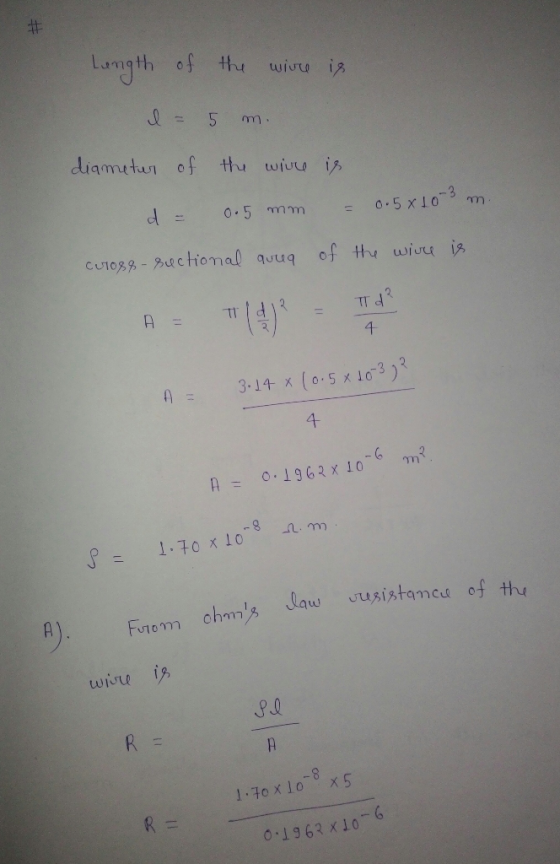
You have a 5 meter length of copper wire. The diameter of the wire is 0.5 mm Copper has a resistivity of p = 1.70*10^-18 ohms at room temperature.
A) What is the resistance of the wire?
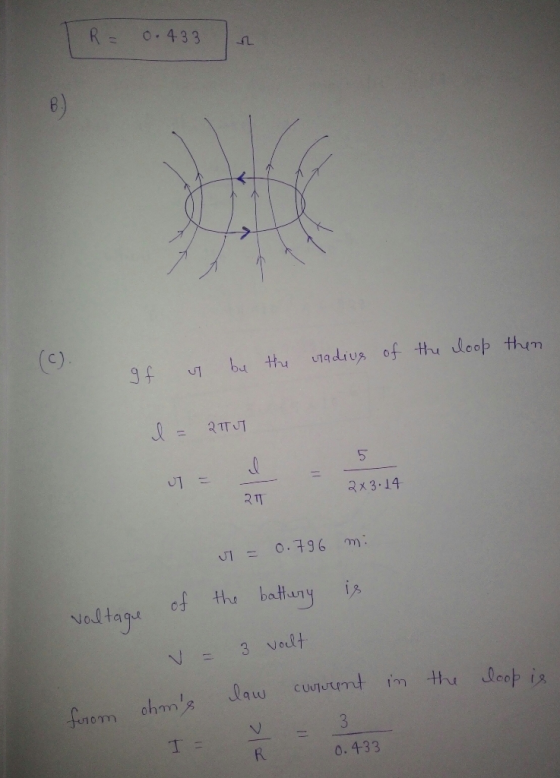
B)Suppose you connect the wire to a battery, and shape the circuit to one circular loop. Sketch what the magnetic field looks like in this scenario. Include direction of current.
C) What is the magnetic field at the center of the loop. The battery is 3.00 V
D) Now consider coiling the wire so there are many, many, turns. Sketch what the magnetic field looks like in this scenario.
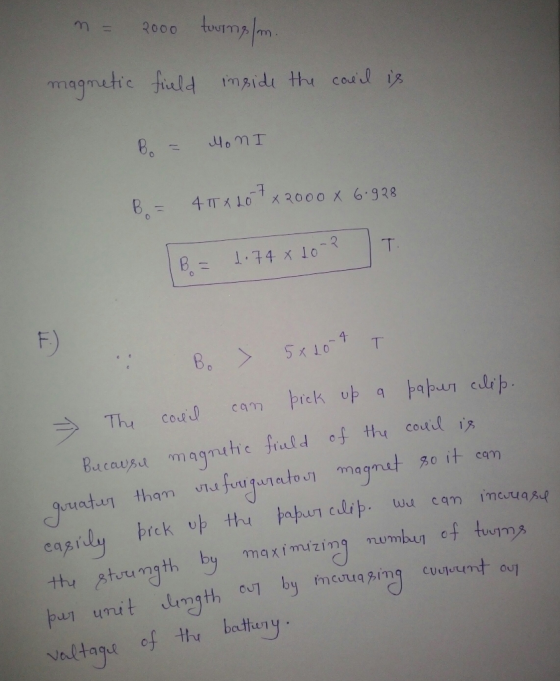
E) What is the magnetic field inside the coil if there are 500 turns that span 25 cm (20 turns/cm)? This is as densely as you can pack the turns.
F) A typical weak refrigerator magnet is about 5 * 10^-4 T and can pick up a paperclip. Could the coil from part E pick up a paperclip? If not, what are some things you can change to make it pick up a paperclip? If it can pick up a paperclip, what are some things you can do to increase its strength?
Homework Answers

Add Answer to:
You have a 5 meter length of copper wire. The diameter of the wire is 0.5 mm Copper has a resisti...
A 22.0-cm-diameter coil consists of 30 turns of circular copper wire 2.8 mm in diameter. A...
A 22.0-cm-diameter coil consists of 30 turns of circular copper wire 2.8 mm in diameter. A uniform magnetic field, perpendicular to the plane of the coil, changes at a rate of 9.35×10⁻³ T/s . The resistivity of copper is 1.68×10⁻⁸Ω⋅m. Determine the current in the loop. Determine the rate at which thermal energy is produced.
A 30.0 cm diameter coil consists of 37 turns of cylindrical copper wire 2.40 mm in...
A 30.0 cm diameter coil consists of 37 turns of cylindrical copper wire 2.40 mm in diameter. A uniform magnetic field, perpendicular to the plane of the coil, changes at a rate of 9.50 x 10⁻³ T/s. Determine the current in the loop in milli-amps (the resistivity for copper is 1.72 x 10⁻⁸ Ω.m).
A 29.0 cm diameter coil consists of 23 turns of cylindrical copper wire 2.00 mm in...
A 29.0 cm diameter coil consists of 23 turns of cylindrical copper wire 2.00 mm in diameter. A uniform magnetic field, perpendicular to the plane of the coil, changes at a rate of 7 x 10^-3 T/s. Determine the current in the loop in milli-amps (the resistivity for copper is 1.72 x 10^-8 Ω.m).
A copper wire makes up a 139 turns, 5.60 cm diameter coil. The resistance of the...
A copper wire makes up a 139 turns, 5.60 cm diameter coil. The resistance of the coil is 3.40 Ω. There is a magnetic field parallel to the axis of the coil. If the induced current in the coil is 2.20 A, what is the rate of change of the magnetic field?
A 25 cm diameter tangent galvanometer consists of 15 turns of 0.5 mm diameter copper wire...
A 25 cm diameter tangent galvanometer consists of 15 turns of 0.5 mm diameter copper wire and has a current of 2 A running through it. Calculate the total internal resistance of the wire and the magnetic field at the center of the loop. (The resistivity of copper is p = 1.69 x 10⁻⁸ ohm meter).
A 29.8 cm -diameter coil consists of 22 turns of circular copper wire 3.0 mm in...
A 29.8 cm -diameter coil consists of 22 turns of circular copper wire 3.0 mm in diameter. A uniform magnetic field, perpendicular to the plane of the coil, changes at a rate of 8.30×10⁻³ T/s . A. Determine the current in the loop B. Determine the rate at which thermal energy is produced.
A 27.6 cm -diameter coil consists of 28 turns of circular copper wire 2.8 mm in...
A 27.6 cm -diameter coil consists of 28 turns of circular copper wire 2.8 mm in diameter. A uniform magnetic field, perpendicular to the plane of the coil, changes at a rate of 7.10×10⁻³ T/s . A) Determine the current in the loop. B) Determine the rate at which thermal energy is produced.
A 20.8 cm -diameter coil consists of 30 turns of circular copper wire 2.4 mm in...
A 20.8 cm -diameter coil consists of 30 turns of circular copper wire 2.4 mm in diameter. A uniform magnetic field, perpendicular to the plane of the coil, changes at a rate of 7.64×10⁻³ T/s . PART A: Determine the current in the loop. PART B: Determine the rate at which thermal energy is produced.
You have 10 m of 0.46 mm -diameter copper wire and a battery capable of passing...
You have 10 m of 0.46 mm -diameter copper wire and a battery capable of passing 14 A through the wire. What magnetic field strength could you obtain inside a 2.8cm -diameter solenoid wound with the wire as closely spaced as possible? What magnetic field strength could you obtain at the center of a single circular loop made from the wire?
A 15.6 cm -diameter coil consists of 27 turns of circular copper wire 2.6 mm in...
A 15.6 cm -diameter coil consists of 27 turns of circular copper wire 2.6 mm in diameter. A uniform magnetic field, perpendicular to the plane of the coil, changes at a rate of 7.90×10⁻³ T/s . (PLEASE show step by step and don't write down random numbers without showing how you got it. Thank you!) A. Determine the current in the loop. B. Determine the rate at which thermal energy is produced.
Most questions answered within 3 hours.
-
Where is the error in this code sequence?
String s1 = "Hello";
String s2 = "ello";...
asked 11 months ago -
Financial data for Joel de Paris, Inc., for last year
follow:
Joel de Paris, Inc.
Balance...
asked 11 months ago -
Consider this reaction:
Al2(SO4)3 (aq)+ BaCl3
(aq) Al2Cl6 (aq)- +
3BaSO4(s) . What is the...
asked 11 months ago -
Suppose that Savneet is considering increasing her
recent random sample from 20 car rentals to 40...
asked 11 months ago -
Trucks arrive at an unloading terminal at an average rate of 120
per hour.
Trucks arrive...
asked 11 months ago -
Why are methanol and ethanol completely soluble in water while
octanol is not very little soluble....
asked 11 months ago -
A facilities manager at a university reads in a research report
that the mean amount of...
asked 11 months ago -
When the CuSO4 is rehydrated by adding water to the anhydrous
compound, is this an endothermic...
asked 11 months ago -
A ray of sunlight is passing from diamond into crown glass; the
angle of incidence is...
asked 11 months ago -
A block of mass 0.249 kg is placed on top of a light, vertical
spring of...
asked 11 months ago -
how do the kidneys compensate in the presences of acidosis
a) trigger hyperventilate
b) reserve acid...
asked 11 months ago -
Question 501 pts
The rental rate of capital to the firm increases. Which of the
following...
asked 11 months ago