
Homework Answers
Add Answer to:
6. (5 pt.) The figure shows three equal currents i, two parallel, one anti-parallel, and four Amp...
why is this the answer? The figure shows four arrangements in which long parallel wires carry...
 why is this the answer?
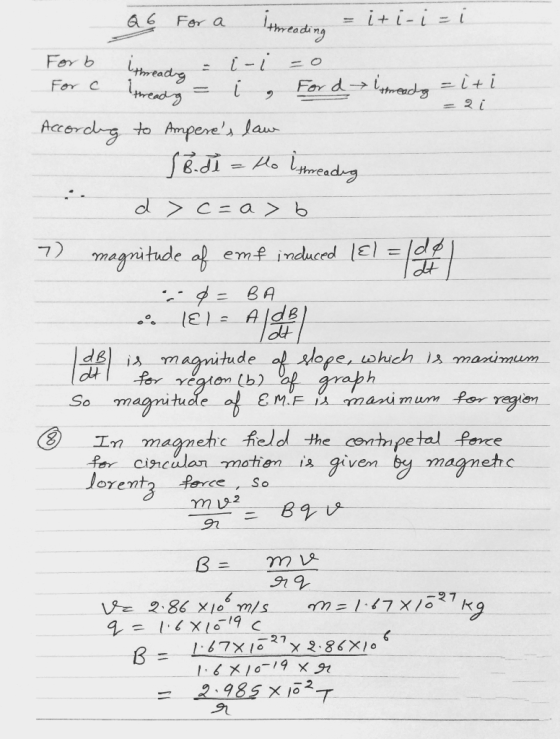
The figure shows four arrangements in which long parallel wires carry equal currents directly into or out of the page at the corners of identical squares. Rank the arrangements according to the magnitude of the net magnetic field at the center of the square, greatest first. a>b>c>d C> > > • coda-b a = b = c+d
why is this the answer?
The figure shows four arrangements in which long parallel wires carry equal currents directly into or out of the page at the corners of identical squares. Rank the arrangements according to the magnitude of the net magnetic field at the center of the square, greatest first. a>b>c>d C> > > • coda-b a = b = c+d
Four long, parallel conductors carry equal currents of I. The figure is an end view of...
 Four long, parallel conductors carry equal currents of I. The figure is an end view of the conductors. Crosses are INTO 2) the page and dots are OUT of the page. Calculate the magnitude and direction of the magnetic field at the center of the square with sides of length a. 3) A rectangular conducting loop (with very very long length) of resistance R, mass m and width w falls (gravity is constant) into a uniform magnetic field (B) as...
Four long, parallel conductors carry equal currents of I- 2.00 A. The figure below is an...
 Four long, parallel conductors carry equal currents of I- 2.00 A. The figure below is an end view of the conductors. The current direction is into the page at points A and B and out of the page at C and (a) Calculate the magnitude of the magnetic field at point P, located at the center of the square of edge length 0.200 m n. HT (b) Determine the direction of the magnetic field at point P, located at the...
Four long, parallel conductors carry equal currents of I=4.93 A. The figure shown below is an...
 Four long, parallel conductors carry equal currents of I=4.93 A. The figure shown below is an end view of the conductors. The direction of the current is into the page at points A and B (indicated by the crosses) and out of the page at C and D (indicated by the dots). Calculate the magnitude and direction of the magnetic field at point P, located at the center of the square with edge of length 0.200 m. (Draw the figure...
3) Three long parallel conductors carry equal currents of I= 5 Amperes. The wires are separated...
 3) Three long parallel conductors carry equal currents of I= 5 Amperes. The wires are separated by a neighboring wire from a distance of a = 20 cm. a a а i) Find the magnitude and direction of the magnetic field in the center of the equilateral triangle formed by the three wires. (10 pts) ii) Find the net force per unit length exerted on the bottom left wire due to the other two wires. (10 pts) iii) Find the...
The figure below shows two long, parallel wires in cross-section, and the currents they carry are...
 The figure below shows two long, parallel wires in cross-section, and the currents they carry are directed out of the page. The left wire carries a current of I, = 2.86 A, and the right carries a current of I = 3.25 A. The two wires are a distance d = 20.0 cm apart. Point P is the same distance d above the right wire. Assume the +xr-direction is to the right, and the +y-direction is upward. I2 (a) What...
please fill in the blanks Four long, parallel conductors carry equal currents of I = 6.70...
 please fill in the blanks
Four long, parallel conductors carry equal currents of I = 6.70 A. The figure below is an end view of the conductors. The current direction is into the page at points A and B and out of the page at C and D. А С BX D (a) Calculate the magnitude of the magnetic field at point P, located at the center of the square of edge length ( = 0.200 m. (b) Determine the...
please fill in the blanks
Four long, parallel conductors carry equal currents of I = 6.70 A. The figure below is an end view of the conductors. The current direction is into the page at points A and B and out of the page at C and D. А С BX D (a) Calculate the magnitude of the magnetic field at point P, located at the center of the square of edge length ( = 0.200 m. (b) Determine the...
Four long, parallel conductors carry equal currents of I = 4.21 A. The figure shown below...
 Four long, parallel conductors carry equal currents of I = 4.21 A. The figure shown below is an end view of the conductors. The direction of the current is into the page at points A and B (indicated by the crosses) and out of the page at C and D indicated by the dots). Calculate the magnitude and direction of the magnetic field at point P, located at the center of the square with edge of length 0.200 m. 5.95...
I mostly just need to confirm my answers thanks! In a typical parallel plate capacitor the...
 I mostly just need to confirm my answers thanks!
In a typical parallel plate capacitor the separation distance between the plates is "d". For a charged capacitor, if you increase only the separation distance of the plates the following occurs: The potential (V) between the plates remains constant but the electric field increases, The potential (V) between the plates increases but the electric field remains constant. The potential (V) between the plates remains constant and the electric remains constant. The...
I mostly just need to confirm my answers thanks!
In a typical parallel plate capacitor the separation distance between the plates is "d". For a charged capacitor, if you increase only the separation distance of the plates the following occurs: The potential (V) between the plates remains constant but the electric field increases, The potential (V) between the plates increases but the electric field remains constant. The potential (V) between the plates remains constant and the electric remains constant. The...
5. (5 points) Two very long, straight parallel wires carry currents of equal magnitude, but opposite...
 5. (5 points) Two very long, straight parallel wires carry currents of equal magnitude, but opposite direction, perpendicular to the paper in the directions shown in the Figure. The direction of the net magnetic field due to these two wires at point a, which is equidistant from both wires, is 1O Current out of page I ⓧ Current into page (a) directly to the right (b) directly to the left (c) straight downward (d) straight upward
 why is this the answer?
The figure shows four arrangements in which long parallel wires carry equal currents directly into or out of the page at the corners of identical squares. Rank the arrangements according to the magnitude of the net magnetic field at the center of the square, greatest first. a>b>c>d C> > > • coda-b a = b = c+d
why is this the answer?
The figure shows four arrangements in which long parallel wires carry equal currents directly into or out of the page at the corners of identical squares. Rank the arrangements according to the magnitude of the net magnetic field at the center of the square, greatest first. a>b>c>d C> > > • coda-b a = b = c+d
 Four long, parallel conductors carry equal currents of I. The figure is an end view of the conductors. Crosses are INTO 2) the page and dots are OUT of the page. Calculate the magnitude and direction of the magnetic field at the center of the square with sides of length a. 3) A rectangular conducting loop (with very very long length) of resistance R, mass m and width w falls (gravity is constant) into a uniform magnetic field (B) as...
 Four long, parallel conductors carry equal currents of I- 2.00 A. The figure below is an end view of the conductors. The current direction is into the page at points A and B and out of the page at C and (a) Calculate the magnitude of the magnetic field at point P, located at the center of the square of edge length 0.200 m n. HT (b) Determine the direction of the magnetic field at point P, located at the...
 Four long, parallel conductors carry equal currents of I=4.93 A. The figure shown below is an end view of the conductors. The direction of the current is into the page at points A and B (indicated by the crosses) and out of the page at C and D (indicated by the dots). Calculate the magnitude and direction of the magnetic field at point P, located at the center of the square with edge of length 0.200 m. (Draw the figure...
 3) Three long parallel conductors carry equal currents of I= 5 Amperes. The wires are separated by a neighboring wire from a distance of a = 20 cm. a a а i) Find the magnitude and direction of the magnetic field in the center of the equilateral triangle formed by the three wires. (10 pts) ii) Find the net force per unit length exerted on the bottom left wire due to the other two wires. (10 pts) iii) Find the...
 The figure below shows two long, parallel wires in cross-section, and the currents they carry are directed out of the page. The left wire carries a current of I, = 2.86 A, and the right carries a current of I = 3.25 A. The two wires are a distance d = 20.0 cm apart. Point P is the same distance d above the right wire. Assume the +xr-direction is to the right, and the +y-direction is upward. I2 (a) What...
 please fill in the blanks
Four long, parallel conductors carry equal currents of I = 6.70 A. The figure below is an end view of the conductors. The current direction is into the page at points A and B and out of the page at C and D. А С BX D (a) Calculate the magnitude of the magnetic field at point P, located at the center of the square of edge length ( = 0.200 m. (b) Determine the...
please fill in the blanks
Four long, parallel conductors carry equal currents of I = 6.70 A. The figure below is an end view of the conductors. The current direction is into the page at points A and B and out of the page at C and D. А С BX D (a) Calculate the magnitude of the magnetic field at point P, located at the center of the square of edge length ( = 0.200 m. (b) Determine the...
 Four long, parallel conductors carry equal currents of I = 4.21 A. The figure shown below is an end view of the conductors. The direction of the current is into the page at points A and B (indicated by the crosses) and out of the page at C and D indicated by the dots). Calculate the magnitude and direction of the magnetic field at point P, located at the center of the square with edge of length 0.200 m. 5.95...
 I mostly just need to confirm my answers thanks!
In a typical parallel plate capacitor the separation distance between the plates is "d". For a charged capacitor, if you increase only the separation distance of the plates the following occurs: The potential (V) between the plates remains constant but the electric field increases, The potential (V) between the plates increases but the electric field remains constant. The potential (V) between the plates remains constant and the electric remains constant. The...
I mostly just need to confirm my answers thanks!
In a typical parallel plate capacitor the separation distance between the plates is "d". For a charged capacitor, if you increase only the separation distance of the plates the following occurs: The potential (V) between the plates remains constant but the electric field increases, The potential (V) between the plates increases but the electric field remains constant. The potential (V) between the plates remains constant and the electric remains constant. The...
 5. (5 points) Two very long, straight parallel wires carry currents of equal magnitude, but opposite direction, perpendicular to the paper in the directions shown in the Figure. The direction of the net magnetic field due to these two wires at point a, which is equidistant from both wires, is 1O Current out of page I ⓧ Current into page (a) directly to the right (b) directly to the left (c) straight downward (d) straight upward
Most questions answered within 3 hours.
-
Where is the error in this code sequence?
String s1 = "Hello";
String s2 = "ello";...
asked 11 months ago -
Financial data for Joel de Paris, Inc., for last year
follow:
Joel de Paris, Inc.
Balance...
asked 11 months ago -
Consider this reaction:
Al2(SO4)3 (aq)+ BaCl3
(aq) Al2Cl6 (aq)- +
3BaSO4(s) . What is the...
asked 11 months ago -
Suppose that Savneet is considering increasing her
recent random sample from 20 car rentals to 40...
asked 11 months ago -
Trucks arrive at an unloading terminal at an average rate of 120
per hour.
Trucks arrive...
asked 11 months ago -
Why are methanol and ethanol completely soluble in water while
octanol is not very little soluble....
asked 11 months ago -
A facilities manager at a university reads in a research report
that the mean amount of...
asked 11 months ago -
When the CuSO4 is rehydrated by adding water to the anhydrous
compound, is this an endothermic...
asked 11 months ago -
A ray of sunlight is passing from diamond into crown glass; the
angle of incidence is...
asked 11 months ago -
A block of mass 0.249 kg is placed on top of a light, vertical
spring of...
asked 11 months ago -
how do the kidneys compensate in the presences of acidosis
a) trigger hyperventilate
b) reserve acid...
asked 11 months ago -
Question 501 pts
The rental rate of capital to the firm increases. Which of the
following...
asked 11 months ago