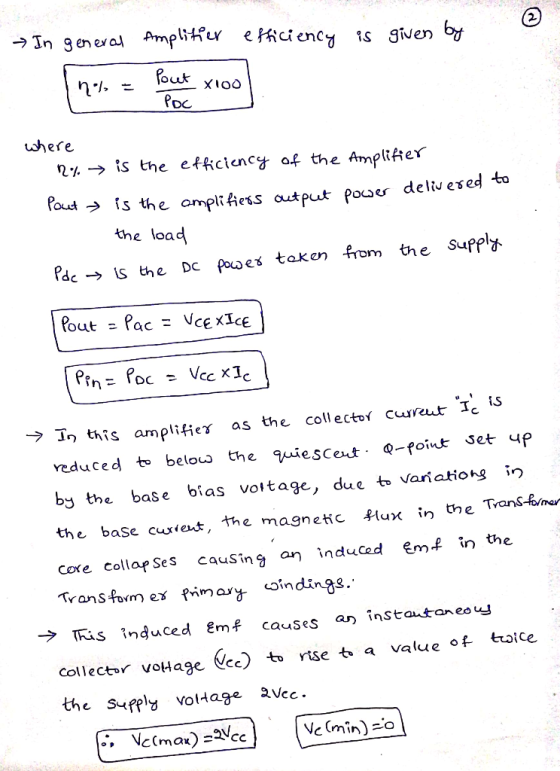
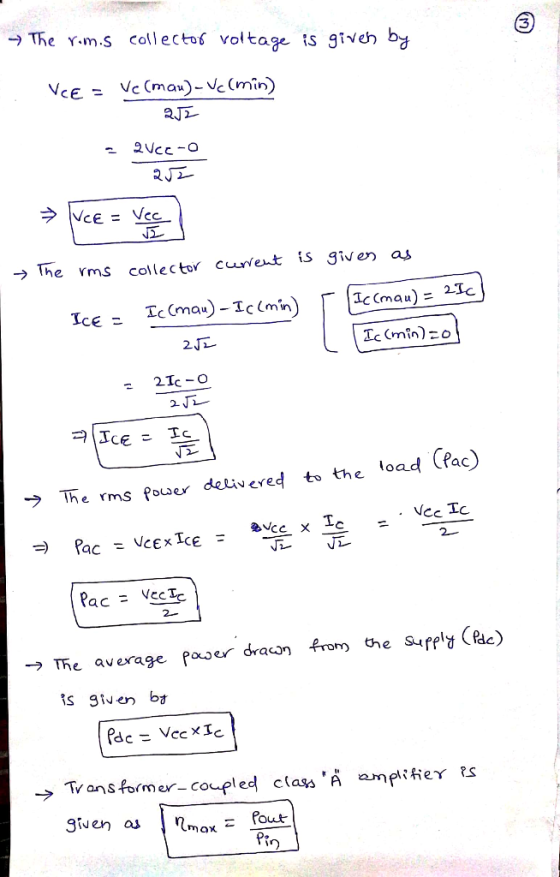
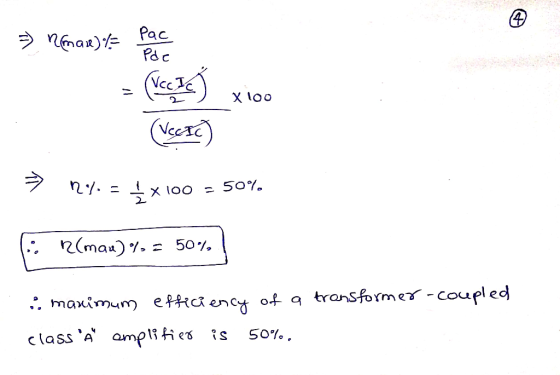
Show that the maximum efficiency of a transformer-coupled Class A amplifier is 50%.
Show that the maximum efficiency of a transformer-coupled Class A amplifier is 50%.
Homework Answers

Add Answer to:
Show that the maximum efficiency of a transformer-coupled Class A amplifier is 50%.
A transformer-coupled FE power amplifier must deliver an output of 0.5 Watt to an class ?...
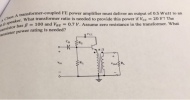 A transformer-coupled FE power amplifier must deliver an output of 0.5 Watt to an class ? istor has ?-100 and VBE 0.7 V. Assume zero resistance in the transformer. What ansistor power rating is needed? o Vcc Ce R2 Vin
Consider a class-A power amplifier using output transformer as in the beside figure, where the transformer ration N=1.5. β=100, VBE =0,6V
 Consider a class-A power amplifier
using output transformer as in the
beside figure, where the transformer
ration N=1.5. β=100, VBE
=0,6V. Determine:
a/ Maximum power consumed by the
load RL
. b/ Average power supplied by the DC
source. c/ Efficiency of the circuit. d/ Average power dissipation of BJT
Consider a class-A power amplifier
using output transformer as in the
beside figure, where the transformer
ration N=1.5. β=100, VBE
=0,6V. Determine:
a/ Maximum power consumed by the
load RL
. b/ Average power supplied by the DC
source. c/ Efficiency of the circuit. d/ Average power dissipation of BJT
A 40-KVA, 50 Hz transformer was found to have an efficiency of 97% at full-load, 0.8...
 A 40-KVA, 50 Hz transformer was found to have an efficiency of
97% at full-load, 0.8 power factor lagging. It was also found that
the maximum efficiency was obtained at 82% full-load, at the same
power factor. Determine the core loss Pi , copper loss at full load
Pcufl and the maximum efficiency of the transformer ηmax at 0.8
power factor lagging?
Question 1 A 40-KVA, 50 Hz transformer was found to have an efficiency of 97% at full-load, 0.8...
A 40-KVA, 50 Hz transformer was found to have an efficiency of
97% at full-load, 0.8 power factor lagging. It was also found that
the maximum efficiency was obtained at 82% full-load, at the same
power factor. Determine the core loss Pi , copper loss at full load
Pcufl and the maximum efficiency of the transformer ηmax at 0.8
power factor lagging?
Question 1 A 40-KVA, 50 Hz transformer was found to have an efficiency of 97% at full-load, 0.8...
2) Show that in a 50% reaction turbine stage, the maximum stage efficiency is a is...
 2) Show that in a 50% reaction turbine stage, the maximum stage efficiency is a is the nozzle angle. 2cosa where 1+ cosa
QUESTION 19 A class B amplifier conducts for O a. 90° of input cycle O b....
 QUESTION 19 A class B amplifier conducts for O a. 90° of input cycle O b. 180° of input cycle O c. 270° of input cycle O d. 360° of input cycle QUESTION 20 The maximum efficiency of a class A power amplifier is O a. 50 % b. 25 % OC. 75 % d. 95 %
Why does a Class C amplifier have good efficiency but has a poor linearity?
Why does a Class C amplifier have good efficiency but has a poor linearity?
a) What is "power-conversion efficiency' of an output stage? Comparo the class-A and class-B amplifier output...
 a) What is "power-conversion efficiency' of an output stage? Comparo the class-A and class-B amplifier output stages with rospect to their power-conversion officiencies. b) Assume that an emitter follower 9, is used as a class-A output stago, with the constant current supplied by another transistor 2. (as in Figure Q.4.a). Let Vcc=16V, 1 =100mA, and R=10002. If the output voltage is an 4-V-peak sinusoid, find the power conversion efficiency. VC Figure Q.4.a c) Explain the crossover distortion in a class-B...
Un 100nFR out 2kC2 4.7uF Figure 3-3 (a) AC-coupled and (b) DC-coupled non-inverting AC-amplifier a) Why do you need a 100kS2 resistor to ground in the AC-coupled amplifier? b) Wharis the mainal and m...
 Un 100nFR out 2kC2 4.7uF Figure 3-3 (a) AC-coupled and (b) DC-coupled non-inverting AC-amplifier a) Why do you need a 100kS2 resistor to ground in the AC-coupled amplifier? b) Wharis the mainal and minima input ipedane Z- of this a ih freguencies do they occur? c) Where is the 3dB breakpoint frequency for the amplifier in Figure 3-3b? d) How large is Zin at the 3dB breakpoint frequency? e) What are the differences between the two circuits in Figure 3-3a...
Q2: A single-phase 10 KVA, 2400/240 V, 50 Hz transformer used in distribution network has the...
 Q2: A single-phase 10 KVA, 2400/240 V, 50 Hz transformer used in distribution network has the following wattmeter reading: (10 X 3 = 30 Marks) Open-circuit Test wattmeter reading: 100 W (at rated voltage) Short-circuit Test wattmeter reading: 60 W (test conducted at 50% load condition) (a) Calculate the efficiency of the transformer when it delivers full load at 0.8 pflagging. (b) Calculate the output when transformer operating at maximum efficiency and also calculate the maximum efficiency. (c) Load on...
In a given transformer, 87% of the flux produced in the primary is coupled into the...
In a given transformer, 87% of the flux produced in the primary is coupled into the secondary winding, what is the coefficient of coupling? A) 0.87 B) 13 C) 87 D) 0.13
 A transformer-coupled FE power amplifier must deliver an output of 0.5 Watt to an class ? istor has ?-100 and VBE 0.7 V. Assume zero resistance in the transformer. What ansistor power rating is needed? o Vcc Ce R2 Vin
 A 40-KVA, 50 Hz transformer was found to have an efficiency of
97% at full-load, 0.8 power factor lagging. It was also found that
the maximum efficiency was obtained at 82% full-load, at the same
power factor. Determine the core loss Pi , copper loss at full load
Pcufl and the maximum efficiency of the transformer ηmax at 0.8
power factor lagging?
Question 1 A 40-KVA, 50 Hz transformer was found to have an efficiency of 97% at full-load, 0.8...
A 40-KVA, 50 Hz transformer was found to have an efficiency of
97% at full-load, 0.8 power factor lagging. It was also found that
the maximum efficiency was obtained at 82% full-load, at the same
power factor. Determine the core loss Pi , copper loss at full load
Pcufl and the maximum efficiency of the transformer ηmax at 0.8
power factor lagging?
Question 1 A 40-KVA, 50 Hz transformer was found to have an efficiency of 97% at full-load, 0.8...
 2) Show that in a 50% reaction turbine stage, the maximum stage efficiency is a is the nozzle angle. 2cosa where 1+ cosa
 QUESTION 19 A class B amplifier conducts for O a. 90° of input cycle O b. 180° of input cycle O c. 270° of input cycle O d. 360° of input cycle QUESTION 20 The maximum efficiency of a class A power amplifier is O a. 50 % b. 25 % OC. 75 % d. 95 %
 a) What is "power-conversion efficiency' of an output stage? Comparo the class-A and class-B amplifier output stages with rospect to their power-conversion officiencies. b) Assume that an emitter follower 9, is used as a class-A output stago, with the constant current supplied by another transistor 2. (as in Figure Q.4.a). Let Vcc=16V, 1 =100mA, and R=10002. If the output voltage is an 4-V-peak sinusoid, find the power conversion efficiency. VC Figure Q.4.a c) Explain the crossover distortion in a class-B...
 Un 100nFR out 2kC2 4.7uF Figure 3-3 (a) AC-coupled and (b) DC-coupled non-inverting AC-amplifier a) Why do you need a 100kS2 resistor to ground in the AC-coupled amplifier? b) Wharis the mainal and minima input ipedane Z- of this a ih freguencies do they occur? c) Where is the 3dB breakpoint frequency for the amplifier in Figure 3-3b? d) How large is Zin at the 3dB breakpoint frequency? e) What are the differences between the two circuits in Figure 3-3a...
 Q2: A single-phase 10 KVA, 2400/240 V, 50 Hz transformer used in distribution network has the following wattmeter reading: (10 X 3 = 30 Marks) Open-circuit Test wattmeter reading: 100 W (at rated voltage) Short-circuit Test wattmeter reading: 60 W (test conducted at 50% load condition) (a) Calculate the efficiency of the transformer when it delivers full load at 0.8 pflagging. (b) Calculate the output when transformer operating at maximum efficiency and also calculate the maximum efficiency. (c) Load on...
Most questions answered within 3 hours.
-
Where is the error in this code sequence?
String s1 = "Hello";
String s2 = "ello";...
asked 11 months ago -
Financial data for Joel de Paris, Inc., for last year
follow:
Joel de Paris, Inc.
Balance...
asked 11 months ago -
Consider this reaction:
Al2(SO4)3 (aq)+ BaCl3
(aq) Al2Cl6 (aq)- +
3BaSO4(s) . What is the...
asked 11 months ago -
Suppose that Savneet is considering increasing her
recent random sample from 20 car rentals to 40...
asked 11 months ago -
Trucks arrive at an unloading terminal at an average rate of 120
per hour.
Trucks arrive...
asked 11 months ago -
Why are methanol and ethanol completely soluble in water while
octanol is not very little soluble....
asked 11 months ago -
A facilities manager at a university reads in a research report
that the mean amount of...
asked 11 months ago -
When the CuSO4 is rehydrated by adding water to the anhydrous
compound, is this an endothermic...
asked 11 months ago -
A ray of sunlight is passing from diamond into crown glass; the
angle of incidence is...
asked 11 months ago -
A block of mass 0.249 kg is placed on top of a light, vertical
spring of...
asked 11 months ago -
how do the kidneys compensate in the presences of acidosis
a) trigger hyperventilate
b) reserve acid...
asked 11 months ago -
Question 501 pts
The rental rate of capital to the firm increases. Which of the
following...
asked 11 months ago