
Homework Answers


Add Answer to:
The analog inpur signal is iv as (t)ses (ect The signal is sompled a t fs nco, Find the anolog ov...
An analog signal is given as below x(t) = 10sin 4rtt The signal is sampled by...
 An analog signal is given as below x(t) = 10sin 4rtt The signal is sampled by two different frequencies f, = 1Hz, f, = 10Hz respectively, and the output are yı, Yz. (i) Sketch signal x(t) in the time domain. (3 marks) (ii) Sketch frequency spectrum of x(t). (3 marks) (iii) After sampling, the continuous signal is converted to a discrete signal. Draw the two discrete signals Yı, Y2: (4 marks) (iv) Discuss whether f1, f, can successfully sample the...
For an analog signal E(t) = 4 + 2 sin 47t + 3 sin 16t V...
 For an analog signal E(t) = 4 + 2 sin 47t + 3 sin 16t V which sampled at a sample rate of 32 Hz. What are the criteria to properly construct its discrete time series. Discuss the results when using fs = 16 Hz and at fs = 45 Hz.
plz give correct answer Q5. We are collecting an analog signal ranging from oV to SV...
 plz give correct answer
Q5. We are collecting an analog signal ranging from oV to SV with a 3-bit analog-to-digital converter. Calculate the discrete voltage range and fill in the table, and calculate the analog quantization size (resolution). 0.5pt Output states Diserete voltage range IV Analog quantization size (resolution)- 06. Calculate the resolutions for the 2-bit, S-bit, 12-bit, and 16-bit analog-digital converter: Input and output signal ranges from-10V to 10V. 0.5pt 1) 2-bit: 2) 8-bit: 3) 12-bit: 4) 16-bit:
plz give correct answer
Q5. We are collecting an analog signal ranging from oV to SV with a 3-bit analog-to-digital converter. Calculate the discrete voltage range and fill in the table, and calculate the analog quantization size (resolution). 0.5pt Output states Diserete voltage range IV Analog quantization size (resolution)- 06. Calculate the resolutions for the 2-bit, S-bit, 12-bit, and 16-bit analog-digital converter: Input and output signal ranges from-10V to 10V. 0.5pt 1) 2-bit: 2) 8-bit: 3) 12-bit: 4) 16-bit:
For given analog signal xa(t) what is the maximum frequency of this signal and what is...
For given analog signal xa(t) what is the maximum frequency of this signal and what is the Nyquist rate for this signal (choose the minimum one) xa(t)=5 cos(310pi t) + 8 sin(420pi t)
Question 1: (Sampling and Aliasing Effeet) (25 Marks) The given analog signal x(t)--sin(16xt)+ sin(11xt)+ sin (5nt), where t is in milliseconds, is sampled at a rate of 12kHz. The resulting sampl...
 Question 1: (Sampling and Aliasing Effeet) (25 Marks) The given analog signal x(t)--sin(16xt)+ sin(11xt)+ sin (5nt), where t is in milliseconds, is sampled at a rate of 12kHz. The resulting samples are immediately reconstructed by an ideal reconstructor. a. Find and sketch the spectrum of x(t) versus Ω. b. Find and sketch the spectrum of the sampled signal versus o. c. Determine the analog signal x (t) at the output of the reconstructor. d. Prove the x(0) and x(t) having...
a. Consider the following signal xi(t)= cos(2aft) The signal is sampled with the sampling frequency Fs....
 a. Consider the following signal xi(t)= cos(2aft) The signal is sampled with the sampling frequency Fs. Answer the following: for a given sampling frequency Fs, what is the range of f so that the continuous time signal has a unique sampled signal? What happens if f is outside this range? Show you result using a number of illustrative Matlab plots (with suitably chosen Fs and f, try for example (some of) F=0.1Fs, 0.2Fs,..., 2Fs – but don't include all plots...
Amplitude=3; fs=8000; n=0:399; t=0:1/fs: n*1/fs-1/fs; signal=3+3*cos(2*pi*1100*t)+3*cos(2*pi*2200*t)+3*cos(2*pi*3300*t); fftSignal= fft(signal); fftSignal=f ftshift (fftSignal); f=fs/2*linspace(-1,1,fs); plot(f,abs(fftsignal); xlabel('Frequency(Hz)’) yla
Amplitude=3; fs=8000; n=0:399; t=0:1/fs: n*1/fs-1/fs; signal=3+3*cos(2*pi*1100*t)+3*cos(2*pi*2200*t)+3*cos(2*pi*3300*t); fftSignal= fft(signal); fftSignal=f ftshift (fftSignal); f=fs/2*linspace(-1,1,fs); plot(f,abs(fftsignal); xlabel('Frequency(Hz)’) ylabel('amplitude(v)') title('Spectral domain') plz code above using For ..End loop to archive the same results.
Problem 2: An analog signal is to be converted into a PCM signal that is a binary polar NRZ line ...
 Problem 2: An analog signal is to be converted into a PCM signal that is a binary polar NRZ line code. The signal is transmitted over a channel that is absolutely bandlimited to B-8 kHz. Assume that the PCM quantizer has 32 steps and that the overall equivalent system transfer function He is of the raised cosine-rolloff type with r 0.5. Find the maximum symbol rate D that can be supported over this channel without causing ISI a) c) Find...
Consider a sampler which samples the continuous-time input signal x(t) at a sampling frequency fs =...
 Consider a sampler which samples the continuous-time input signal x(t) at a sampling frequency fs = 8000 Hz and produces at its output a sampled discrete-time signal x$(t) = x(nTs), where To = 1/fs is the sampling period. If the sampled signal is passed through a unity-gain lowpass filter with cutoff frequency of fs/2, sketch the magnitude spectrum of the resulting signal for the following input signals: (a) x(t) = cos(6000nt). (b) x(t) = cos(12000nt). (c) x(t) = cos(18000nt).
Please explain the answer, thank you An analog signal is given as below x(t) 10sin 4Tt...
 Please explain the answer, thank you
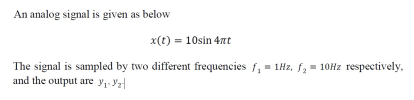
An analog signal is given as below x(t) 10sin 4Tt The signal is sampled by two different frequencies f and the output are y1, y2 10HZ respectively 1Hz, f2 Discuss whether f,, f2 aliasing effect. Explain your answer can successfully sample the analog signal x(t) without
Please explain the answer, thank you
An analog signal is given as below x(t) 10sin 4Tt The signal is sampled by two different frequencies f and the output are y1, y2 10HZ respectively 1Hz, f2 Discuss whether f,, f2 aliasing effect. Explain your answer can successfully sample the analog signal x(t) without
 An analog signal is given as below x(t) = 10sin 4rtt The signal is sampled by two different frequencies f, = 1Hz, f, = 10Hz respectively, and the output are yı, Yz. (i) Sketch signal x(t) in the time domain. (3 marks) (ii) Sketch frequency spectrum of x(t). (3 marks) (iii) After sampling, the continuous signal is converted to a discrete signal. Draw the two discrete signals Yı, Y2: (4 marks) (iv) Discuss whether f1, f, can successfully sample the...
 For an analog signal E(t) = 4 + 2 sin 47t + 3 sin 16t V which sampled at a sample rate of 32 Hz. What are the criteria to properly construct its discrete time series. Discuss the results when using fs = 16 Hz and at fs = 45 Hz.
 plz give correct answer
Q5. We are collecting an analog signal ranging from oV to SV with a 3-bit analog-to-digital converter. Calculate the discrete voltage range and fill in the table, and calculate the analog quantization size (resolution). 0.5pt Output states Diserete voltage range IV Analog quantization size (resolution)- 06. Calculate the resolutions for the 2-bit, S-bit, 12-bit, and 16-bit analog-digital converter: Input and output signal ranges from-10V to 10V. 0.5pt 1) 2-bit: 2) 8-bit: 3) 12-bit: 4) 16-bit:
plz give correct answer
Q5. We are collecting an analog signal ranging from oV to SV with a 3-bit analog-to-digital converter. Calculate the discrete voltage range and fill in the table, and calculate the analog quantization size (resolution). 0.5pt Output states Diserete voltage range IV Analog quantization size (resolution)- 06. Calculate the resolutions for the 2-bit, S-bit, 12-bit, and 16-bit analog-digital converter: Input and output signal ranges from-10V to 10V. 0.5pt 1) 2-bit: 2) 8-bit: 3) 12-bit: 4) 16-bit:
 Question 1: (Sampling and Aliasing Effeet) (25 Marks) The given analog signal x(t)--sin(16xt)+ sin(11xt)+ sin (5nt), where t is in milliseconds, is sampled at a rate of 12kHz. The resulting samples are immediately reconstructed by an ideal reconstructor. a. Find and sketch the spectrum of x(t) versus Ω. b. Find and sketch the spectrum of the sampled signal versus o. c. Determine the analog signal x (t) at the output of the reconstructor. d. Prove the x(0) and x(t) having...
 a. Consider the following signal xi(t)= cos(2aft) The signal is sampled with the sampling frequency Fs. Answer the following: for a given sampling frequency Fs, what is the range of f so that the continuous time signal has a unique sampled signal? What happens if f is outside this range? Show you result using a number of illustrative Matlab plots (with suitably chosen Fs and f, try for example (some of) F=0.1Fs, 0.2Fs,..., 2Fs – but don't include all plots...
 Problem 2: An analog signal is to be converted into a PCM signal that is a binary polar NRZ line code. The signal is transmitted over a channel that is absolutely bandlimited to B-8 kHz. Assume that the PCM quantizer has 32 steps and that the overall equivalent system transfer function He is of the raised cosine-rolloff type with r 0.5. Find the maximum symbol rate D that can be supported over this channel without causing ISI a) c) Find...
 Consider a sampler which samples the continuous-time input signal x(t) at a sampling frequency fs = 8000 Hz and produces at its output a sampled discrete-time signal x$(t) = x(nTs), where To = 1/fs is the sampling period. If the sampled signal is passed through a unity-gain lowpass filter with cutoff frequency of fs/2, sketch the magnitude spectrum of the resulting signal for the following input signals: (a) x(t) = cos(6000nt). (b) x(t) = cos(12000nt). (c) x(t) = cos(18000nt).
 Please explain the answer, thank you
An analog signal is given as below x(t) 10sin 4Tt The signal is sampled by two different frequencies f and the output are y1, y2 10HZ respectively 1Hz, f2 Discuss whether f,, f2 aliasing effect. Explain your answer can successfully sample the analog signal x(t) without
Please explain the answer, thank you
An analog signal is given as below x(t) 10sin 4Tt The signal is sampled by two different frequencies f and the output are y1, y2 10HZ respectively 1Hz, f2 Discuss whether f,, f2 aliasing effect. Explain your answer can successfully sample the analog signal x(t) without
Most questions answered within 3 hours.
-
Where is the error in this code sequence?
String s1 = "Hello";
String s2 = "ello";...
asked 11 months ago -
Financial data for Joel de Paris, Inc., for last year
follow:
Joel de Paris, Inc.
Balance...
asked 11 months ago -
Consider this reaction:
Al2(SO4)3 (aq)+ BaCl3
(aq) Al2Cl6 (aq)- +
3BaSO4(s) . What is the...
asked 11 months ago -
Suppose that Savneet is considering increasing her
recent random sample from 20 car rentals to 40...
asked 11 months ago -
Trucks arrive at an unloading terminal at an average rate of 120
per hour.
Trucks arrive...
asked 11 months ago -
Why are methanol and ethanol completely soluble in water while
octanol is not very little soluble....
asked 11 months ago -
A facilities manager at a university reads in a research report
that the mean amount of...
asked 11 months ago -
When the CuSO4 is rehydrated by adding water to the anhydrous
compound, is this an endothermic...
asked 11 months ago -
A ray of sunlight is passing from diamond into crown glass; the
angle of incidence is...
asked 11 months ago -
A block of mass 0.249 kg is placed on top of a light, vertical
spring of...
asked 11 months ago -
how do the kidneys compensate in the presences of acidosis
a) trigger hyperventilate
b) reserve acid...
asked 11 months ago -
Question 501 pts
The rental rate of capital to the firm increases. Which of the
following...
asked 11 months ago