
Homework Answers
Add Answer to:
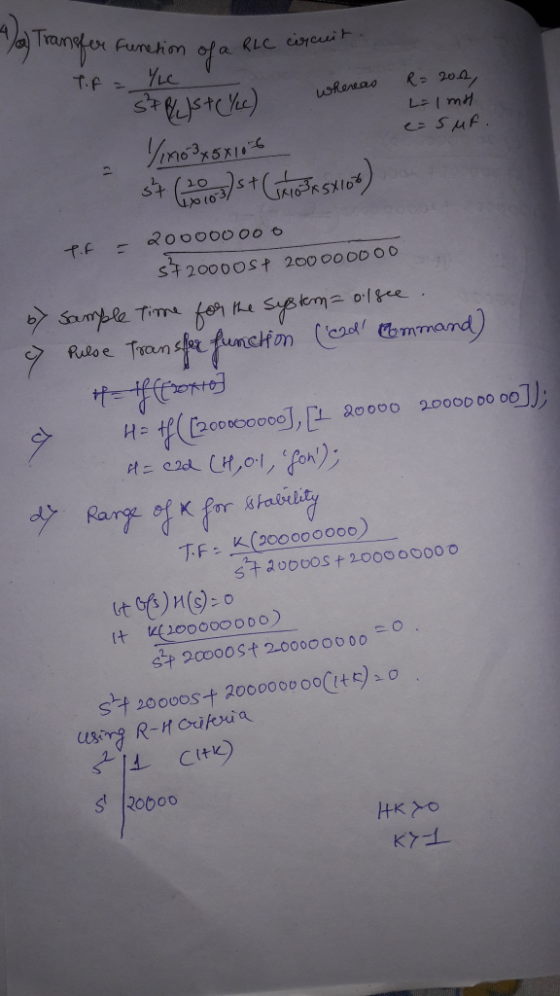
4. Consider a series RLC circuit driven by a voltage source with capacitor voltage as output. Ass...
Consider the model of a spring-mass-damper system, where the following parameter values are assum...
 answer 3 and 4 please
Consider the model of a spring-mass-damper system, where the following parameter values are assumed: m 1,b 2,k 2. 3. a. Write down the transfer function of the system b. Choose a sample time for the system c. Find the pulse transfer function (use MATLAB 'c2d' command) d. Find the range of K for stability for the closed-loop sampled-data system 4. Consider a series RLC circuit driven by a voltage source with capacitor voltage as output....
answer 3 and 4 please
Consider the model of a spring-mass-damper system, where the following parameter values are assumed: m 1,b 2,k 2. 3. a. Write down the transfer function of the system b. Choose a sample time for the system c. Find the pulse transfer function (use MATLAB 'c2d' command) d. Find the range of K for stability for the closed-loop sampled-data system 4. Consider a series RLC circuit driven by a voltage source with capacitor voltage as output....
Consider the model of a small DC motor, where the following parameter values are assumed: R-10 L-10mH,J-0.01kgm0.0.05 2. ra a. Write down the transfer function of the system b. Choose a sample ti...
 Consider the model of a small DC motor, where the following parameter values are assumed: R-10 L-10mH,J-0.01kgm0.0.05 2. ra a. Write down the transfer function of the system b. Choose a sample time for the system c. Find the pulse transfer function (use MATLAB 'c2d' command) d. Find the range of K for stability for the closed-loop sampled-data system
Consider the model of a small DC motor, where the following parameter values are assumed: R-10 L-10mH,J-0.01kgm0.0.05 2. ra a. Write...
Consider the model of a small DC motor, where the following parameter values are assumed: R-10 L-10mH,J-0.01kgm0.0.05 2. ra a. Write down the transfer function of the system b. Choose a sample time for the system c. Find the pulse transfer function (use MATLAB 'c2d' command) d. Find the range of K for stability for the closed-loop sampled-data system
Consider the model of a small DC motor, where the following parameter values are assumed: R-10 L-10mH,J-0.01kgm0.0.05 2. ra a. Write...
Consider the model of a cylinderical hydraulic reservoir with a bottom flow valve with input qin ...
 Consider the model of a cylinderical hydraulic reservoir with a bottom flow valve with input qin and output ΔΡ where the parameter values are: A-1m2, ρ 20 ; let g 10. 1. 1 l 图,R- 20 let g10 , a. Write down the transfer function of the system b. Choose a sample time for the system c. Find the pulse transfer function (use MATLAB 'c2d' command) d. Find the range of K for stability for the closed-loop sampled-data system
Consider...
Consider the model of a cylinderical hydraulic reservoir with a bottom flow valve with input qin and output ΔΡ where the parameter values are: A-1m2, ρ 20 ; let g 10. 1. 1 l 图,R- 20 let g10 , a. Write down the transfer function of the system b. Choose a sample time for the system c. Find the pulse transfer function (use MATLAB 'c2d' command) d. Find the range of K for stability for the closed-loop sampled-data system
Consider...
4. In a particular series RLC circuit driven by an AC source of a set frequency, the voltage on t...
 4. In a particular series RLC circuit driven by an AC source of a set frequency, the voltage on the inductor is twice as large as the voltage on the capacitor. On the accompanying power vs voltage graph, which labeled point best matches this circuit? a. point A b. point B c. point C d. more information is needed. (Hz)
4. In a particular series RLC circuit driven by an AC source of a set frequency, the voltage on the...
4. In a particular series RLC circuit driven by an AC source of a set frequency, the voltage on the inductor is twice as large as the voltage on the capacitor. On the accompanying power vs voltage graph, which labeled point best matches this circuit? a. point A b. point B c. point C d. more information is needed. (Hz)
4. In a particular series RLC circuit driven by an AC source of a set frequency, the voltage on the...
Consider the series RLC circuit in Figure 1. Suppose the source voltage is initially OV, and...
 Consider the series RLC circuit in Figure 1. Suppose the source voltage is initially OV, and no energy is stored in both the capacitor and inductor. At t = 0, the source voltage is switched to 1V. Calculate the resistor, inductor and capacitor voltages, and the loop current VROV.O.Vc),it). Show all the steps. SOL L1 n 8.2m 10 3 R1 Figure 1: A series RLC circuit
Consider the series RLC circuit in Figure 1. Suppose the source voltage is initially OV, and...
 Consider the series RLC circuit in Figure 1. Suppose the source voltage is initially OV, and no energy is stored in both the capacitor and inductor. At t = 0, the source voltage is switched to 1V. Calculate the resistor, inductor and capacitor voltages, and the loop current V (t),,(t),Vc(t),i(t). Show all the steps. C1 L1 1.2u 8.2m 10 3 R1 Figure 1: A series RLC circuit
A series RLC circuit is driven by a voltage source which provides a time varying emf...
A series RLC circuit is driven by a voltage source which provides a time varying emf of epsilon space equals space 100 cos left parenthesis 8000 t right parenthesis space straight V and consists of an resistor, capacitor and inductor with values of R space equals space 100 space capital omega L space equals space 1.00 space mH C space equals space 1.00 space μF. When the potential across the resistor is 0 V, what is the potential across the...
1. Consider a series RLC circuit with input voltage source Vin and the output voltage V,...
 1. Consider a series RLC circuit with input voltage source Vin and the output voltage V, taken as the resistor voltage. Assume the values are R = 10 kN, L = 10 mH, and C = 100 pF. a) Find the maximum output voltage and the frequency that it occurs. b) Determine the bandwidth and the quality factor and discuss the value of the quality factor.
A series RLC circuit has a 242 Hz resonant frequency, and is driven by an AC...
 A series RLC circuit has a 242 Hz resonant frequency, and is
driven by an AC voltage source at 315 Hz. The circuit has a 75.0
resistor and a
66.0 mH inductor. The maximum current is 1.20 A.
a) Find the capacitance in the circuit.
b) Find the maximum voltage of the source.
c) Find the average power of the circuit
d) Find the phase angle .
A series RLC circuit has a 242 Hz resonant frequency, and is
driven by an AC voltage source at 315 Hz. The circuit has a 75.0
resistor and a
66.0 mH inductor. The maximum current is 1.20 A.
a) Find the capacitance in the circuit.
b) Find the maximum voltage of the source.
c) Find the average power of the circuit
d) Find the phase angle .
A series RLC circuit is driven by an alternating source at a frequency of 296 Hz...
A series RLC circuit is driven by an alternating source at a frequency of 296 Hz and an emf amplitude of 78.2 V. The resistance is 27.1 Ω, the capacitance is 10.5 µF, and the inductance is 25.5 mH. What is the rms potential difference across (a) the resistor, (b) the capacitor, and (c) the inductor? (d) What is the average rate at which energy is dissipated?
 answer 3 and 4 please
Consider the model of a spring-mass-damper system, where the following parameter values are assumed: m 1,b 2,k 2. 3. a. Write down the transfer function of the system b. Choose a sample time for the system c. Find the pulse transfer function (use MATLAB 'c2d' command) d. Find the range of K for stability for the closed-loop sampled-data system 4. Consider a series RLC circuit driven by a voltage source with capacitor voltage as output....
answer 3 and 4 please
Consider the model of a spring-mass-damper system, where the following parameter values are assumed: m 1,b 2,k 2. 3. a. Write down the transfer function of the system b. Choose a sample time for the system c. Find the pulse transfer function (use MATLAB 'c2d' command) d. Find the range of K for stability for the closed-loop sampled-data system 4. Consider a series RLC circuit driven by a voltage source with capacitor voltage as output....
 Consider the model of a small DC motor, where the following parameter values are assumed: R-10 L-10mH,J-0.01kgm0.0.05 2. ra a. Write down the transfer function of the system b. Choose a sample time for the system c. Find the pulse transfer function (use MATLAB 'c2d' command) d. Find the range of K for stability for the closed-loop sampled-data system
Consider the model of a small DC motor, where the following parameter values are assumed: R-10 L-10mH,J-0.01kgm0.0.05 2. ra a. Write...
Consider the model of a small DC motor, where the following parameter values are assumed: R-10 L-10mH,J-0.01kgm0.0.05 2. ra a. Write down the transfer function of the system b. Choose a sample time for the system c. Find the pulse transfer function (use MATLAB 'c2d' command) d. Find the range of K for stability for the closed-loop sampled-data system
Consider the model of a small DC motor, where the following parameter values are assumed: R-10 L-10mH,J-0.01kgm0.0.05 2. ra a. Write...
 Consider the model of a cylinderical hydraulic reservoir with a bottom flow valve with input qin and output ΔΡ where the parameter values are: A-1m2, ρ 20 ; let g 10. 1. 1 l 图,R- 20 let g10 , a. Write down the transfer function of the system b. Choose a sample time for the system c. Find the pulse transfer function (use MATLAB 'c2d' command) d. Find the range of K for stability for the closed-loop sampled-data system
Consider...
Consider the model of a cylinderical hydraulic reservoir with a bottom flow valve with input qin and output ΔΡ where the parameter values are: A-1m2, ρ 20 ; let g 10. 1. 1 l 图,R- 20 let g10 , a. Write down the transfer function of the system b. Choose a sample time for the system c. Find the pulse transfer function (use MATLAB 'c2d' command) d. Find the range of K for stability for the closed-loop sampled-data system
Consider...
 4. In a particular series RLC circuit driven by an AC source of a set frequency, the voltage on the inductor is twice as large as the voltage on the capacitor. On the accompanying power vs voltage graph, which labeled point best matches this circuit? a. point A b. point B c. point C d. more information is needed. (Hz)
4. In a particular series RLC circuit driven by an AC source of a set frequency, the voltage on the...
4. In a particular series RLC circuit driven by an AC source of a set frequency, the voltage on the inductor is twice as large as the voltage on the capacitor. On the accompanying power vs voltage graph, which labeled point best matches this circuit? a. point A b. point B c. point C d. more information is needed. (Hz)
4. In a particular series RLC circuit driven by an AC source of a set frequency, the voltage on the...
 Consider the series RLC circuit in Figure 1. Suppose the source voltage is initially OV, and no energy is stored in both the capacitor and inductor. At t = 0, the source voltage is switched to 1V. Calculate the resistor, inductor and capacitor voltages, and the loop current VROV.O.Vc),it). Show all the steps. SOL L1 n 8.2m 10 3 R1 Figure 1: A series RLC circuit
 Consider the series RLC circuit in Figure 1. Suppose the source voltage is initially OV, and no energy is stored in both the capacitor and inductor. At t = 0, the source voltage is switched to 1V. Calculate the resistor, inductor and capacitor voltages, and the loop current V (t),,(t),Vc(t),i(t). Show all the steps. C1 L1 1.2u 8.2m 10 3 R1 Figure 1: A series RLC circuit
 1. Consider a series RLC circuit with input voltage source Vin and the output voltage V, taken as the resistor voltage. Assume the values are R = 10 kN, L = 10 mH, and C = 100 pF. a) Find the maximum output voltage and the frequency that it occurs. b) Determine the bandwidth and the quality factor and discuss the value of the quality factor.
 A series RLC circuit has a 242 Hz resonant frequency, and is
driven by an AC voltage source at 315 Hz. The circuit has a 75.0
resistor and a
66.0 mH inductor. The maximum current is 1.20 A.
a) Find the capacitance in the circuit.
b) Find the maximum voltage of the source.
c) Find the average power of the circuit
d) Find the phase angle .
A series RLC circuit has a 242 Hz resonant frequency, and is
driven by an AC voltage source at 315 Hz. The circuit has a 75.0
resistor and a
66.0 mH inductor. The maximum current is 1.20 A.
a) Find the capacitance in the circuit.
b) Find the maximum voltage of the source.
c) Find the average power of the circuit
d) Find the phase angle .
Most questions answered within 3 hours.
-
Where is the error in this code sequence?
String s1 = "Hello";
String s2 = "ello";...
asked 10 months ago -
Financial data for Joel de Paris, Inc., for last year
follow:
Joel de Paris, Inc.
Balance...
asked 10 months ago -
Consider this reaction:
Al2(SO4)3 (aq)+ BaCl3
(aq) Al2Cl6 (aq)- +
3BaSO4(s) . What is the...
asked 10 months ago -
Suppose that Savneet is considering increasing her
recent random sample from 20 car rentals to 40...
asked 10 months ago -
Trucks arrive at an unloading terminal at an average rate of 120
per hour.
Trucks arrive...
asked 10 months ago -
Why are methanol and ethanol completely soluble in water while
octanol is not very little soluble....
asked 10 months ago -
A facilities manager at a university reads in a research report
that the mean amount of...
asked 10 months ago -
When the CuSO4 is rehydrated by adding water to the anhydrous
compound, is this an endothermic...
asked 10 months ago -
A ray of sunlight is passing from diamond into crown glass; the
angle of incidence is...
asked 10 months ago -
A block of mass 0.249 kg is placed on top of a light, vertical
spring of...
asked 10 months ago -
how do the kidneys compensate in the presences of acidosis
a) trigger hyperventilate
b) reserve acid...
asked 10 months ago -
Question 501 pts
The rental rate of capital to the firm increases. Which of the
following...
asked 10 months ago