Biochemistry Question:
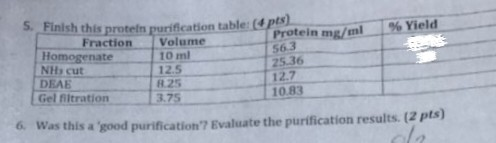
I'm having trouble understanding how to calculate % yield with the given information (Volume & Concentration), I don't necessarily need the answers, but I'd like to know how to calculate them. Additionally, while I'm asking this, how could one evaluate those results to determine if the purification was 'good' or not?
Thank you
Homework Answers
% yield represents how much of the enzyme desired was actually recovered. So to calculate it you must have the data of total activity units obtained in each step of purification.
The data of protein obtained in each step doesn t represent the quantity of the protein you are purifying only.Is a mixture of proteins, so you cannot used it for calculate the yield.
Activity units data is specific for the protein you are purificating. (1 activity unit = 1 micromole of product obtained per 1 minute / ml)
Fomula
: total activity units( en each step) / intial activity units x 100
So with the given information you cannot calculate % yield
A good purification process take account in 2 parameters high final protein recovery with high % yield ( total activity units)
Final protein obtained could have good yield but it can be recovery in a low concentration or viceversa .In both cases, you have to improve the purification process .
From the data of the table you can see that the % final of protein recovery was 7.2%.
( from 563 mg protein in homogenate, you obtained 40.6 mg of total protein in the final step)
With this data, you cannot conclude if the purification was good, you need activity units data.
Add Answer to:
Biochemistry Question: I'm having trouble understanding how to calculate % yield with the given i...
Parts A, B & C ***I'm having a lot of trouble understanding how to get the...
 Parts A, B & C
***I'm having a lot of trouble understanding how to get the
results. If you would be able to explain it would really help
me.
Thank You!***
Question 1 Not yet answered Marked out of 31.00 Flag question Variable and Absorption Costing Scott Manufacturing makes only one product with total unit manufacturing costs of $59, of which $41 is variable. No units were on hand at the beginning of 2015. During 2015 and 2016, the only...
Parts A, B & C
***I'm having a lot of trouble understanding how to get the
results. If you would be able to explain it would really help
me.
Thank You!***
Question 1 Not yet answered Marked out of 31.00 Flag question Variable and Absorption Costing Scott Manufacturing makes only one product with total unit manufacturing costs of $59, of which $41 is variable. No units were on hand at the beginning of 2015. During 2015 and 2016, the only...
Please help with this physics 009 question! I'm especially having trouble figuring out how to calculate...
 Please help with this physics 009 question!
I'm especially having trouble figuring out how to calculate the
product of the two vectors! And calculating the angle between
them!
Vector ?⃗ has a magnitude of 16.6 and is at an angle of 30.5∘
counterclockwise from the +?‑axis. Vector ?⃗ has a magnitude of
29.1 and is −50.3∘ from the +?‑axis. Resolve ?⃗ and ?⃗ into
components, and express in ??? unit vector form,
?⃗=???+???
?⃗=???+???
Vector A has a magnitude of...
Please help with this physics 009 question!
I'm especially having trouble figuring out how to calculate the
product of the two vectors! And calculating the angle between
them!
Vector ?⃗ has a magnitude of 16.6 and is at an angle of 30.5∘
counterclockwise from the +?‑axis. Vector ?⃗ has a magnitude of
29.1 and is −50.3∘ from the +?‑axis. Resolve ?⃗ and ?⃗ into
components, and express in ??? unit vector form,
?⃗=???+???
?⃗=???+???
Vector A has a magnitude of...
Im having trouble figuring out how to do this question especially since "formed" is emphasized on....
 Im
having trouble figuring out how to do this question especially
since "formed" is emphasized on. its the bottom one thats giving me
trouble.
H-17 Practice Questions: Reaction Enthalpy Question 1: Neutralization Enthalpy Results (NaOH + HCI) Volume of NaOH (c = 1.25 mol L ) Volume of HCI (c = 1.00 moll) 6.9 un (use correct sign) Amount of limiting reagent (specify reagent) Astration per mole of water formed HCL CV-n mol kl mol 1. Calculate the heat of...
Im
having trouble figuring out how to do this question especially
since "formed" is emphasized on. its the bottom one thats giving me
trouble.
H-17 Practice Questions: Reaction Enthalpy Question 1: Neutralization Enthalpy Results (NaOH + HCI) Volume of NaOH (c = 1.25 mol L ) Volume of HCI (c = 1.00 moll) 6.9 un (use correct sign) Amount of limiting reagent (specify reagent) Astration per mole of water formed HCL CV-n mol kl mol 1. Calculate the heat of...
I'm having trouble figuring out how to calculate the numbers that go into the NPV analysis...
 I'm having trouble figuring out how to calculate the numbers
that go into the NPV analysis grids. The three values that I came
up with in the first grid next to NPV in cells I'm not sure if it's
correct. Can you help with both grids please? The questions below
must be answered after.
2D. Based on your NPV Scenario / Risk Analysis Grids, is
NPV more sensitive to changing cost of capital or changing salvage
values? How do you...
I'm having trouble figuring out how to calculate the numbers
that go into the NPV analysis grids. The three values that I came
up with in the first grid next to NPV in cells I'm not sure if it's
correct. Can you help with both grids please? The questions below
must be answered after.
2D. Based on your NPV Scenario / Risk Analysis Grids, is
NPV more sensitive to changing cost of capital or changing salvage
values? How do you...
how do i calculate the number of moles, theoretical yield, and limiting reagent on the READ...
 how do i calculate the number of moles, theoretical yield, and
limiting reagent on the READ ABOUT part? thank you
i need help on READ ABOUT: Calculate the number of moles of
2-methyl-2-butanol and hydrochloric acid (concentrated HCl is 12
M). Based on the balanced equation, determine the limiting reagent
and the theoretical yield of 2-chloride-2-methylbutane.
PREPARATION AND ANALYSIS OF T-AMYL CHLORIDE ОН HCI (conc.) + H2O DISCUSSION: Compounds with good leaving groups often participate in substitution reactions. Two limiting...
how do i calculate the number of moles, theoretical yield, and
limiting reagent on the READ ABOUT part? thank you
i need help on READ ABOUT: Calculate the number of moles of
2-methyl-2-butanol and hydrochloric acid (concentrated HCl is 12
M). Based on the balanced equation, determine the limiting reagent
and the theoretical yield of 2-chloride-2-methylbutane.
PREPARATION AND ANALYSIS OF T-AMYL CHLORIDE ОН HCI (conc.) + H2O DISCUSSION: Compounds with good leaving groups often participate in substitution reactions. Two limiting...
Having trouble with the do while/while loop and the switch statement. I got some of the...
 Having trouble with the do while/while loop and the switch
statement. I got some of the switch statement but cant get the
program to repeat itself like it should.What i have so far for my
code is below. Any help is appreciated... i am not sure what I am
doing wrong or what i am missing. I am completely lost on the while
loop and where and how to use it in this scenario.
import java.util.Scanner;
public class sampleforchegg {...
Having trouble with the do while/while loop and the switch
statement. I got some of the switch statement but cant get the
program to repeat itself like it should.What i have so far for my
code is below. Any help is appreciated... i am not sure what I am
doing wrong or what i am missing. I am completely lost on the while
loop and where and how to use it in this scenario.
import java.util.Scanner;
public class sampleforchegg {...
PREPARATION OF PHARMACEUTICALS - Fischer Esterification Reactions Q: Calculate the expected mass of both methyl salicylate and aspirin assuming 100% yield. EXPERIMENT7 PREPARATION OF PHARMACEUTICALS...
 PREPARATION OF PHARMACEUTICALS - Fischer Esterification
Reactions
Q: Calculate the expected mass of both methyl salicylate and
aspirin assuming 100% yield.
EXPERIMENT7 PREPARATION OF PHARMACEUTICALS Fischer Esterification Reactions Almost 2500 years ago, physicians such as Hippocrates recommended that patients chew on the bark of the willow to alleviate pain. The active ingredient in willow bark was found to be salicin, a compound made of a molecule of salicyl alcohol bonded to a p-D-glucose molecule. In the stomach, the bond between...
PREPARATION OF PHARMACEUTICALS - Fischer Esterification
Reactions
Q: Calculate the expected mass of both methyl salicylate and
aspirin assuming 100% yield.
EXPERIMENT7 PREPARATION OF PHARMACEUTICALS Fischer Esterification Reactions Almost 2500 years ago, physicians such as Hippocrates recommended that patients chew on the bark of the willow to alleviate pain. The active ingredient in willow bark was found to be salicin, a compound made of a molecule of salicyl alcohol bonded to a p-D-glucose molecule. In the stomach, the bond between...
 Parts A, B & C
***I'm having a lot of trouble understanding how to get the
results. If you would be able to explain it would really help
me.
Thank You!***
Question 1 Not yet answered Marked out of 31.00 Flag question Variable and Absorption Costing Scott Manufacturing makes only one product with total unit manufacturing costs of $59, of which $41 is variable. No units were on hand at the beginning of 2015. During 2015 and 2016, the only...
Parts A, B & C
***I'm having a lot of trouble understanding how to get the
results. If you would be able to explain it would really help
me.
Thank You!***
Question 1 Not yet answered Marked out of 31.00 Flag question Variable and Absorption Costing Scott Manufacturing makes only one product with total unit manufacturing costs of $59, of which $41 is variable. No units were on hand at the beginning of 2015. During 2015 and 2016, the only...
 Please help with this physics 009 question!
I'm especially having trouble figuring out how to calculate the
product of the two vectors! And calculating the angle between
them!
Vector ?⃗ has a magnitude of 16.6 and is at an angle of 30.5∘
counterclockwise from the +?‑axis. Vector ?⃗ has a magnitude of
29.1 and is −50.3∘ from the +?‑axis. Resolve ?⃗ and ?⃗ into
components, and express in ??? unit vector form,
?⃗=???+???
?⃗=???+???
Vector A has a magnitude of...
Please help with this physics 009 question!
I'm especially having trouble figuring out how to calculate the
product of the two vectors! And calculating the angle between
them!
Vector ?⃗ has a magnitude of 16.6 and is at an angle of 30.5∘
counterclockwise from the +?‑axis. Vector ?⃗ has a magnitude of
29.1 and is −50.3∘ from the +?‑axis. Resolve ?⃗ and ?⃗ into
components, and express in ??? unit vector form,
?⃗=???+???
?⃗=???+???
Vector A has a magnitude of...
 Im
having trouble figuring out how to do this question especially
since "formed" is emphasized on. its the bottom one thats giving me
trouble.
H-17 Practice Questions: Reaction Enthalpy Question 1: Neutralization Enthalpy Results (NaOH + HCI) Volume of NaOH (c = 1.25 mol L ) Volume of HCI (c = 1.00 moll) 6.9 un (use correct sign) Amount of limiting reagent (specify reagent) Astration per mole of water formed HCL CV-n mol kl mol 1. Calculate the heat of...
Im
having trouble figuring out how to do this question especially
since "formed" is emphasized on. its the bottom one thats giving me
trouble.
H-17 Practice Questions: Reaction Enthalpy Question 1: Neutralization Enthalpy Results (NaOH + HCI) Volume of NaOH (c = 1.25 mol L ) Volume of HCI (c = 1.00 moll) 6.9 un (use correct sign) Amount of limiting reagent (specify reagent) Astration per mole of water formed HCL CV-n mol kl mol 1. Calculate the heat of...
 I'm having trouble figuring out how to calculate the numbers
that go into the NPV analysis grids. The three values that I came
up with in the first grid next to NPV in cells I'm not sure if it's
correct. Can you help with both grids please? The questions below
must be answered after.
2D. Based on your NPV Scenario / Risk Analysis Grids, is
NPV more sensitive to changing cost of capital or changing salvage
values? How do you...
I'm having trouble figuring out how to calculate the numbers
that go into the NPV analysis grids. The three values that I came
up with in the first grid next to NPV in cells I'm not sure if it's
correct. Can you help with both grids please? The questions below
must be answered after.
2D. Based on your NPV Scenario / Risk Analysis Grids, is
NPV more sensitive to changing cost of capital or changing salvage
values? How do you...
 how do i calculate the number of moles, theoretical yield, and
limiting reagent on the READ ABOUT part? thank you
i need help on READ ABOUT: Calculate the number of moles of
2-methyl-2-butanol and hydrochloric acid (concentrated HCl is 12
M). Based on the balanced equation, determine the limiting reagent
and the theoretical yield of 2-chloride-2-methylbutane.
PREPARATION AND ANALYSIS OF T-AMYL CHLORIDE ОН HCI (conc.) + H2O DISCUSSION: Compounds with good leaving groups often participate in substitution reactions. Two limiting...
how do i calculate the number of moles, theoretical yield, and
limiting reagent on the READ ABOUT part? thank you
i need help on READ ABOUT: Calculate the number of moles of
2-methyl-2-butanol and hydrochloric acid (concentrated HCl is 12
M). Based on the balanced equation, determine the limiting reagent
and the theoretical yield of 2-chloride-2-methylbutane.
PREPARATION AND ANALYSIS OF T-AMYL CHLORIDE ОН HCI (conc.) + H2O DISCUSSION: Compounds with good leaving groups often participate in substitution reactions. Two limiting...
 Having trouble with the do while/while loop and the switch
statement. I got some of the switch statement but cant get the
program to repeat itself like it should.What i have so far for my
code is below. Any help is appreciated... i am not sure what I am
doing wrong or what i am missing. I am completely lost on the while
loop and where and how to use it in this scenario.
import java.util.Scanner;
public class sampleforchegg {...
Having trouble with the do while/while loop and the switch
statement. I got some of the switch statement but cant get the
program to repeat itself like it should.What i have so far for my
code is below. Any help is appreciated... i am not sure what I am
doing wrong or what i am missing. I am completely lost on the while
loop and where and how to use it in this scenario.
import java.util.Scanner;
public class sampleforchegg {...
 PREPARATION OF PHARMACEUTICALS - Fischer Esterification
Reactions
Q: Calculate the expected mass of both methyl salicylate and
aspirin assuming 100% yield.
EXPERIMENT7 PREPARATION OF PHARMACEUTICALS Fischer Esterification Reactions Almost 2500 years ago, physicians such as Hippocrates recommended that patients chew on the bark of the willow to alleviate pain. The active ingredient in willow bark was found to be salicin, a compound made of a molecule of salicyl alcohol bonded to a p-D-glucose molecule. In the stomach, the bond between...
PREPARATION OF PHARMACEUTICALS - Fischer Esterification
Reactions
Q: Calculate the expected mass of both methyl salicylate and
aspirin assuming 100% yield.
EXPERIMENT7 PREPARATION OF PHARMACEUTICALS Fischer Esterification Reactions Almost 2500 years ago, physicians such as Hippocrates recommended that patients chew on the bark of the willow to alleviate pain. The active ingredient in willow bark was found to be salicin, a compound made of a molecule of salicyl alcohol bonded to a p-D-glucose molecule. In the stomach, the bond between...
Most questions answered within 3 hours.
-
Where is the error in this code sequence?
String s1 = "Hello";
String s2 = "ello";...
asked 11 months ago -
Financial data for Joel de Paris, Inc., for last year
follow:
Joel de Paris, Inc.
Balance...
asked 11 months ago -
Consider this reaction:
Al2(SO4)3 (aq)+ BaCl3
(aq) Al2Cl6 (aq)- +
3BaSO4(s) . What is the...
asked 11 months ago -
Suppose that Savneet is considering increasing her
recent random sample from 20 car rentals to 40...
asked 11 months ago -
Trucks arrive at an unloading terminal at an average rate of 120
per hour.
Trucks arrive...
asked 11 months ago -
Why are methanol and ethanol completely soluble in water while
octanol is not very little soluble....
asked 11 months ago -
A facilities manager at a university reads in a research report
that the mean amount of...
asked 11 months ago -
When the CuSO4 is rehydrated by adding water to the anhydrous
compound, is this an endothermic...
asked 11 months ago -
A ray of sunlight is passing from diamond into crown glass; the
angle of incidence is...
asked 11 months ago -
A block of mass 0.249 kg is placed on top of a light, vertical
spring of...
asked 11 months ago -
how do the kidneys compensate in the presences of acidosis
a) trigger hyperventilate
b) reserve acid...
asked 11 months ago -
Question 501 pts
The rental rate of capital to the firm increases. Which of the
following...
asked 11 months ago