
Homework Answers
![> b-ㄧㄧㄧㄧㄚ-temb] .._--la w) telo, h ㄥ tela, b]. tul t ela,b]](http://img.homeworklib.com/images/befddce0-ec23-4ae8-befc-9d5a572573a8.png?x-oss-process=image/resize,w_560)
Add Answer to:
Please solve this question step by step and make it clear to understand. Also, please send clear ...
Please solve this question step by step and make it clear to understand. Also, please send clear ...
 please solve this question step by step and make it clear to
understand. Also, please send clear picture to see everything
clearly. thanks!
13. Let S be a compact metric space andK) a decreasing sequence of closed subsets of S. Suppose f:S-+S is continuous, prove that 1 1
13. Let S be a compact metric space andK) a decreasing sequence of closed subsets of S. Suppose f:S-+S is continuous, prove that 1 1
please solve this question step by step and make it clear to
understand. Also, please send clear picture to see everything
clearly. thanks!
13. Let S be a compact metric space andK) a decreasing sequence of closed subsets of S. Suppose f:S-+S is continuous, prove that 1 1
13. Let S be a compact metric space andK) a decreasing sequence of closed subsets of S. Suppose f:S-+S is continuous, prove that 1 1
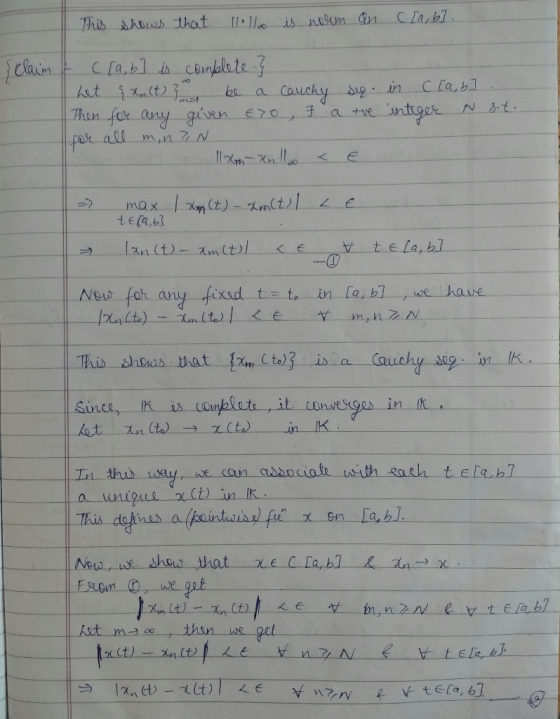
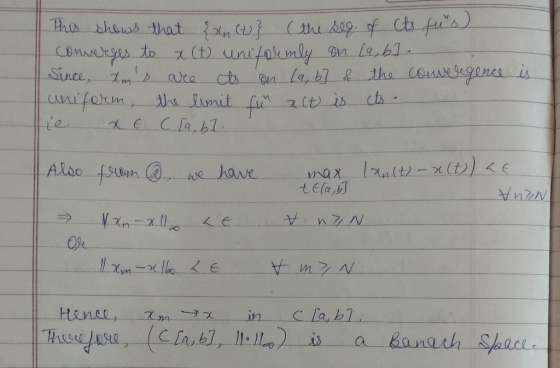
please solve it by easy way , and send clear picture . 2. Let Cla,히 be the space of continuous functions and define l|-lla via Show that (Cla, b),Il a) is a normed linear space. Moreover, prove...
 please solve it by easy way , and send clear picture .
2. Let Cla,히 be the space of continuous functions and define l|-lla via Show that (Cla, b),Il a) is a normed linear space. Moreover, prove that (Cla. b,1la) is not a Banach space is a normed linear space. Moreover, prove that (Cla, b
2. Let Cla,히 be the space of continuous functions and define l|-lla via Show that (Cla, b),Il a) is a normed linear space. Moreover, prove...
please solve it by easy way , and send clear picture .
2. Let Cla,히 be the space of continuous functions and define l|-lla via Show that (Cla, b),Il a) is a normed linear space. Moreover, prove that (Cla. b,1la) is not a Banach space is a normed linear space. Moreover, prove that (Cla, b
2. Let Cla,히 be the space of continuous functions and define l|-lla via Show that (Cla, b),Il a) is a normed linear space. Moreover, prove...
functional analysis.. please step by step and explain it well cause its analysis... helpsss i will...
 functional analysis.. please step by step and explain
it well cause its analysis... helpsss
i will rate ur answer
fastly and step by step
11111111111111111111112222222222222swsssssssssssssssssssssfff Illooooooooo 00000000000000000000000000 Oppppppppppppppppppppppppppppppnnnnnnnnnnnnnnnnnnnnnnn (35) Let X = C.(R) be the space of continuous functions vanishing at infinity, i.e. Co(r) = {sec() lim f(x)=0} Define a norm by llfll = sup f(x). Prove that (X. II-II) is a Banach space. ex
functional analysis.. please step by step and explain
it well cause its analysis... helpsss
i will rate ur answer
fastly and step by step
11111111111111111111112222222222222swsssssssssssssssssssssfff Illooooooooo 00000000000000000000000000 Oppppppppppppppppppppppppppppppnnnnnnnnnnnnnnnnnnnnnnn (35) Let X = C.(R) be the space of continuous functions vanishing at infinity, i.e. Co(r) = {sec() lim f(x)=0} Define a norm by llfll = sup f(x). Prove that (X. II-II) is a Banach space. ex
please solve this question step by step and make it clear to understand .please send clear...
 please solve this question step by step and make it clear to
understand .please send clear picture to see everything clearly.
Thanks!
8. Let (Xy 11-11), j = 1, 2 be normed linear spaces. Prove that f : X1 → X2 is continuous if and only if f-(E°) C (f (E))o for every subset EX2. Here Eo denotes the interior of E.
please solve this question step by step and make it clear to
understand .please send clear picture to see everything clearly.
Thanks!
8. Let (Xy 11-11), j = 1, 2 be normed linear spaces. Prove that f : X1 → X2 is continuous if and only if f-(E°) C (f (E))o for every subset EX2. Here Eo denotes the interior of E.
Number 6 please S. Let ) be a sequence of continuous real-valued functions that converges uniformly...
 Number 6 please
S. Let ) be a sequence of continuous real-valued functions that converges uniformly to a function fon a set ECR. Prove that lim S.(z) =S(x) for every sequence (x.) C Esuch that ,E E 6. Let ECRand let D be a dense subset of E. If .) is a sequence of continuous real-valued functions on E. and if () converges unifomly on D. prove that (.) converges uniformly on E. (Recall that D is dense in E...
Number 6 please
S. Let ) be a sequence of continuous real-valued functions that converges uniformly to a function fon a set ECR. Prove that lim S.(z) =S(x) for every sequence (x.) C Esuch that ,E E 6. Let ECRand let D be a dense subset of E. If .) is a sequence of continuous real-valued functions on E. and if () converges unifomly on D. prove that (.) converges uniformly on E. (Recall that D is dense in E...
12. Let M be the set of continuous functions on R which vanish outside a finite...
 12. Let M be the set of continuous functions on R which vanish outside a finite interval (the interval may depend on the function). (a) Show that M is a metric space in the sup norm. (b) Show that M is not complete. Chapter 5. Sequences of Function 210 (C) Show that C.(R), the continuous functions which go to zero et is complete in the sup norm (problem 10 of Section 5.3). (d) Prove that Mis dense in Co(R). T...
7. Recall the space m of bounded sequences of real numbers together with the metric d(х,...
 7. Recall the space m of bounded sequences of real numbers together with the metric d(х, у) — suр |2; — Ук). k 1,2. (a) Give a simple proof to show that m is complete by showing that m = suitable space X. (Recall that C(X) denotes the space of continuous bounded real- valued functions on X together with the supremum norm.) C(X) for some (b) Let A denote the unit ball in m given by А 3 (x€ т:...
Part 2: Metrics and Norms 1. Norms and convergence: (a) Prove the l2 metric defined in...
 Part 2: Metrics and Norms 1. Norms and convergence: (a) Prove the l2 metric defined in class is a valid norm on R2 (b) Prove that in R2, any open ball in 12 ("Euclidean metric") can be enclosed in an open ball in the loo norm ("sup" norm). (c). Say I have a collection of functions f:I R. Say I (1,2). Consider the convergence of a sequence of functions fn (z) → f(x) in 12-Show that the convergence amounts to...
Please solve this question. Sorry please neglect the bottom picture which says "moreover ...". I am...
 Please solve this question.
Sorry please neglect the bottom picture
which says "moreover ...".
I am happy to upbote if you solve (1)-(5).
Problem 1. We denote by the set of all sequences (UK)x=1,2,... = (U1, U2, ...) (ux E C) u= satisfying luxl <00. Moreover, we define k=1 (u, v) = xox(u, v E f). k=1 (1) Prove that is a vector space. (2) Prove that is a inner product space with respect to (5.). (3) Construct the norm...
Please solve this question.
Sorry please neglect the bottom picture
which says "moreover ...".
I am happy to upbote if you solve (1)-(5).
Problem 1. We denote by the set of all sequences (UK)x=1,2,... = (U1, U2, ...) (ux E C) u= satisfying luxl <00. Moreover, we define k=1 (u, v) = xox(u, v E f). k=1 (1) Prove that is a vector space. (2) Prove that is a inner product space with respect to (5.). (3) Construct the norm...
2008-2. Please provide clear justified step-by-step solutions (preferably handwritten) for the following question. The answers have...
 2008-2. Please provide clear justified step-by-step solutions
(preferably handwritten) for the following question. The answers
have been provided.
Questions:
Answers:
(a) Let X be the set of functions f : R → R in F such that the graph of y - f(x) passes through the point (0, 0). Show that X is a subspace of F (b) For any real number m, define pm E P1 by Pm(x)-mx +1. (c) Let Z P, P2, p3) C P2, where pi(x)...
2008-2. Please provide clear justified step-by-step solutions
(preferably handwritten) for the following question. The answers
have been provided.
Questions:
Answers:
(a) Let X be the set of functions f : R → R in F such that the graph of y - f(x) passes through the point (0, 0). Show that X is a subspace of F (b) For any real number m, define pm E P1 by Pm(x)-mx +1. (c) Let Z P, P2, p3) C P2, where pi(x)...
 please solve this question step by step and make it clear to
understand. Also, please send clear picture to see everything
clearly. thanks!
13. Let S be a compact metric space andK) a decreasing sequence of closed subsets of S. Suppose f:S-+S is continuous, prove that 1 1
13. Let S be a compact metric space andK) a decreasing sequence of closed subsets of S. Suppose f:S-+S is continuous, prove that 1 1
please solve this question step by step and make it clear to
understand. Also, please send clear picture to see everything
clearly. thanks!
13. Let S be a compact metric space andK) a decreasing sequence of closed subsets of S. Suppose f:S-+S is continuous, prove that 1 1
13. Let S be a compact metric space andK) a decreasing sequence of closed subsets of S. Suppose f:S-+S is continuous, prove that 1 1
 please solve it by easy way , and send clear picture .
2. Let Cla,히 be the space of continuous functions and define l|-lla via Show that (Cla, b),Il a) is a normed linear space. Moreover, prove that (Cla. b,1la) is not a Banach space is a normed linear space. Moreover, prove that (Cla, b
2. Let Cla,히 be the space of continuous functions and define l|-lla via Show that (Cla, b),Il a) is a normed linear space. Moreover, prove...
please solve it by easy way , and send clear picture .
2. Let Cla,히 be the space of continuous functions and define l|-lla via Show that (Cla, b),Il a) is a normed linear space. Moreover, prove that (Cla. b,1la) is not a Banach space is a normed linear space. Moreover, prove that (Cla, b
2. Let Cla,히 be the space of continuous functions and define l|-lla via Show that (Cla, b),Il a) is a normed linear space. Moreover, prove...
 functional analysis.. please step by step and explain
it well cause its analysis... helpsss
i will rate ur answer
fastly and step by step
11111111111111111111112222222222222swsssssssssssssssssssssfff Illooooooooo 00000000000000000000000000 Oppppppppppppppppppppppppppppppnnnnnnnnnnnnnnnnnnnnnnn (35) Let X = C.(R) be the space of continuous functions vanishing at infinity, i.e. Co(r) = {sec() lim f(x)=0} Define a norm by llfll = sup f(x). Prove that (X. II-II) is a Banach space. ex
functional analysis.. please step by step and explain
it well cause its analysis... helpsss
i will rate ur answer
fastly and step by step
11111111111111111111112222222222222swsssssssssssssssssssssfff Illooooooooo 00000000000000000000000000 Oppppppppppppppppppppppppppppppnnnnnnnnnnnnnnnnnnnnnnn (35) Let X = C.(R) be the space of continuous functions vanishing at infinity, i.e. Co(r) = {sec() lim f(x)=0} Define a norm by llfll = sup f(x). Prove that (X. II-II) is a Banach space. ex
 please solve this question step by step and make it clear to
understand .please send clear picture to see everything clearly.
Thanks!
8. Let (Xy 11-11), j = 1, 2 be normed linear spaces. Prove that f : X1 → X2 is continuous if and only if f-(E°) C (f (E))o for every subset EX2. Here Eo denotes the interior of E.
please solve this question step by step and make it clear to
understand .please send clear picture to see everything clearly.
Thanks!
8. Let (Xy 11-11), j = 1, 2 be normed linear spaces. Prove that f : X1 → X2 is continuous if and only if f-(E°) C (f (E))o for every subset EX2. Here Eo denotes the interior of E.
 Number 6 please
S. Let ) be a sequence of continuous real-valued functions that converges uniformly to a function fon a set ECR. Prove that lim S.(z) =S(x) for every sequence (x.) C Esuch that ,E E 6. Let ECRand let D be a dense subset of E. If .) is a sequence of continuous real-valued functions on E. and if () converges unifomly on D. prove that (.) converges uniformly on E. (Recall that D is dense in E...
Number 6 please
S. Let ) be a sequence of continuous real-valued functions that converges uniformly to a function fon a set ECR. Prove that lim S.(z) =S(x) for every sequence (x.) C Esuch that ,E E 6. Let ECRand let D be a dense subset of E. If .) is a sequence of continuous real-valued functions on E. and if () converges unifomly on D. prove that (.) converges uniformly on E. (Recall that D is dense in E...
 12. Let M be the set of continuous functions on R which vanish outside a finite interval (the interval may depend on the function). (a) Show that M is a metric space in the sup norm. (b) Show that M is not complete. Chapter 5. Sequences of Function 210 (C) Show that C.(R), the continuous functions which go to zero et is complete in the sup norm (problem 10 of Section 5.3). (d) Prove that Mis dense in Co(R). T...
 7. Recall the space m of bounded sequences of real numbers together with the metric d(х, у) — suр |2; — Ук). k 1,2. (a) Give a simple proof to show that m is complete by showing that m = suitable space X. (Recall that C(X) denotes the space of continuous bounded real- valued functions on X together with the supremum norm.) C(X) for some (b) Let A denote the unit ball in m given by А 3 (x€ т:...
 Part 2: Metrics and Norms 1. Norms and convergence: (a) Prove the l2 metric defined in class is a valid norm on R2 (b) Prove that in R2, any open ball in 12 ("Euclidean metric") can be enclosed in an open ball in the loo norm ("sup" norm). (c). Say I have a collection of functions f:I R. Say I (1,2). Consider the convergence of a sequence of functions fn (z) → f(x) in 12-Show that the convergence amounts to...
 Please solve this question.
Sorry please neglect the bottom picture
which says "moreover ...".
I am happy to upbote if you solve (1)-(5).
Problem 1. We denote by the set of all sequences (UK)x=1,2,... = (U1, U2, ...) (ux E C) u= satisfying luxl <00. Moreover, we define k=1 (u, v) = xox(u, v E f). k=1 (1) Prove that is a vector space. (2) Prove that is a inner product space with respect to (5.). (3) Construct the norm...
Please solve this question.
Sorry please neglect the bottom picture
which says "moreover ...".
I am happy to upbote if you solve (1)-(5).
Problem 1. We denote by the set of all sequences (UK)x=1,2,... = (U1, U2, ...) (ux E C) u= satisfying luxl <00. Moreover, we define k=1 (u, v) = xox(u, v E f). k=1 (1) Prove that is a vector space. (2) Prove that is a inner product space with respect to (5.). (3) Construct the norm...
 2008-2. Please provide clear justified step-by-step solutions
(preferably handwritten) for the following question. The answers
have been provided.
Questions:
Answers:
(a) Let X be the set of functions f : R → R in F such that the graph of y - f(x) passes through the point (0, 0). Show that X is a subspace of F (b) For any real number m, define pm E P1 by Pm(x)-mx +1. (c) Let Z P, P2, p3) C P2, where pi(x)...
2008-2. Please provide clear justified step-by-step solutions
(preferably handwritten) for the following question. The answers
have been provided.
Questions:
Answers:
(a) Let X be the set of functions f : R → R in F such that the graph of y - f(x) passes through the point (0, 0). Show that X is a subspace of F (b) For any real number m, define pm E P1 by Pm(x)-mx +1. (c) Let Z P, P2, p3) C P2, where pi(x)...
Most questions answered within 3 hours.
-
Where is the error in this code sequence?
String s1 = "Hello";
String s2 = "ello";...
asked 11 months ago -
Financial data for Joel de Paris, Inc., for last year
follow:
Joel de Paris, Inc.
Balance...
asked 11 months ago -
Consider this reaction:
Al2(SO4)3 (aq)+ BaCl3
(aq) Al2Cl6 (aq)- +
3BaSO4(s) . What is the...
asked 11 months ago -
Suppose that Savneet is considering increasing her
recent random sample from 20 car rentals to 40...
asked 11 months ago -
Trucks arrive at an unloading terminal at an average rate of 120
per hour.
Trucks arrive...
asked 11 months ago -
Why are methanol and ethanol completely soluble in water while
octanol is not very little soluble....
asked 11 months ago -
A facilities manager at a university reads in a research report
that the mean amount of...
asked 11 months ago -
When the CuSO4 is rehydrated by adding water to the anhydrous
compound, is this an endothermic...
asked 11 months ago -
A ray of sunlight is passing from diamond into crown glass; the
angle of incidence is...
asked 11 months ago -
A block of mass 0.249 kg is placed on top of a light, vertical
spring of...
asked 11 months ago -
how do the kidneys compensate in the presences of acidosis
a) trigger hyperventilate
b) reserve acid...
asked 11 months ago -
Question 501 pts
The rental rate of capital to the firm increases. Which of the
following...
asked 11 months ago