
Homework Answers
`Hey,
Note: Brother in case of any queries, just comment in box I would be very happy to assist all your queries
clc
clear all
x=linspace(-2,2,5);
y=[];
g=@(x) 5*x^5+6*x^4-2*x^3+8*x^2+3*x-15;
h=0.01;
for i=1:length(x)
y(i)=(g(x(i)+h)-g(x(i)-h))/(2*h);
end
C=polyfit(x,y,4);
gd=@(x) 25*x^4+24*x^3-6*x^2+16*x+3;
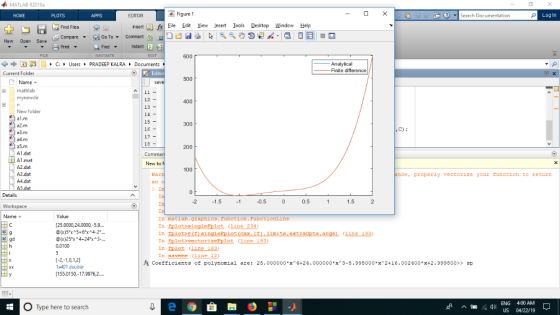
fplot(gd,[-2,2]);
xx=-2:0.01:2;
hold on;
plot(xx,polyval(C,xx));
fprintf('Coefficients of polynomial are:
%f*x^4+%f*x^3%f*x^2+%f*x+%f',C);
legend('Analytical','Finite difference');
disp('Both are approximately same since this is a polynomial fit
for centered difference with low h');
Kindly revert for any queries
Thanks.
Add Answer to:
Problem 4 : Finite difference formula and interpolation For this problem, you will approximate th...
Homework 5 (35 Points max) Please Submit all Matlab and Data files that you create for this homew...
 Homework 5 (35 Points max) Please Submit all Matlab and Data files that you create for this homework Problem 1 (max 20 Points): For the second-order drag model (see Eq.(1)), compute the velocity of a free-falling parachutist using Euler's method for the case where m80 kg and cd 0.25 kg/m. Perform the calculation from t 0 to 20 s with a step size of 1ms. Use an initial condition that the parachutist has an upward velocity of 20 m/s at...
The first two parts should be solved by Matlab. This is from an intro to Numerical...
 The first two parts should be solved by Matlab. This is from an
intro to Numerical Analysis Class and I have provided the Alog 3.2
in below. Please write the whole codes for me.
Alog3.2
% NEWTONS INTERPOLATORY DIVIDED-DIFFERENCE FORMULA ALGORITHM
3.2
% To obtain the divided-difference coefficients of the
% interpolatory polynomial P on the (n+1) distinct numbers
x(0),
% x(1), ..., x(n) for the function f:
% INPUT: numbers x(0), x(1), ..., x(n); values f(x(0)),
f(x(1)),
% ...,...
The first two parts should be solved by Matlab. This is from an
intro to Numerical Analysis Class and I have provided the Alog 3.2
in below. Please write the whole codes for me.
Alog3.2
% NEWTONS INTERPOLATORY DIVIDED-DIFFERENCE FORMULA ALGORITHM
3.2
% To obtain the divided-difference coefficients of the
% interpolatory polynomial P on the (n+1) distinct numbers
x(0),
% x(1), ..., x(n) for the function f:
% INPUT: numbers x(0), x(1), ..., x(n); values f(x(0)),
f(x(1)),
% ...,...
(b) . Write the k-th step of the trapezoidal method as a root-finding problem Ğ = is Y+1 where the unknown (e)Find the Jacobian matrix of the vector function from the previous part. (dWrite a funct...
 (b) . Write the k-th step of the trapezoidal method as a root-finding problem Ğ = is Y+1 where the unknown (e)Find the Jacobian matrix of the vector function from the previous part. (dWrite a function in its own file with definition [Y] dampedPendulum(L, T) function alpha, beta, d, h, that approximates the solution to the equivalent system you derived in part (a) with L: the length of the pendulum string alpha: the initial displacement beta: the initial velocity d:...
2. Consider a mass m moving in R3 without friction. It is fasten tightly at one...
 2. Consider a mass m moving in R3 without friction. It is fasten tightly at one end of a string with length 1 and can swing in any direction. In fact, it moves on a sphere, a subspace of R3 1 0 φ g 2.1 Use the spherical coordinates (1,0,) to derive the Lagrangian L(0,0,0,0) = T-U, namely the difference of kinetic energy T and potential energy U. (Note r = 1 is fixed.) 2.2 Calculate the Euler-Lagrange equations, namely...
 Homework 5 (35 Points max) Please Submit all Matlab and Data files that you create for this homework Problem 1 (max 20 Points): For the second-order drag model (see Eq.(1)), compute the velocity of a free-falling parachutist using Euler's method for the case where m80 kg and cd 0.25 kg/m. Perform the calculation from t 0 to 20 s with a step size of 1ms. Use an initial condition that the parachutist has an upward velocity of 20 m/s at...
 The first two parts should be solved by Matlab. This is from an
intro to Numerical Analysis Class and I have provided the Alog 3.2
in below. Please write the whole codes for me.
Alog3.2
% NEWTONS INTERPOLATORY DIVIDED-DIFFERENCE FORMULA ALGORITHM
3.2
% To obtain the divided-difference coefficients of the
% interpolatory polynomial P on the (n+1) distinct numbers
x(0),
% x(1), ..., x(n) for the function f:
% INPUT: numbers x(0), x(1), ..., x(n); values f(x(0)),
f(x(1)),
% ...,...
The first two parts should be solved by Matlab. This is from an
intro to Numerical Analysis Class and I have provided the Alog 3.2
in below. Please write the whole codes for me.
Alog3.2
% NEWTONS INTERPOLATORY DIVIDED-DIFFERENCE FORMULA ALGORITHM
3.2
% To obtain the divided-difference coefficients of the
% interpolatory polynomial P on the (n+1) distinct numbers
x(0),
% x(1), ..., x(n) for the function f:
% INPUT: numbers x(0), x(1), ..., x(n); values f(x(0)),
f(x(1)),
% ...,...
 (b) . Write the k-th step of the trapezoidal method as a root-finding problem Ğ = is Y+1 where the unknown (e)Find the Jacobian matrix of the vector function from the previous part. (dWrite a function in its own file with definition [Y] dampedPendulum(L, T) function alpha, beta, d, h, that approximates the solution to the equivalent system you derived in part (a) with L: the length of the pendulum string alpha: the initial displacement beta: the initial velocity d:...
 2. Consider a mass m moving in R3 without friction. It is fasten tightly at one end of a string with length 1 and can swing in any direction. In fact, it moves on a sphere, a subspace of R3 1 0 φ g 2.1 Use the spherical coordinates (1,0,) to derive the Lagrangian L(0,0,0,0) = T-U, namely the difference of kinetic energy T and potential energy U. (Note r = 1 is fixed.) 2.2 Calculate the Euler-Lagrange equations, namely...
Most questions answered within 3 hours.
-
Where is the error in this code sequence?
String s1 = "Hello";
String s2 = "ello";...
asked 11 months ago -
Financial data for Joel de Paris, Inc., for last year
follow:
Joel de Paris, Inc.
Balance...
asked 11 months ago -
Consider this reaction:
Al2(SO4)3 (aq)+ BaCl3
(aq) Al2Cl6 (aq)- +
3BaSO4(s) . What is the...
asked 11 months ago -
Suppose that Savneet is considering increasing her
recent random sample from 20 car rentals to 40...
asked 11 months ago -
Trucks arrive at an unloading terminal at an average rate of 120
per hour.
Trucks arrive...
asked 11 months ago -
Why are methanol and ethanol completely soluble in water while
octanol is not very little soluble....
asked 11 months ago -
A facilities manager at a university reads in a research report
that the mean amount of...
asked 11 months ago -
When the CuSO4 is rehydrated by adding water to the anhydrous
compound, is this an endothermic...
asked 11 months ago -
A ray of sunlight is passing from diamond into crown glass; the
angle of incidence is...
asked 11 months ago -
A block of mass 0.249 kg is placed on top of a light, vertical
spring of...
asked 11 months ago -
how do the kidneys compensate in the presences of acidosis
a) trigger hyperventilate
b) reserve acid...
asked 11 months ago -
Question 501 pts
The rental rate of capital to the firm increases. Which of the
following...
asked 11 months ago