
Homework Answers
Add Answer to:
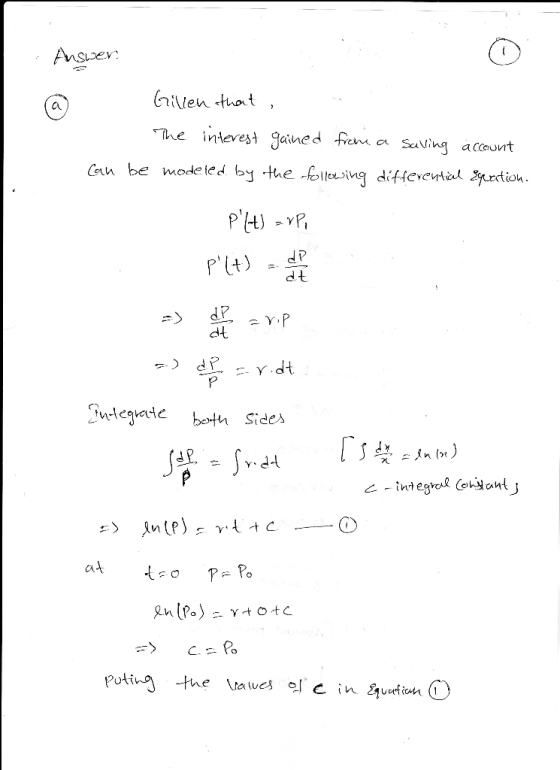
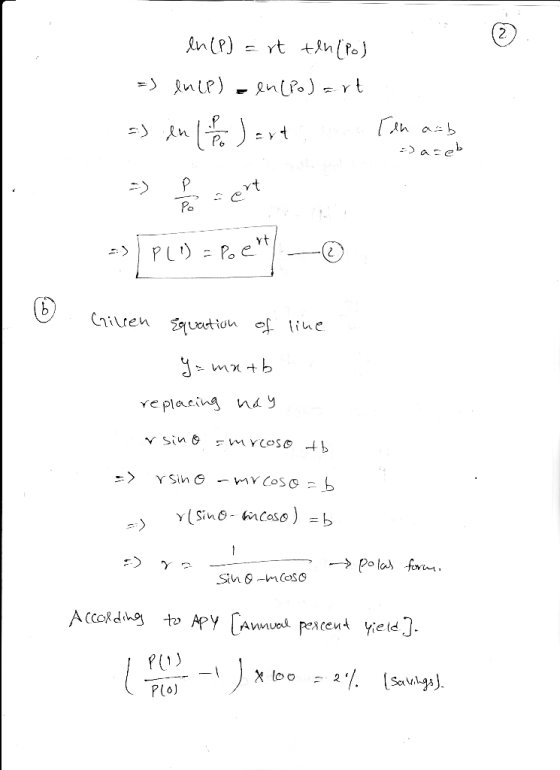
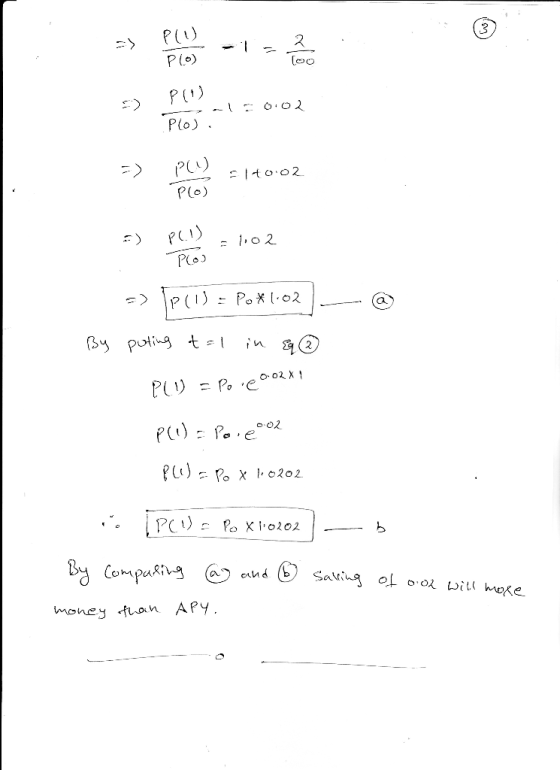
3. Interest gained from a savin gs account can be modeled by the following differential equation ...
Suppose that Po is invested in a savings account in which interest is compounded continuously at ...
 Suppose that Po is invested in a savings account in which interest is compounded continuously at 59% per year. That is, the balance P grows at the rate given by the following equation dP 0.059P(t) dt (a)Find the function P(t) that satisfies the equation. Write it in terms of Po and 0.059. (b)Suppose that $1500 is invested. What is the balance after 2 years? (c)When will an investment of $1500 double itself? (a) Choose the correct answer below. Po P(t)...
= (x-3)(y+1)2/3 Solve the differential 1) dy/dx equation. It is assumed that the bank account with...
 = (x-3)(y+1)2/3 Solve the differential 1) dy/dx equation. It is assumed that the bank account with annual compound interest rate i contains TL in the amount of M (t). The increase in TL amount in the bank; It is expressed as the dM / dt = i / 100 M differential equation. In the equation, i = 0.05 (constant value), t: How much money is there in the bank account after 3 years since the period (year) and the initial...
differential It is assumed that the bank account with annual compound interest rate i contains TL...
 differential
It is assumed that the bank account with annual compound interest rate i contains TL in the amount of M (t). The increase in TL amount in the bank; dM / dt M is expressed by the differential equation. In the equation, since i = 0.05 (fixed value), t: duration (year) and initial money M (0) = 1000 TL, how much money will be in the bank account after 3 years? Calculate.
differential
It is assumed that the bank account with annual compound interest rate i contains TL in the amount of M (t). The increase in TL amount in the bank; dM / dt M is expressed by the differential equation. In the equation, since i = 0.05 (fixed value), t: duration (year) and initial money M (0) = 1000 TL, how much money will be in the bank account after 3 years? Calculate.
Question 1 A bank features a savings account that has an annual percentage rate of r...
 Question 1 A bank features a savings account that has an annual percentage rate of r = 4.5% with interest compounded quarterly. Logan deposits $11,000 into the account. The account balance can be modeled by the exponential formula S(t) = P(1+)", nt Th where S is the future value, P is the present value, r is the annual percentage rate written as a decimal, n is the number of times each year that the interest is compounded, and t is...
14.Compound Interest hank account pays compound interest, it pays interest not only on the principal amount...
 14.Compound Interest hank account pays compound interest, it pays interest not only on the principal amount that was deposited into the account, but also on the interest that has accumulated over time. Suppose you want to deposit some money into a savings account, and let the account earn compound interest for a certain number of years. The formula for calculating the balance of the account afer a specified namber of years is The terms in the formula are A is...
2. Continuous compound interest can be calculated using the formula A(t) = Perl, where P is...
 2. Continuous compound interest can be calculated using the formula A(t) = Perl, where P is the initial amount and At) is the value after time t at interest rater (as a decimal). (a) When Angela was born, her grandparents deposited $5,000 into a college savings account paying 6% interest compounded continuously. What is the balance after 15 years? Round your answer to two decimal places. (b) If her grandparents want her to have $15,000 after 17 years, how much...
In Chapter 1 of the text we looked at calculating a monthly payment for a loan. A related formula is to calculate the amount accruing when regular payments are made into an interest bearing account -...
In Chapter 1 of the text we looked at calculating a monthly payment for a loan. A related formula is to calculate the amount accruing when regular payments are made into an interest bearing account - often called the Savings Plan formula. (A is the accrued amount after t years of making regular payments, PMT, into an account at interest rate, r%, compounded ntimes each year.) A(t) = PMT·((1 + r/N)N·t - 1)/(r/N) = PMT*((1 + r/N)^(N*t) - 1)/(r/N) The...
Can someone show step by step how to get P0e^rt from equation (1.4)? Consider a population...
 Can someone show step by step how to get P0e^rt from equation
(1.4)?
Consider a population P(t) that is varying with time. A mathematician will say that the rate at which the population is changing with respect to time is given by the derivative dP dt On the other hand, a population biologist will say that the rate of change is roughly proportional to the population. This means that there is a constant r, called the reproductive rate, such that...
Can someone show step by step how to get P0e^rt from equation
(1.4)?
Consider a population P(t) that is varying with time. A mathematician will say that the rate at which the population is changing with respect to time is given by the derivative dP dt On the other hand, a population biologist will say that the rate of change is roughly proportional to the population. This means that there is a constant r, called the reproductive rate, such that...
The amount of money in an account earning compound interest is modelled by the equation: P(n)...
The amount of money in an account earning compound interest is modelled by the equation: P(n) = Arn – 1 where P(n) is the amount in the account at year n, A is the amount invested, and r = 1 + i, and i expressed as a percent is the effective rate of interest. If a man invests $1500 in year 1, and earns 4% interest, how much money will he have in year 30? a. $4677.98 c. $6482.91 b....
Simple interest is given by the formula A=P+PrtA=P+Prt. Where AA is the balance of the account...
 Simple interest is given by the formula A=P+PrtA=P+Prt. Where AA
is the balance of the account after tt years, and PP is the
starting principal invested at an annual percentage rate of rr,
expressed as a decimal.
Keegan is investing money into a savings account that pays 4%
simple interest, and plans to leave it there for 20 years.
Determine what Keegan needs to deposit now in order to have a
balance of $50,000 in his savings account after 20...
Simple interest is given by the formula A=P+PrtA=P+Prt. Where AA
is the balance of the account after tt years, and PP is the
starting principal invested at an annual percentage rate of rr,
expressed as a decimal.
Keegan is investing money into a savings account that pays 4%
simple interest, and plans to leave it there for 20 years.
Determine what Keegan needs to deposit now in order to have a
balance of $50,000 in his savings account after 20...
 Suppose that Po is invested in a savings account in which interest is compounded continuously at 59% per year. That is, the balance P grows at the rate given by the following equation dP 0.059P(t) dt (a)Find the function P(t) that satisfies the equation. Write it in terms of Po and 0.059. (b)Suppose that $1500 is invested. What is the balance after 2 years? (c)When will an investment of $1500 double itself? (a) Choose the correct answer below. Po P(t)...
 = (x-3)(y+1)2/3 Solve the differential 1) dy/dx equation. It is assumed that the bank account with annual compound interest rate i contains TL in the amount of M (t). The increase in TL amount in the bank; It is expressed as the dM / dt = i / 100 M differential equation. In the equation, i = 0.05 (constant value), t: How much money is there in the bank account after 3 years since the period (year) and the initial...
 differential
It is assumed that the bank account with annual compound interest rate i contains TL in the amount of M (t). The increase in TL amount in the bank; dM / dt M is expressed by the differential equation. In the equation, since i = 0.05 (fixed value), t: duration (year) and initial money M (0) = 1000 TL, how much money will be in the bank account after 3 years? Calculate.
differential
It is assumed that the bank account with annual compound interest rate i contains TL in the amount of M (t). The increase in TL amount in the bank; dM / dt M is expressed by the differential equation. In the equation, since i = 0.05 (fixed value), t: duration (year) and initial money M (0) = 1000 TL, how much money will be in the bank account after 3 years? Calculate.
 Question 1 A bank features a savings account that has an annual percentage rate of r = 4.5% with interest compounded quarterly. Logan deposits $11,000 into the account. The account balance can be modeled by the exponential formula S(t) = P(1+)", nt Th where S is the future value, P is the present value, r is the annual percentage rate written as a decimal, n is the number of times each year that the interest is compounded, and t is...
 14.Compound Interest hank account pays compound interest, it pays interest not only on the principal amount that was deposited into the account, but also on the interest that has accumulated over time. Suppose you want to deposit some money into a savings account, and let the account earn compound interest for a certain number of years. The formula for calculating the balance of the account afer a specified namber of years is The terms in the formula are A is...
 2. Continuous compound interest can be calculated using the formula A(t) = Perl, where P is the initial amount and At) is the value after time t at interest rater (as a decimal). (a) When Angela was born, her grandparents deposited $5,000 into a college savings account paying 6% interest compounded continuously. What is the balance after 15 years? Round your answer to two decimal places. (b) If her grandparents want her to have $15,000 after 17 years, how much...
 Can someone show step by step how to get P0e^rt from equation
(1.4)?
Consider a population P(t) that is varying with time. A mathematician will say that the rate at which the population is changing with respect to time is given by the derivative dP dt On the other hand, a population biologist will say that the rate of change is roughly proportional to the population. This means that there is a constant r, called the reproductive rate, such that...
Can someone show step by step how to get P0e^rt from equation
(1.4)?
Consider a population P(t) that is varying with time. A mathematician will say that the rate at which the population is changing with respect to time is given by the derivative dP dt On the other hand, a population biologist will say that the rate of change is roughly proportional to the population. This means that there is a constant r, called the reproductive rate, such that...
 Simple interest is given by the formula A=P+PrtA=P+Prt. Where AA
is the balance of the account after tt years, and PP is the
starting principal invested at an annual percentage rate of rr,
expressed as a decimal.
Keegan is investing money into a savings account that pays 4%
simple interest, and plans to leave it there for 20 years.
Determine what Keegan needs to deposit now in order to have a
balance of $50,000 in his savings account after 20...
Simple interest is given by the formula A=P+PrtA=P+Prt. Where AA
is the balance of the account after tt years, and PP is the
starting principal invested at an annual percentage rate of rr,
expressed as a decimal.
Keegan is investing money into a savings account that pays 4%
simple interest, and plans to leave it there for 20 years.
Determine what Keegan needs to deposit now in order to have a
balance of $50,000 in his savings account after 20...
Most questions answered within 3 hours.
-
Where is the error in this code sequence?
String s1 = "Hello";
String s2 = "ello";...
asked 11 months ago -
Financial data for Joel de Paris, Inc., for last year
follow:
Joel de Paris, Inc.
Balance...
asked 11 months ago -
Consider this reaction:
Al2(SO4)3 (aq)+ BaCl3
(aq) Al2Cl6 (aq)- +
3BaSO4(s) . What is the...
asked 11 months ago -
Suppose that Savneet is considering increasing her
recent random sample from 20 car rentals to 40...
asked 11 months ago -
Trucks arrive at an unloading terminal at an average rate of 120
per hour.
Trucks arrive...
asked 11 months ago -
Why are methanol and ethanol completely soluble in water while
octanol is not very little soluble....
asked 11 months ago -
A facilities manager at a university reads in a research report
that the mean amount of...
asked 11 months ago -
When the CuSO4 is rehydrated by adding water to the anhydrous
compound, is this an endothermic...
asked 11 months ago -
A ray of sunlight is passing from diamond into crown glass; the
angle of incidence is...
asked 11 months ago -
A block of mass 0.249 kg is placed on top of a light, vertical
spring of...
asked 11 months ago -
how do the kidneys compensate in the presences of acidosis
a) trigger hyperventilate
b) reserve acid...
asked 11 months ago -
Question 501 pts
The rental rate of capital to the firm increases. Which of the
following...
asked 11 months ago