
Homework Answers

Add Answer to:
C. Explain briefly the addressing scheme in the cache system of 1.b. with a diagram showing the h...
A 2-way set associative cache consists of four sets 0, 1, 2, 3. The main memory...
 A 2-way set associative cache consists of four sets 0, 1, 2, 3. The main memory is word addressable (i.e. treat the memory as an array of words indexed by the address). It contains 2048 blocks 0 through 2047, and each block has eight words. (a) How many bits are needed to address the main memory? (b) Show how a main memory address will be translated into a tag, a set number, and an offset within a block. Illustrate this...
1. Cache memory (8pts) Consider adding cache to a processor-memory system design. The microprocessor without cache needs 12 clock cycles to read a 16-bit word from the memory. With cache, it take...
 1. Cache memory (8pts) Consider adding cache to a processor-memory system design. The microprocessor without cache needs 12 clock cycles to read a 16-bit word from the memory. With cache, it takes only 4 clock cycles if the data happens to be in the cache and a total 20 clock cycles including the cache misses. a. What is the performance ratio of the cache system to the non-cache system given a hit rate of 80%? b. For what hit rate...
1. Cache memory (8pts) Consider adding cache to a processor-memory system desigrn. The microprocessor without cache needs 12 clock cycles to read a 16-bit word from the memory. With cache, it takes o...
 1. Cache memory (8pts) Consider adding cache to a processor-memory system desigrn. The microprocessor without cache needs 12 clock cycles to read a 16-bit word from the memory. With cache, it takes only 4 clock cycles if the data happens to be in the cache and a total 20 clock cycles including the cache misses a. What is the performance ratio of the cache system to the non-cache system given a hit rate of 80%? b. For what hit rate...
1. Draw a memory hierarchy diagram. 2. Briefly describe the different types of memory in the...
1. Draw a memory hierarchy diagram. 2. Briefly describe the different types of memory in the memory hierarchy in terms of performance, access time and cost. 3. Describe the followings regarding cache: a. Block placement b. Block identification c. Block replacement d. Write strategy
(b) Using a timing diagram showing the clk, Q1 and D2 signals, explain the following timing const...
 (b) Using a timing diagram showing the clk, Q1 and D2 signals, explain the following timing constraints for the circuit shown in Figure 2.1 cqtcd 2 old where tod is the contamination delay of the combinational logic 7 marks reg2 reg1 Combinational D2 logic clk. clk Figure 2.1 (c) In the circuit shown in Figure 2.2, the flip-flops have a clock-to-Q contamination delay of 30 ps and a propagation delay of 80 ps. They have a setup time of 50...
Given the following cache specifications: (S, E, B, m) = (4, 2, 2, 6) where S...
Given the following cache specifications: (S, E, B, m) = (4, 2, 2, 6) where S is the number of sets, E is the number of lines per set, B is the number of blocks per line, and m is the memory address length. a. Construct a block diagram of the cache. b. Identify the tag bits, set bits and block offset bits for the address field. c. The cache replacement policy is: Last-in First-out. Show how the cache contents...
Q3. Figure 3 below shows the initial state diagram for a two input (X2, Xi), single output (Z) control system. Design a...
 Q3. Figure 3 below shows the initial state diagram for a two input (X2, Xi), single output (Z) control system. Design a Moore asynchronous logic solution addressing the following steps A flow table a) [5 marks] b) A merged flow table (explaining why merging was used, and showing the re-numbered merged states) and the revised merged state diagram [8 marks] Assign state variables, and generate an excitation table, marking transitions from unstable to stable states, making statements regarding the presence...
can I please get help asap (a) Draw and label an appropriate diagram showing a firm...
 can I please get help asap
(a) Draw and label an appropriate diagram showing a firm in a perfectly competitive market making a loss (5 marks) (b) Explain what will happen in a perfectly competitive market (3 marks) (c) Using an appropriately labelled diagram explain briefly why a firm in a perfectly competitive market does not have market power. (2 marks)
can I please get help asap
(a) Draw and label an appropriate diagram showing a firm in a perfectly competitive market making a loss (5 marks) (b) Explain what will happen in a perfectly competitive market (3 marks) (c) Using an appropriately labelled diagram explain briefly why a firm in a perfectly competitive market does not have market power. (2 marks)
Operating Systems Questions (Please help if you can) 1. A computer has cache, main memory, and...
Operating Systems Questions (Please help if you can) 1. A computer has cache, main memory, and a disk used for virtual memory. If a referenced word is in the cache, 20ns are required to access it. If it is in main memory but not in the cache, 60ns are required to load it into the cache (this includes the time to originally check the cache), and then, the reference is started again. If the word is not in main memory,...
I want someone to explain how you reach these answers. Thank you! For the memory system...
 I want someone to explain how you reach these answers. Thank
you!
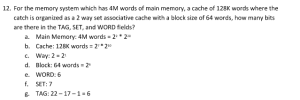
For the memory system which has 4M words of main memory, a cache
of 128K words where the
catch is organized as a 2 way set associative cache with a block
size of 64 words, how many bits
are there in the TAG, SET, and WORD fields?
a. Main Memory: 4M words = 2 2 * 2 20
b. Cache: 128K words = 2 7 * 2 10...
I want someone to explain how you reach these answers. Thank
you!
For the memory system which has 4M words of main memory, a cache
of 128K words where the
catch is organized as a 2 way set associative cache with a block
size of 64 words, how many bits
are there in the TAG, SET, and WORD fields?
a. Main Memory: 4M words = 2 2 * 2 20
b. Cache: 128K words = 2 7 * 2 10...
 A 2-way set associative cache consists of four sets 0, 1, 2, 3. The main memory is word addressable (i.e. treat the memory as an array of words indexed by the address). It contains 2048 blocks 0 through 2047, and each block has eight words. (a) How many bits are needed to address the main memory? (b) Show how a main memory address will be translated into a tag, a set number, and an offset within a block. Illustrate this...
 1. Cache memory (8pts) Consider adding cache to a processor-memory system design. The microprocessor without cache needs 12 clock cycles to read a 16-bit word from the memory. With cache, it takes only 4 clock cycles if the data happens to be in the cache and a total 20 clock cycles including the cache misses. a. What is the performance ratio of the cache system to the non-cache system given a hit rate of 80%? b. For what hit rate...
 1. Cache memory (8pts) Consider adding cache to a processor-memory system desigrn. The microprocessor without cache needs 12 clock cycles to read a 16-bit word from the memory. With cache, it takes only 4 clock cycles if the data happens to be in the cache and a total 20 clock cycles including the cache misses a. What is the performance ratio of the cache system to the non-cache system given a hit rate of 80%? b. For what hit rate...
 (b) Using a timing diagram showing the clk, Q1 and D2 signals, explain the following timing constraints for the circuit shown in Figure 2.1 cqtcd 2 old where tod is the contamination delay of the combinational logic 7 marks reg2 reg1 Combinational D2 logic clk. clk Figure 2.1 (c) In the circuit shown in Figure 2.2, the flip-flops have a clock-to-Q contamination delay of 30 ps and a propagation delay of 80 ps. They have a setup time of 50...
 Q3. Figure 3 below shows the initial state diagram for a two input (X2, Xi), single output (Z) control system. Design a Moore asynchronous logic solution addressing the following steps A flow table a) [5 marks] b) A merged flow table (explaining why merging was used, and showing the re-numbered merged states) and the revised merged state diagram [8 marks] Assign state variables, and generate an excitation table, marking transitions from unstable to stable states, making statements regarding the presence...
 can I please get help asap
(a) Draw and label an appropriate diagram showing a firm in a perfectly competitive market making a loss (5 marks) (b) Explain what will happen in a perfectly competitive market (3 marks) (c) Using an appropriately labelled diagram explain briefly why a firm in a perfectly competitive market does not have market power. (2 marks)
can I please get help asap
(a) Draw and label an appropriate diagram showing a firm in a perfectly competitive market making a loss (5 marks) (b) Explain what will happen in a perfectly competitive market (3 marks) (c) Using an appropriately labelled diagram explain briefly why a firm in a perfectly competitive market does not have market power. (2 marks)
 I want someone to explain how you reach these answers. Thank
you!
For the memory system which has 4M words of main memory, a cache
of 128K words where the
catch is organized as a 2 way set associative cache with a block
size of 64 words, how many bits
are there in the TAG, SET, and WORD fields?
a. Main Memory: 4M words = 2 2 * 2 20
b. Cache: 128K words = 2 7 * 2 10...
I want someone to explain how you reach these answers. Thank
you!
For the memory system which has 4M words of main memory, a cache
of 128K words where the
catch is organized as a 2 way set associative cache with a block
size of 64 words, how many bits
are there in the TAG, SET, and WORD fields?
a. Main Memory: 4M words = 2 2 * 2 20
b. Cache: 128K words = 2 7 * 2 10...
Most questions answered within 3 hours.
-
Where is the error in this code sequence?
String s1 = "Hello";
String s2 = "ello";...
asked 11 months ago -
Financial data for Joel de Paris, Inc., for last year
follow:
Joel de Paris, Inc.
Balance...
asked 11 months ago -
Consider this reaction:
Al2(SO4)3 (aq)+ BaCl3
(aq) Al2Cl6 (aq)- +
3BaSO4(s) . What is the...
asked 11 months ago -
Suppose that Savneet is considering increasing her
recent random sample from 20 car rentals to 40...
asked 11 months ago -
Trucks arrive at an unloading terminal at an average rate of 120
per hour.
Trucks arrive...
asked 11 months ago -
Why are methanol and ethanol completely soluble in water while
octanol is not very little soluble....
asked 11 months ago -
A facilities manager at a university reads in a research report
that the mean amount of...
asked 11 months ago -
When the CuSO4 is rehydrated by adding water to the anhydrous
compound, is this an endothermic...
asked 11 months ago -
A ray of sunlight is passing from diamond into crown glass; the
angle of incidence is...
asked 11 months ago -
A block of mass 0.249 kg is placed on top of a light, vertical
spring of...
asked 11 months ago -
how do the kidneys compensate in the presences of acidosis
a) trigger hyperventilate
b) reserve acid...
asked 11 months ago -
Question 501 pts
The rental rate of capital to the firm increases. Which of the
following...
asked 11 months ago