
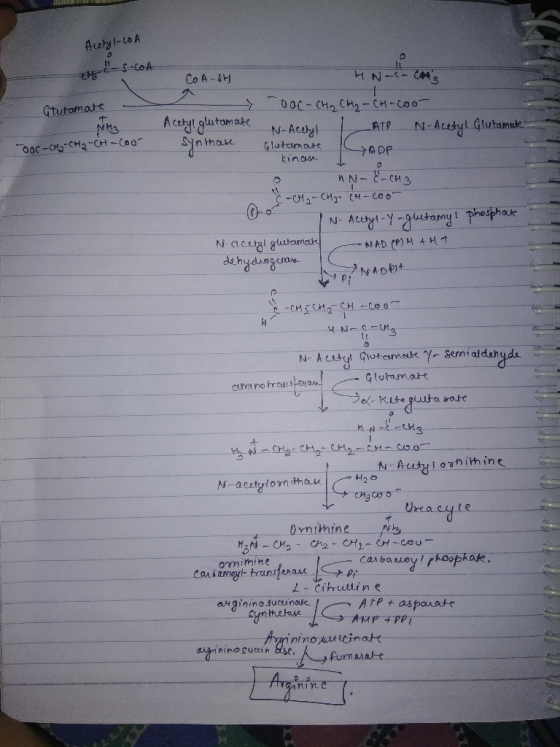
Diagram the process of generating arginine from glutamate and acetyl CoA. Please include every metabolic intermediate and enzyme needed.
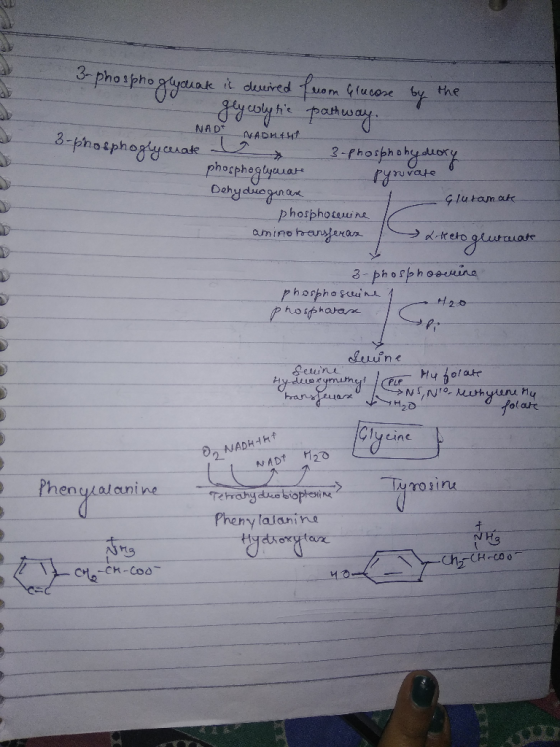
What was the source of the 3-phosphoglycerate?
Diagram the process of generating arginine from glutamate and acetyl CoA. Please include every metabolic intermediate and enzyme needed.
Homework Answers
Add Answer to:
Diagram the process of generating arginine from glutamate and acetyl CoA. Please include every me...
Question 10: (10 points) Diagram the process of generating arginine from glutamate and acetyl CoA. Please...
Question 10: (10 points) Diagram the process of generating arginine from glutamate and acetyl CoA. Please include every metabolic intermediate and enzyme needed. Use Worksheet 10 to illustrate this process Question 11: (4 points) What was the source of the glutamate and acetyl CoA?
Describe “hub” molecules acetyl CoA and pyruvate that serve different pathways. Explain metabolic regulation favoring metabolic pathway choices leading to and from hub molecules. Describe how C.A.C. s...
 Describe “hub” molecules acetyl CoA and pyruvate that serve
different pathways. Explain metabolic regulation favoring metabolic
pathway choices leading to and from hub molecules. Describe how
C.A.C. serves as a “hub “pathway. Use picture as a reference.
Pyruvate Glucose Fatty acids sterols pyruvate carboxylase Acetyl-CoA PEP carboxykinase Glutamine Citrate Phosphoenolpyruvate (PEP) Proline Arginine Oxaloacetate PEP carboxylase Citric acid cycle a-Ketoglutarate Malate Glutamate Aspartate Asparagine Serine Glycine Cysteine malic enzyme Purines Succinyl-CoA Phenylalanine Pyrimidines Pyruvate Tyrosine Tryptophan Porphyrins heme Figure 16-16...
Describe “hub” molecules acetyl CoA and pyruvate that serve
different pathways. Explain metabolic regulation favoring metabolic
pathway choices leading to and from hub molecules. Describe how
C.A.C. serves as a “hub “pathway. Use picture as a reference.
Pyruvate Glucose Fatty acids sterols pyruvate carboxylase Acetyl-CoA PEP carboxykinase Glutamine Citrate Phosphoenolpyruvate (PEP) Proline Arginine Oxaloacetate PEP carboxylase Citric acid cycle a-Ketoglutarate Malate Glutamate Aspartate Asparagine Serine Glycine Cysteine malic enzyme Purines Succinyl-CoA Phenylalanine Pyrimidines Pyruvate Tyrosine Tryptophan Porphyrins heme Figure 16-16...
Starting with Acetyl-CoA in the mitochondrial matrix, show how a molecule of acetyl-CoA may get incorporated...
Starting with Acetyl-CoA in the mitochondrial matrix, show how a molecule of acetyl-CoA may get incorporated into a molecule of phosphatyidylserine in the plasma membrane. You should summarize the pathways involved into the critical steps involved. You do NOT need to show every reaction and/or enzyme. You can present your summarizing note in any form like a table, diagram, or outline, do NOT describe it in just words. Your pathway should have a minimum of six steps. Label at least...
The process of transforming Pyruvate and Acetyl CoA requires the use of 5 coenzymes. Provide the...
The process of transforming Pyruvate and Acetyl CoA requires the use of 5 coenzymes. Provide the name and structure of all of these coenzymes below. The process of transforming Pyruvate and Acetyl CoA requires the use of 3 enzymes. Provide the name of those 3 enzymes and which of the coenzymes from above are used by these enzymes. List the 6 enzymes involved in the electron transport chain List the 3 coenzymes and which enzymes they are linked to. List...
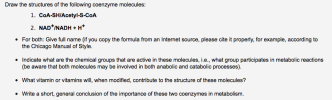
Please answer all. Draw the structures of the following coenzyme molecules: 1. COA-SH/Acetyl-S-COA 2. NADTINADH +...
 Please answer all.
Draw the structures of the following coenzyme molecules: 1. COA-SH/Acetyl-S-COA 2. NADTINADH + H+ • For both: Give full name (if you copy the formula from an Internet source, please cite it properly, for example, according to the Chicago Manual of Style. • Indicate what are the chemical groups that are active in these molecules, i.e., what group participates in metabolic reactions (be aware that both molecules may be involved in both anabolic and catabolic processes). •...
Please answer all.
Draw the structures of the following coenzyme molecules: 1. COA-SH/Acetyl-S-COA 2. NADTINADH + H+ • For both: Give full name (if you copy the formula from an Internet source, please cite it properly, for example, according to the Chicago Manual of Style. • Indicate what are the chemical groups that are active in these molecules, i.e., what group participates in metabolic reactions (be aware that both molecules may be involved in both anabolic and catabolic processes). •...
Easy question, 30 min timed assignment, please answer ASAP, thanks. 1. Glycerol from hydrolysis of triacylglycerols...
 Easy question, 30 min timed assignment, please answer ASAP,
thanks.
1. Glycerol from hydrolysis of triacylglycerols enters gluconeogenesis at. a. glyceraldehyde-3-phosphate. b. dihydroxyacetone phosphate. c. 1,3-bisphosphoglycerate. d. 3-phosphoglycerate. e. 2-phosphoglycerate. or tissue prefers to use ketone bodies such as acetoacetate as a source of fuel instead of glucose? a. heart muscle c. brain d. liver e. stomach b. adrenal cortex 3. The key enzyme in glycogen degradation is a. glycogen phosphatase. b. glycogen hydrolase. c. glycogen phosphorylase A d. glycogen...
Easy question, 30 min timed assignment, please answer ASAP,
thanks.
1. Glycerol from hydrolysis of triacylglycerols enters gluconeogenesis at. a. glyceraldehyde-3-phosphate. b. dihydroxyacetone phosphate. c. 1,3-bisphosphoglycerate. d. 3-phosphoglycerate. e. 2-phosphoglycerate. or tissue prefers to use ketone bodies such as acetoacetate as a source of fuel instead of glucose? a. heart muscle c. brain d. liver e. stomach b. adrenal cortex 3. The key enzyme in glycogen degradation is a. glycogen phosphatase. b. glycogen hydrolase. c. glycogen phosphorylase A d. glycogen...
Please help with questions #10 and #11. Fatty acid degradation is a slow process that occurs...
Please help with questions #10 and #11. Fatty acid degradation is a slow process that occurs by cutting out 2 carbon units at a time. Question 8: (3 points) what are all the reagents other than the fatty acid needed for this process? All the reagents needed in beta-oxidation of fatty acid break down are – acyl coA dehydrogenase to form enoyl coA, enoyl coA hydratase to form 3-hydroxy acyl coA, hydroxy acyl-coA dehydrogenase to form beat-ketoacyl coA, and thiolase...
Glucose Pyruvate Acetyl-CoA Glycolysis Pyruvate Oxidation Bifunctional Dehydrogenase Ethanol The diagram above represents processes needed for...
 Glucose Pyruvate Acetyl-CoA Glycolysis Pyruvate Oxidation Bifunctional Dehydrogenase Ethanol The diagram above represents processes needed for ethanol production in C. besci. For each numbered blank in the diagram, write the number and the molecule that the blank represents. Then answer the following questions. The glyceraldehyde 3 phosphate dehydrogenasse reaction in the previous question takes place in glycolysis. Write a concise and coherent explanation of why that reaction is needed to produce ethanol in C. bescii. Your answer must integrate the...
40.Fatty acid synthase is an enzyme in the lipid metabolism pathway, that: A. occurs in the...
 40.Fatty acid synthase is an enzyme in the lipid metabolism pathway, that: A. occurs in the mitochondrion in animal cells, 2 nor Section A B. utilises NADH as an electron donor C) requires NADPH as a substrate. D. requires acetic acid as a substrate. E. consists of a single multifunctional protein in plants and bacteria. 41.One round of beta oxidation produces 1 molecule of acetyl-CoA from a saturated Acyl-CoA molecule. Which reducing equivalents are made in this process in which...
Description: In order to go from glycolysis to the citric acid cycle we first must harvest...
Description: In order to go from glycolysis to the citric acid cycle we first must harvest pyruvates into acetyl CoA’s. This process involves many small steps which result in the main entrance in the citric acid cycle Instructions: For this presentation, your goal is to walk the audience through every step that is involved in generating acetyl CoA from Pyruvate. Be sure to focus on any cofactors need and show how this process is reset at the end to allow...
 Describe “hub” molecules acetyl CoA and pyruvate that serve
different pathways. Explain metabolic regulation favoring metabolic
pathway choices leading to and from hub molecules. Describe how
C.A.C. serves as a “hub “pathway. Use picture as a reference.
Pyruvate Glucose Fatty acids sterols pyruvate carboxylase Acetyl-CoA PEP carboxykinase Glutamine Citrate Phosphoenolpyruvate (PEP) Proline Arginine Oxaloacetate PEP carboxylase Citric acid cycle a-Ketoglutarate Malate Glutamate Aspartate Asparagine Serine Glycine Cysteine malic enzyme Purines Succinyl-CoA Phenylalanine Pyrimidines Pyruvate Tyrosine Tryptophan Porphyrins heme Figure 16-16...
Describe “hub” molecules acetyl CoA and pyruvate that serve
different pathways. Explain metabolic regulation favoring metabolic
pathway choices leading to and from hub molecules. Describe how
C.A.C. serves as a “hub “pathway. Use picture as a reference.
Pyruvate Glucose Fatty acids sterols pyruvate carboxylase Acetyl-CoA PEP carboxykinase Glutamine Citrate Phosphoenolpyruvate (PEP) Proline Arginine Oxaloacetate PEP carboxylase Citric acid cycle a-Ketoglutarate Malate Glutamate Aspartate Asparagine Serine Glycine Cysteine malic enzyme Purines Succinyl-CoA Phenylalanine Pyrimidines Pyruvate Tyrosine Tryptophan Porphyrins heme Figure 16-16...
 Please answer all.
Draw the structures of the following coenzyme molecules: 1. COA-SH/Acetyl-S-COA 2. NADTINADH + H+ • For both: Give full name (if you copy the formula from an Internet source, please cite it properly, for example, according to the Chicago Manual of Style. • Indicate what are the chemical groups that are active in these molecules, i.e., what group participates in metabolic reactions (be aware that both molecules may be involved in both anabolic and catabolic processes). •...
Please answer all.
Draw the structures of the following coenzyme molecules: 1. COA-SH/Acetyl-S-COA 2. NADTINADH + H+ • For both: Give full name (if you copy the formula from an Internet source, please cite it properly, for example, according to the Chicago Manual of Style. • Indicate what are the chemical groups that are active in these molecules, i.e., what group participates in metabolic reactions (be aware that both molecules may be involved in both anabolic and catabolic processes). •...
 Easy question, 30 min timed assignment, please answer ASAP,
thanks.
1. Glycerol from hydrolysis of triacylglycerols enters gluconeogenesis at. a. glyceraldehyde-3-phosphate. b. dihydroxyacetone phosphate. c. 1,3-bisphosphoglycerate. d. 3-phosphoglycerate. e. 2-phosphoglycerate. or tissue prefers to use ketone bodies such as acetoacetate as a source of fuel instead of glucose? a. heart muscle c. brain d. liver e. stomach b. adrenal cortex 3. The key enzyme in glycogen degradation is a. glycogen phosphatase. b. glycogen hydrolase. c. glycogen phosphorylase A d. glycogen...
Easy question, 30 min timed assignment, please answer ASAP,
thanks.
1. Glycerol from hydrolysis of triacylglycerols enters gluconeogenesis at. a. glyceraldehyde-3-phosphate. b. dihydroxyacetone phosphate. c. 1,3-bisphosphoglycerate. d. 3-phosphoglycerate. e. 2-phosphoglycerate. or tissue prefers to use ketone bodies such as acetoacetate as a source of fuel instead of glucose? a. heart muscle c. brain d. liver e. stomach b. adrenal cortex 3. The key enzyme in glycogen degradation is a. glycogen phosphatase. b. glycogen hydrolase. c. glycogen phosphorylase A d. glycogen...
 Glucose Pyruvate Acetyl-CoA Glycolysis Pyruvate Oxidation Bifunctional Dehydrogenase Ethanol The diagram above represents processes needed for ethanol production in C. besci. For each numbered blank in the diagram, write the number and the molecule that the blank represents. Then answer the following questions. The glyceraldehyde 3 phosphate dehydrogenasse reaction in the previous question takes place in glycolysis. Write a concise and coherent explanation of why that reaction is needed to produce ethanol in C. bescii. Your answer must integrate the...
 40.Fatty acid synthase is an enzyme in the lipid metabolism pathway, that: A. occurs in the mitochondrion in animal cells, 2 nor Section A B. utilises NADH as an electron donor C) requires NADPH as a substrate. D. requires acetic acid as a substrate. E. consists of a single multifunctional protein in plants and bacteria. 41.One round of beta oxidation produces 1 molecule of acetyl-CoA from a saturated Acyl-CoA molecule. Which reducing equivalents are made in this process in which...
Most questions answered within 3 hours.
-
Where is the error in this code sequence?
String s1 = "Hello";
String s2 = "ello";...
asked 10 months ago -
Financial data for Joel de Paris, Inc., for last year
follow:
Joel de Paris, Inc.
Balance...
asked 10 months ago -
Consider this reaction:
Al2(SO4)3 (aq)+ BaCl3
(aq) Al2Cl6 (aq)- +
3BaSO4(s) . What is the...
asked 10 months ago -
Suppose that Savneet is considering increasing her
recent random sample from 20 car rentals to 40...
asked 10 months ago -
Trucks arrive at an unloading terminal at an average rate of 120
per hour.
Trucks arrive...
asked 10 months ago -
Why are methanol and ethanol completely soluble in water while
octanol is not very little soluble....
asked 10 months ago -
A facilities manager at a university reads in a research report
that the mean amount of...
asked 10 months ago -
When the CuSO4 is rehydrated by adding water to the anhydrous
compound, is this an endothermic...
asked 10 months ago -
A ray of sunlight is passing from diamond into crown glass; the
angle of incidence is...
asked 10 months ago -
A block of mass 0.249 kg is placed on top of a light, vertical
spring of...
asked 10 months ago -
how do the kidneys compensate in the presences of acidosis
a) trigger hyperventilate
b) reserve acid...
asked 10 months ago -
Question 501 pts
The rental rate of capital to the firm increases. Which of the
following...
asked 10 months ago