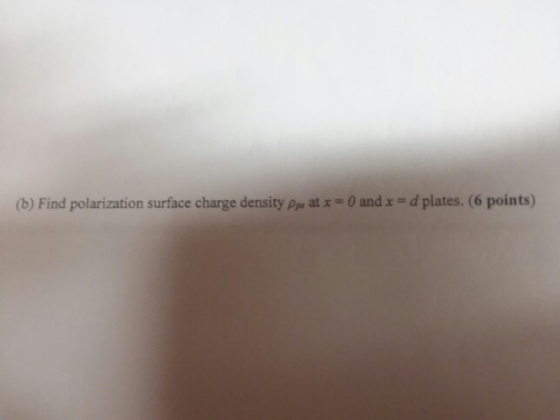
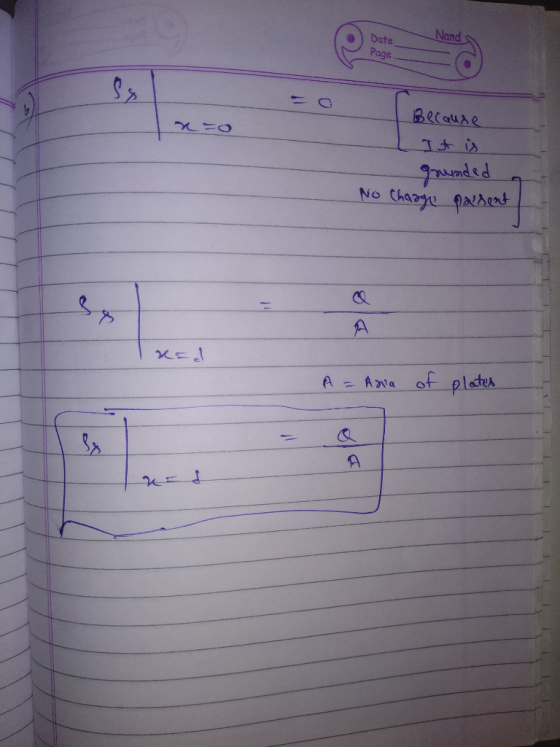
(b) Find polarization surface charge density Pr' at x = 0 and x = d plates. (6 points)
Homework Answers
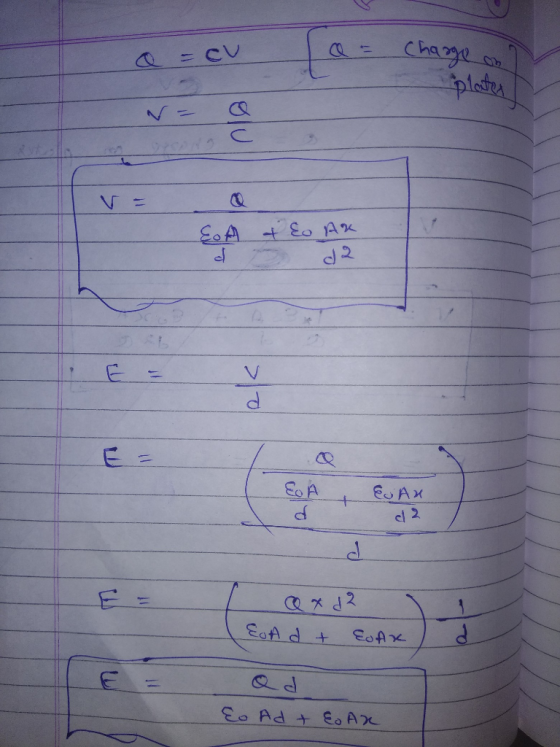
Summary - it is basic problem so I have shown step by step
solution for it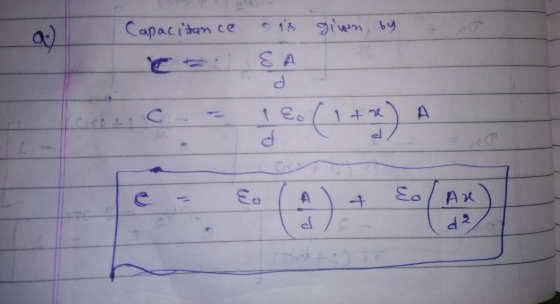
Add Answer to:
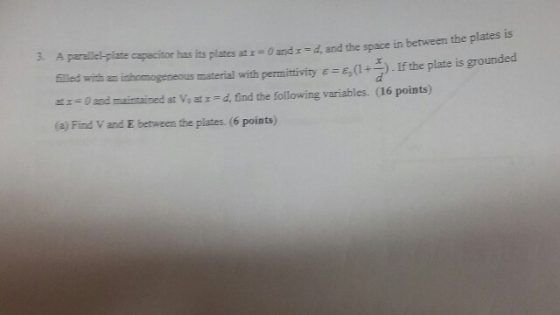
A paralle-plate capacitor has its plates at0 and x -, and the space in between the p filled won an inhomogeneous material with permittivity ε, l +. If the plate is grounded at r= 0 and maintai...
A parallel plate capacitor has plates of area A positioned at x=0 and x=b. The free...
A parallel plate capacitor has plates of area A positioned at x=0 and x=b. The free surface charge density on the plates is ±σfree with (+) charge at x=0. The space between the plates is filled with a non-uniform dielectric whose relative permittivity varies continuously between the plates as: ?? = ??^??,? > 1 ??? ? > 0. a) Derive expressions for the capacitance of the device. b) Derive expressions for the surface polarization charge density at each electrode and...
The space between the plates of a parallel-plate capacitor, shown below, is filled with two slabs of different dielectric materials
 Problem 5 The space between the plates of a parallel-plate capacitor, shown below, is filled with two slabs of different dielectric materials. The slab at the top has thickness 2d and a relative dielectric constant of er1 = 3 and the one at the bottom has thickness d and a relative dielectric constant of er2 = 2. The capacitor plates have surface area S. a. Assume a total charge of +Q on the top plate and -Q on the bottom plate. Find...
The space between a parallel plate capacitor of area "A," is filled with a dielectric whose...
 The space between a parallel plate capacitor of area "A," is filled with a dielectric whose permittivity varies linearly from e1 at one plate (y 0) to s2 at the other plate ( y=d). The plates have equal and opposite charge densities of magnitude o Write the equation for the permittivity as a function of position, i.e. s(y)= ? 3. AV Show the potential difference between the plates is 4. In Ae2-1 1 Determine the capacitance of the parallel plate...
7. A parallel plate capacitor has the space between plates filled with two slabs of dielectric...
 7. A parallel plate capacitor has the space between plates filled with two slabs of dielectric (same size) with constants ki and ką. Show that the capacitances are C = 289A K; $2 for the left one and C d *y+ C = 91 Ni+2 for the right one, where d is the total spacing between plates.
An air-filled parallel-plate capacitor has plate area A andplate separation d. The capacitor is connected...
An air-filled parallel-plate capacitor has plate area A and plate separation d. The capacitor is connected to a battery that creates a constant voltage V.A) Find the energy U_0 stored in the capacitor. Express your answer in terms of A, d, V, and ϵ_0.B) The capacitor is now disconnected from the battery, and the plates of the capacitor are then slowly pulled apart until the separation reaches 3d. Find the new energy U_1 of the capacitor after this process. Express...
Question 26 5 points Save Answer Consider a parallel-plate capacitor with empty space between its plates,...
 Question 26 5 points Save Answer Consider a parallel-plate capacitor with empty space between its plates, which are separated by a distance of 3 mm. If the charge on the positive plate is 8 uC, and the electrical potential energy stored in this capacitor is 12 nJ, what is the magnitude of the electric field in the region between the plates? A. 4 V/m B. 6 V/m C. 3 V/m D. 2 V/m E. 1 V/m
Answer: 13. A parallel-plate capacitor of cross-sectional area A and spacing between the plates d is...
 Answer:
13. A parallel-plate capacitor of cross-sectional area A and spacing between the plates d is filled with a dielectric material whose permittivity varies linearly from s at one plate to the other plate according to at s(2) d sz)=, +(e,-6) Find the capacitance. d (-A 13. CIn(2/6,) d In(e2/)
Answer:
13. A parallel-plate capacitor of cross-sectional area A and spacing between the plates d is filled with a dielectric material whose permittivity varies linearly from s at one plate to the other plate according to at s(2) d sz)=, +(e,-6) Find the capacitance. d (-A 13. CIn(2/6,) d In(e2/)
19. A parallel plate capacitor of separations distance d between the plates has the space between...
19. A parallel plate capacitor of separations distance d between the plates has the space between filled with two slabs of dielectrics, one with constant κ1 and the other with constant κ2. (a) Each slab has thickness d/2, show that the capacitance is given by ?=2ϵoAd( k1k2K1+k2) (b) The thickness of each slab is the same as the plate separation d, and each slab fills half of the volume between the plates. Show that the capacitance is ?=???(?1+?2)2?
A parallel plate capacitor is made using two rectangular plates with dimension 1.1mX0.6m containing two dielectrics between the conducting plates. One plate is at x-0m plane and the other plate i...
 A parallel plate capacitor is made using two rectangular plates with dimension 1.1mX0.6m containing two dielectrics between the conducting plates. One plate is at x-0m plane and the other plate is at x -3m plane. Let -2.0 for 0 < z < 0.5 m, and ε,2 = 4.5 for 0.5m< z < 0.6m. Draw this capacitor and find the capacitance.
A parallel plate capacitor is made using two rectangular plates with dimension 1.1mX0.6m containing two dielectrics between the conducting plates....
A parallel plate capacitor is made using two rectangular plates with dimension 1.1mX0.6m containing two dielectrics between the conducting plates. One plate is at x-0m plane and the other plate is at x -3m plane. Let -2.0 for 0 < z < 0.5 m, and ε,2 = 4.5 for 0.5m< z < 0.6m. Draw this capacitor and find the capacitance.
A parallel plate capacitor is made using two rectangular plates with dimension 1.1mX0.6m containing two dielectrics between the conducting plates....
An air-filled, parallel plate capacitor has plates of area A = .006 [m^2] and are separated...
 An air-filled, parallel plate capacitor has plates of area A = .006 [m^2] and are separated by a distance d = 3.5 [mm]. The plates have equal, but opposite charges of Q = .025 [mu C]. Find: sigma, surface charge density E, electric field V, voltage C, capacitance.
 The space between a parallel plate capacitor of area "A," is filled with a dielectric whose permittivity varies linearly from e1 at one plate (y 0) to s2 at the other plate ( y=d). The plates have equal and opposite charge densities of magnitude o Write the equation for the permittivity as a function of position, i.e. s(y)= ? 3. AV Show the potential difference between the plates is 4. In Ae2-1 1 Determine the capacitance of the parallel plate...
 7. A parallel plate capacitor has the space between plates filled with two slabs of dielectric (same size) with constants ki and ką. Show that the capacitances are C = 289A K; $2 for the left one and C d *y+ C = 91 Ni+2 for the right one, where d is the total spacing between plates.
 Question 26 5 points Save Answer Consider a parallel-plate capacitor with empty space between its plates, which are separated by a distance of 3 mm. If the charge on the positive plate is 8 uC, and the electrical potential energy stored in this capacitor is 12 nJ, what is the magnitude of the electric field in the region between the plates? A. 4 V/m B. 6 V/m C. 3 V/m D. 2 V/m E. 1 V/m
 Answer:
13. A parallel-plate capacitor of cross-sectional area A and spacing between the plates d is filled with a dielectric material whose permittivity varies linearly from s at one plate to the other plate according to at s(2) d sz)=, +(e,-6) Find the capacitance. d (-A 13. CIn(2/6,) d In(e2/)
Answer:
13. A parallel-plate capacitor of cross-sectional area A and spacing between the plates d is filled with a dielectric material whose permittivity varies linearly from s at one plate to the other plate according to at s(2) d sz)=, +(e,-6) Find the capacitance. d (-A 13. CIn(2/6,) d In(e2/)
 A parallel plate capacitor is made using two rectangular plates with dimension 1.1mX0.6m containing two dielectrics between the conducting plates. One plate is at x-0m plane and the other plate is at x -3m plane. Let -2.0 for 0 < z < 0.5 m, and ε,2 = 4.5 for 0.5m< z < 0.6m. Draw this capacitor and find the capacitance.
A parallel plate capacitor is made using two rectangular plates with dimension 1.1mX0.6m containing two dielectrics between the conducting plates....
A parallel plate capacitor is made using two rectangular plates with dimension 1.1mX0.6m containing two dielectrics between the conducting plates. One plate is at x-0m plane and the other plate is at x -3m plane. Let -2.0 for 0 < z < 0.5 m, and ε,2 = 4.5 for 0.5m< z < 0.6m. Draw this capacitor and find the capacitance.
A parallel plate capacitor is made using two rectangular plates with dimension 1.1mX0.6m containing two dielectrics between the conducting plates....
 An air-filled, parallel plate capacitor has plates of area A = .006 [m^2] and are separated by a distance d = 3.5 [mm]. The plates have equal, but opposite charges of Q = .025 [mu C]. Find: sigma, surface charge density E, electric field V, voltage C, capacitance.
Most questions answered within 3 hours.
-
Where is the error in this code sequence?
String s1 = "Hello";
String s2 = "ello";...
asked 10 months ago -
Financial data for Joel de Paris, Inc., for last year
follow:
Joel de Paris, Inc.
Balance...
asked 10 months ago -
Consider this reaction:
Al2(SO4)3 (aq)+ BaCl3
(aq) Al2Cl6 (aq)- +
3BaSO4(s) . What is the...
asked 10 months ago -
Suppose that Savneet is considering increasing her
recent random sample from 20 car rentals to 40...
asked 10 months ago -
Trucks arrive at an unloading terminal at an average rate of 120
per hour.
Trucks arrive...
asked 10 months ago -
Why are methanol and ethanol completely soluble in water while
octanol is not very little soluble....
asked 10 months ago -
A facilities manager at a university reads in a research report
that the mean amount of...
asked 10 months ago -
When the CuSO4 is rehydrated by adding water to the anhydrous
compound, is this an endothermic...
asked 10 months ago -
A ray of sunlight is passing from diamond into crown glass; the
angle of incidence is...
asked 10 months ago -
A block of mass 0.249 kg is placed on top of a light, vertical
spring of...
asked 10 months ago -
how do the kidneys compensate in the presences of acidosis
a) trigger hyperventilate
b) reserve acid...
asked 10 months ago -
Question 501 pts
The rental rate of capital to the firm increases. Which of the
following...
asked 10 months ago