You have an enzyme that uses two substrates in a random reaction (the order of binding of the substrates is random). And the reaction A + B à P is catalyzed by the enzyme bringtogetherase You have car...
You have an enzyme that uses two substrates in a random reaction (the order of binding of the substrates is random). And the reaction A + B à P is catalyzed by the enzyme bringtogetherase
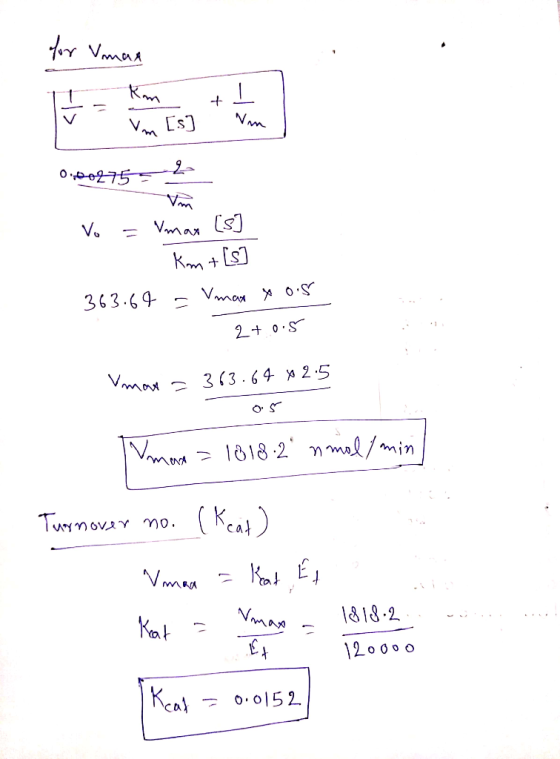
You have carried out five sets of reaction rates Keeping B constant and varying A and then increasing B and Vary ing A again until all combinations of A and B are measured. In the reaction you used 0.02 mg of bringtogetherase which is a 120,000 Dalton protein.
The set of data is as follows
[A] mM Vo nmoles per min [B] mM
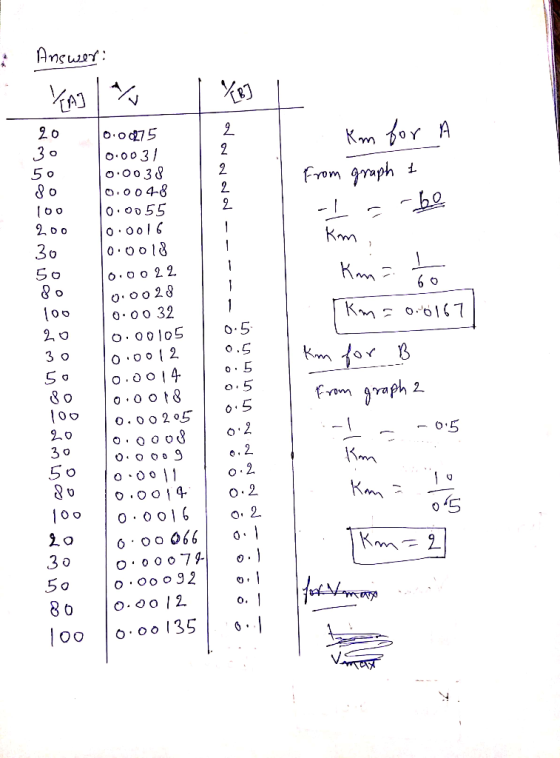
0.05 363.64 0.5
0.03333 322.58 0.5
0.0200 263.16 0.5
0.0125 208.33 0.5
0.01 181.81 0.5
0.0050 625 1
0.03333 555.56 1
0.0200 454.54 1
0.0125 357.14 1
0.01 312.5 1
0.05 952.38 2
0.03333 847.45 2
0.0200 714.29 2
0.0125 555.56 2
0.01 487.80 2
0.05 1250 5
0.03333 1111.11 5
0.0200 909.1 5
0.0125 724.64 5
0.01 632.91 5
0.05 1515.15 10
0.03333 1351.35 10
0.0200 1086.96 10
0.0125 847.46 10
0.01 740.74 10
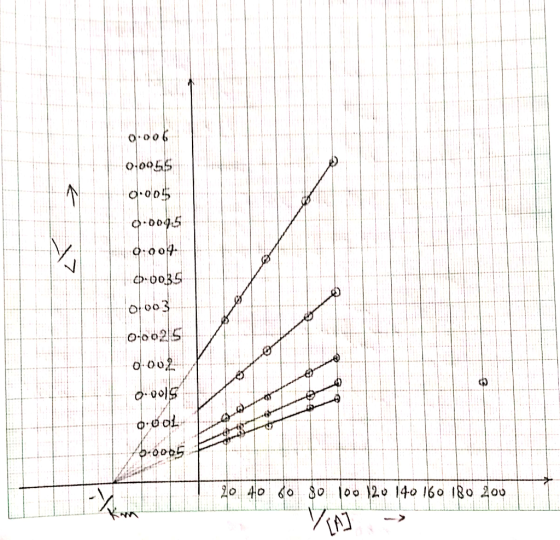
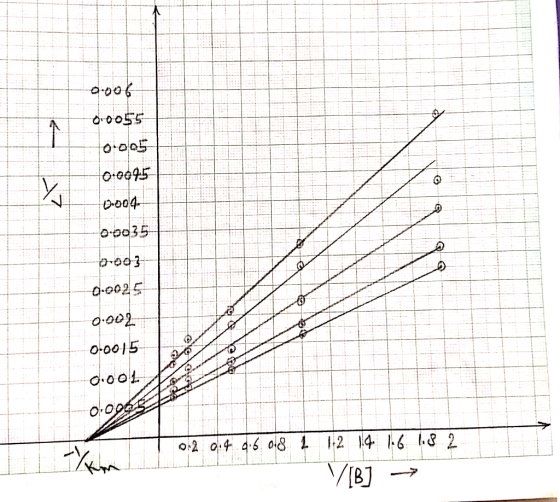
Determine the Km for A, the Km for B the Vmax and the turnover number for the enzyme.
To get the Vmax you need to replot the intercepts [Vmax apparent] vs the other substrate.
Homework Answers
Add Answer to:
You have an enzyme that uses two substrates in a random reaction (the order of binding of the substrates is random). And the reaction A + B à P is catalyzed by the enzyme bringtogetherase You have car...
You have an enzyme that uses two substrates in a random reaction (the order of binding...
You have an enzyme that uses two substrates in a random reaction (the order of binding of the substrates is random). And the reaction A + B à P is catalyzed by the enzyme bringtogetherase You have carried out five sets of reaction rates Keeping B constant and varying A and then increasing B and Vary ing A again until all combinations of A and B are measured. In the reaction you used 0.02 mg of bringtogetherase which is a...
After collecting enzyme kinetics data using substrates in mM and reaction velocities in mM/min, you make...
 After collecting enzyme kinetics data using substrates in mM and reaction velocities in mM/min, you make a Lineweaver-Burk plot. Your line of best fit has the equation: y = 0.00160 x + 0.00759. Calculate the Vmax of the enzyme using the equation: 1 KM 1 - = v Vmax [S] Vmax +
CHEM3250 Assignment-Enzyme Inhibition Consider the data below for an enzyme catalyzed reaction. T...
 CHEM3250 Assignment-Enzyme Inhibition Consider the data below for an enzyme catalyzed reaction. The rate of the reaction has been determined with and without an inhibitor. A total concentration of enzyme of 20 uM was used in the experiment. SHOW WORK AND UNITS!!! Without Inhibitor With Inhibitor [substrate] (mM)Rate of formation of te of formation of product product (mM/min) mM/min) 6.67 5.25 0.49 7.04 38.91 1.0 2.2 6.9 41.8 44.0 1.5 3.5 1 a) On the same graph, plot the data...
2. (20 points) An enzyme catalyzes the reaction A | B. The initial rate of the...
 2. (20 points) An enzyme catalyzes the reaction A | B. The initial rate of the reaction was measured as a function of the concentration of A. The following data were obtained: 0.08 |(A), micromolar V.,. nmoles/min 0.05 0.1 0.5 5 10 SO 100 500 1.000 5,000 10,000 20,000 2012 a) b) What is the of the enzyme for the substrate A? What is the K of the enzyme for the substrate A?
Suppose that the following data are obtained for an enzyme-catalyzed reaction: [S] (mM) V (mmol ml-1min-1)...
Suppose that the following data are obtained for an enzyme-catalyzed reaction: [S] (mM) V (mmol ml-1min-1) 0.1 3.33 0.2 5.00 0.5 7.14 0.8 8.0 1.0 8.33 2.0 9.09 a.) From a double-reciprocal plot of the data, determine Km and Vmax. b.) Assuming that the enzyme present in the system had a concentration of 10-6 M, calculate its turnover number.
An enzyme catalyzes the reaction A ® B. The initial rate of the reaction was measured...
An enzyme catalyzes the reaction A ® B. The initial rate of the reaction was measured as a function of the concentration of A (substrate). The following data were obtained: [10 pts.] [A], micromolar V0, nmoles/min 0.05 0.08 0.1 0.16 0.5 0.79 1 1.6 5 7.3 10 13 50 40 100 53 500 73 1,000 76 5,000 79 10,000 80 20,000 80 Answer the following questions: What...
included proper units when HLLL 1. The following kinetic data were generated for the enzyme SpB1,...
 included proper units when HLLL 1. The following kinetic data were generated for the enzyme SpB1, this enzyme has an unknown biological function. Using the information provided below answer questions la-le. All reactions had 0.1 mg/mL SPBT which based on amino acid sequence and gel filtration column chromatography has a molecular weight of 42,500 Daltons. S002- Substrate 1 Substrate 2 KM (MM) kcat (sec) glucose >50 <0.01 glucose NADP 4+1 0.5+0.07 glucose NAD 2718 2 +0.05 galactose >50 <0.01 galactose...
Rodrigo is an enzyme engineer. He wants to know which of four peptide substrates is bound...
 Rodrigo is an enzyme engineer. He wants to know which of four peptide substrates is bound most tightly by his engineered enzyme. Which value should he measure and pay attention to? Km KCAT Vo Both A and B kcat, [S], and [E]t Rodrigo's enzyme was assayed with three substrates (A, B, and C). The SAME enzyme concentration used was for each of the three reactions. The results of the three experiments are plotted as Lineweaver-Burke plots below. Considering what you...
5. The rate of a simple enzyme reaction is given by the standard Michaelis-Menten equation. a....
 5. The rate of a simple enzyme reaction is given by the standard Michaelis-Menten equation. a. If the Vmax = 354 umol/sec and the KM = 1.5 mm, at what substrate concentration is the rate is 177 umol/sec? b. Using MATLAB, plot a graph of rate versus substrate concentration using the enzyme parameters in part (a) for (S] = 0.5 to 30.0 mM in increments of 0.5 mM). Don't forget to include units on your axes. Include a copy of...
Enzyme kinetics: You recently joined a new research group, and in your first week you successfully...
Enzyme kinetics: You recently joined a new research group, and in your first week you successfully discover a new version of an enzyme called happyase, which you name happyase*, that catalyzes the chemical reaction: HAPPY ↔ SAD You begin devising ways to characterize the enzyme. (5 points total, 2 each for A, B and 1 for C). In the first experiment, with [Et] at 4 nM, you find that the Vmax is 1.6 mM/s. Based on this experiment, what is...
 After collecting enzyme kinetics data using substrates in mM and reaction velocities in mM/min, you make a Lineweaver-Burk plot. Your line of best fit has the equation: y = 0.00160 x + 0.00759. Calculate the Vmax of the enzyme using the equation: 1 KM 1 - = v Vmax [S] Vmax +
 CHEM3250 Assignment-Enzyme Inhibition Consider the data below for an enzyme catalyzed reaction. The rate of the reaction has been determined with and without an inhibitor. A total concentration of enzyme of 20 uM was used in the experiment. SHOW WORK AND UNITS!!! Without Inhibitor With Inhibitor [substrate] (mM)Rate of formation of te of formation of product product (mM/min) mM/min) 6.67 5.25 0.49 7.04 38.91 1.0 2.2 6.9 41.8 44.0 1.5 3.5 1 a) On the same graph, plot the data...
 2. (20 points) An enzyme catalyzes the reaction A | B. The initial rate of the reaction was measured as a function of the concentration of A. The following data were obtained: 0.08 |(A), micromolar V.,. nmoles/min 0.05 0.1 0.5 5 10 SO 100 500 1.000 5,000 10,000 20,000 2012 a) b) What is the of the enzyme for the substrate A? What is the K of the enzyme for the substrate A?
 included proper units when HLLL 1. The following kinetic data were generated for the enzyme SpB1, this enzyme has an unknown biological function. Using the information provided below answer questions la-le. All reactions had 0.1 mg/mL SPBT which based on amino acid sequence and gel filtration column chromatography has a molecular weight of 42,500 Daltons. S002- Substrate 1 Substrate 2 KM (MM) kcat (sec) glucose >50 <0.01 glucose NADP 4+1 0.5+0.07 glucose NAD 2718 2 +0.05 galactose >50 <0.01 galactose...
 Rodrigo is an enzyme engineer. He wants to know which of four peptide substrates is bound most tightly by his engineered enzyme. Which value should he measure and pay attention to? Km KCAT Vo Both A and B kcat, [S], and [E]t Rodrigo's enzyme was assayed with three substrates (A, B, and C). The SAME enzyme concentration used was for each of the three reactions. The results of the three experiments are plotted as Lineweaver-Burke plots below. Considering what you...
 5. The rate of a simple enzyme reaction is given by the standard Michaelis-Menten equation. a. If the Vmax = 354 umol/sec and the KM = 1.5 mm, at what substrate concentration is the rate is 177 umol/sec? b. Using MATLAB, plot a graph of rate versus substrate concentration using the enzyme parameters in part (a) for (S] = 0.5 to 30.0 mM in increments of 0.5 mM). Don't forget to include units on your axes. Include a copy of...
Most questions answered within 3 hours.
-
Where is the error in this code sequence?
String s1 = "Hello";
String s2 = "ello";...
asked 10 months ago -
Financial data for Joel de Paris, Inc., for last year
follow:
Joel de Paris, Inc.
Balance...
asked 10 months ago -
Consider this reaction:
Al2(SO4)3 (aq)+ BaCl3
(aq) Al2Cl6 (aq)- +
3BaSO4(s) . What is the...
asked 10 months ago -
Suppose that Savneet is considering increasing her
recent random sample from 20 car rentals to 40...
asked 10 months ago -
Trucks arrive at an unloading terminal at an average rate of 120
per hour.
Trucks arrive...
asked 10 months ago -
Why are methanol and ethanol completely soluble in water while
octanol is not very little soluble....
asked 10 months ago -
A facilities manager at a university reads in a research report
that the mean amount of...
asked 10 months ago -
When the CuSO4 is rehydrated by adding water to the anhydrous
compound, is this an endothermic...
asked 10 months ago -
A ray of sunlight is passing from diamond into crown glass; the
angle of incidence is...
asked 10 months ago -
A block of mass 0.249 kg is placed on top of a light, vertical
spring of...
asked 10 months ago -
how do the kidneys compensate in the presences of acidosis
a) trigger hyperventilate
b) reserve acid...
asked 10 months ago -
Question 501 pts
The rental rate of capital to the firm increases. Which of the
following...
asked 10 months ago