
Homework Answers
A. The reactions having 

B. The reactions
having 

C. Reaction (a)
have 


D. Reaction (c) and (d), having
greater 
E. Reaction (d) can force both reaction (b) and (e) to proceed together as a part of the biochemical pathway.
Add Answer to:
3. (a) S>P AG8.5 kcal/mol (b) S → P ΔG + 3.5 kcal/mol (c) S-P AG-3.5 kcal/mol (d) S-) P ΔG_-9.5 kcal/mol (e) S → P ΔG= +3.0 kcal/mol (f) S-) P ΔG__ 2.5 kcal/mol A. (5 points) Which reactions are s...
Consider these hypothetical chemical reactions: A⇌B,ΔG= 13.7 kJ/mol B⇌C,ΔG= -27.2 kJ/mol C⇌D,ΔG= 6.20 kJ/mol What is...
Consider these hypothetical chemical reactions: A⇌B,ΔG= 13.7 kJ/mol B⇌C,ΔG= -27.2 kJ/mol C⇌D,ΔG= 6.20 kJ/mol What is the free energy, ΔG, for the overall reaction, A⇌D? Express your answer with the appropriate units. ΔG = Firefly luciferase is the enzyme that allows fireflies to illuminate their abdomens. Because this light generation is an ATP-requiring reaction, firefly luciferase can be used to test for the presence of ATP. In this way, luciferase can test for the presence of life. The coupled reactions...
D ⇌ E + F DeltaG = -100 kCal mol-1; Activation energy = 5 kCal mol-1...
D ⇌ E + F DeltaG = -100 kCal mol-1; Activation energy = 5 kCal mol-1 A+ B ⇌ F DeltaG = +30 kCal mol-1; Activation energy = 10 kCal mol-1 We can couple these two reactions to carry out the overall reaction. What is the overall reaction and What is the change in free energy of the overall reaction?
31. If the AG values for reactions A and B are -100 kj/mol and -10 kJ/mol,...
 31. If the AG values for reactions A and B are -100 kj/mol and -10 kJ/mol, then: a. Reaction A proceeds at a faster rate than reaction B b. Reaction B proceeds at a faster rate than reaction A C. Only reaction A is spontaneous d. Only reaction B is spontaneous e. No conclusion can be deduced regarding the rates of the reactions 32. On the following plot, the estimated Vmax for the enzyme is: a. -0.02 b. 25 C....
Consider reaction 1, which is A + B C + D; reaction 2, which is C...
Consider reaction 1, which is A + B C + D; reaction 2, which is C + D E + F; and reaction 3, which is E + F G + H. ΔG°´ for the first reaction is -3.1 kcal/mol; ΔG°´ for the second reaction is 4.2 kcal/mol; and ΔG°´ for the third reaction is 0.7 kcal/mol. Given this information, what would be the value of ΔG°´ (in kcal/mol) for the following net reaction ( A + B G +...
view Use these responses for the next 3 questions: A.+AH B.-AH C.-AG D. +AG E. +AS F.-AS Which represents an exothe...
 view Use these responses for the next 3 questions: A.+AH B.-AH C.-AG D. +AG E. +AS F.-AS Which represents an exothermic chemical reaction? represents a spontaneous chemical reaction? 3. F Which would be used to represent a system with increasing order? 2. Which For the following three questions, use A. Xonly B.Y only C. both X and Y D. neither X nor Y 4. A In which of the following reactions does the entropy increase? reactionX: CaCOs(s) → CaO(s)+000 5.上...
Which of the following is true regarding ᐃG? (mark all that apply) Group of answer choices...
Which of the following is true regarding ᐃG? (mark all that apply) Group of answer choices When Keq is >> 1, ᐃG is large and negative When Keq is << 1, ᐃG is large and positive When Keq is << 1, ᐃG is small and positive When Keq is << 1, ᐃG is large and negative When Keq is >> 1, ᐃG is small and positive 2-Why is coupling of reactions an important biochemical mechanism to allow non-spontaneous reactions to...
6. Consider the reactions in which the elements A, B, C, and D are elements in...
 6. Consider the reactions in which the elements A, B, C, and D are elements in their most stable states: a. Draw out a thermodynamic cycle to describe the formation of E. b. Using the following table of ΔG° values, what is the value of Δ(G" for the formation of E? AG (kJ/mol) reaction 100 120 40
1.0 s; (b) 2.5 s; (c) 3.5 s; (d) 4.5 s; (e) 5.0s; 15 10F 5...
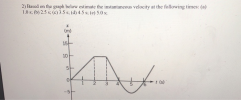 1.0 s; (b) 2.5 s; (c) 3.5 s; (d) 4.5 s; (e) 5.0s; 15 10F 5 0 5 56t(s)
25 20 15 B Free Energy (kcal/mol) 10 tions A 5 e 0 Reaction progress Use...
 25 20 15 B Free Energy (kcal/mol) 10 tions A 5 e 0 Reaction progress Use the reaction energy diagram above to answer the following questions. Calculate the activation energy, AG #, for the step B to C. Include algebraic sign.[ kcal/mol Calculate the overall energy change, AGO, for the process A to B. Include algebraic sign. kcal/mol Which step is faster, (a) C to B or (b) B to A?
Consider the Gibbs energies at 25 ∘C. SubstanceSubstance ΔG∘f (kJ⋅mol−1)ΔGf∘ (kJ·mol−1) Ag+(aq)Ag+(aq) 77.177.1 Cl−(aq)Cl−(aq) −131.2−131.2 AgCl(s)AgCl(s)...
Consider the Gibbs energies at 25 ∘C. SubstanceSubstance ΔG∘f (kJ⋅mol−1)ΔGf∘ (kJ·mol−1) Ag+(aq)Ag+(aq) 77.177.1 Cl−(aq)Cl−(aq) −131.2−131.2 AgCl(s)AgCl(s) −109.8−109.8 Br−(aq)Br−(aq) −104.0−104.0 AgBr(s)AgBr(s) −96.9−96.9 (a) Calculate ΔG∘rxn for the dissolution of AgCl(s)AgCl(s). kJ⋅mol−1 (b) Calculate the solubility-product constant of AgCl. K= (c) Calculate ΔG∘rxnΔGrxn∘ for the dissolution of AgBr(s)AgBr(s). kJ⋅mol−1kJ⋅mol−1 (d) Calculate the solubility-product constant of AgBr. K=K=
 31. If the AG values for reactions A and B are -100 kj/mol and -10 kJ/mol, then: a. Reaction A proceeds at a faster rate than reaction B b. Reaction B proceeds at a faster rate than reaction A C. Only reaction A is spontaneous d. Only reaction B is spontaneous e. No conclusion can be deduced regarding the rates of the reactions 32. On the following plot, the estimated Vmax for the enzyme is: a. -0.02 b. 25 C....
 view Use these responses for the next 3 questions: A.+AH B.-AH C.-AG D. +AG E. +AS F.-AS Which represents an exothermic chemical reaction? represents a spontaneous chemical reaction? 3. F Which would be used to represent a system with increasing order? 2. Which For the following three questions, use A. Xonly B.Y only C. both X and Y D. neither X nor Y 4. A In which of the following reactions does the entropy increase? reactionX: CaCOs(s) → CaO(s)+000 5.上...
 6. Consider the reactions in which the elements A, B, C, and D are elements in their most stable states: a. Draw out a thermodynamic cycle to describe the formation of E. b. Using the following table of ΔG° values, what is the value of Δ(G" for the formation of E? AG (kJ/mol) reaction 100 120 40
 1.0 s; (b) 2.5 s; (c) 3.5 s; (d) 4.5 s; (e) 5.0s; 15 10F 5 0 5 56t(s)
 25 20 15 B Free Energy (kcal/mol) 10 tions A 5 e 0 Reaction progress Use the reaction energy diagram above to answer the following questions. Calculate the activation energy, AG #, for the step B to C. Include algebraic sign.[ kcal/mol Calculate the overall energy change, AGO, for the process A to B. Include algebraic sign. kcal/mol Which step is faster, (a) C to B or (b) B to A?
Most questions answered within 3 hours.
-
Where is the error in this code sequence?
String s1 = "Hello";
String s2 = "ello";...
asked 11 months ago -
Financial data for Joel de Paris, Inc., for last year
follow:
Joel de Paris, Inc.
Balance...
asked 11 months ago -
Consider this reaction:
Al2(SO4)3 (aq)+ BaCl3
(aq) Al2Cl6 (aq)- +
3BaSO4(s) . What is the...
asked 11 months ago -
Suppose that Savneet is considering increasing her
recent random sample from 20 car rentals to 40...
asked 11 months ago -
Trucks arrive at an unloading terminal at an average rate of 120
per hour.
Trucks arrive...
asked 11 months ago -
Why are methanol and ethanol completely soluble in water while
octanol is not very little soluble....
asked 11 months ago -
A facilities manager at a university reads in a research report
that the mean amount of...
asked 11 months ago -
When the CuSO4 is rehydrated by adding water to the anhydrous
compound, is this an endothermic...
asked 11 months ago -
A ray of sunlight is passing from diamond into crown glass; the
angle of incidence is...
asked 11 months ago -
A block of mass 0.249 kg is placed on top of a light, vertical
spring of...
asked 11 months ago -
how do the kidneys compensate in the presences of acidosis
a) trigger hyperventilate
b) reserve acid...
asked 11 months ago -
Question 501 pts
The rental rate of capital to the firm increases. Which of the
following...
asked 11 months ago