I just need help with question 4 only:
Homework Answers


Add Answer to:
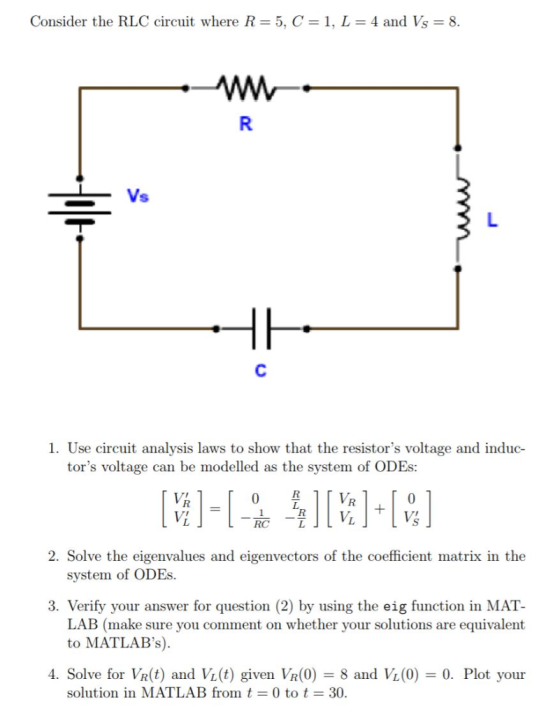
I just need help with question 4 only: Consider the RLC circuit where R = 5, C = 1, L = 4 and Vs = 8. 1. Use circuit analysis laws to show that the resistor's voltage and induc- tor's voltage...
Consider the RLC circuit where R = 5, C = 1, L = 4 and V = 8. 1. Use circuit analysis laws to show that the resistor's voltage and induc- tor's voltage can be modelled as the system of ODEs...
 Consider the RLC circuit where R = 5, C = 1, L = 4 and V = 8. 1. Use circuit analysis laws to show that the resistor's voltage and induc- tor's voltage can be modelled as the system of ODEs し」L 2. Solve the eigenvalues and eigenvectors of the coefficient matrix in the system of ODEs. 3. Verify your answer for question (2) by using the eig function in MAT- LAB (make sure you comment on whether your solutions...
For MATLAB users. Can you please type the answers for the MATLAB sections. Consider the RLC circuit where R - 5, C- 1, L- 4 and Vs - 8 1. Use circuit analysis laws to show that the resistor's vol...
 For MATLAB users. Can you please type the answers for the MATLAB
sections.
Consider the RLC circuit where R - 5, C- 1, L- 4 and Vs - 8 1. Use circuit analysis laws to show that the resistor's voltage and induc- tor's voltage can be modelled as the system of ODEs Vi VL RC 2. Solve the eigenvalues and eigenvectors of the coefficient matrix in the system of ODEs. 3. Verify your answer for question (2) by using the...
For MATLAB users. Can you please type the answers for the MATLAB
sections.
Consider the RLC circuit where R - 5, C- 1, L- 4 and Vs - 8 1. Use circuit analysis laws to show that the resistor's voltage and induc- tor's voltage can be modelled as the system of ODEs Vi VL RC 2. Solve the eigenvalues and eigenvectors of the coefficient matrix in the system of ODEs. 3. Verify your answer for question (2) by using the...
ONLY NEED SOLUTION TO QUESTION 4 PLEASE, THANK YOU (PLEASE MAKE SURE TO PLOT THE SOLUTION IN MATLAB) Part A (Based off week 7 Workshop content) Consider the RLC circuit where R = 5, C = 1, L = 4 and...
 ONLY NEED SOLUTION TO QUESTION 4 PLEASE, THANK
YOU
(PLEASE MAKE SURE TO PLOT THE SOLUTION IN
MATLAB)
Part A (Based off week 7 Workshop content) Consider the RLC circuit where R = 5, C = 1, L = 4 and Vs = 8. 1. Use circuit analysis laws to show that the resistor's voltage and induc tor's voltage can be modelled as the system of ODEs: L RC i the system of ODEs 3. Verify your answer for question...
ONLY NEED SOLUTION TO QUESTION 4 PLEASE, THANK
YOU
(PLEASE MAKE SURE TO PLOT THE SOLUTION IN
MATLAB)
Part A (Based off week 7 Workshop content) Consider the RLC circuit where R = 5, C = 1, L = 4 and Vs = 8. 1. Use circuit analysis laws to show that the resistor's voltage and induc tor's voltage can be modelled as the system of ODEs: L RC i the system of ODEs 3. Verify your answer for question...
Part A (Based off week 7 Workshop content) Consider the RLC circuit where R = 5,...
Part A (Based off week 7 Workshop content) Consider the RLC circuit where R = 5, C = 1, L = 4 and VS = 8. 1. Use circuit analysis laws to show that the resistor’s voltage and inductor’s voltage can be modelled as the system of ODEs: V 0 R V 0 L = 0 R L − 1 RC − R L VR VL + 0 V 0 S 2. Solve the eigenvalues and eigenvectors of the coefficient...
3. (40 pts total) Eigenvalues of Systems of Equations Application: Series RLC Circuit, Natural, or Transient...
 3. (40 pts total) Eigenvalues of Systems of Equations Application: Series RLC Circuit, Natural, or Transient Response (Remember EE280, maybe not) M SR v(t) Consider a series RLC circuit, with a resistor R, inductor L, and capacitor C in series. The same current i(t) flows through R, L, and C. The switch S1 is initially closed and S2 is initially open allowing the circuit to fully charge. At t=0 the switch S1 opens and S2 closes as shown above. Solving...
Consider the following circuit , where the voltage v(t) is imposed for t 2 0, R 4 Ω, L-1H and C 1/4F. The initial in...
 Consider the following circuit , where the voltage v(t) is imposed for t 2 0, R 4 Ω, L-1H and C 1/4F. The initial initial current going through the inductor is i(0-) -0 A and its first derivative is i(0)-1A/s. We are interested in the evolution of the current i(t). ve(t) i(t) The corresponding input-output relationship is i(r)dr Ug(t) + Li'(t) + Ri(t)-r(t) with t e(t)-ve(0) + (0) Which physical quantity is the input of the system? Explain. (ü) Which...
PROBLEM 5. TUNING A CIRCUIT: PRACTICAL RESONANCE. Consider a forced RLC circuit with L-1 (H), R-1...
 PROBLEM 5. TUNING A CIRCUIT: PRACTICAL RESONANCE. Consider a forced RLC circuit with L-1 (H), R-10 (12) and C 丽0 (f). Suppose an alternating current supplies a electromotive force Et)100 coswt. The equation modeling the charge Q(t) on the capacitor is 650 Q"(t) 10Q650Q(t) 100 coswt. a. Is the damping over-, under- or critical? Find the form of the general solution. Identify the transient and steady-state parts of the solution. b. Find the amplitude C(w) of the steady-state piece (here...
 Consider the RLC circuit where R = 5, C = 1, L = 4 and V = 8. 1. Use circuit analysis laws to show that the resistor's voltage and induc- tor's voltage can be modelled as the system of ODEs し」L 2. Solve the eigenvalues and eigenvectors of the coefficient matrix in the system of ODEs. 3. Verify your answer for question (2) by using the eig function in MAT- LAB (make sure you comment on whether your solutions...
 For MATLAB users. Can you please type the answers for the MATLAB
sections.
Consider the RLC circuit where R - 5, C- 1, L- 4 and Vs - 8 1. Use circuit analysis laws to show that the resistor's voltage and induc- tor's voltage can be modelled as the system of ODEs Vi VL RC 2. Solve the eigenvalues and eigenvectors of the coefficient matrix in the system of ODEs. 3. Verify your answer for question (2) by using the...
For MATLAB users. Can you please type the answers for the MATLAB
sections.
Consider the RLC circuit where R - 5, C- 1, L- 4 and Vs - 8 1. Use circuit analysis laws to show that the resistor's voltage and induc- tor's voltage can be modelled as the system of ODEs Vi VL RC 2. Solve the eigenvalues and eigenvectors of the coefficient matrix in the system of ODEs. 3. Verify your answer for question (2) by using the...
 ONLY NEED SOLUTION TO QUESTION 4 PLEASE, THANK
YOU
(PLEASE MAKE SURE TO PLOT THE SOLUTION IN
MATLAB)
Part A (Based off week 7 Workshop content) Consider the RLC circuit where R = 5, C = 1, L = 4 and Vs = 8. 1. Use circuit analysis laws to show that the resistor's voltage and induc tor's voltage can be modelled as the system of ODEs: L RC i the system of ODEs 3. Verify your answer for question...
ONLY NEED SOLUTION TO QUESTION 4 PLEASE, THANK
YOU
(PLEASE MAKE SURE TO PLOT THE SOLUTION IN
MATLAB)
Part A (Based off week 7 Workshop content) Consider the RLC circuit where R = 5, C = 1, L = 4 and Vs = 8. 1. Use circuit analysis laws to show that the resistor's voltage and induc tor's voltage can be modelled as the system of ODEs: L RC i the system of ODEs 3. Verify your answer for question...
 3. (40 pts total) Eigenvalues of Systems of Equations Application: Series RLC Circuit, Natural, or Transient Response (Remember EE280, maybe not) M SR v(t) Consider a series RLC circuit, with a resistor R, inductor L, and capacitor C in series. The same current i(t) flows through R, L, and C. The switch S1 is initially closed and S2 is initially open allowing the circuit to fully charge. At t=0 the switch S1 opens and S2 closes as shown above. Solving...
 Consider the following circuit , where the voltage v(t) is imposed for t 2 0, R 4 Ω, L-1H and C 1/4F. The initial initial current going through the inductor is i(0-) -0 A and its first derivative is i(0)-1A/s. We are interested in the evolution of the current i(t). ve(t) i(t) The corresponding input-output relationship is i(r)dr Ug(t) + Li'(t) + Ri(t)-r(t) with t e(t)-ve(0) + (0) Which physical quantity is the input of the system? Explain. (ü) Which...
 PROBLEM 5. TUNING A CIRCUIT: PRACTICAL RESONANCE. Consider a forced RLC circuit with L-1 (H), R-10 (12) and C 丽0 (f). Suppose an alternating current supplies a electromotive force Et)100 coswt. The equation modeling the charge Q(t) on the capacitor is 650 Q"(t) 10Q650Q(t) 100 coswt. a. Is the damping over-, under- or critical? Find the form of the general solution. Identify the transient and steady-state parts of the solution. b. Find the amplitude C(w) of the steady-state piece (here...
Most questions answered within 3 hours.
-
Where is the error in this code sequence?
String s1 = "Hello";
String s2 = "ello";...
asked 11 months ago -
Financial data for Joel de Paris, Inc., for last year
follow:
Joel de Paris, Inc.
Balance...
asked 11 months ago -
Consider this reaction:
Al2(SO4)3 (aq)+ BaCl3
(aq) Al2Cl6 (aq)- +
3BaSO4(s) . What is the...
asked 11 months ago -
Suppose that Savneet is considering increasing her
recent random sample from 20 car rentals to 40...
asked 11 months ago -
Trucks arrive at an unloading terminal at an average rate of 120
per hour.
Trucks arrive...
asked 11 months ago -
Why are methanol and ethanol completely soluble in water while
octanol is not very little soluble....
asked 11 months ago -
A facilities manager at a university reads in a research report
that the mean amount of...
asked 11 months ago -
When the CuSO4 is rehydrated by adding water to the anhydrous
compound, is this an endothermic...
asked 11 months ago -
A ray of sunlight is passing from diamond into crown glass; the
angle of incidence is...
asked 11 months ago -
A block of mass 0.249 kg is placed on top of a light, vertical
spring of...
asked 11 months ago -
how do the kidneys compensate in the presences of acidosis
a) trigger hyperventilate
b) reserve acid...
asked 11 months ago -
Question 501 pts
The rental rate of capital to the firm increases. Which of the
following...
asked 11 months ago