List the major steps in aerobic degradation of benzene to CO2 and water.
List the major steps in aerobic degradation of benzene to CO2 and water.
Homework Answers

Add Answer to:
List the major steps in aerobic degradation of benzene to CO2 and water.
Aerobic degradation of an organic compound by a mixed culture of organisms in waste water can...
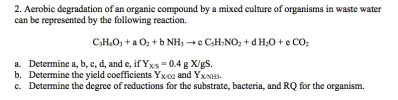 Aerobic degradation of an organic compound by a mixed culture of organisms in waste water can be represented by the following reaction. C_3 H_6 O_3 + a O_2 + b NH_3 rightarrow c C_5H_7NO_2 + d H_2O + e CO_2 a. Determine a, b, c, d, and e, if Y_X/S = 0.4 g X/gS. b. Determine the yield coefficients Y_X/O2 and Y_X/NH3. c. Determine the degree of reductions for the substrate, bacteria, and RQ for the organism.
Provide degradation stoichiometry of aerobic and anaerobic reactions for the bioremediation of Toluene? Provide the reaction...
 Provide degradation stoichiometry of aerobic and anaerobic
reactions for the bioremediation of Toluene? Provide the reaction
stoichiometry for aerobic and anaerobic degradation separately.
After each reactions, provide mass of compound and elements for
both side of reactions. In the context of stoichiometry under room
temperature,
How many grams of O2 is needed to biodegrade 1 gm of
Toluene?
How many grams of NO3- is needed to biodegrade 1 gm of
Toluene?
How many grams of Fe3+ is needed to biodegrade...
Provide degradation stoichiometry of aerobic and anaerobic
reactions for the bioremediation of Toluene? Provide the reaction
stoichiometry for aerobic and anaerobic degradation separately.
After each reactions, provide mass of compound and elements for
both side of reactions. In the context of stoichiometry under room
temperature,
How many grams of O2 is needed to biodegrade 1 gm of
Toluene?
How many grams of NO3- is needed to biodegrade 1 gm of
Toluene?
How many grams of Fe3+ is needed to biodegrade...
QUESTION 5 Aerobic degradation of benzoic acid by a mixed culture of microorganisms can be represented...
QUESTION 5 Aerobic degradation of benzoic acid by a mixed culture of microorganisms can be represented by the following reaction: C6H5COOH + a O2 + b NH3 → c C5H7NO2 + d H2O + e CO2 where C6H5COOH is the substrate, and C5H7NO2 is the bacteria. Determine a, b, c, d and e, knowing that 0.9 moles of CO2 are produced per mole of O2 consumed. MCQ Options: a = - 4.5 b = 2.4 c = 2.4 d = - 1.8 e = -...
Stage 2: Monosaccharide Degradation to Acetyl CoA (Glycolysis + Pyruvate Conversion) Pyruvate: Aerobic and Anaerobic Conversion...
 Stage 2: Monosaccharide Degradation to Acetyl CoA (Glycolysis + Pyruvate Conversion) Pyruvate: Aerobic and Anaerobic Conversion 1. Define what it means for a biochemical reaction to be aerobic vs. anaerobic. List what pyruvate will be converted to under each set of conditions. Conditions Definition Pyruvate Conversion Product aerobic anaerobic 2. In the space below, write the coupled reaction for the aerobic conversion of pyruvate, labeling the name of each reactant and product in the reaction. 3. Even though oxygen is...
Combustion analysis: Combustion of a 5.50 g sample of benzene produces 18.59 g of CO2 and...
Combustion analysis: Combustion of a 5.50 g sample of benzene produces 18.59 g of CO2 and 3.81 g of water. Determine the empirical formula and the molecular formula of benzene, given that its molar mass is approximately 78 g/mol.
how did anaerobic and aerobic yeast cultures differ in rate of co2 and ethanol production? do...
how did anaerobic and aerobic yeast cultures differ in rate of co2 and ethanol production? do aerobic yeast produce some ethanol?
List and give a short explanation of the major steps involved in the closing process.
List and give a short explanation of the major steps involved in the closing process.
Benzene can be converted to 2,4,6-tribromoaniline in three reaction steps and two intermediate compounds. Select the...
 Benzene can be converted to 2,4,6-tribromoaniline in three
reaction steps and two intermediate compounds. Select the
appropriate reagent from the drop-down list for each step in this
overall synthesis.
Benzene can be converted to 2,4,6-tribromoaniline in three reaction steps and two intermediate compounds. Select the appropriate reagent from the drop-down list for each step in this overall synthesis.
Benzene can be converted to 2,4,6-tribromoaniline in three
reaction steps and two intermediate compounds. Select the
appropriate reagent from the drop-down list for each step in this
overall synthesis.
Benzene can be converted to 2,4,6-tribromoaniline in three reaction steps and two intermediate compounds. Select the appropriate reagent from the drop-down list for each step in this overall synthesis.
Candida utilis (CH1.73O0.43N0.24) converts glucose (C6H12O6)to CO2 and H2O in aerobic culture with ammonia (NH3) as...
Candida utilis (CH1.73O0.43N0.24) converts glucose (C6H12O6)to CO2 and H2O in aerobic culture with ammonia (NH3) as nitrogen source. Write down the general reaction for the aerobic growth. Calculate the degree of reduction for substrate Calculate the degree of reduction for biomass.
due to 1) You are in charge of a remediation strategy that requires aerobic, microbial respiration...
 due to
1) You are in charge of a remediation strategy that requires aerobic, microbial respiration to degrade the compound ethanol in groundwater. There is 840mg/L ethanol in the groundwater; how much oxygen (total, steady state concentration in mg/L) will you need to completely oxidize the ethanol to CO2? Can you accomplish this using only atmospheric oxygen (21 % v/v) at 1 atm total pressure (Pro) and 25°C? If you cannot, what options do you have for increasing oxygen content...
due to
1) You are in charge of a remediation strategy that requires aerobic, microbial respiration to degrade the compound ethanol in groundwater. There is 840mg/L ethanol in the groundwater; how much oxygen (total, steady state concentration in mg/L) will you need to completely oxidize the ethanol to CO2? Can you accomplish this using only atmospheric oxygen (21 % v/v) at 1 atm total pressure (Pro) and 25°C? If you cannot, what options do you have for increasing oxygen content...
 Aerobic degradation of an organic compound by a mixed culture of organisms in waste water can be represented by the following reaction. C_3 H_6 O_3 + a O_2 + b NH_3 rightarrow c C_5H_7NO_2 + d H_2O + e CO_2 a. Determine a, b, c, d, and e, if Y_X/S = 0.4 g X/gS. b. Determine the yield coefficients Y_X/O2 and Y_X/NH3. c. Determine the degree of reductions for the substrate, bacteria, and RQ for the organism.
 Provide degradation stoichiometry of aerobic and anaerobic
reactions for the bioremediation of Toluene? Provide the reaction
stoichiometry for aerobic and anaerobic degradation separately.
After each reactions, provide mass of compound and elements for
both side of reactions. In the context of stoichiometry under room
temperature,
How many grams of O2 is needed to biodegrade 1 gm of
Toluene?
How many grams of NO3- is needed to biodegrade 1 gm of
Toluene?
How many grams of Fe3+ is needed to biodegrade...
Provide degradation stoichiometry of aerobic and anaerobic
reactions for the bioremediation of Toluene? Provide the reaction
stoichiometry for aerobic and anaerobic degradation separately.
After each reactions, provide mass of compound and elements for
both side of reactions. In the context of stoichiometry under room
temperature,
How many grams of O2 is needed to biodegrade 1 gm of
Toluene?
How many grams of NO3- is needed to biodegrade 1 gm of
Toluene?
How many grams of Fe3+ is needed to biodegrade...
 Stage 2: Monosaccharide Degradation to Acetyl CoA (Glycolysis + Pyruvate Conversion) Pyruvate: Aerobic and Anaerobic Conversion 1. Define what it means for a biochemical reaction to be aerobic vs. anaerobic. List what pyruvate will be converted to under each set of conditions. Conditions Definition Pyruvate Conversion Product aerobic anaerobic 2. In the space below, write the coupled reaction for the aerobic conversion of pyruvate, labeling the name of each reactant and product in the reaction. 3. Even though oxygen is...
 Benzene can be converted to 2,4,6-tribromoaniline in three
reaction steps and two intermediate compounds. Select the
appropriate reagent from the drop-down list for each step in this
overall synthesis.
Benzene can be converted to 2,4,6-tribromoaniline in three reaction steps and two intermediate compounds. Select the appropriate reagent from the drop-down list for each step in this overall synthesis.
Benzene can be converted to 2,4,6-tribromoaniline in three
reaction steps and two intermediate compounds. Select the
appropriate reagent from the drop-down list for each step in this
overall synthesis.
Benzene can be converted to 2,4,6-tribromoaniline in three reaction steps and two intermediate compounds. Select the appropriate reagent from the drop-down list for each step in this overall synthesis.
 due to
1) You are in charge of a remediation strategy that requires aerobic, microbial respiration to degrade the compound ethanol in groundwater. There is 840mg/L ethanol in the groundwater; how much oxygen (total, steady state concentration in mg/L) will you need to completely oxidize the ethanol to CO2? Can you accomplish this using only atmospheric oxygen (21 % v/v) at 1 atm total pressure (Pro) and 25°C? If you cannot, what options do you have for increasing oxygen content...
due to
1) You are in charge of a remediation strategy that requires aerobic, microbial respiration to degrade the compound ethanol in groundwater. There is 840mg/L ethanol in the groundwater; how much oxygen (total, steady state concentration in mg/L) will you need to completely oxidize the ethanol to CO2? Can you accomplish this using only atmospheric oxygen (21 % v/v) at 1 atm total pressure (Pro) and 25°C? If you cannot, what options do you have for increasing oxygen content...
Most questions answered within 3 hours.
-
Where is the error in this code sequence?
String s1 = "Hello";
String s2 = "ello";...
asked 11 months ago -
Financial data for Joel de Paris, Inc., for last year
follow:
Joel de Paris, Inc.
Balance...
asked 11 months ago -
Consider this reaction:
Al2(SO4)3 (aq)+ BaCl3
(aq) Al2Cl6 (aq)- +
3BaSO4(s) . What is the...
asked 11 months ago -
Suppose that Savneet is considering increasing her
recent random sample from 20 car rentals to 40...
asked 11 months ago -
Trucks arrive at an unloading terminal at an average rate of 120
per hour.
Trucks arrive...
asked 11 months ago -
Why are methanol and ethanol completely soluble in water while
octanol is not very little soluble....
asked 11 months ago -
A facilities manager at a university reads in a research report
that the mean amount of...
asked 11 months ago -
When the CuSO4 is rehydrated by adding water to the anhydrous
compound, is this an endothermic...
asked 11 months ago -
A ray of sunlight is passing from diamond into crown glass; the
angle of incidence is...
asked 11 months ago -
A block of mass 0.249 kg is placed on top of a light, vertical
spring of...
asked 11 months ago -
how do the kidneys compensate in the presences of acidosis
a) trigger hyperventilate
b) reserve acid...
asked 11 months ago -
Question 501 pts
The rental rate of capital to the firm increases. Which of the
following...
asked 11 months ago