
Homework Answers

Add Answer to:
Smar On M (2) Find the o ut put voltage vo for the following circuit: Excha 100 kΩ 20 k2 10V ( 0 Smar On M (2) Find the o ut put voltage vo for the following circuit: Excha 100 kΩ 20 k2 10V ( 0
20 kΩ 180 kΩ Va 18 k2 30 kΩ 0) 20 kΩ Wd 20 kΩ For...
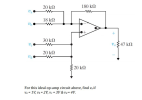 20 kΩ 180 kΩ Va 18 k2 30 kΩ 0) 20 kΩ Wd 20 kΩ For this ideal op-amp circuit above, find vo if
For the circuit below, voltage vo is: 20 k2 ww 2 k2 + 3 kS2 1...
 For the circuit below, voltage vo is: 20 k2 ww 2 k2 + 3 kS2 1 V Da-1.5 b.0.1 OC-10 Od.10 For the circuit in Fig. 5.40, current iy is: 20 k2 wW 2 k2 1 V 3 kQ a. 1 mA b.500 HA C. 200 HA Od.0.1 HA OIO+O
9. In this ideal op amp circuit: a) Find the output voltage vo in terms of...
 9. In this ideal op amp circuit: a) Find the output voltage vo in terms of the input voltage v. b) The op amp is supplied by +10v and -10v. If0 V15v, find the range of the output voltage vo. (15 pts.) 10 k2 5 kQ 10V -10V ng 2.5v(+ 0)
Good morning, I need help with the following, they all relate to OP Amps. Thanks in advance. 2 value 10.00 points Problem 05.010 An op amp voltage divider Find the voltage gain vo/vs of the circ...
 Good morning, I need help with the following, they all relate to
OP Amps. Thanks in advance.
2 value 10.00 points Problem 05.010 An op amp voltage divider Find the voltage gain vo/vs of the circuit given below, where R1-18 kΩ and R2-14 k 2. 20 kΩ R1 1% R2 The voltage gain vo/vs of the circuit is Hints Referene eBook & Resources Hint#1 Check my work 3. 1000 points value Problem 05.025-Voltage follower Calculate the output voltage vo in...
Good morning, I need help with the following, they all relate to
OP Amps. Thanks in advance.
2 value 10.00 points Problem 05.010 An op amp voltage divider Find the voltage gain vo/vs of the circuit given below, where R1-18 kΩ and R2-14 k 2. 20 kΩ R1 1% R2 The voltage gain vo/vs of the circuit is Hints Referene eBook & Resources Hint#1 Check my work 3. 1000 points value Problem 05.025-Voltage follower Calculate the output voltage vo in...
ReviewI Constants Part A RI-3 kΩ and R2-3 kΩ in the circuit shown. Find the (unitless)...
 ReviewI Constants Part A RI-3 kΩ and R2-3 kΩ in the circuit shown. Find the (unitless) voltage gain Vo/Vi for this circuit 2 k2 Express your answer to three significant figures. 0 R2 Submit Request Answer
Assuming an ideal op-amp in the following circuit, find output voltage, Vo if R1= 2 K2,...
 Assuming an ideal op-amp in the following circuit, find output voltage, Vo if R1= 2 K2, R2=8 K2, R3=5.1 K2, R4=6 KN, R5=14 KN, R6=4.2 KS, RL=10.3 KS, V1=1V, 12=0.5 mA and V3=3.2 V. R6 R1 R5 Vo w + * RL + 12 R2 V1 R3 R4 V3 Answer: OV Using the above circuit, but consider the following component values: R1= 2 K12 R2=8 K2, R3=2.9 K2, R4=6 KI2, R5=10.8 K92, R6=15 KO, RL=10 K2, V1=1V, 12=0.5mA and V3=2V....
(20 pts) Use Thevenin's theorem to find Vo in the circuit. 6 V 2 k2 2 I Ik() 1 k12 0 (20 pts) Use Thevenin&...
 (20 pts) Use Thevenin's theorem to find Vo in the circuit. 6 V 2 k2 2 I Ik() 1 k12 0
(20 pts) Use Thevenin's theorem to find Vo in the circuit. 6 V 2 k2 2 I Ik() 1 k12 0
(20 pts) Use Thevenin's theorem to find Vo in the circuit. 6 V 2 k2 2 I Ik() 1 k12 0
1. Find the ratio of the output voltage to the input voltage, Vo/Vin, in the circuit...
 1. Find the ratio of the output voltage to the input voltage, Vo/Vin, in the circuit shown. State your assumptions in using the ideal op-amp model. 15 k2 Vin 2. Find the output voltage Vo in the circuit shown assuming an ideal op-amp. State your assumptions in using the ideal op-amp model 15 k12 Vo . Find the voltage Vx and the output voltage Vo in the circuit shown assuming ideal op-amp 3 k2 1 V 6 kn 12 k2
Assuming an ideal op-amp in the following circuit, find output voltage, Vo if R1= 2 K2,...
 Assuming an ideal op-amp in the following circuit, find output voltage, Vo if R1= 2 K2, R2=8 K12, R3=3.8 KS2, R4=6 KI2, R5=15 KS2, R6=3.8 KN, RL=9.8 K12, V1=1V, 12=0.5 mA and V3=2.2 V. } R6 R1 w R5 w + Vo + } RL 12 R2 V1 R3 R4 + +1 V3 Using the above circuit, but consider the following component values: R1= 2 KN R2=8 K2, R3=4.1 K12, R4=6 KI2, R5=17.0 K12, R6=15 KI, RL=10 KI, V1=1V, 12=0.5mA...
Using the circuit of Figure 2, calculate the output voltage Vo) using five different input voltages...
 Using the circuit of Figure 2, calculate the output voltage Vo) using five different input voltages (Vm) between 0 and 15V. Record your answers in Table Calculate the proportionality constant (k) that relates the output voltage to the input voltage as follows, k=-out Vin 10 kΩ 10kg2 10 k2 10 kΩ
 20 kΩ 180 kΩ Va 18 k2 30 kΩ 0) 20 kΩ Wd 20 kΩ For this ideal op-amp circuit above, find vo if
 For the circuit below, voltage vo is: 20 k2 ww 2 k2 + 3 kS2 1 V Da-1.5 b.0.1 OC-10 Od.10 For the circuit in Fig. 5.40, current iy is: 20 k2 wW 2 k2 1 V 3 kQ a. 1 mA b.500 HA C. 200 HA Od.0.1 HA OIO+O
 9. In this ideal op amp circuit: a) Find the output voltage vo in terms of the input voltage v. b) The op amp is supplied by +10v and -10v. If0 V15v, find the range of the output voltage vo. (15 pts.) 10 k2 5 kQ 10V -10V ng 2.5v(+ 0)
 Good morning, I need help with the following, they all relate to
OP Amps. Thanks in advance.
2 value 10.00 points Problem 05.010 An op amp voltage divider Find the voltage gain vo/vs of the circuit given below, where R1-18 kΩ and R2-14 k 2. 20 kΩ R1 1% R2 The voltage gain vo/vs of the circuit is Hints Referene eBook & Resources Hint#1 Check my work 3. 1000 points value Problem 05.025-Voltage follower Calculate the output voltage vo in...
Good morning, I need help with the following, they all relate to
OP Amps. Thanks in advance.
2 value 10.00 points Problem 05.010 An op amp voltage divider Find the voltage gain vo/vs of the circuit given below, where R1-18 kΩ and R2-14 k 2. 20 kΩ R1 1% R2 The voltage gain vo/vs of the circuit is Hints Referene eBook & Resources Hint#1 Check my work 3. 1000 points value Problem 05.025-Voltage follower Calculate the output voltage vo in...
 ReviewI Constants Part A RI-3 kΩ and R2-3 kΩ in the circuit shown. Find the (unitless) voltage gain Vo/Vi for this circuit 2 k2 Express your answer to three significant figures. 0 R2 Submit Request Answer
 Assuming an ideal op-amp in the following circuit, find output voltage, Vo if R1= 2 K2, R2=8 K2, R3=5.1 K2, R4=6 KN, R5=14 KN, R6=4.2 KS, RL=10.3 KS, V1=1V, 12=0.5 mA and V3=3.2 V. R6 R1 R5 Vo w + * RL + 12 R2 V1 R3 R4 V3 Answer: OV Using the above circuit, but consider the following component values: R1= 2 K12 R2=8 K2, R3=2.9 K2, R4=6 KI2, R5=10.8 K92, R6=15 KO, RL=10 K2, V1=1V, 12=0.5mA and V3=2V....
 (20 pts) Use Thevenin's theorem to find Vo in the circuit. 6 V 2 k2 2 I Ik() 1 k12 0
(20 pts) Use Thevenin's theorem to find Vo in the circuit. 6 V 2 k2 2 I Ik() 1 k12 0
(20 pts) Use Thevenin's theorem to find Vo in the circuit. 6 V 2 k2 2 I Ik() 1 k12 0
 1. Find the ratio of the output voltage to the input voltage, Vo/Vin, in the circuit shown. State your assumptions in using the ideal op-amp model. 15 k2 Vin 2. Find the output voltage Vo in the circuit shown assuming an ideal op-amp. State your assumptions in using the ideal op-amp model 15 k12 Vo . Find the voltage Vx and the output voltage Vo in the circuit shown assuming ideal op-amp 3 k2 1 V 6 kn 12 k2
 Assuming an ideal op-amp in the following circuit, find output voltage, Vo if R1= 2 K2, R2=8 K12, R3=3.8 KS2, R4=6 KI2, R5=15 KS2, R6=3.8 KN, RL=9.8 K12, V1=1V, 12=0.5 mA and V3=2.2 V. } R6 R1 w R5 w + Vo + } RL 12 R2 V1 R3 R4 + +1 V3 Using the above circuit, but consider the following component values: R1= 2 KN R2=8 K2, R3=4.1 K12, R4=6 KI2, R5=17.0 K12, R6=15 KI, RL=10 KI, V1=1V, 12=0.5mA...
 Using the circuit of Figure 2, calculate the output voltage Vo) using five different input voltages (Vm) between 0 and 15V. Record your answers in Table Calculate the proportionality constant (k) that relates the output voltage to the input voltage as follows, k=-out Vin 10 kΩ 10kg2 10 k2 10 kΩ
Most questions answered within 3 hours.
-
Where is the error in this code sequence?
String s1 = "Hello";
String s2 = "ello";...
asked 11 months ago -
Financial data for Joel de Paris, Inc., for last year
follow:
Joel de Paris, Inc.
Balance...
asked 11 months ago -
Consider this reaction:
Al2(SO4)3 (aq)+ BaCl3
(aq) Al2Cl6 (aq)- +
3BaSO4(s) . What is the...
asked 11 months ago -
Suppose that Savneet is considering increasing her
recent random sample from 20 car rentals to 40...
asked 11 months ago -
Trucks arrive at an unloading terminal at an average rate of 120
per hour.
Trucks arrive...
asked 11 months ago -
Why are methanol and ethanol completely soluble in water while
octanol is not very little soluble....
asked 11 months ago -
A facilities manager at a university reads in a research report
that the mean amount of...
asked 11 months ago -
When the CuSO4 is rehydrated by adding water to the anhydrous
compound, is this an endothermic...
asked 11 months ago -
A ray of sunlight is passing from diamond into crown glass; the
angle of incidence is...
asked 11 months ago -
A block of mass 0.249 kg is placed on top of a light, vertical
spring of...
asked 11 months ago -
how do the kidneys compensate in the presences of acidosis
a) trigger hyperventilate
b) reserve acid...
asked 11 months ago -
Question 501 pts
The rental rate of capital to the firm increases. Which of the
following...
asked 11 months ago