
Homework Answers


Add Answer to:
An automatic feedback control system is shown below. G(o), H(o), and Gc(o) are such that G(s) H(s) = +1 1 = unction Gcu(s) relating Y(9) to R(s) (b) What is the system order? (c) If Tp(s) = 0, in...
A feedback control system with adjustable gain K is shown as in Figure 4.1. Here, Q4 1 and H (s) where b 2a bs +a G(s)=...
 A feedback control system with adjustable gain K is shown as in Figure 4.1. Here, Q4 1 and H (s) where b 2a bs +a G(s)= 3(s+a) Y(s) R(s) G(s) К H(s) Figure 4.1 A feedback control system with adjustable gain Sketch Nyquist plot for G(s)H(s) for 0.9 <a < 1.1. (a) (18 marks) (b) Discuss the stability of closed-loop system with open-loop function as in (a) if K 10b (7 marks)
A feedback control system with adjustable gain K...
A feedback control system with adjustable gain K is shown as in Figure 4.1. Here, Q4 1 and H (s) where b 2a bs +a G(s)= 3(s+a) Y(s) R(s) G(s) К H(s) Figure 4.1 A feedback control system with adjustable gain Sketch Nyquist plot for G(s)H(s) for 0.9 <a < 1.1. (a) (18 marks) (b) Discuss the stability of closed-loop system with open-loop function as in (a) if K 10b (7 marks)
A feedback control system with adjustable gain K...
R(s) C(s) G (s) G(s) Given the control loop above, determine the Kd gain for the Gc(s) for a given G(s) and design requirements. Peak Time (Tp) 0.25 second Settling time (Ts) 0.8 second G(s) 1/s211s2...
 R(s) C(s) G (s) G(s) Given the control loop above, determine the Kd gain for the Gc(s) for a given G(s) and design requirements. Peak Time (Tp) 0.25 second Settling time (Ts) 0.8 second G(s) 1/s211s28) Design the PID controller to have two-distinct roots. Assume the angle for (one root) Z1 30 degrees.
R(s) C(s) G (s) G(s) Given the control loop above, determine the Kd gain for the Gc(s) for a given G(s) and design requirements. Peak Time (Tp)...
R(s) C(s) G (s) G(s) Given the control loop above, determine the Kd gain for the Gc(s) for a given G(s) and design requirements. Peak Time (Tp) 0.25 second Settling time (Ts) 0.8 second G(s) 1/s211s28) Design the PID controller to have two-distinct roots. Assume the angle for (one root) Z1 30 degrees.
R(s) C(s) G (s) G(s) Given the control loop above, determine the Kd gain for the Gc(s) for a given G(s) and design requirements. Peak Time (Tp)...
A standard feedback control loop is shown below: 0.125 36s213s 1 0.125 a) Determine y(t) for the ...
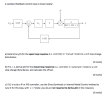 A standard feedback control loop is shown below: 0.125 36s213s 1 0.125 a) Determine y(t) for the open loop response (i.e. controller in 'manual' mode) to a unit step-change disturbance (3 marks) b) If G 1, derive y(t) for the closed loop response (i.e. controller in 'automatic' mode) to a unit step-change disturbance, and calculate the off-set. (4 marks) c) If Gc is to be a Pl or PID controller, use the Direct Synthesis or Internal Model Control method to...
1. Consider a feedback system given below: T(s) Disturbance Controller Dynamics R(S) + Gc(s) G.(s) U(s)...
 1. Consider a feedback system given below: T(s) Disturbance Controller Dynamics R(S) + Gc(s) G.(s) U(s) Sensor H(s) IMs) Sensor noise where the input and transfer functions are given as follows: R(s) = –,7,(s) = 0, N(s) = 0, G, - 15,6, -_- , and H(s) = 1. s's + 3) a. Derive the system transfer function Y(s)/R(s) = G,, poles, $, On, and, from the response function y(t), the performance measures: rise time Tr, peak time Tp, percent overshoot...
Question 6 The open-loop transfer function G(s) of a control system is given as G(8)- s(s+2)(s +5...
 Question 6 The open-loop transfer function G(s) of a control system is given as G(8)- s(s+2)(s +5) A proportional controller is used to control the system as shown in Figure 6 below: Y(s) R(s) + G(s) Figure 6: A control system with a proportional controller a) Assume Hp(s) is a proportional controller with the transfer function H,(s) kp. Determine, using the Routh-Hurwitz Stability Criterion, the value of kp for which the closed-loop system in Figure 6 is marginally stable. (6...
We want to control output(y) using PID control in Kds2+KpS+Ki C(s) S Input(r) is a magnitude1...
 We want to control output(y) using PID control in Kds2+KpS+Ki C(s) S Input(r) is a magnitude1 step. Plant is given by 1 (s+1)(s+2)(s+5) controller plant Y C(s) P(s) a) Calculate Closed Loop characteristics and steady-state error(unity feedback and Kp=1, Kd=1, Ki=0)) 2.Using automatic PID tuning function, reduce steady-state error=0 and report Kp=?, Kd=? And Ki=?
Using MATLAB. We want to control output(y) using PID control in Kds? +Kps+Ki C(s) S Input(r)...
 Using MATLAB. We want to control output(y) using PID control in Kds? +Kps+Ki C(s) S Input(r) is a magnitude1 step. Plant is given by 1 (s+1)(s+2)(s+59) controller plant 14 y C(s) P(S) a) Calculate Closed Loop characteristics and steady-state error(unity feedback and Kp=1, Kd=1, Ki=0)) 2.Using automatic PID tuning function, reduce steady-state error=0 and report Kp=?, Kd=? And Ki=?
Using MATLAB. We want to control output(y) using PID control in Kds? +Kps+Ki C(s) S Input(r)...
 Using MATLAB. We want to control output(y) using PID control in Kds? +Kps+Ki C(s) S Input(r) is a magnitude1 step. Plant is given by 1 (s+1)(3+2)(s+5 ) controller plant + 14 y C(s) P(S) a) Calculate Closed Loop characteristics and steady-state error(unity feedback and Kp=1, Kd=1, Ki=0)) 2.Using automatic PID tuning function, reduce steady-state error=0 and report Kp=?, Kd=? And Ki=?
3. For the feedback control system shown in Figure Q3 below, the forward-path transfer function given...
 3. For the feedback control system shown in Figure Q3 below, the forward-path transfer function given by G(s) and the sensor transfer function is given by H(s). R(s) C(s) G(s) H(s) Figure Q3 It is known that G(s) -- K(+20) S(+5) H(s) = and K is the proportional gain. (S+10) i. Determine the closed-loop transfer function and hence the characteristic equation of the system. [6 marks] ii. Using the Routh-Hurwitz criterion, determine the stability of the closed-loop system. Determine the...
Q4. The feedback system shown below has a plant, a controller, and sensor transfer functions as...
 Q4. The feedback system shown below has a plant, a controller, and sensor transfer functions as G(s), Gc(s) and H(s), respectively. Find the output Y(s) and the input U(s) as a function of the inputs and transfer functions. (2 Points) D(s) R(s) + U(s) Gc (s) O G(s) - Y(s) H(S)
 A feedback control system with adjustable gain K is shown as in Figure 4.1. Here, Q4 1 and H (s) where b 2a bs +a G(s)= 3(s+a) Y(s) R(s) G(s) К H(s) Figure 4.1 A feedback control system with adjustable gain Sketch Nyquist plot for G(s)H(s) for 0.9 <a < 1.1. (a) (18 marks) (b) Discuss the stability of closed-loop system with open-loop function as in (a) if K 10b (7 marks)
A feedback control system with adjustable gain K...
A feedback control system with adjustable gain K is shown as in Figure 4.1. Here, Q4 1 and H (s) where b 2a bs +a G(s)= 3(s+a) Y(s) R(s) G(s) К H(s) Figure 4.1 A feedback control system with adjustable gain Sketch Nyquist plot for G(s)H(s) for 0.9 <a < 1.1. (a) (18 marks) (b) Discuss the stability of closed-loop system with open-loop function as in (a) if K 10b (7 marks)
A feedback control system with adjustable gain K...
 R(s) C(s) G (s) G(s) Given the control loop above, determine the Kd gain for the Gc(s) for a given G(s) and design requirements. Peak Time (Tp) 0.25 second Settling time (Ts) 0.8 second G(s) 1/s211s28) Design the PID controller to have two-distinct roots. Assume the angle for (one root) Z1 30 degrees.
R(s) C(s) G (s) G(s) Given the control loop above, determine the Kd gain for the Gc(s) for a given G(s) and design requirements. Peak Time (Tp)...
R(s) C(s) G (s) G(s) Given the control loop above, determine the Kd gain for the Gc(s) for a given G(s) and design requirements. Peak Time (Tp) 0.25 second Settling time (Ts) 0.8 second G(s) 1/s211s28) Design the PID controller to have two-distinct roots. Assume the angle for (one root) Z1 30 degrees.
R(s) C(s) G (s) G(s) Given the control loop above, determine the Kd gain for the Gc(s) for a given G(s) and design requirements. Peak Time (Tp)...
 A standard feedback control loop is shown below: 0.125 36s213s 1 0.125 a) Determine y(t) for the open loop response (i.e. controller in 'manual' mode) to a unit step-change disturbance (3 marks) b) If G 1, derive y(t) for the closed loop response (i.e. controller in 'automatic' mode) to a unit step-change disturbance, and calculate the off-set. (4 marks) c) If Gc is to be a Pl or PID controller, use the Direct Synthesis or Internal Model Control method to...
 1. Consider a feedback system given below: T(s) Disturbance Controller Dynamics R(S) + Gc(s) G.(s) U(s) Sensor H(s) IMs) Sensor noise where the input and transfer functions are given as follows: R(s) = –,7,(s) = 0, N(s) = 0, G, - 15,6, -_- , and H(s) = 1. s's + 3) a. Derive the system transfer function Y(s)/R(s) = G,, poles, $, On, and, from the response function y(t), the performance measures: rise time Tr, peak time Tp, percent overshoot...
 Question 6 The open-loop transfer function G(s) of a control system is given as G(8)- s(s+2)(s +5) A proportional controller is used to control the system as shown in Figure 6 below: Y(s) R(s) + G(s) Figure 6: A control system with a proportional controller a) Assume Hp(s) is a proportional controller with the transfer function H,(s) kp. Determine, using the Routh-Hurwitz Stability Criterion, the value of kp for which the closed-loop system in Figure 6 is marginally stable. (6...
 We want to control output(y) using PID control in Kds2+KpS+Ki C(s) S Input(r) is a magnitude1 step. Plant is given by 1 (s+1)(s+2)(s+5) controller plant Y C(s) P(s) a) Calculate Closed Loop characteristics and steady-state error(unity feedback and Kp=1, Kd=1, Ki=0)) 2.Using automatic PID tuning function, reduce steady-state error=0 and report Kp=?, Kd=? And Ki=?
 Using MATLAB. We want to control output(y) using PID control in Kds? +Kps+Ki C(s) S Input(r) is a magnitude1 step. Plant is given by 1 (s+1)(s+2)(s+59) controller plant 14 y C(s) P(S) a) Calculate Closed Loop characteristics and steady-state error(unity feedback and Kp=1, Kd=1, Ki=0)) 2.Using automatic PID tuning function, reduce steady-state error=0 and report Kp=?, Kd=? And Ki=?
 Using MATLAB. We want to control output(y) using PID control in Kds? +Kps+Ki C(s) S Input(r) is a magnitude1 step. Plant is given by 1 (s+1)(3+2)(s+5 ) controller plant + 14 y C(s) P(S) a) Calculate Closed Loop characteristics and steady-state error(unity feedback and Kp=1, Kd=1, Ki=0)) 2.Using automatic PID tuning function, reduce steady-state error=0 and report Kp=?, Kd=? And Ki=?
 3. For the feedback control system shown in Figure Q3 below, the forward-path transfer function given by G(s) and the sensor transfer function is given by H(s). R(s) C(s) G(s) H(s) Figure Q3 It is known that G(s) -- K(+20) S(+5) H(s) = and K is the proportional gain. (S+10) i. Determine the closed-loop transfer function and hence the characteristic equation of the system. [6 marks] ii. Using the Routh-Hurwitz criterion, determine the stability of the closed-loop system. Determine the...
 Q4. The feedback system shown below has a plant, a controller, and sensor transfer functions as G(s), Gc(s) and H(s), respectively. Find the output Y(s) and the input U(s) as a function of the inputs and transfer functions. (2 Points) D(s) R(s) + U(s) Gc (s) O G(s) - Y(s) H(S)
Most questions answered within 3 hours.
-
Where is the error in this code sequence?
String s1 = "Hello";
String s2 = "ello";...
asked 11 months ago -
Financial data for Joel de Paris, Inc., for last year
follow:
Joel de Paris, Inc.
Balance...
asked 11 months ago -
Consider this reaction:
Al2(SO4)3 (aq)+ BaCl3
(aq) Al2Cl6 (aq)- +
3BaSO4(s) . What is the...
asked 11 months ago -
Suppose that Savneet is considering increasing her
recent random sample from 20 car rentals to 40...
asked 11 months ago -
Trucks arrive at an unloading terminal at an average rate of 120
per hour.
Trucks arrive...
asked 11 months ago -
Why are methanol and ethanol completely soluble in water while
octanol is not very little soluble....
asked 11 months ago -
A facilities manager at a university reads in a research report
that the mean amount of...
asked 11 months ago -
When the CuSO4 is rehydrated by adding water to the anhydrous
compound, is this an endothermic...
asked 11 months ago -
A ray of sunlight is passing from diamond into crown glass; the
angle of incidence is...
asked 11 months ago -
A block of mass 0.249 kg is placed on top of a light, vertical
spring of...
asked 11 months ago -
how do the kidneys compensate in the presences of acidosis
a) trigger hyperventilate
b) reserve acid...
asked 11 months ago -
Question 501 pts
The rental rate of capital to the firm increases. Which of the
following...
asked 11 months ago