
Homework Answers






Add Answer to:
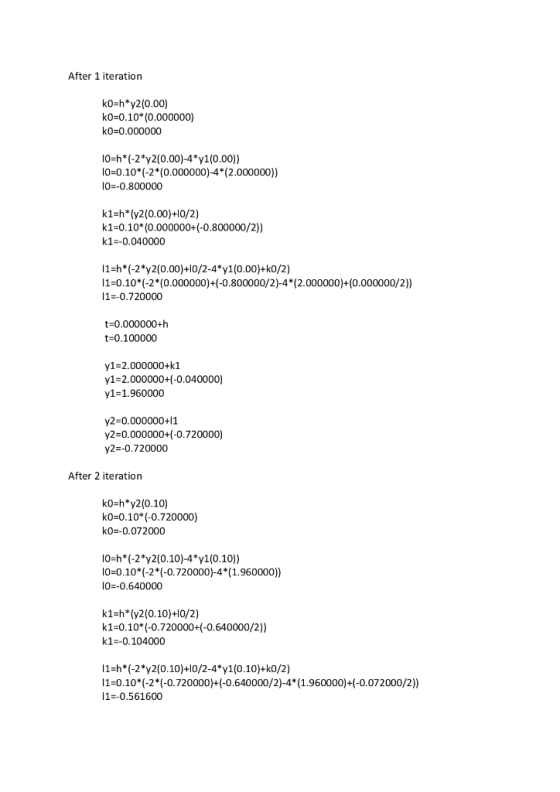
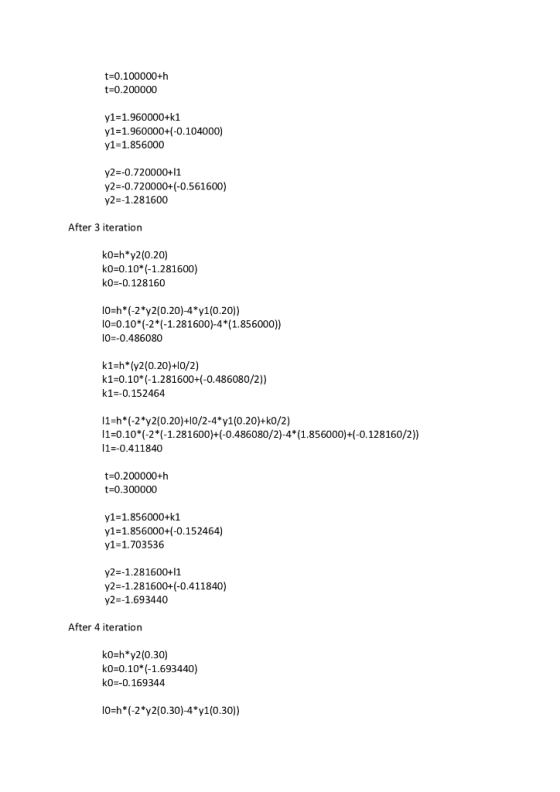
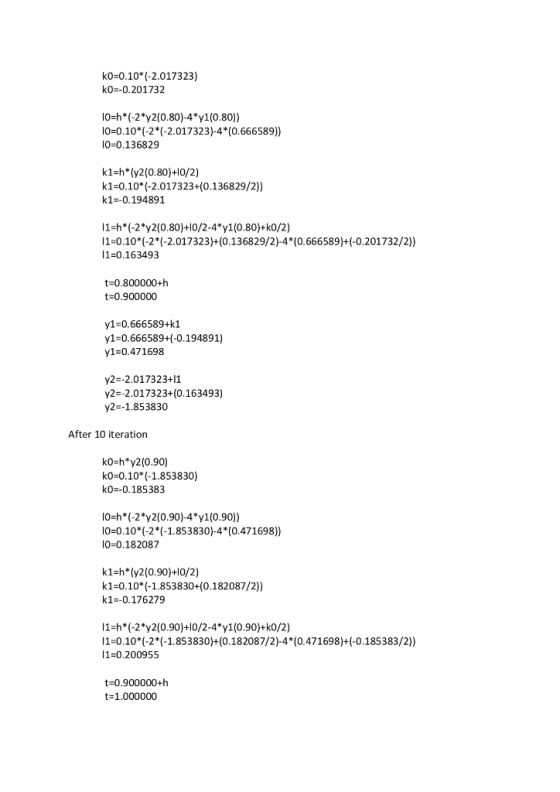
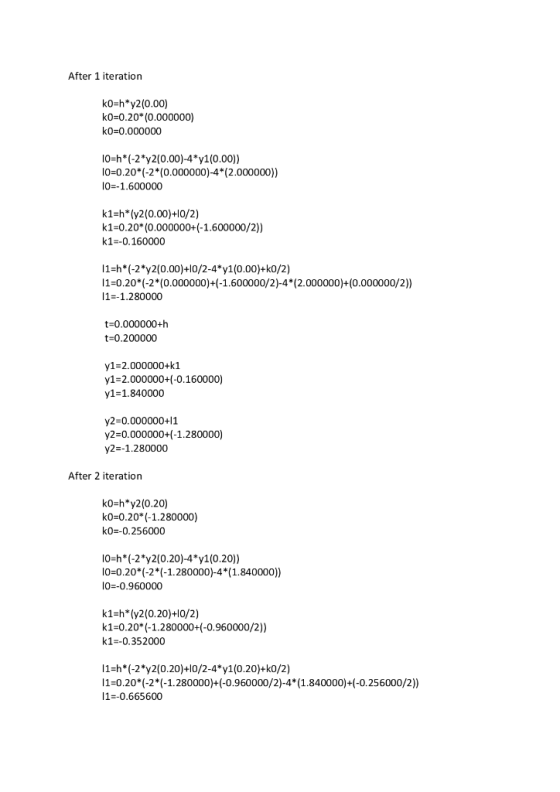
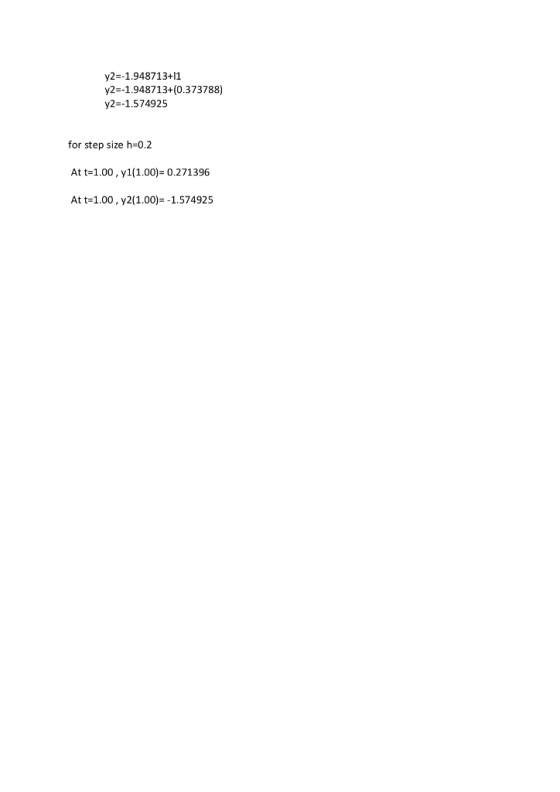
2nd order Runge Kutta method S the Titivalue proben 2ndl order Runge-Kta methael S the Titivalue proben 2ndl order Runge-Kta methael
Use the Runge Kutta 4th Order (RK-4) Method on the function below to predict the value...
 Use the Runge Kutta 4th Order (RK-4) Method on the function below to predict the value of y(0.1), given t = 0, y(0)-2, and h-01. Report your answer to 3 decimal places. dy/dt = e + 3y Answer: Use the Runge-Kutta 4th Order (RK-4) Method on the function below to predict the value of y(0.2), given y(0.1) from the previous question, and h = 0.1. Report your answer to 3 decimal places. -t dy/dt -e +3y Answer
2. a. Show that the fourth order Runge Kutta method, when applied to the differential equation y'...
 2. a. Show that the fourth order Runge Kutta method, when applied to the differential equation y' - Ay, can be written in the form i.e. show that w+1 Q(hA)w, where (10) b. Show that the backward Euler method, when applied to the differential equation y'- Xy, can be written in the form (12) wi. i.e. show that w+1-Q(hA)w; where (13)
2. a. Show that the fourth order Runge Kutta method, when applied to the differential equation y' - Ay,...
2. a. Show that the fourth order Runge Kutta method, when applied to the differential equation y' - Ay, can be written in the form i.e. show that w+1 Q(hA)w, where (10) b. Show that the backward Euler method, when applied to the differential equation y'- Xy, can be written in the form (12) wi. i.e. show that w+1-Q(hA)w; where (13)
2. a. Show that the fourth order Runge Kutta method, when applied to the differential equation y' - Ay,...
Both parts please! 1 Runge-Kutta Method The discretization of the spatial derivatives of a PDE often...
 Both parts please!
1 Runge-Kutta Method The discretization of the spatial derivatives of a PDE often results in a system of ODEs of the fornm du Runge-Kutta methods are the most commonly used schemes for numerically integrating in time the ODE system. We will numerically implement the "standard" third-order Runge-Kutta method. To advance the solution u from time t to t + Δ1, three sub-steps, are taken. If the solution at time t is un the following three steps are...
Both parts please!
1 Runge-Kutta Method The discretization of the spatial derivatives of a PDE often results in a system of ODEs of the fornm du Runge-Kutta methods are the most commonly used schemes for numerically integrating in time the ODE system. We will numerically implement the "standard" third-order Runge-Kutta method. To advance the solution u from time t to t + Δ1, three sub-steps, are taken. If the solution at time t is un the following three steps are...
(e) Consider the Runge-Kutta method in solving the following first order ODE: dy First, using Taylor series expansion, we have the following approximation of y evaluated at the time step n+1 as a...
 (e) Consider the Runge-Kutta method in solving the following first order ODE: dy First, using Taylor series expansion, we have the following approximation of y evaluated at the time step n+1 as a function of y at the time step n: where h is the size of the time step. The fourth order Runge-Kutta method assumes the following form where the following approximations can be made at various iterations: )sh+รู้: ,f(t.ta, ),. Note that the first term is evaluated at...
Hey Can someone write me a c++ pogramm using 4th order runge kutta method? h=0.1 y'...
 Hey
Can someone write me a c++ pogramm using 4th order runge kutta
method? h=0.1
y' = 3y, y(0) = 1
Hey
Can someone write me a c++ pogramm using 4th order runge kutta
method? h=0.1
y' = 3y, y(0) = 1
Problem: Write a computer program to implement the Fourth Order Runge-Kutta method to solve the differential...
 Problem: Write a computer program to implement the Fourth Order Runge-Kutta method to solve the differential equation x=x2 (1) cos(x(1))-4fx(t), x(0)=-0.5 Use h-0.01. Evaluate and print a table of the solution over the interval [O, 1 x(t) 0
Derive the three-stage Runge-Kutta method that corresponds to the collocation points c1 = 1, c2 = 1, c3 = 3 and determine its order.
Derive the three-stage Runge-Kutta method that corresponds to the collocation points c1 = 1, c2 = 1, c3 = 3 and determine its order.
Numerical Methods for Conservation Laws, Randall J. LeVeque, Ed. 2. question/ do 2nd order explicit Runge-Kutta...
 Numerical Methods for Conservation Laws, Randall J.
LeVeque, Ed. 2.
question/ do 2nd order explicit Runge-Kutta
hint
1. Consider the linear equations, Use central difference for the spatial discretization. Derive the stability condition for the schemes with the followinor temporal discretization α2 Ζα where α v sin θ α2 |λ| > 1 for any positive k when θ π/2 .
Numerical Methods for Conservation Laws, Randall J.
LeVeque, Ed. 2.
question/ do 2nd order explicit Runge-Kutta
hint
1. Consider the linear equations, Use central difference for the spatial discretization. Derive the stability condition for the schemes with the followinor temporal discretization α2 Ζα where α v sin θ α2 |λ| > 1 for any positive k when θ π/2 .
In Exercise, use the Runge-Kutta method with the given number n of steps to approximate the...
 In Exercise, use the Runge-Kutta method with the given number n of steps to approximate the solution to the initial-value problem specified. Your answer should include a table of approximate values of the dependent variable. It should also include a sketch of the graph of the approximate solution. Compare the graphs that you get from the Runge-Kutta method to those that come from Euler's method and improved Euler's method. If your computer has a built-in routine for the numerical solution...
Consider the pendulum, y " + sin(y) = 0. Using at least a 41th order Runge-Kutta...
 Consider the pendulum, y " + sin(y) = 0. Using at least a 41th order Runge-Kutta method: Compute the motion for a variety of amplitudes. Keep the amplitudes to 3 or less. For each amplitude, determine the corresponding period of motion. Plot the period as a function of amplitude.
 Use the Runge Kutta 4th Order (RK-4) Method on the function below to predict the value of y(0.1), given t = 0, y(0)-2, and h-01. Report your answer to 3 decimal places. dy/dt = e + 3y Answer: Use the Runge-Kutta 4th Order (RK-4) Method on the function below to predict the value of y(0.2), given y(0.1) from the previous question, and h = 0.1. Report your answer to 3 decimal places. -t dy/dt -e +3y Answer
 2. a. Show that the fourth order Runge Kutta method, when applied to the differential equation y' - Ay, can be written in the form i.e. show that w+1 Q(hA)w, where (10) b. Show that the backward Euler method, when applied to the differential equation y'- Xy, can be written in the form (12) wi. i.e. show that w+1-Q(hA)w; where (13)
2. a. Show that the fourth order Runge Kutta method, when applied to the differential equation y' - Ay,...
2. a. Show that the fourth order Runge Kutta method, when applied to the differential equation y' - Ay, can be written in the form i.e. show that w+1 Q(hA)w, where (10) b. Show that the backward Euler method, when applied to the differential equation y'- Xy, can be written in the form (12) wi. i.e. show that w+1-Q(hA)w; where (13)
2. a. Show that the fourth order Runge Kutta method, when applied to the differential equation y' - Ay,...
 Both parts please!
1 Runge-Kutta Method The discretization of the spatial derivatives of a PDE often results in a system of ODEs of the fornm du Runge-Kutta methods are the most commonly used schemes for numerically integrating in time the ODE system. We will numerically implement the "standard" third-order Runge-Kutta method. To advance the solution u from time t to t + Δ1, three sub-steps, are taken. If the solution at time t is un the following three steps are...
Both parts please!
1 Runge-Kutta Method The discretization of the spatial derivatives of a PDE often results in a system of ODEs of the fornm du Runge-Kutta methods are the most commonly used schemes for numerically integrating in time the ODE system. We will numerically implement the "standard" third-order Runge-Kutta method. To advance the solution u from time t to t + Δ1, three sub-steps, are taken. If the solution at time t is un the following three steps are...
 (e) Consider the Runge-Kutta method in solving the following first order ODE: dy First, using Taylor series expansion, we have the following approximation of y evaluated at the time step n+1 as a function of y at the time step n: where h is the size of the time step. The fourth order Runge-Kutta method assumes the following form where the following approximations can be made at various iterations: )sh+รู้: ,f(t.ta, ),. Note that the first term is evaluated at...
 Hey
Can someone write me a c++ pogramm using 4th order runge kutta
method? h=0.1
y' = 3y, y(0) = 1
Hey
Can someone write me a c++ pogramm using 4th order runge kutta
method? h=0.1
y' = 3y, y(0) = 1
 Problem: Write a computer program to implement the Fourth Order Runge-Kutta method to solve the differential equation x=x2 (1) cos(x(1))-4fx(t), x(0)=-0.5 Use h-0.01. Evaluate and print a table of the solution over the interval [O, 1 x(t) 0
 Numerical Methods for Conservation Laws, Randall J.
LeVeque, Ed. 2.
question/ do 2nd order explicit Runge-Kutta
hint
1. Consider the linear equations, Use central difference for the spatial discretization. Derive the stability condition for the schemes with the followinor temporal discretization α2 Ζα where α v sin θ α2 |λ| > 1 for any positive k when θ π/2 .
Numerical Methods for Conservation Laws, Randall J.
LeVeque, Ed. 2.
question/ do 2nd order explicit Runge-Kutta
hint
1. Consider the linear equations, Use central difference for the spatial discretization. Derive the stability condition for the schemes with the followinor temporal discretization α2 Ζα where α v sin θ α2 |λ| > 1 for any positive k when θ π/2 .
 In Exercise, use the Runge-Kutta method with the given number n of steps to approximate the solution to the initial-value problem specified. Your answer should include a table of approximate values of the dependent variable. It should also include a sketch of the graph of the approximate solution. Compare the graphs that you get from the Runge-Kutta method to those that come from Euler's method and improved Euler's method. If your computer has a built-in routine for the numerical solution...
 Consider the pendulum, y " + sin(y) = 0. Using at least a 41th order Runge-Kutta method: Compute the motion for a variety of amplitudes. Keep the amplitudes to 3 or less. For each amplitude, determine the corresponding period of motion. Plot the period as a function of amplitude.
Most questions answered within 3 hours.
-
Where is the error in this code sequence?
String s1 = "Hello";
String s2 = "ello";...
asked 11 months ago -
Financial data for Joel de Paris, Inc., for last year
follow:
Joel de Paris, Inc.
Balance...
asked 11 months ago -
Consider this reaction:
Al2(SO4)3 (aq)+ BaCl3
(aq) Al2Cl6 (aq)- +
3BaSO4(s) . What is the...
asked 11 months ago -
Suppose that Savneet is considering increasing her
recent random sample from 20 car rentals to 40...
asked 11 months ago -
Trucks arrive at an unloading terminal at an average rate of 120
per hour.
Trucks arrive...
asked 11 months ago -
Why are methanol and ethanol completely soluble in water while
octanol is not very little soluble....
asked 11 months ago -
A facilities manager at a university reads in a research report
that the mean amount of...
asked 11 months ago -
When the CuSO4 is rehydrated by adding water to the anhydrous
compound, is this an endothermic...
asked 11 months ago -
A ray of sunlight is passing from diamond into crown glass; the
angle of incidence is...
asked 11 months ago -
A block of mass 0.249 kg is placed on top of a light, vertical
spring of...
asked 11 months ago -
how do the kidneys compensate in the presences of acidosis
a) trigger hyperventilate
b) reserve acid...
asked 11 months ago -
Question 501 pts
The rental rate of capital to the firm increases. Which of the
following...
asked 11 months ago