
Homework Answers
1) Option d.
Vitamin B and C are water soluble.It is soluble in water and easily get transferred to bodytissue but it is not stored in the body.Vitamin A,D,E and K are called as fat soluble vitamins.
2) Option c
Vitamin K helps in clotting the blood that is stops blood flow and thickens the affected area.
3) Option a
Collagen is important protein in our body.It helps in formation of tendons,ligaments,skin and tissues.
4) Option c
Deficiency of niacin leads to Pellagra which inturn causes diarrhea,dermatitis,dementia and death.
5) Option b
Vitamin B12 is a essential nutrient in synthesis of protective cover of nerves that is myelin sheath.
6) Option a
Vitamin D is essential for healthy bones and is got from sunlight.
7) Option b
Flouride inhibits dental carries
8) Option c
Folate helps in preventing neural tube effects before and during pregnancy.
9) Option d
Selenium,Copper and zinc is considered as antioxidants.
10 ) Option a
Zinc helps in growth ans sexual maturation in children.
11) Option a
Vitamin D is necessary for healthy bones and its deficiency causes osteoporosis
Add Answer to:
1. Which of the following vitamins are classified as water-soluble? a. Vitamins B,D b. Vitamins B, E, and Cool...
12. This nutrient is also known as the "anti-infective" nutrient. b. vitamin A c. phosphorus d. sodium 13. An...
 12. This nutrient is also known as the "anti-infective" nutrient. b. vitamin A c. phosphorus d. sodium 13. An antioxidant found primarily in oils, seeds, and other fats. a vitamin E b. vitamin C c. vitamin A d. selenium d. thiamine 14. A deficiency of this nutrient causes goiters. a. chromium b. iodine c. zinc 15. A deficiency of this nutrient causes Beri-Beri. a. thiamine b. niacin c . vitamin B6 d. vitamin B12 16. This nutrient helps maintain healthy...
Chapter 7 Vitamins Define what a vitamin is. Identify the fat-soluble vitamins and water-soluble vitamins. Identify...
Chapter 7 Vitamins Define what a vitamin is. Identify the fat-soluble vitamins and water-soluble vitamins. Identify the functions and major food sources of: vitamin A, Vitamin D, Vitamin E, Vitamin K, Vitamin C, Vitamin B12, niacin, thiamin, riboflavin, pantothenic acid, folic acid/folate, and beta-carotene. What are the functions of antioxidants. Identify the causes of beriberi, scurvy, pellagra, hemolytic anemia, megaloblastic anemia, macrocytic anemia, pernicious anemia, neural tube defects, rickets, osteoporosis, xerophthalmia. Chapter 8 Minerals Define what a mineral is. What...
Question: Vitamins A, D, E, and K are fat‑soluble vitamins. Classify the following phrases as describing...
Question: Vitamins A, D, E, and K are fat‑soluble vitamins. Classify the following phrases as describing vitamin A, vitamin D, vitamin E, or vitamin K. : Options: (1) hormone precursor and visual pigment (2) production takes place in skin (3) deficiency can cause dry skin (4) regulates gene expression in epithelial tissue (5) hormone precursor derived from a steroid (6) regulates calcium uptake by intestine (7) prevents oxidative damage to membrane lipids (8) antioxidant (9) cofactor (10) functions in fibrin...
What is a characteristic of water-soluble vitamins? a. Toxic levels are often reached. b. Long-term storage...
What is a characteristic of water-soluble vitamins? a. Toxic levels are often reached. b. Long-term storage is available in body tissues. c. Excess intake provides enhanced health benefits. d. Deficiency symptoms take several months to a year to show up. e. They are very unstable during food handling and processing. What is a correct pairing of the vitamin with an associated deficiency symptom? a. Vitamin C - pellegra b. Vitamin D – night blindness c. Thiamin – eye problems d....
1. Unlike water-soluble vitamins, fat-soluble vitamins such as vitamin K are circulated away from the small...
1. Unlike water-soluble vitamins, fat-soluble vitamins such as vitamin K are circulated away from the small intestine by the ___________________. a. endocrine system b. pulmonary circulatory system c. systemic circulatory system d. lymphatic system 2. Muayyad was curious to learn more about fat-soluble vitamins. He was surprised that exposure to sunlight allows his body to synthesize ___________________. a. vitamin E b. vitamin A c. vitamin D d. vitamin K 3. Some fat-soluble vitamins, such as vitamin E, function as ____________...
42. may result in major losses of water-soluble vitamins. c. boiling in a pan full of...
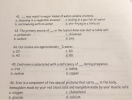 42. may result in major losses of water-soluble vitamins. c. boiling in a pan full of water d. stir-frying in a little ol a. steaming in a vegetable steamer b. microwaving with no water 43. The primary source of _ in the typical American diet is table salt. a. potassium b. sodium c. chromium d. zinc 44 Our bodies are approximately-% water. a. 20 b. 40 c. 60 d. 80 45. Cretinism is associated with a deficiency of during pregnancy....
Vitamin D is converted to its active form by the fat tissue and liver. ...
Vitamin D is converted to its active form by the fat tissue and liver. kidneys and liver. skin and small intestine. skin and liver. small intestines and kidneys. Question 13 0 / 1 pts Which list contains only vitamins that do NOT function as coenzymes in energy metabolism? vitamin B6 and vitamin C choline and vitamin C biotin, pantothenic acid, riboflavin niacin, vitamin B6, folate thiamin, riboflavin, niacin UnansweredQuestion 14...
1.Which vitamins play a role in bone health? A. Vitamin E and Vitamin K B. Vitamin...
1.Which vitamins play a role in bone health? A. Vitamin E and Vitamin K B. Vitamin D and carotenoids C.Vitamin D and Vitamin K D.Vitamin E and carotenoids E.Vitamin D and vitamin E 2.Too much of which vitamin can result in birth defects? A. Carotenoids B. Vitamin D C.Vitamin E D.Vitamin A E.Vitamin K 3.What vitamin plays a key role in both blood clotting and bone formation? A. Vitamin D B.Vitamin K C.Vitamin A D.Vitamin E 9.What choice correctly matches...
Match the symptoms of deficiency or the named deficiency disease with the nutrient. • Beriberi (wet...
 Match the symptoms of deficiency or the named deficiency disease with the nutrient. • Beriberi (wet and dry) A. Thiamin Pellegra B. Vitamin B12 - Ariboflavinosis C. Vitamin K Scurvy D. Vitamin B6 Rickets E. Vitamin D + Osteomalacia F. Niacin • Pernicious anemia G. Riboflavin - Anemia; depression; confusion; scaly dermatitis H. Vitamin A - Anemia; depression; confusion; smooth red tongue 1. Folate - Purplish red tongue J. Vitamin A Hemorrhage; abnormal bone formation K. Riboflavin Red blood cell...
Match the function with the nutrient. Some answers may be used more than once. Vision; maintenance...
 Match the function with the nutrient. Some answers may be used more than once. Vision; maintenance of cornea, epithelial cells, skin # Growth; regulation of gene expression; reproduction - Mineralization of bones and teeth A. Vitamin K Antioxidant B. Thiamin, riboflavin, niacin C. Vitamin B12 D. Vitamin D - - Synthesis of blood clotting proteins and bone proteins Collagen synthesis Antioxidant Restores Vitamin E to active form Coenzyme in energy metabolism Part of a coenzyme for new cell synthesis E....
 12. This nutrient is also known as the "anti-infective" nutrient. b. vitamin A c. phosphorus d. sodium 13. An antioxidant found primarily in oils, seeds, and other fats. a vitamin E b. vitamin C c. vitamin A d. selenium d. thiamine 14. A deficiency of this nutrient causes goiters. a. chromium b. iodine c. zinc 15. A deficiency of this nutrient causes Beri-Beri. a. thiamine b. niacin c . vitamin B6 d. vitamin B12 16. This nutrient helps maintain healthy...
 42. may result in major losses of water-soluble vitamins. c. boiling in a pan full of water d. stir-frying in a little ol a. steaming in a vegetable steamer b. microwaving with no water 43. The primary source of _ in the typical American diet is table salt. a. potassium b. sodium c. chromium d. zinc 44 Our bodies are approximately-% water. a. 20 b. 40 c. 60 d. 80 45. Cretinism is associated with a deficiency of during pregnancy....
 Match the symptoms of deficiency or the named deficiency disease with the nutrient. • Beriberi (wet and dry) A. Thiamin Pellegra B. Vitamin B12 - Ariboflavinosis C. Vitamin K Scurvy D. Vitamin B6 Rickets E. Vitamin D + Osteomalacia F. Niacin • Pernicious anemia G. Riboflavin - Anemia; depression; confusion; scaly dermatitis H. Vitamin A - Anemia; depression; confusion; smooth red tongue 1. Folate - Purplish red tongue J. Vitamin A Hemorrhage; abnormal bone formation K. Riboflavin Red blood cell...
 Match the function with the nutrient. Some answers may be used more than once. Vision; maintenance of cornea, epithelial cells, skin # Growth; regulation of gene expression; reproduction - Mineralization of bones and teeth A. Vitamin K Antioxidant B. Thiamin, riboflavin, niacin C. Vitamin B12 D. Vitamin D - - Synthesis of blood clotting proteins and bone proteins Collagen synthesis Antioxidant Restores Vitamin E to active form Coenzyme in energy metabolism Part of a coenzyme for new cell synthesis E....
Most questions answered within 3 hours.
-
Where is the error in this code sequence?
String s1 = "Hello";
String s2 = "ello";...
asked 11 months ago -
Financial data for Joel de Paris, Inc., for last year
follow:
Joel de Paris, Inc.
Balance...
asked 11 months ago -
Consider this reaction:
Al2(SO4)3 (aq)+ BaCl3
(aq) Al2Cl6 (aq)- +
3BaSO4(s) . What is the...
asked 11 months ago -
Suppose that Savneet is considering increasing her
recent random sample from 20 car rentals to 40...
asked 11 months ago -
Trucks arrive at an unloading terminal at an average rate of 120
per hour.
Trucks arrive...
asked 11 months ago -
Why are methanol and ethanol completely soluble in water while
octanol is not very little soluble....
asked 11 months ago -
A facilities manager at a university reads in a research report
that the mean amount of...
asked 11 months ago -
When the CuSO4 is rehydrated by adding water to the anhydrous
compound, is this an endothermic...
asked 11 months ago -
A ray of sunlight is passing from diamond into crown glass; the
angle of incidence is...
asked 11 months ago -
A block of mass 0.249 kg is placed on top of a light, vertical
spring of...
asked 11 months ago -
how do the kidneys compensate in the presences of acidosis
a) trigger hyperventilate
b) reserve acid...
asked 11 months ago -
Question 501 pts
The rental rate of capital to the firm increases. Which of the
following...
asked 11 months ago