
Homework Answers


Add Answer to:
14) Explain the sampling theorem. What is aliasing Show (by developing the formulas) how an analog signal is recover...
3 Sampling and aliasing The aim of this part is to demonstrate the effects of aliasing...
 3 Sampling and aliasing The aim of this part is to demonstrate the effects of aliasing arising from improper sampling. A given analog signal z(t) is sampled at a rate fs = 1/T, the resulting samples (nT) are then reconstructed by an ideal reconstructor into the analog signal rat). Improper choice of f, will result in different signals ra(t) + (t), even though they agree at their sample values, that is, tanT) = x(nT). The procedure is illustrated by the...
4. Aliasing Effects 1. Preliminary work State the sampling theorem. For a sampling frequency of 8.3 kH,under what conditions would aliasing occur? 4. Aliasing Effects 1. Preliminary work State t...
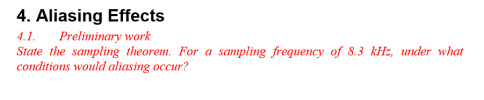 4. Aliasing Effects 1. Preliminary work State the sampling theorem. For a sampling frequency of 8.3 kH,under what conditions would aliasing occur?
4. Aliasing Effects 1. Preliminary work State the sampling theorem. For a sampling frequency of 8.3 kH,under what conditions would aliasing occur?
4. Aliasing Effects 1. Preliminary work State the sampling theorem. For a sampling frequency of 8.3 kH,under what conditions would aliasing occur?
(CO 5) What is needed to eliminate aliasing that can occur during the analog-to-digital conversion? The...
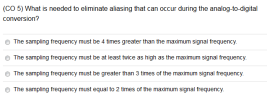 (CO 5) What is needed to eliminate aliasing that can occur during the analog-to-digital conversion? The sampling frequency must be 4 times greater than the maximum signal frequency The sampling frequency must be at least twice as high as the maximum signal frequency The sampling frequency must be greater than 3 times of the maximum signal frequency. The sampling frequency must equal to 2 times of the maximum signal frequency.
Question 1: (Sampling and Aliasing Effeet) (25 Marks) The given analog signal x(t)--sin(16xt)+ sin(11xt)+ sin (5nt), where t is in milliseconds, is sampled at a rate of 12kHz. The resulting sampl...
 Question 1: (Sampling and Aliasing Effeet) (25 Marks) The given analog signal x(t)--sin(16xt)+ sin(11xt)+ sin (5nt), where t is in milliseconds, is sampled at a rate of 12kHz. The resulting samples are immediately reconstructed by an ideal reconstructor. a. Find and sketch the spectrum of x(t) versus Ω. b. Find and sketch the spectrum of the sampled signal versus o. c. Determine the analog signal x (t) at the output of the reconstructor. d. Prove the x(0) and x(t) having...
Q1) Given an analog signal X(t) = 3 cos (2π . 2000t) + 2 cos (2π...
Q1) Given an analog signal X(t) = 3 cos (2π . 2000t) + 2 cos (2π . 5500t) sampled at a rate of 10,000 Hz, a. Sketch the spectrum of the sampled signal up to 20 kHz; b. Sketch the recovered analog signal spectrum if an ideal lowpass filter with a cutoff frequency of 4 kHz is used to filter the sampled signal in order to recover the original signal ; c. Determine the frequency/frequencies of aliasing noise . Q2)...
Q2.) Consider the sampling of the continuous-time signal x(t) to obtain a discrete-time signal x[...
 Q2.) Consider the sampling of the continuous-time signal x(t) to obtain a discrete-time signal x[n (1)-10cos(1000m + π/3) + 20cos(2000m + π/6). 110points! ], where x a) What is the maximum sampling interval (minimum sampling frequency) that could be used to ensure an aliasing free sampling of this signal? b) Plot the spectrum of the sampled signal if x() is sampled using a sampling frequency of (i) 2500 Hz (ii) 1800 Hz and state whether there will be an aliasing...
A student (A) who hasn't studied the sampling theorem properly, sampled the following signal at 200 rad/sec. The student then provided the discrete time signal to another student (B - who knows t...
 A student (A) who hasn't studied the sampling theorem properly, sampled the following signal at 200 rad/sec. The student then provided the discrete time signal to another student (B - who knows the sampling theorem and signal reconstruction very well) telling them that the signal was sampled at 200 rad/sec. (t) 3cos(500Tt) +2cos(100mt) a) Derive the discrete time signal that student A created in its most simplified form. b) Explain how student B can try to recover a continuous signal...
An analog signal is given as below x(t) = 10sin 4rtt The signal is sampled by...
 An analog signal is given as below x(t) = 10sin 4rtt The signal is sampled by two different frequencies f, = 1Hz, f, = 10Hz respectively, and the output are yı, Yz. (i) Sketch signal x(t) in the time domain. (3 marks) (ii) Sketch frequency spectrum of x(t). (3 marks) (iii) After sampling, the continuous signal is converted to a discrete signal. Draw the two discrete signals Yı, Y2: (4 marks) (iv) Discuss whether f1, f, can successfully sample the...
1. An analog signal \(\mathrm{x}(\mathrm{t})\) contains frequencies from 0 up to \(10 \mathrm{kHz}\). You can assume...
1. An analog signal \(\mathrm{x}(\mathrm{t})\) contains frequencies from 0 up to \(10 \mathrm{kHz}\). You can assume any arbitrary spectrum for this signal. (Note that this signals also has frequencies from 0 to \(-10 \mathrm{KHz} .)\) a) Draw the frequency spectrum of the signal after it has been sampled with a sampling frequency \(\mathrm{F}_{\mathrm{s}}=25 \mathrm{kHz}\) b) What range of sampling frequencies allows exact reconstruction of this signal from its samples? c) How is the original signal reconstructed from the sampled signal?...
2.12. Aliasing will not occur if the sampling rate is greater than twice the signal band-...
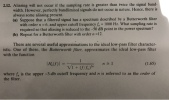 2.12. Aliasing will not occur if the sampling rate is greater than twice the signal band- width. However, perfectly bandlimited signals do not occur in nature. Hence, there is always some aliasing present. (a) Suppose that a filtered signal has a spectrum described by a Butterworth filter with order n 6, and upper cutoff frequency f 1000 Hz. What sampling rate is required so that aliasing is reduced to the -50 dB point in the power spectrum? (b) Repeat for...
 3 Sampling and aliasing The aim of this part is to demonstrate the effects of aliasing arising from improper sampling. A given analog signal z(t) is sampled at a rate fs = 1/T, the resulting samples (nT) are then reconstructed by an ideal reconstructor into the analog signal rat). Improper choice of f, will result in different signals ra(t) + (t), even though they agree at their sample values, that is, tanT) = x(nT). The procedure is illustrated by the...
 4. Aliasing Effects 1. Preliminary work State the sampling theorem. For a sampling frequency of 8.3 kH,under what conditions would aliasing occur?
4. Aliasing Effects 1. Preliminary work State the sampling theorem. For a sampling frequency of 8.3 kH,under what conditions would aliasing occur?
4. Aliasing Effects 1. Preliminary work State the sampling theorem. For a sampling frequency of 8.3 kH,under what conditions would aliasing occur?
 (CO 5) What is needed to eliminate aliasing that can occur during the analog-to-digital conversion? The sampling frequency must be 4 times greater than the maximum signal frequency The sampling frequency must be at least twice as high as the maximum signal frequency The sampling frequency must be greater than 3 times of the maximum signal frequency. The sampling frequency must equal to 2 times of the maximum signal frequency.
 Question 1: (Sampling and Aliasing Effeet) (25 Marks) The given analog signal x(t)--sin(16xt)+ sin(11xt)+ sin (5nt), where t is in milliseconds, is sampled at a rate of 12kHz. The resulting samples are immediately reconstructed by an ideal reconstructor. a. Find and sketch the spectrum of x(t) versus Ω. b. Find and sketch the spectrum of the sampled signal versus o. c. Determine the analog signal x (t) at the output of the reconstructor. d. Prove the x(0) and x(t) having...
 Q2.) Consider the sampling of the continuous-time signal x(t) to obtain a discrete-time signal x[n (1)-10cos(1000m + π/3) + 20cos(2000m + π/6). 110points! ], where x a) What is the maximum sampling interval (minimum sampling frequency) that could be used to ensure an aliasing free sampling of this signal? b) Plot the spectrum of the sampled signal if x() is sampled using a sampling frequency of (i) 2500 Hz (ii) 1800 Hz and state whether there will be an aliasing...
 A student (A) who hasn't studied the sampling theorem properly, sampled the following signal at 200 rad/sec. The student then provided the discrete time signal to another student (B - who knows the sampling theorem and signal reconstruction very well) telling them that the signal was sampled at 200 rad/sec. (t) 3cos(500Tt) +2cos(100mt) a) Derive the discrete time signal that student A created in its most simplified form. b) Explain how student B can try to recover a continuous signal...
 An analog signal is given as below x(t) = 10sin 4rtt The signal is sampled by two different frequencies f, = 1Hz, f, = 10Hz respectively, and the output are yı, Yz. (i) Sketch signal x(t) in the time domain. (3 marks) (ii) Sketch frequency spectrum of x(t). (3 marks) (iii) After sampling, the continuous signal is converted to a discrete signal. Draw the two discrete signals Yı, Y2: (4 marks) (iv) Discuss whether f1, f, can successfully sample the...
 2.12. Aliasing will not occur if the sampling rate is greater than twice the signal band- width. However, perfectly bandlimited signals do not occur in nature. Hence, there is always some aliasing present. (a) Suppose that a filtered signal has a spectrum described by a Butterworth filter with order n 6, and upper cutoff frequency f 1000 Hz. What sampling rate is required so that aliasing is reduced to the -50 dB point in the power spectrum? (b) Repeat for...
Most questions answered within 3 hours.
-
Where is the error in this code sequence?
String s1 = "Hello";
String s2 = "ello";...
asked 10 months ago -
Financial data for Joel de Paris, Inc., for last year
follow:
Joel de Paris, Inc.
Balance...
asked 10 months ago -
Consider this reaction:
Al2(SO4)3 (aq)+ BaCl3
(aq) Al2Cl6 (aq)- +
3BaSO4(s) . What is the...
asked 10 months ago -
Suppose that Savneet is considering increasing her
recent random sample from 20 car rentals to 40...
asked 10 months ago -
Trucks arrive at an unloading terminal at an average rate of 120
per hour.
Trucks arrive...
asked 10 months ago -
Why are methanol and ethanol completely soluble in water while
octanol is not very little soluble....
asked 10 months ago -
A facilities manager at a university reads in a research report
that the mean amount of...
asked 10 months ago -
When the CuSO4 is rehydrated by adding water to the anhydrous
compound, is this an endothermic...
asked 10 months ago -
A ray of sunlight is passing from diamond into crown glass; the
angle of incidence is...
asked 10 months ago -
A block of mass 0.249 kg is placed on top of a light, vertical
spring of...
asked 10 months ago -
how do the kidneys compensate in the presences of acidosis
a) trigger hyperventilate
b) reserve acid...
asked 10 months ago -
Question 501 pts
The rental rate of capital to the firm increases. Which of the
following...
asked 10 months ago