Draw the structures of glucose, fructose, sucrose, starch and cellulose (your structures must show the correct stereoc...
-
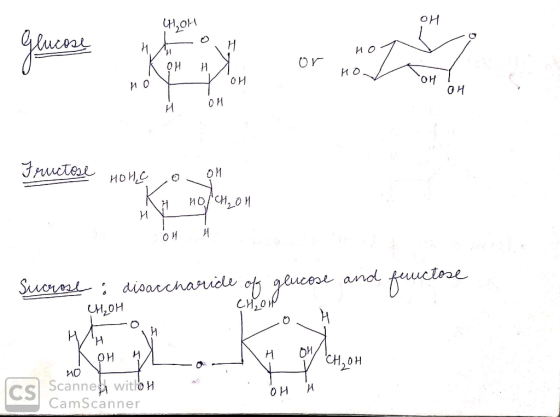
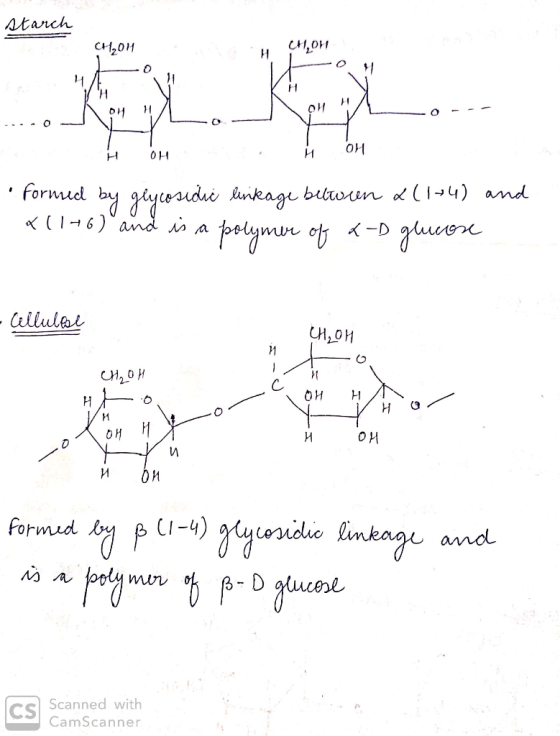
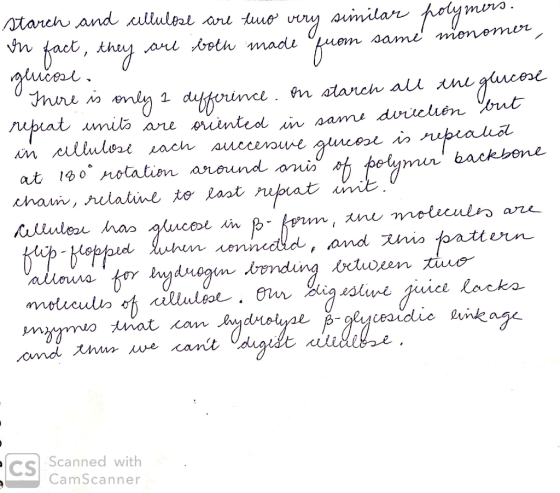
Draw the structures of glucose, fructose, sucrose, starch and cellulose (your structures must show the correct stereochemistry; for starch and cellulose draw at least two repeating units). Comment on the structural differences between starch and cellulose and how that relates to their relative viability as a biomass feedstock.[15 points]
Homework Answers
Add Answer to:
Draw the structures of glucose, fructose, sucrose, starch and cellulose (your structures must show the correct stereoc...
Draw the structures of glucose, fructose, sucrose, starch, and cellulose (your structures must show the correct...
Draw the structures of glucose, fructose, sucrose, starch, and cellulose (your structures must show the correct stereochemistry; for starch and cellulose draw at least two repeating units). Comment on the structural differences between starch and cellulose and how that relates to their relative viability as a biomass feedstock.
1. Which of the following carbohydrates contain ketohexoses? a. starch b. sucrose c. cellulose d. fructose...
1. Which of the following carbohydrates contain ketohexoses? a. starch b. sucrose c. cellulose d. fructose d. lactose 2. Which of the following functional groups in a carbohydrate are able to be oxidized to carboxylic acids? a. ketones that are rearranged in solution b. ketones that are not rearranged in solution c. aldehydes d. alcohols 3. Which of the following carbohydrates were reducing sugars? a. lactose b. sucrose c. fructose d. starch e. cellulose 4. Why does lactose give a...
(CHO)n- CH1403a-C7H1407 C7H107 cellulose and chitin- starch and glycogen-sucrose-galactose- maltose-fructose-fatty acids- polymer-monomer-saturated- unsaturated-glycerol- glycogen-collagen hemoglobin-ribose- nitrogen...
 (CHO)n- CH1403a-C7H1407 C7H107 cellulose and chitin- starch and glycogen-sucrose-galactose- maltose-fructose-fatty acids- polymer-monomer-saturated- unsaturated-glycerol- glycogen-collagen hemoglobin-ribose- nitrogen base- chitin-phosphate group-insulin-pentose sugar-carbon- nitrogen- hydrogen-phosphorus- steroids- hydrolysis- dehydration-hydrogen bond- covalent bond-peptide bond- disulfide bond-guanine-cytosine- adenine-thymine- uracil-van der Waals-hydrophobic- sugar and phosphate bond- 1.A is a large organic molecule that contains repeating subunits called 2. A has fatty acids with double bonds, is liquid at room temperature and comes from a plant source. 3. Amino acids are joined together by bonds. 4. All molecules...
5) What is meant by the term"reducing sugar"? 6) Draw out structures to show the hydrolysis...
5) What is meant by the term"reducing sugar"? 6) Draw out structures to show the hydrolysis of the following carbohydrates: a) Sucrose b) Lactose c) Starch ( show 4 repeating units)
2) if any alpha or beta show work 3)Here,make sure to describe how many reducing groups are in the molecule dissaccha...
 2) if any alpha or beta show work
3)Here,make sure to describe how many reducing groups are in
the molecule dissaccharide.SHOW Work
Sugar Structures Describe the common structural features and the differences for each pair: (a) cellulose and glycogen; (b) D-glucose and D-fructose; (c) maltose and sucrose. Reducing Sugars Draw the structural formula for a-D-glucosyl-(1-6)-D-mannosamine and circle the part of this structure that makes the compound a reducing sugar.
2) if any alpha or beta show work
3)Here,make sure to describe how many reducing groups are in
the molecule dissaccharide.SHOW Work
Sugar Structures Describe the common structural features and the differences for each pair: (a) cellulose and glycogen; (b) D-glucose and D-fructose; (c) maltose and sucrose. Reducing Sugars Draw the structural formula for a-D-glucosyl-(1-6)-D-mannosamine and circle the part of this structure that makes the compound a reducing sugar.
For the following, draw correct Lewis structures showing any formal charges and resonance structures on this...
 For the following, draw correct Lewis structures showing any formal charges and resonance structures on this sheet. For each molecule, give the geometry, shape and hybridization of the central atom in the molecule and whether the molecule is polar or non-polar (has a dipole moment). Fill in the table with these values. In your diagram, show one of the bond angles between bonded atoms (you choose which one). Put the hond angle in the answer table as well. (8 points...
Chapter 4 Assessment Extra Credit How many units of ATP are produced per unit of glucose...
 Chapter 4 Assessment Extra Credit How many units of ATP are produced per unit of glucose in anaerobic metabolism? C 12 24 Which of the following BEST describes the association between carbohydrate intake and diabetes mellitus? Populations whose diet is high in refined starches and added sugars, there is a higher risk of developing type 2 than those who consume a diet high in whole grains. Populations whose diet is high in whole grains, there is a lower risk of...
Show all working clearly and include diagrams where appropriate. Express all answers to the correct number...
 Show all working clearly and include diagrams where appropriate. Express all answers to the correct number of significant figures and units. A storm approaches an office and the air pressure outside suddenly drops from 1.013 kPa to 0.960 kPa. Before the pressure inside the office has time to change, what is the magnitude of the overall force exerted on an external window of the office with dimensions 1.2 m by 1.8 m? Four people, with a combined mass of 320...
The smallest chemical units of matter are atoms b) molecules c) protons d) neutrons e) electrons...
 The smallest chemical units of matter are atoms b) molecules c) protons d) neutrons e) electrons . Which of the following would have the largest size? a) an atom b) a molecule c) a proton d) a neutron e) an electron 3. Isotopes of an element differ in the number of a) protons in the nucleus b) electrons in the nucleus © neutrons in the nucleus d) electron clouds e) energy levels they contain 4. VO The atomic number represents...
(C) Protonation of alkene to form a carbocation followed by addition of bromide ion (D) Addition...
 (C) Protonation of alkene to form a carbocation followed by addition of bromide ion (D) Addition of the proton to one face of the alkene with simultaneous delivery of a bromide ion from a different molecule of H-Br. 11. Which compound is the strongest nmucleophile for reaction of methane methanesulfonate (CHOS0.CH) in methanol at room temperature? (You may assume that everything is soluble in methanol) (A) potassium bromide (B) cesium iodide (C) sodiam chloride (D) lithium flaoride 12. Which proton...
 (CHO)n- CH1403a-C7H1407 C7H107 cellulose and chitin- starch and glycogen-sucrose-galactose- maltose-fructose-fatty acids- polymer-monomer-saturated- unsaturated-glycerol- glycogen-collagen hemoglobin-ribose- nitrogen base- chitin-phosphate group-insulin-pentose sugar-carbon- nitrogen- hydrogen-phosphorus- steroids- hydrolysis- dehydration-hydrogen bond- covalent bond-peptide bond- disulfide bond-guanine-cytosine- adenine-thymine- uracil-van der Waals-hydrophobic- sugar and phosphate bond- 1.A is a large organic molecule that contains repeating subunits called 2. A has fatty acids with double bonds, is liquid at room temperature and comes from a plant source. 3. Amino acids are joined together by bonds. 4. All molecules...
 2) if any alpha or beta show work
3)Here,make sure to describe how many reducing groups are in
the molecule dissaccharide.SHOW Work
Sugar Structures Describe the common structural features and the differences for each pair: (a) cellulose and glycogen; (b) D-glucose and D-fructose; (c) maltose and sucrose. Reducing Sugars Draw the structural formula for a-D-glucosyl-(1-6)-D-mannosamine and circle the part of this structure that makes the compound a reducing sugar.
2) if any alpha or beta show work
3)Here,make sure to describe how many reducing groups are in
the molecule dissaccharide.SHOW Work
Sugar Structures Describe the common structural features and the differences for each pair: (a) cellulose and glycogen; (b) D-glucose and D-fructose; (c) maltose and sucrose. Reducing Sugars Draw the structural formula for a-D-glucosyl-(1-6)-D-mannosamine and circle the part of this structure that makes the compound a reducing sugar.
 For the following, draw correct Lewis structures showing any formal charges and resonance structures on this sheet. For each molecule, give the geometry, shape and hybridization of the central atom in the molecule and whether the molecule is polar or non-polar (has a dipole moment). Fill in the table with these values. In your diagram, show one of the bond angles between bonded atoms (you choose which one). Put the hond angle in the answer table as well. (8 points...
 Chapter 4 Assessment Extra Credit How many units of ATP are produced per unit of glucose in anaerobic metabolism? C 12 24 Which of the following BEST describes the association between carbohydrate intake and diabetes mellitus? Populations whose diet is high in refined starches and added sugars, there is a higher risk of developing type 2 than those who consume a diet high in whole grains. Populations whose diet is high in whole grains, there is a lower risk of...
 Show all working clearly and include diagrams where appropriate. Express all answers to the correct number of significant figures and units. A storm approaches an office and the air pressure outside suddenly drops from 1.013 kPa to 0.960 kPa. Before the pressure inside the office has time to change, what is the magnitude of the overall force exerted on an external window of the office with dimensions 1.2 m by 1.8 m? Four people, with a combined mass of 320...
 The smallest chemical units of matter are atoms b) molecules c) protons d) neutrons e) electrons . Which of the following would have the largest size? a) an atom b) a molecule c) a proton d) a neutron e) an electron 3. Isotopes of an element differ in the number of a) protons in the nucleus b) electrons in the nucleus © neutrons in the nucleus d) electron clouds e) energy levels they contain 4. VO The atomic number represents...
 (C) Protonation of alkene to form a carbocation followed by addition of bromide ion (D) Addition of the proton to one face of the alkene with simultaneous delivery of a bromide ion from a different molecule of H-Br. 11. Which compound is the strongest nmucleophile for reaction of methane methanesulfonate (CHOS0.CH) in methanol at room temperature? (You may assume that everything is soluble in methanol) (A) potassium bromide (B) cesium iodide (C) sodiam chloride (D) lithium flaoride 12. Which proton...
Most questions answered within 3 hours.
-
Where is the error in this code sequence?
String s1 = "Hello";
String s2 = "ello";...
asked 10 months ago -
Financial data for Joel de Paris, Inc., for last year
follow:
Joel de Paris, Inc.
Balance...
asked 10 months ago -
Consider this reaction:
Al2(SO4)3 (aq)+ BaCl3
(aq) Al2Cl6 (aq)- +
3BaSO4(s) . What is the...
asked 10 months ago -
Suppose that Savneet is considering increasing her
recent random sample from 20 car rentals to 40...
asked 10 months ago -
Trucks arrive at an unloading terminal at an average rate of 120
per hour.
Trucks arrive...
asked 10 months ago -
Why are methanol and ethanol completely soluble in water while
octanol is not very little soluble....
asked 10 months ago -
A facilities manager at a university reads in a research report
that the mean amount of...
asked 10 months ago -
When the CuSO4 is rehydrated by adding water to the anhydrous
compound, is this an endothermic...
asked 10 months ago -
A ray of sunlight is passing from diamond into crown glass; the
angle of incidence is...
asked 10 months ago -
A block of mass 0.249 kg is placed on top of a light, vertical
spring of...
asked 10 months ago -
how do the kidneys compensate in the presences of acidosis
a) trigger hyperventilate
b) reserve acid...
asked 10 months ago -
Question 501 pts
The rental rate of capital to the firm increases. Which of the
following...
asked 10 months ago