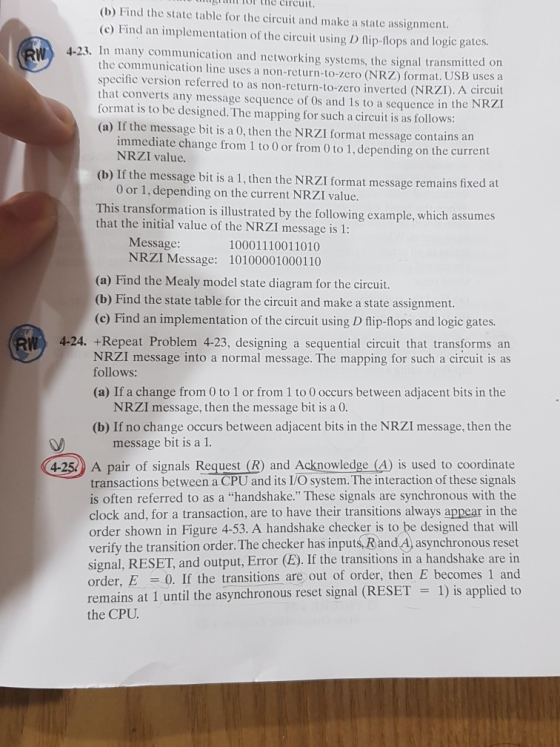
how to slove 4-25,26,27 ?? and please 2way slove state assignment gray code and counting Order
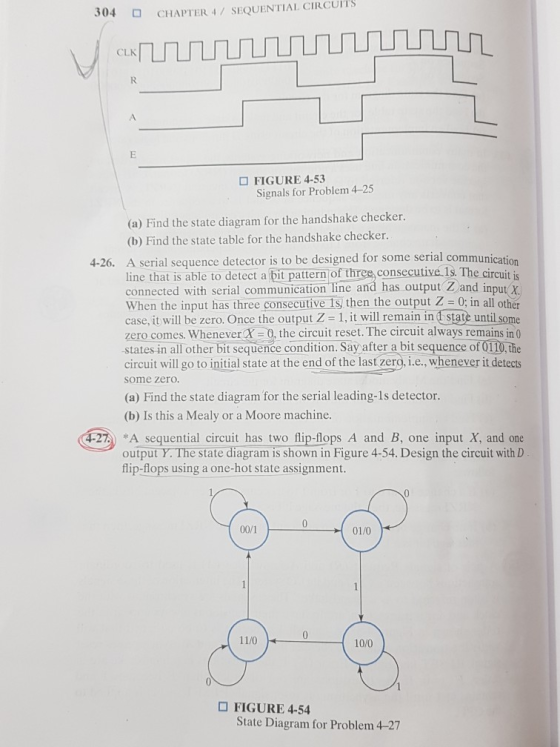
304 □ CHAPTER 4 /SEQUENTIAL CIRCUIis O FIGURE 4-53 Signals for Problem 4-25 (a) Find the state diagram for the handshake checker. (b) Find the state table for the handshake checker 4-26. A serial sequence detector is to be designed for some serial communication line that is able to detect a bit pattern of three, consecutive 1s connected with serial communication line and has output Z and input X When the input has three consecutive 1s then the output Z-0; in all other case, it will be zero. Once the output Z- 1, it will remain in state until some zero comes. Whenever0, the circuit reset. The circuit always remains in 0 states in all other bit sequence condition. Say after a bit sequence of O110, the circuit will go to initial state at the end of the last zerg, i.e, whenever it detects some zero. (a) Find the state diagram for the serial leading-1s detector. (b) Is this a Mealy or a Moore machine. *Asequential circuit has two flip-flops A and B, one input X, and one output Y. The state diagram is shown in Figure 4-54. Design the circuit with D lip-flops using a one-hot state assignment 00/101/0 11/0 10/0 FIGURE 4-54 State Diagram for Problem 4-27
Homework Answers
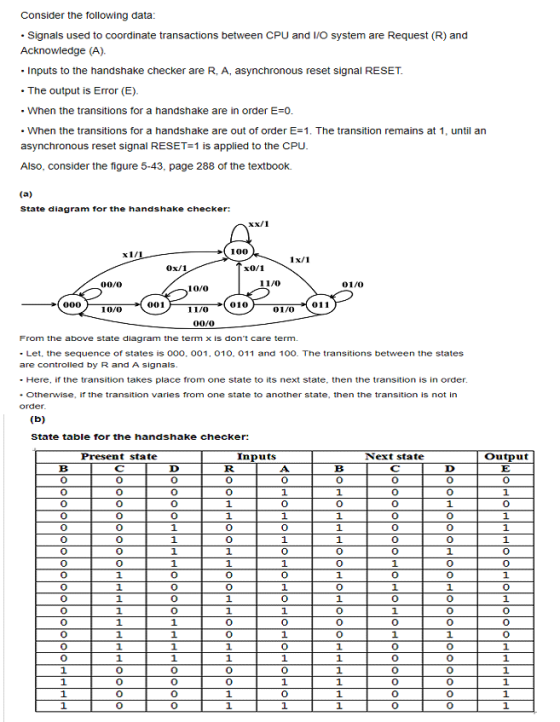
4-25)
Add Answer to:
how to slove 4-25,26,27 ?? and please 2way slove state assignment gray code and counting Order or tIne Circuit....
How do we know about the output? In a part? networking systems, the signal nverted NRZIMA...
 How do we know about the output? In a part?
networking systems, the signal nverted NRZIMA uit that converts any m:ssage sequence of and the NRZ be designed. The mapying immediate change depending b) the message bit is a thon the NRZI format message remains tied at0 or 1, depending the current NRZI val ilustrated by the holowng example, which of the NRZ NRZI 10100001000110 Find thR Mealy mndel diagram forth riinsait lb) Find tha Rtate table for the circuit...
How do we know about the output? In a part?
networking systems, the signal nverted NRZIMA uit that converts any m:ssage sequence of and the NRZ be designed. The mapying immediate change depending b) the message bit is a thon the NRZI format message remains tied at0 or 1, depending the current NRZI val ilustrated by the holowng example, which of the NRZ NRZI 10100001000110 Find thR Mealy mndel diagram forth riinsait lb) Find tha Rtate table for the circuit...
how slove 4-34, 4-35, 4-36??? I dont know that! please hlep me! 306 □ CHAPTER 4/SEQUENTIAL CIRCUITS OTABLE 4-16...
 how slove 4-34, 4-35, 4-36??? I dont know that! please hlep me!
306 □ CHAPTER 4/SEQUENTIAL CIRCUITS OTABLE 4-16 State Table for Problem 4-33 Next State Input Output Present State 4-36 4-37 0 0 0 0 4-38 Design the circuit specified by Table 4-14 and use the sequence from Problen 4-31 (either yours or the one posted on the text website) to perform an automatic logic simulation-based verification of your design. 4 433. The state table for a sequential circuit...
how slove 4-34, 4-35, 4-36??? I dont know that! please hlep me!
306 □ CHAPTER 4/SEQUENTIAL CIRCUITS OTABLE 4-16 State Table for Problem 4-33 Next State Input Output Present State 4-36 4-37 0 0 0 0 4-38 Design the circuit specified by Table 4-14 and use the sequence from Problen 4-31 (either yours or the one posted on the text website) to perform an automatic logic simulation-based verification of your design. 4 433. The state table for a sequential circuit...
the problem and it's solution is given please derive the steps Problem 4 (30 pts) The...
 the problem and it's solution is given please derive the
steps
Problem 4 (30 pts) The input to the circuit of the following Figure is a square wave having a period of 1s, maximum value of 5 V, and minimum value of 0 V. Assume all flip-flops are initially in the RESET state +5 V J J J J K K Q K Input pulse train Output # 1 Output #2 Output #3 Output #4 (1) Explain what the circuit...
the problem and it's solution is given please derive the
steps
Problem 4 (30 pts) The input to the circuit of the following Figure is a square wave having a period of 1s, maximum value of 5 V, and minimum value of 0 V. Assume all flip-flops are initially in the RESET state +5 V J J J J K K Q K Input pulse train Output # 1 Output #2 Output #3 Output #4 (1) Explain what the circuit...
Design a 4-bit serial bit sequence detector. The input to your state detector is called DIN...
 Design a 4-bit serial bit sequence detector. The input to your state detector is called DIN and the output is called FOUND. Your detector will assert FOUND anytime there is a 4-bit sequence of "0101". For all other input sequuences the output is not asserted. (a) (b) Provide the state diagram for this FSM. Encode your states using binary encoding. How many D-Flip-Flops does it take to implement the state memory for this FSM? (c) Provide the state transition table...
Please send an easy to read circuit design as well and explain how it works. 4:02...
 Please send an easy to read circuit design as well and explain
how it works.
4:02 00 LTE il 50% + ENEE 2586 - Lab 9_f... @ + : ENEF 356 Lab -Sequence Detector ENEE 2586 Lab #9 - Sequence Detector Purpose: The goal of this lab is to design a sequence detector using sequential logic circuits Procedure: 1. Design a sequential logic circuit to check an input stream labeled X and to produce an output Z=1 for any input...
Please send an easy to read circuit design as well and explain
how it works.
4:02 00 LTE il 50% + ENEE 2586 - Lab 9_f... @ + : ENEF 356 Lab -Sequence Detector ENEE 2586 Lab #9 - Sequence Detector Purpose: The goal of this lab is to design a sequence detector using sequential logic circuits Procedure: 1. Design a sequential logic circuit to check an input stream labeled X and to produce an output Z=1 for any input...
Please make the circuit Design a Mealy sequential circuit (Figure 16-27) which investigates an input sequence...
 Please make the circuit
Design a Mealy sequential circuit (Figure 16-27) which investigates an input sequence X and will produce an output of Z 16.8 1 for any input sequence ending in 0011 or 110 Example: X 101001 1 00 11 Z 0 00 0 001 1 0 0 1 Notice that the circuit does not reset to the start state when an output of Z1 occurs. However, your circuit should have a start state and should be provided with...
Please make the circuit
Design a Mealy sequential circuit (Figure 16-27) which investigates an input sequence X and will produce an output of Z 16.8 1 for any input sequence ending in 0011 or 110 Example: X 101001 1 00 11 Z 0 00 0 001 1 0 0 1 Notice that the circuit does not reset to the start state when an output of Z1 occurs. However, your circuit should have a start state and should be provided with...
a) (5 marks) Explain the difference between a latch, a gated latch and a flip flop....
 a) (5 marks) Explain the difference between a latch, a gated latch and a flip flop. b) (5 marks) A gated SR latch has the following schematic diagram CLK a) Draw a timing diagram showing the Q and Q outputs for the following sequence of inputs: CLK R Assume that the initial state of the outputs is Q 0 and Q 1 c) (5 marks) Draw a schematic diagram for a rising edge-triggered master-slave D flip- flop built using two...
HW#4-SYNCHRONOUS SEQUENTIAL CIRCUIT DESIGN Given the following state diagram, obtain the corresponding synchronous sequential circuit with...
 HW#4-SYNCHRONOUS SEQUENTIAL CIRCUIT DESIGN Given the following state diagram, obtain the corresponding synchronous sequential circuit with D flip-flops. Draw this circuit. (Use x as an input, and z as an output). 50 points] 1) 1/0 0/0 1/0
please help question 2 2. Design a half-adder with the constraint that you can only use...
 please help question 2
2. Design a half-adder with the constraint that you can only use NAND and NOR gates. The circuit inputs are two bits I and y and the outputs are the sum bit s and carry bit c. Draw a circuit diagram and label each input and output. 3. The digital circuit below contains a latch and two flip-flops. Use the wave forms provided to find Qa. Qb, and Qe. Assume that all three states have initial...
please help question 2
2. Design a half-adder with the constraint that you can only use NAND and NOR gates. The circuit inputs are two bits I and y and the outputs are the sum bit s and carry bit c. Draw a circuit diagram and label each input and output. 3. The digital circuit below contains a latch and two flip-flops. Use the wave forms provided to find Qa. Qb, and Qe. Assume that all three states have initial...
A combination circuit is specified by the following Boolean functions listed below. h(a, b, c) = b,c' + a'c Implement the circuit with a 3x8 decoder. Provide truth table and drawing the l...
 A combination circuit is specified by the following Boolean functions listed below. h(a, b, c) = b,c' + a'c Implement the circuit with a 3x8 decoder. Provide truth table and drawing the logic/circuit diagram. Use the block diagram for the decoder provided in Figure A4 in supplements. Please label the inputs and outputs clearly. Note: use single 3x8 decoder Question 2 (15 points] A priority encoder is an encoder circuit that includes the Truth Table of a priority function. The...
 How do we know about the output? In a part?
networking systems, the signal nverted NRZIMA uit that converts any m:ssage sequence of and the NRZ be designed. The mapying immediate change depending b) the message bit is a thon the NRZI format message remains tied at0 or 1, depending the current NRZI val ilustrated by the holowng example, which of the NRZ NRZI 10100001000110 Find thR Mealy mndel diagram forth riinsait lb) Find tha Rtate table for the circuit...
How do we know about the output? In a part?
networking systems, the signal nverted NRZIMA uit that converts any m:ssage sequence of and the NRZ be designed. The mapying immediate change depending b) the message bit is a thon the NRZI format message remains tied at0 or 1, depending the current NRZI val ilustrated by the holowng example, which of the NRZ NRZI 10100001000110 Find thR Mealy mndel diagram forth riinsait lb) Find tha Rtate table for the circuit...
 how slove 4-34, 4-35, 4-36??? I dont know that! please hlep me!
306 □ CHAPTER 4/SEQUENTIAL CIRCUITS OTABLE 4-16 State Table for Problem 4-33 Next State Input Output Present State 4-36 4-37 0 0 0 0 4-38 Design the circuit specified by Table 4-14 and use the sequence from Problen 4-31 (either yours or the one posted on the text website) to perform an automatic logic simulation-based verification of your design. 4 433. The state table for a sequential circuit...
how slove 4-34, 4-35, 4-36??? I dont know that! please hlep me!
306 □ CHAPTER 4/SEQUENTIAL CIRCUITS OTABLE 4-16 State Table for Problem 4-33 Next State Input Output Present State 4-36 4-37 0 0 0 0 4-38 Design the circuit specified by Table 4-14 and use the sequence from Problen 4-31 (either yours or the one posted on the text website) to perform an automatic logic simulation-based verification of your design. 4 433. The state table for a sequential circuit...
 the problem and it's solution is given please derive the
steps
Problem 4 (30 pts) The input to the circuit of the following Figure is a square wave having a period of 1s, maximum value of 5 V, and minimum value of 0 V. Assume all flip-flops are initially in the RESET state +5 V J J J J K K Q K Input pulse train Output # 1 Output #2 Output #3 Output #4 (1) Explain what the circuit...
the problem and it's solution is given please derive the
steps
Problem 4 (30 pts) The input to the circuit of the following Figure is a square wave having a period of 1s, maximum value of 5 V, and minimum value of 0 V. Assume all flip-flops are initially in the RESET state +5 V J J J J K K Q K Input pulse train Output # 1 Output #2 Output #3 Output #4 (1) Explain what the circuit...
 Design a 4-bit serial bit sequence detector. The input to your state detector is called DIN and the output is called FOUND. Your detector will assert FOUND anytime there is a 4-bit sequence of "0101". For all other input sequuences the output is not asserted. (a) (b) Provide the state diagram for this FSM. Encode your states using binary encoding. How many D-Flip-Flops does it take to implement the state memory for this FSM? (c) Provide the state transition table...
 Please send an easy to read circuit design as well and explain
how it works.
4:02 00 LTE il 50% + ENEE 2586 - Lab 9_f... @ + : ENEF 356 Lab -Sequence Detector ENEE 2586 Lab #9 - Sequence Detector Purpose: The goal of this lab is to design a sequence detector using sequential logic circuits Procedure: 1. Design a sequential logic circuit to check an input stream labeled X and to produce an output Z=1 for any input...
Please send an easy to read circuit design as well and explain
how it works.
4:02 00 LTE il 50% + ENEE 2586 - Lab 9_f... @ + : ENEF 356 Lab -Sequence Detector ENEE 2586 Lab #9 - Sequence Detector Purpose: The goal of this lab is to design a sequence detector using sequential logic circuits Procedure: 1. Design a sequential logic circuit to check an input stream labeled X and to produce an output Z=1 for any input...
 Please make the circuit
Design a Mealy sequential circuit (Figure 16-27) which investigates an input sequence X and will produce an output of Z 16.8 1 for any input sequence ending in 0011 or 110 Example: X 101001 1 00 11 Z 0 00 0 001 1 0 0 1 Notice that the circuit does not reset to the start state when an output of Z1 occurs. However, your circuit should have a start state and should be provided with...
Please make the circuit
Design a Mealy sequential circuit (Figure 16-27) which investigates an input sequence X and will produce an output of Z 16.8 1 for any input sequence ending in 0011 or 110 Example: X 101001 1 00 11 Z 0 00 0 001 1 0 0 1 Notice that the circuit does not reset to the start state when an output of Z1 occurs. However, your circuit should have a start state and should be provided with...
 a) (5 marks) Explain the difference between a latch, a gated latch and a flip flop. b) (5 marks) A gated SR latch has the following schematic diagram CLK a) Draw a timing diagram showing the Q and Q outputs for the following sequence of inputs: CLK R Assume that the initial state of the outputs is Q 0 and Q 1 c) (5 marks) Draw a schematic diagram for a rising edge-triggered master-slave D flip- flop built using two...
 HW#4-SYNCHRONOUS SEQUENTIAL CIRCUIT DESIGN Given the following state diagram, obtain the corresponding synchronous sequential circuit with D flip-flops. Draw this circuit. (Use x as an input, and z as an output). 50 points] 1) 1/0 0/0 1/0
 please help question 2
2. Design a half-adder with the constraint that you can only use NAND and NOR gates. The circuit inputs are two bits I and y and the outputs are the sum bit s and carry bit c. Draw a circuit diagram and label each input and output. 3. The digital circuit below contains a latch and two flip-flops. Use the wave forms provided to find Qa. Qb, and Qe. Assume that all three states have initial...
please help question 2
2. Design a half-adder with the constraint that you can only use NAND and NOR gates. The circuit inputs are two bits I and y and the outputs are the sum bit s and carry bit c. Draw a circuit diagram and label each input and output. 3. The digital circuit below contains a latch and two flip-flops. Use the wave forms provided to find Qa. Qb, and Qe. Assume that all three states have initial...
 A combination circuit is specified by the following Boolean functions listed below. h(a, b, c) = b,c' + a'c Implement the circuit with a 3x8 decoder. Provide truth table and drawing the logic/circuit diagram. Use the block diagram for the decoder provided in Figure A4 in supplements. Please label the inputs and outputs clearly. Note: use single 3x8 decoder Question 2 (15 points] A priority encoder is an encoder circuit that includes the Truth Table of a priority function. The...
Most questions answered within 3 hours.
-
Where is the error in this code sequence?
String s1 = "Hello";
String s2 = "ello";...
asked 11 months ago -
Financial data for Joel de Paris, Inc., for last year
follow:
Joel de Paris, Inc.
Balance...
asked 11 months ago -
Consider this reaction:
Al2(SO4)3 (aq)+ BaCl3
(aq) Al2Cl6 (aq)- +
3BaSO4(s) . What is the...
asked 11 months ago -
Suppose that Savneet is considering increasing her
recent random sample from 20 car rentals to 40...
asked 11 months ago -
Trucks arrive at an unloading terminal at an average rate of 120
per hour.
Trucks arrive...
asked 11 months ago -
Why are methanol and ethanol completely soluble in water while
octanol is not very little soluble....
asked 11 months ago -
A facilities manager at a university reads in a research report
that the mean amount of...
asked 11 months ago -
When the CuSO4 is rehydrated by adding water to the anhydrous
compound, is this an endothermic...
asked 11 months ago -
A ray of sunlight is passing from diamond into crown glass; the
angle of incidence is...
asked 11 months ago -
A block of mass 0.249 kg is placed on top of a light, vertical
spring of...
asked 11 months ago -
how do the kidneys compensate in the presences of acidosis
a) trigger hyperventilate
b) reserve acid...
asked 11 months ago -
Question 501 pts
The rental rate of capital to the firm increases. Which of the
following...
asked 11 months ago