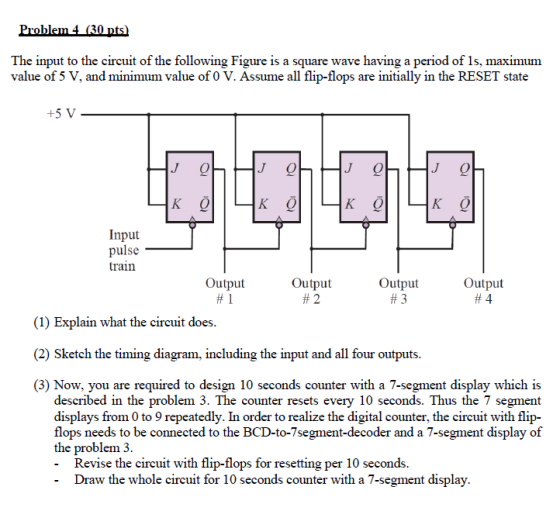
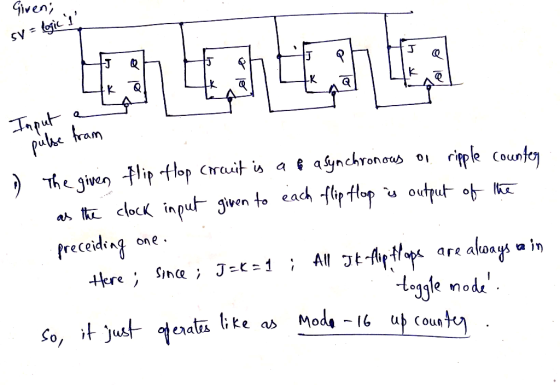
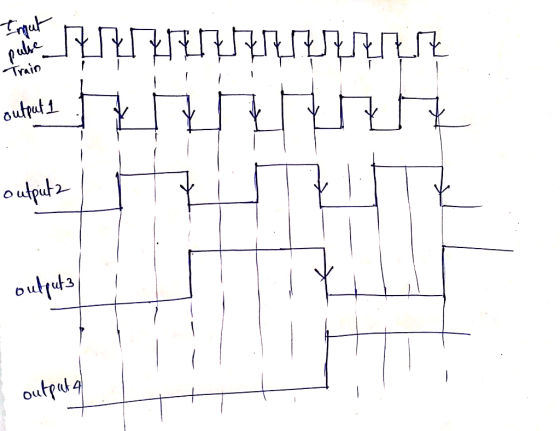
the problem and it's solution is given please derive the steps
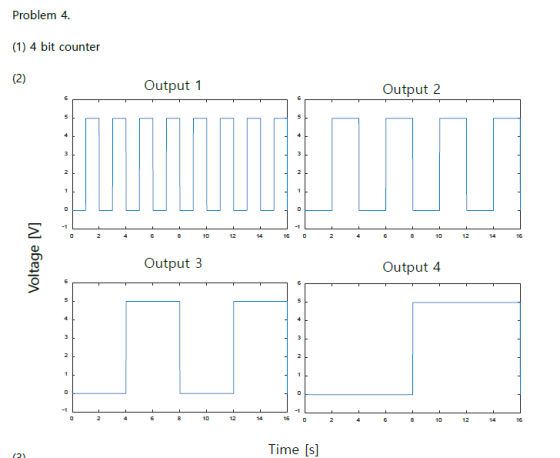
Problem 4 (1) 4 bit counter (2) Output 2 Output 1 17 16 10 14 16 12 10 2 Output 4 Output 3 16 12 14 10 14 16. 12 2 10 Time [s] Voltage V]
Homework Answers
Add Answer to:
the problem and it's solution is given please derive the steps Problem 4 (30 pts) The...
(a) Design an asynchronous Binary Coded Decimal (BCD) count-up counter using JK flip-flops. Draw the counter circuit clearly showing the configuration of the JK flip-flops and the necessary logic gat...
 (a) Design an asynchronous Binary Coded Decimal (BCD) count-up counter using JK flip-flops. Draw the counter circuit clearly showing the configuration of the JK flip-flops and the necessary logic gate(s). Sketch the input and output waveforms of this counter (7 Marks) (b) The binary up/down counter for a cargo lift controller in a 7-storey building has an up-down (UID) control input and a buzzer output (B). The buzzer will sound B 1) when the lift is at level 1 or...
solve 1 2 and 3 Problems 1 and 2 require a 7-segment display. You may want to re-use the display driver you developed in Lab 3. Use a push-button as the clock - the pushbuttons are debounced, whereas...
 solve 1 2 and 3
Problems 1 and 2 require a 7-segment display. You may want to re-use the display driver you developed in Lab 3. Use a push-button as the clock - the pushbuttons are debounced, whereas the slide switches are not. Remember to provide columnsfor lest data in your state lables (use the observed next state as the test data in problems I and 2, and the observed next state and preseni output as the lest data in...
solve 1 2 and 3
Problems 1 and 2 require a 7-segment display. You may want to re-use the display driver you developed in Lab 3. Use a push-button as the clock - the pushbuttons are debounced, whereas the slide switches are not. Remember to provide columnsfor lest data in your state lables (use the observed next state as the test data in problems I and 2, and the observed next state and preseni output as the lest data in...
How do I design a 3-bit down counter from 6 to 0 using a 7 segment...
How do I design a 3-bit down counter from 6 to 0 using a 7 segment display .The counting needs to wrap around to its lowest digit.With my situation I have a 2 display segment and not a 1 display segment. Am using a 74LS 112A DUAL J-K DUAL J-K FLIP FLOPS.But I need to have three flip flops to my 7 Display segment.
2. Design an even parity detection circuit. A parity bit is an error checking mechanism. Your...
 2. Design an even parity detection circuit. A parity bit is an error checking mechanism. Your circuit will count the number of 1's in a stream of bits. If the number of l's is even, the circuit turns on an output called y. Assume a single bit at each cycle - call the input x. Do not use an accumulator or counter. Design the even parity detection circuit using J-K flip-flops. Your answer must include: a. The state diagram. b....
Consider the circuit in Figure 1. It is a 4-bit (QQ2Q3) synchronous counter which uses four T-typ...
 Consider the circuit in Figure 1. It is a 4-bit (QQ2Q3) synchronous counter which uses four T-type flip-flops. The counter increases its value on each positive edge of the clock if the Enable signal is asserted. The counter is reset to 0 by setting the Clear signal low. You are to implement an 8-bit counter of this type Enable T Q Clock Clear Figure 1. 4-bit synchronous counter (but you need to implement 8-bit counter in this lab) Specific notes:...
Modify the hours stage of figure 10-18 to keep military time (00-23 hours) SECTION 10-4/DIGITAL CLOCK...
 Modify the hours stage of figure 10-18 to keep military
time (00-23 hours)
SECTION 10-4/DIGITAL CLOCK PROJECT 763 AMPM tens hrs PM CLRN 74160 units hrs O] QB QC ENT QD ENP RCO units hrs 2] units-hrs[3] CLRN Tens of hours PRN Units of hours CLRN FIGURE 10-18 Detailed circuitry for the HOURS section to count tens of hours. The BCD counter is a 74160, which has two active- HIGH inputs, ENT and ENP, that are ANDed together internally to...
Modify the hours stage of figure 10-18 to keep military
time (00-23 hours)
SECTION 10-4/DIGITAL CLOCK PROJECT 763 AMPM tens hrs PM CLRN 74160 units hrs O] QB QC ENT QD ENP RCO units hrs 2] units-hrs[3] CLRN Tens of hours PRN Units of hours CLRN FIGURE 10-18 Detailed circuitry for the HOURS section to count tens of hours. The BCD counter is a 74160, which has two active- HIGH inputs, ENT and ENP, that are ANDed together internally to...
Objective: In this lab, we will learn how we can design sequential circuits using behavioral mode...
 Just need the code for the
random counter,Thanks
Objective: In this lab, we will learn how we can design sequential circuits using behavioral modelling, and implementing the design in FPGA. Problem: Design a random counter with the following counting sequence: Counting Sequence: 04 2 9 168573 Design Description: The counter has one clock (Clock), one reset (Reset), and one move left or right control signal (L/R) as input. The counter also has one 4bit output O and one 2bit output...
Just need the code for the
random counter,Thanks
Objective: In this lab, we will learn how we can design sequential circuits using behavioral modelling, and implementing the design in FPGA. Problem: Design a random counter with the following counting sequence: Counting Sequence: 04 2 9 168573 Design Description: The counter has one clock (Clock), one reset (Reset), and one move left or right control signal (L/R) as input. The counter also has one 4bit output O and one 2bit output...
Problem 2 Design a BCD counter that uses four(4) T flip-flops using the given table format...
 Problem 2 Design a BCD counter that uses four(4) T flip-flops using the given table format below. The output signal Y = 0 only during the counter transition from 1001 to 0000, otherwise, Y = 1 (for each valid input). Determine the following: (a) The circuit's state table 14 pts. Present State Next State Output Minterm Flip-Flop Inputs Q8 Q4 Q2 Q1 Q8Q4Q2 Y (m) TQ8 TQ4 TQ2 TQ1 Q1 Required format of the state table in Problem 2(a). Show...
Problem 2 Design a BCD counter that uses four(4) T flip-flops using the given table format...
 Problem 2 Design a BCD counter that uses four(4) T flip-flops using the given table format below. The output signal Y = 0 only during the counter transition from 1001 to 0000, otherwise, Y = 1 (for each valid input). Determine the following: (a) The circuit's state table Present State Next State Output Minterm Flip-Flop Inputs Q4 Q1 Q4 Q1 Y (m) TQ8 T04 TQ2 T01 14 pts. Required format of the state table in Problem 2(a). Show table grid...
1. (10) Which of the following describes the operation of a positive edge-triggered D flip-lop? A...
 logic circuit
1. (10) Which of the following describes the operation of a positive edge-triggered D flip-lop? A. If both inputs are HIGH, the output will toggle. B. The output will follow the input on the leading edge of the clock. C. when both inputs are LOW, an invalid state exists. D. The input is toggled into the flip-flop on the leading edge of the clock and is passed to the output on the trailing edge of the clock. Answer...
logic circuit
1. (10) Which of the following describes the operation of a positive edge-triggered D flip-lop? A. If both inputs are HIGH, the output will toggle. B. The output will follow the input on the leading edge of the clock. C. when both inputs are LOW, an invalid state exists. D. The input is toggled into the flip-flop on the leading edge of the clock and is passed to the output on the trailing edge of the clock. Answer...
 (a) Design an asynchronous Binary Coded Decimal (BCD) count-up counter using JK flip-flops. Draw the counter circuit clearly showing the configuration of the JK flip-flops and the necessary logic gate(s). Sketch the input and output waveforms of this counter (7 Marks) (b) The binary up/down counter for a cargo lift controller in a 7-storey building has an up-down (UID) control input and a buzzer output (B). The buzzer will sound B 1) when the lift is at level 1 or...
 solve 1 2 and 3
Problems 1 and 2 require a 7-segment display. You may want to re-use the display driver you developed in Lab 3. Use a push-button as the clock - the pushbuttons are debounced, whereas the slide switches are not. Remember to provide columnsfor lest data in your state lables (use the observed next state as the test data in problems I and 2, and the observed next state and preseni output as the lest data in...
solve 1 2 and 3
Problems 1 and 2 require a 7-segment display. You may want to re-use the display driver you developed in Lab 3. Use a push-button as the clock - the pushbuttons are debounced, whereas the slide switches are not. Remember to provide columnsfor lest data in your state lables (use the observed next state as the test data in problems I and 2, and the observed next state and preseni output as the lest data in...
 2. Design an even parity detection circuit. A parity bit is an error checking mechanism. Your circuit will count the number of 1's in a stream of bits. If the number of l's is even, the circuit turns on an output called y. Assume a single bit at each cycle - call the input x. Do not use an accumulator or counter. Design the even parity detection circuit using J-K flip-flops. Your answer must include: a. The state diagram. b....
 Consider the circuit in Figure 1. It is a 4-bit (QQ2Q3) synchronous counter which uses four T-type flip-flops. The counter increases its value on each positive edge of the clock if the Enable signal is asserted. The counter is reset to 0 by setting the Clear signal low. You are to implement an 8-bit counter of this type Enable T Q Clock Clear Figure 1. 4-bit synchronous counter (but you need to implement 8-bit counter in this lab) Specific notes:...
 Modify the hours stage of figure 10-18 to keep military
time (00-23 hours)
SECTION 10-4/DIGITAL CLOCK PROJECT 763 AMPM tens hrs PM CLRN 74160 units hrs O] QB QC ENT QD ENP RCO units hrs 2] units-hrs[3] CLRN Tens of hours PRN Units of hours CLRN FIGURE 10-18 Detailed circuitry for the HOURS section to count tens of hours. The BCD counter is a 74160, which has two active- HIGH inputs, ENT and ENP, that are ANDed together internally to...
Modify the hours stage of figure 10-18 to keep military
time (00-23 hours)
SECTION 10-4/DIGITAL CLOCK PROJECT 763 AMPM tens hrs PM CLRN 74160 units hrs O] QB QC ENT QD ENP RCO units hrs 2] units-hrs[3] CLRN Tens of hours PRN Units of hours CLRN FIGURE 10-18 Detailed circuitry for the HOURS section to count tens of hours. The BCD counter is a 74160, which has two active- HIGH inputs, ENT and ENP, that are ANDed together internally to...
 Just need the code for the
random counter,Thanks
Objective: In this lab, we will learn how we can design sequential circuits using behavioral modelling, and implementing the design in FPGA. Problem: Design a random counter with the following counting sequence: Counting Sequence: 04 2 9 168573 Design Description: The counter has one clock (Clock), one reset (Reset), and one move left or right control signal (L/R) as input. The counter also has one 4bit output O and one 2bit output...
Just need the code for the
random counter,Thanks
Objective: In this lab, we will learn how we can design sequential circuits using behavioral modelling, and implementing the design in FPGA. Problem: Design a random counter with the following counting sequence: Counting Sequence: 04 2 9 168573 Design Description: The counter has one clock (Clock), one reset (Reset), and one move left or right control signal (L/R) as input. The counter also has one 4bit output O and one 2bit output...
 Problem 2 Design a BCD counter that uses four(4) T flip-flops using the given table format below. The output signal Y = 0 only during the counter transition from 1001 to 0000, otherwise, Y = 1 (for each valid input). Determine the following: (a) The circuit's state table 14 pts. Present State Next State Output Minterm Flip-Flop Inputs Q8 Q4 Q2 Q1 Q8Q4Q2 Y (m) TQ8 TQ4 TQ2 TQ1 Q1 Required format of the state table in Problem 2(a). Show...
 Problem 2 Design a BCD counter that uses four(4) T flip-flops using the given table format below. The output signal Y = 0 only during the counter transition from 1001 to 0000, otherwise, Y = 1 (for each valid input). Determine the following: (a) The circuit's state table Present State Next State Output Minterm Flip-Flop Inputs Q4 Q1 Q4 Q1 Y (m) TQ8 T04 TQ2 T01 14 pts. Required format of the state table in Problem 2(a). Show table grid...
 logic circuit
1. (10) Which of the following describes the operation of a positive edge-triggered D flip-lop? A. If both inputs are HIGH, the output will toggle. B. The output will follow the input on the leading edge of the clock. C. when both inputs are LOW, an invalid state exists. D. The input is toggled into the flip-flop on the leading edge of the clock and is passed to the output on the trailing edge of the clock. Answer...
logic circuit
1. (10) Which of the following describes the operation of a positive edge-triggered D flip-lop? A. If both inputs are HIGH, the output will toggle. B. The output will follow the input on the leading edge of the clock. C. when both inputs are LOW, an invalid state exists. D. The input is toggled into the flip-flop on the leading edge of the clock and is passed to the output on the trailing edge of the clock. Answer...
Most questions answered within 3 hours.
-
Where is the error in this code sequence?
String s1 = "Hello";
String s2 = "ello";...
asked 10 months ago -
Financial data for Joel de Paris, Inc., for last year
follow:
Joel de Paris, Inc.
Balance...
asked 10 months ago -
Consider this reaction:
Al2(SO4)3 (aq)+ BaCl3
(aq) Al2Cl6 (aq)- +
3BaSO4(s) . What is the...
asked 10 months ago -
Suppose that Savneet is considering increasing her
recent random sample from 20 car rentals to 40...
asked 10 months ago -
Trucks arrive at an unloading terminal at an average rate of 120
per hour.
Trucks arrive...
asked 10 months ago -
Why are methanol and ethanol completely soluble in water while
octanol is not very little soluble....
asked 10 months ago -
A facilities manager at a university reads in a research report
that the mean amount of...
asked 10 months ago -
When the CuSO4 is rehydrated by adding water to the anhydrous
compound, is this an endothermic...
asked 10 months ago -
A ray of sunlight is passing from diamond into crown glass; the
angle of incidence is...
asked 10 months ago -
A block of mass 0.249 kg is placed on top of a light, vertical
spring of...
asked 10 months ago -
how do the kidneys compensate in the presences of acidosis
a) trigger hyperventilate
b) reserve acid...
asked 10 months ago -
Question 501 pts
The rental rate of capital to the firm increases. Which of the
following...
asked 10 months ago