
Homework Answers
Add Answer to:
RISC machines than in superscalar processuIS. (c) Show the pipeline activity for the following code fragment with a...
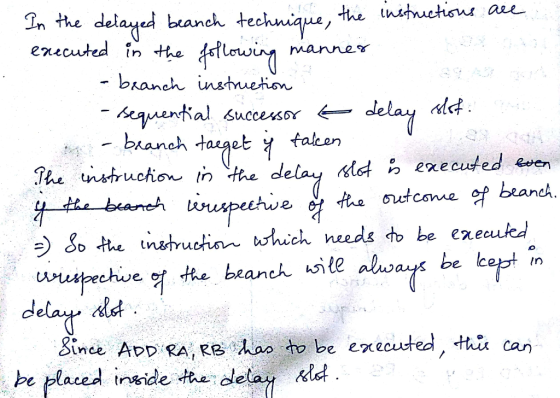
2. (a) Briefly describe the compiler-based register optimization technique (typically (4 marks) (b) Describe the delayed branch technique and explain why it is more common in (4 marks) tetch, ind...
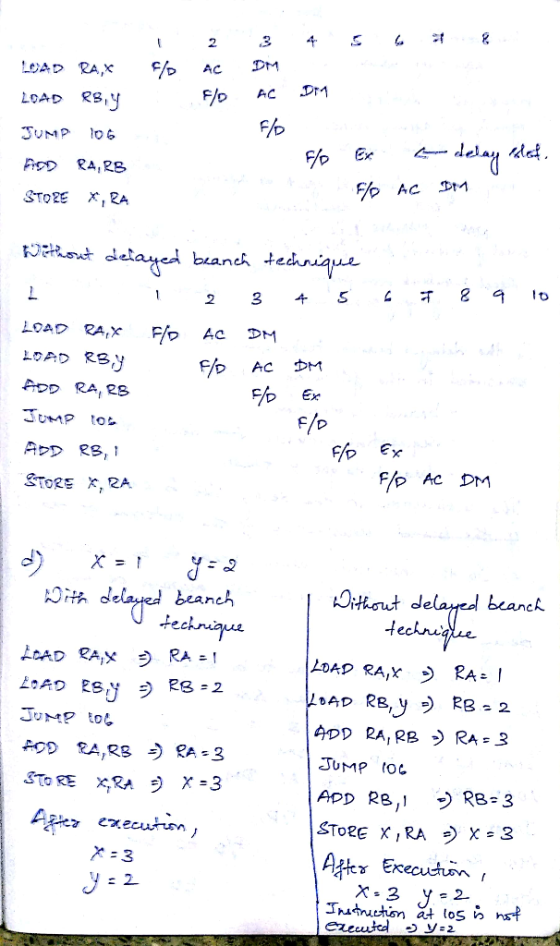
 2. (a) Briefly describe the compiler-based register optimization technique (typically (4 marks) (b) Describe the delayed branch technique and explain why it is more common in (4 marks) tetch, indirect and moon used for RISC machines). (c) Show the pipeline activity for the following code fragment with and without applying the delayed branch technique. Assume that there are three pipeline stages (fetch-decode, address calculation, data movement) for load and store RISC machines than in superscalar processors. instructions and two stages...
a) Describe the main techniques used by superscalar processors to achieve a high degree of machine-level parallelism. Consider the following assembly code: I1: LOAD r3 (r1) TO 12: MOVE r4 #1 1...
 a) Describe the main techniques used by superscalar processors
to achieve a high degree of machine-level parallelism.
Consider the following assembly code: I1: LOAD r3 (r1) TO 12: MOVE r4 #1 13: ADD r3 r3 r4 I4: LOAD r2 (r2) 15: MOVE r4 #2 I6: MUL r2 r2 r4 17: MUL r3 r3 r2 I8: LOAD r4 (r1) 19: MOVE r1 #3 I10: ADD r4 r4 r1 I11: MUL r3 r3 r4 Using register renaming reorganise the code from the...
a) Describe the main techniques used by superscalar processors
to achieve a high degree of machine-level parallelism.
Consider the following assembly code: I1: LOAD r3 (r1) TO 12: MOVE r4 #1 13: ADD r3 r3 r4 I4: LOAD r2 (r2) 15: MOVE r4 #2 I6: MUL r2 r2 r4 17: MUL r3 r3 r2 I8: LOAD r4 (r1) 19: MOVE r1 #3 I10: ADD r4 r4 r1 I11: MUL r3 r3 r4 Using register renaming reorganise the code from the...
a) Describe the main techniques used by superscalar processors to achieve a high degree of machine-level...
 a) Describe the main techniques used by superscalar processors
to achieve a high degree of machine-level parallelism.
Consider the following assembly code: I1: LOAD r3 (r1) TO 12: MOVE r4 #1 13: ADD r3 r3 r4 I4: LOAD r2 (r2) 15: MOVE r4 #2 I6: MUL r2 r2 r4 17: MUL r3 r3 r2 I8: LOAD r4 (r1) 19: MOVE r1 #3 I10: ADD r4 r4 r1 I11: MUL r3 r3 r4 Using register renaming reorganise the code from the...
a) Describe the main techniques used by superscalar processors
to achieve a high degree of machine-level parallelism.
Consider the following assembly code: I1: LOAD r3 (r1) TO 12: MOVE r4 #1 13: ADD r3 r3 r4 I4: LOAD r2 (r2) 15: MOVE r4 #2 I6: MUL r2 r2 r4 17: MUL r3 r3 r2 I8: LOAD r4 (r1) 19: MOVE r1 #3 I10: ADD r4 r4 r1 I11: MUL r3 r3 r4 Using register renaming reorganise the code from the...
Hi can you please help me with the question?..thank you.. QUESTION 2 The pipeline in the...
 Hi can you please help me with the question?..thank
you..
QUESTION 2 The pipeline in the ARMI1 CPU is shown in Figure Q2(a). There are three possible (a) paths through the pipeline. The path of the execution depends on what type of instruction is executing (b) Instruction Fetoh Write Decode Execute Back Address DCI Dcz WBIS FE1 FE2 Decode Issue Shif ALU Saturate WBes MAC2 МАСI МАСУ Figure Q2(a) (i) Identify the number of stages for the ARMI1 CPU pipelines....
Hi can you please help me with the question?..thank
you..
QUESTION 2 The pipeline in the ARMI1 CPU is shown in Figure Q2(a). There are three possible (a) paths through the pipeline. The path of the execution depends on what type of instruction is executing (b) Instruction Fetoh Write Decode Execute Back Address DCI Dcz WBIS FE1 FE2 Decode Issue Shif ALU Saturate WBes MAC2 МАСI МАСУ Figure Q2(a) (i) Identify the number of stages for the ARMI1 CPU pipelines....
hi..can you please help me with this question?..thank you.. QUESTION 2 The pipeline in the ARMI1...
 hi..can you please help me with this question?..thank
you..
QUESTION 2 The pipeline in the ARMI1 CPU is shown in Figure Q2(a). There are three possible (a) paths through the pipeline. The path of the execution depends on what type of instruction is executing (b) Instruction Fetoh Write Decode Execute Back Address DCI Dcz WBIS FE1 FE2 Decode Issue Shif ALU Saturate WBes MAC2 МАСI МАСУ Figure Q2(a) (i) Identify the number of stages for the ARMI1 CPU pipelines. [1...
hi..can you please help me with this question?..thank
you..
QUESTION 2 The pipeline in the ARMI1 CPU is shown in Figure Q2(a). There are three possible (a) paths through the pipeline. The path of the execution depends on what type of instruction is executing (b) Instruction Fetoh Write Decode Execute Back Address DCI Dcz WBIS FE1 FE2 Decode Issue Shif ALU Saturate WBes MAC2 МАСI МАСУ Figure Q2(a) (i) Identify the number of stages for the ARMI1 CPU pipelines. [1...
MARIE Assembly Code Problem For the following problem, please create new MARIE instructions by pr...
MARIE Assembly Code Problem For the following problem, please create new MARIE instructions by providing the full MARIE RTN (register transfer notation) for the described operation. Your answer should include the fetch, decode, operand fetch (if necessary), execution and store result (if necessary) stages. When you see X in these instructions, this is a main memory address (the last 12 bits of the 16-bit instruction) – refer to this as IR[11..0] and not X. Problem: LoadZero X – this is...
MARIE Assembly Code Problem For the following problem, please create new MARIE instructions by pr...
MARIE Assembly Code Problem For the following problem, please create new MARIE instructions by providing the full MARIE RTN (register transfer notation) for the described operation. Your answer should include the fetch, decode, operand fetch (if necessary), execution and store result (if necessary) stages. When you see X in these instructions, this is a main memory address (the last 12 bits of the 16-bit instruction) – refer to this as IR[11..0] and not X. Problem: ClearIndirect X – X is...
MARIE Assembly Code Problem For the following problem, please create new MARIE instructions by providing the...
MARIE Assembly Code Problem For the following problem, please create new MARIE instructions by providing the full MARIE RTN (register transfer notation) for the described operation. Your answer should include the fetch, decode, operand fetch (if necessary), execution and store result (if necessary) stages. When you see X in these instructions, this is a main memory address (the last 12 bits of the 16-bit instruction) – refer to this as IR[11..0] and not X. Problem: ClearIndirect X – X is...
For questions 3-4, provide the full MARIE RTN (register transfer notation) for these new MARIE operations....
 For questions 3-4, provide the full MARIE RTN (register transfer notation) for these new MARIE operations. Your answer should include the fetch, decode, operand fetch (if necessary), execution and store result (if necessary) stages. When you see X in these instructions, this is a main memory address (the last 12 bits of the 16-bit instruction) – refer to this as IR[11..0) and not X in your RTN. 3) AutoIncrLoad X - the autoincrement addressing mode is used to access a...
MARIE Assembly Code Problem For the following problem, please create new MARIE instructions by pr...
MARIE Assembly Code Problem For the following problem, please create new MARIE instructions by providing the full MARIE RTN (register transfer notation) for the described operation. Your answer should include the fetch, decode, operand fetch (if necessary), execution and store result (if necessary) stages. When you see X in these instructions, this is a main memory address (the last 12 bits of the 16-bit instruction) – refer to this as IR[11..0] and not X. Also, assume there is an additional...
 2. (a) Briefly describe the compiler-based register optimization technique (typically (4 marks) (b) Describe the delayed branch technique and explain why it is more common in (4 marks) tetch, indirect and moon used for RISC machines). (c) Show the pipeline activity for the following code fragment with and without applying the delayed branch technique. Assume that there are three pipeline stages (fetch-decode, address calculation, data movement) for load and store RISC machines than in superscalar processors. instructions and two stages...
 a) Describe the main techniques used by superscalar processors
to achieve a high degree of machine-level parallelism.
Consider the following assembly code: I1: LOAD r3 (r1) TO 12: MOVE r4 #1 13: ADD r3 r3 r4 I4: LOAD r2 (r2) 15: MOVE r4 #2 I6: MUL r2 r2 r4 17: MUL r3 r3 r2 I8: LOAD r4 (r1) 19: MOVE r1 #3 I10: ADD r4 r4 r1 I11: MUL r3 r3 r4 Using register renaming reorganise the code from the...
a) Describe the main techniques used by superscalar processors
to achieve a high degree of machine-level parallelism.
Consider the following assembly code: I1: LOAD r3 (r1) TO 12: MOVE r4 #1 13: ADD r3 r3 r4 I4: LOAD r2 (r2) 15: MOVE r4 #2 I6: MUL r2 r2 r4 17: MUL r3 r3 r2 I8: LOAD r4 (r1) 19: MOVE r1 #3 I10: ADD r4 r4 r1 I11: MUL r3 r3 r4 Using register renaming reorganise the code from the...
 a) Describe the main techniques used by superscalar processors
to achieve a high degree of machine-level parallelism.
Consider the following assembly code: I1: LOAD r3 (r1) TO 12: MOVE r4 #1 13: ADD r3 r3 r4 I4: LOAD r2 (r2) 15: MOVE r4 #2 I6: MUL r2 r2 r4 17: MUL r3 r3 r2 I8: LOAD r4 (r1) 19: MOVE r1 #3 I10: ADD r4 r4 r1 I11: MUL r3 r3 r4 Using register renaming reorganise the code from the...
a) Describe the main techniques used by superscalar processors
to achieve a high degree of machine-level parallelism.
Consider the following assembly code: I1: LOAD r3 (r1) TO 12: MOVE r4 #1 13: ADD r3 r3 r4 I4: LOAD r2 (r2) 15: MOVE r4 #2 I6: MUL r2 r2 r4 17: MUL r3 r3 r2 I8: LOAD r4 (r1) 19: MOVE r1 #3 I10: ADD r4 r4 r1 I11: MUL r3 r3 r4 Using register renaming reorganise the code from the...
 Hi can you please help me with the question?..thank
you..
QUESTION 2 The pipeline in the ARMI1 CPU is shown in Figure Q2(a). There are three possible (a) paths through the pipeline. The path of the execution depends on what type of instruction is executing (b) Instruction Fetoh Write Decode Execute Back Address DCI Dcz WBIS FE1 FE2 Decode Issue Shif ALU Saturate WBes MAC2 МАСI МАСУ Figure Q2(a) (i) Identify the number of stages for the ARMI1 CPU pipelines....
Hi can you please help me with the question?..thank
you..
QUESTION 2 The pipeline in the ARMI1 CPU is shown in Figure Q2(a). There are three possible (a) paths through the pipeline. The path of the execution depends on what type of instruction is executing (b) Instruction Fetoh Write Decode Execute Back Address DCI Dcz WBIS FE1 FE2 Decode Issue Shif ALU Saturate WBes MAC2 МАСI МАСУ Figure Q2(a) (i) Identify the number of stages for the ARMI1 CPU pipelines....
 hi..can you please help me with this question?..thank
you..
QUESTION 2 The pipeline in the ARMI1 CPU is shown in Figure Q2(a). There are three possible (a) paths through the pipeline. The path of the execution depends on what type of instruction is executing (b) Instruction Fetoh Write Decode Execute Back Address DCI Dcz WBIS FE1 FE2 Decode Issue Shif ALU Saturate WBes MAC2 МАСI МАСУ Figure Q2(a) (i) Identify the number of stages for the ARMI1 CPU pipelines. [1...
hi..can you please help me with this question?..thank
you..
QUESTION 2 The pipeline in the ARMI1 CPU is shown in Figure Q2(a). There are three possible (a) paths through the pipeline. The path of the execution depends on what type of instruction is executing (b) Instruction Fetoh Write Decode Execute Back Address DCI Dcz WBIS FE1 FE2 Decode Issue Shif ALU Saturate WBes MAC2 МАСI МАСУ Figure Q2(a) (i) Identify the number of stages for the ARMI1 CPU pipelines. [1...
 For questions 3-4, provide the full MARIE RTN (register transfer notation) for these new MARIE operations. Your answer should include the fetch, decode, operand fetch (if necessary), execution and store result (if necessary) stages. When you see X in these instructions, this is a main memory address (the last 12 bits of the 16-bit instruction) – refer to this as IR[11..0) and not X in your RTN. 3) AutoIncrLoad X - the autoincrement addressing mode is used to access a...
Most questions answered within 3 hours.
-
Where is the error in this code sequence?
String s1 = "Hello";
String s2 = "ello";...
asked 10 months ago -
Financial data for Joel de Paris, Inc., for last year
follow:
Joel de Paris, Inc.
Balance...
asked 10 months ago -
Consider this reaction:
Al2(SO4)3 (aq)+ BaCl3
(aq) Al2Cl6 (aq)- +
3BaSO4(s) . What is the...
asked 10 months ago -
Suppose that Savneet is considering increasing her
recent random sample from 20 car rentals to 40...
asked 10 months ago -
Trucks arrive at an unloading terminal at an average rate of 120
per hour.
Trucks arrive...
asked 10 months ago -
Why are methanol and ethanol completely soluble in water while
octanol is not very little soluble....
asked 10 months ago -
A facilities manager at a university reads in a research report
that the mean amount of...
asked 10 months ago -
When the CuSO4 is rehydrated by adding water to the anhydrous
compound, is this an endothermic...
asked 10 months ago -
A ray of sunlight is passing from diamond into crown glass; the
angle of incidence is...
asked 10 months ago -
A block of mass 0.249 kg is placed on top of a light, vertical
spring of...
asked 10 months ago -
how do the kidneys compensate in the presences of acidosis
a) trigger hyperventilate
b) reserve acid...
asked 10 months ago -
Question 501 pts
The rental rate of capital to the firm increases. Which of the
following...
asked 10 months ago