MARIE Assembly Code Problem For the following problem, please create new MARIE instructions by pr...
MARIE Assembly Code Problem
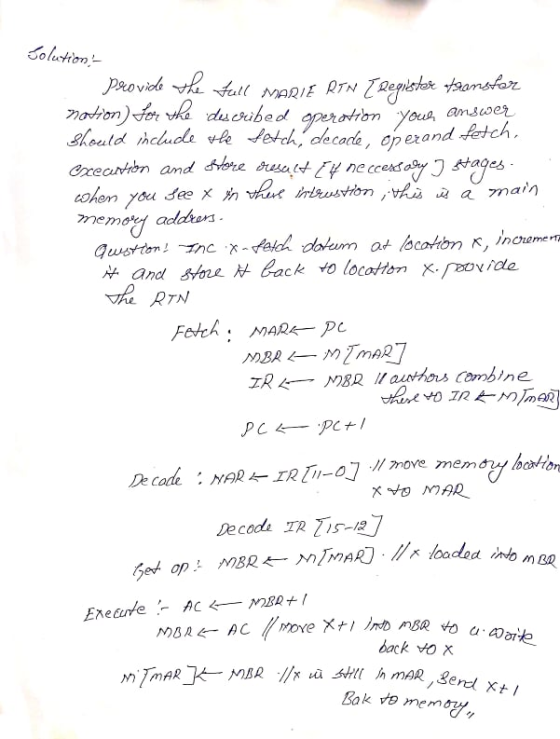
For the following problem, please create new MARIE instructions by providing the full MARIE RTN (register transfer notation) for the described operation. Your answer should include the fetch, decode, operand fetch (if necessary), execution and store result (if necessary) stages. When you see X in these instructions, this is a main memory address (the last 12 bits of the 16-bit instruction) – refer to this as IR[11..0] and not X.
Problem:
LoadZero X – this is a conditional instruction, if the AC currently stores the value 0, then load the datum at memory location X
Homework Answers
Add Answer to:
MARIE Assembly Code Problem For the following problem, please create new MARIE instructions by pr...
MARIE Assembly Code Problem For the following problem, please create new MARIE instructions by pr...
MARIE Assembly Code Problem For the following problem, please create new MARIE instructions by providing the full MARIE RTN (register transfer notation) for the described operation. Your answer should include the fetch, decode, operand fetch (if necessary), execution and store result (if necessary) stages. When you see X in these instructions, this is a main memory address (the last 12 bits of the 16-bit instruction) – refer to this as IR[11..0] and not X. Also, assume there is an additional...
MARIE Assembly Code Problem For the following problem, please create new MARIE instructions by pr...
MARIE Assembly Code Problem For the following problem, please create new MARIE instructions by providing the full MARIE RTN (register transfer notation) for the described operation. Your answer should include the fetch, decode, operand fetch (if necessary), execution and store result (if necessary) stages. When you see X in these instructions, this is a main memory address (the last 12 bits of the 16-bit instruction) – refer to this as IR[11..0] and not X. Problem: ClearIndirect X – X is...
MARIE Assembly Code Problem For the following problem, please create new MARIE instructions by providing the...
MARIE Assembly Code Problem For the following problem, please create new MARIE instructions by providing the full MARIE RTN (register transfer notation) for the described operation. Your answer should include the fetch, decode, operand fetch (if necessary), execution and store result (if necessary) stages. When you see X in these instructions, this is a main memory address (the last 12 bits of the 16-bit instruction) – refer to this as IR[11..0] and not X. Problem: ClearIndirect X – X is...
For questions 3-4, provide the full MARIE RTN (register transfer notation) for these new MARIE operations....
 For questions 3-4, provide the full MARIE RTN (register transfer notation) for these new MARIE operations. Your answer should include the fetch, decode, operand fetch (if necessary), execution and store result (if necessary) stages. When you see X in these instructions, this is a main memory address (the last 12 bits of the 16-bit instruction) – refer to this as IR[11..0) and not X in your RTN. 3) AutoIncrLoad X - the autoincrement addressing mode is used to access a...
[20 pts] 5- Consider the following hypothetical 1-address assembly instruction called "Store Accumulator Indirect with Post-increment"...
 [20 pts] 5- Consider the following hypothetical 1-address assembly instruction called "Store Accumulator Indirect with Post-increment" of the form STA (x)- : M(M(x)) ← AC, M(x) ← M(x)+1 Suppose we want to implement this instruction on the pseudo-CPU discussed in class augmented with a temporary register TEMP. An instruction consists of 16 bits: A 4-bit opcode and a 12-bit address. All operands are 16 bits. PC and MAR each contain 12 bits. AC, MDR, and TEMP each contain 16 bits,...
b. A microprocessor has an instruction set that consists of 117 instructions, which need fetch, decode, read operand, execute, write and interrupt stages. Assume that as an average, each stage requir...
 b. A microprocessor has an instruction set that consists of 117 instructions, which need fetch, decode, read operand, execute, write and interrupt stages. Assume that as an average, each stage requires three micro- operations to complete. Also, assume that the control memory is N bits wide (i.e., control field bits + address selection field bits + address-one bits + address-two bits N bits). The control field bits are 15 and there are 15 flags to be monitored. i. How many...
all info in picture 3. Let's say that Marie added a new command: inc X that adds 1 to the value stored at memory location X. a. Is there an opcode available for this instruction? If so, what o...
 all info in picture
3. Let's say that Marie added a new command: inc X that adds 1 to the value stored at memory location X. a. Is there an opcode available for this instruction? If so, what opcode would you use? b. Show the RTN for the inc command. Bus 0 Main Memory MAR 2 PC MBR ALU AC InREG 6 OutREG 16-bit bus 4. Write a MARIE program that computes and outputs the absolute value of an input...
all info in picture
3. Let's say that Marie added a new command: inc X that adds 1 to the value stored at memory location X. a. Is there an opcode available for this instruction? If so, what opcode would you use? b. Show the RTN for the inc command. Bus 0 Main Memory MAR 2 PC MBR ALU AC InREG 6 OutREG 16-bit bus 4. Write a MARIE program that computes and outputs the absolute value of an input...
A 5-Stage pipeline is composed of the following stages Instruction Fetch (IF), Decode (DE), Execute (EX), Memory Access...
 A 5-Stage pipeline is composed
of the following stages Instruction Fetch (IF), Decode (DE),
Execute (EX), Memory Access (ME) and Register Write-back (WB).
Assume the pipeline does not have a branch prediction unit, does
not have superscalar support and does not support out of order
execution. Assume that all memory accesses are in the L1 cache and
therefore do not introduce any stalls. Show a pipeline diagram that
shows the execution of each stage for the assembly code below. Also...
A 5-Stage pipeline is composed
of the following stages Instruction Fetch (IF), Decode (DE),
Execute (EX), Memory Access (ME) and Register Write-back (WB).
Assume the pipeline does not have a branch prediction unit, does
not have superscalar support and does not support out of order
execution. Assume that all memory accesses are in the L1 cache and
therefore do not introduce any stalls. Show a pipeline diagram that
shows the execution of each stage for the assembly code below. Also...
1. One of the reasons why the MARE architecture is very inefficient is because it only has 1AC As...
 I
need answer for qustion (2)
1. One of the reasons why the MARE architecture is very inefficient is because it only has 1AC Assuming that you have access to many other ACs (AC, AC1, AC2, etc) Assume that in the new MARIE Architecture, you can do ADD 105 AC1 This means: Value @ x105 ACAC or suB 104 AC2 → This means: Valus @ x 104 + AC → AC2 How would your program (Lab #s, Question 1, also...
I
need answer for qustion (2)
1. One of the reasons why the MARE architecture is very inefficient is because it only has 1AC Assuming that you have access to many other ACs (AC, AC1, AC2, etc) Assume that in the new MARIE Architecture, you can do ADD 105 AC1 This means: Value @ x105 ACAC or suB 104 AC2 → This means: Valus @ x 104 + AC → AC2 How would your program (Lab #s, Question 1, also...
RISC machines than in superscalar processuIS. (c) Show the pipeline activity for the following code fragment with a...
 RISC machines than in superscalar processuIS. (c) Show the pipeline activity for the following code fragment with and without applying the delayed branch technique. Assume that there are three pipeline stages (fetch-decode, address calculation, data movement) for load and store instructions and two stages (fetch-decode, execute) for ALU instructions. Address Instruction Comment 100 LOAD RA,X X ->RA 101 LOAD RB,Y ADD RA,RB RA RB -> RA 102 103 104 JUMP 106 ADD RB,1 STORE Y, RB STORE X,RA RB-> Y...
 For questions 3-4, provide the full MARIE RTN (register transfer notation) for these new MARIE operations. Your answer should include the fetch, decode, operand fetch (if necessary), execution and store result (if necessary) stages. When you see X in these instructions, this is a main memory address (the last 12 bits of the 16-bit instruction) – refer to this as IR[11..0) and not X in your RTN. 3) AutoIncrLoad X - the autoincrement addressing mode is used to access a...
 [20 pts] 5- Consider the following hypothetical 1-address assembly instruction called "Store Accumulator Indirect with Post-increment" of the form STA (x)- : M(M(x)) ← AC, M(x) ← M(x)+1 Suppose we want to implement this instruction on the pseudo-CPU discussed in class augmented with a temporary register TEMP. An instruction consists of 16 bits: A 4-bit opcode and a 12-bit address. All operands are 16 bits. PC and MAR each contain 12 bits. AC, MDR, and TEMP each contain 16 bits,...
 b. A microprocessor has an instruction set that consists of 117 instructions, which need fetch, decode, read operand, execute, write and interrupt stages. Assume that as an average, each stage requires three micro- operations to complete. Also, assume that the control memory is N bits wide (i.e., control field bits + address selection field bits + address-one bits + address-two bits N bits). The control field bits are 15 and there are 15 flags to be monitored. i. How many...
 all info in picture
3. Let's say that Marie added a new command: inc X that adds 1 to the value stored at memory location X. a. Is there an opcode available for this instruction? If so, what opcode would you use? b. Show the RTN for the inc command. Bus 0 Main Memory MAR 2 PC MBR ALU AC InREG 6 OutREG 16-bit bus 4. Write a MARIE program that computes and outputs the absolute value of an input...
all info in picture
3. Let's say that Marie added a new command: inc X that adds 1 to the value stored at memory location X. a. Is there an opcode available for this instruction? If so, what opcode would you use? b. Show the RTN for the inc command. Bus 0 Main Memory MAR 2 PC MBR ALU AC InREG 6 OutREG 16-bit bus 4. Write a MARIE program that computes and outputs the absolute value of an input...
 A 5-Stage pipeline is composed
of the following stages Instruction Fetch (IF), Decode (DE),
Execute (EX), Memory Access (ME) and Register Write-back (WB).
Assume the pipeline does not have a branch prediction unit, does
not have superscalar support and does not support out of order
execution. Assume that all memory accesses are in the L1 cache and
therefore do not introduce any stalls. Show a pipeline diagram that
shows the execution of each stage for the assembly code below. Also...
A 5-Stage pipeline is composed
of the following stages Instruction Fetch (IF), Decode (DE),
Execute (EX), Memory Access (ME) and Register Write-back (WB).
Assume the pipeline does not have a branch prediction unit, does
not have superscalar support and does not support out of order
execution. Assume that all memory accesses are in the L1 cache and
therefore do not introduce any stalls. Show a pipeline diagram that
shows the execution of each stage for the assembly code below. Also...
 I
need answer for qustion (2)
1. One of the reasons why the MARE architecture is very inefficient is because it only has 1AC Assuming that you have access to many other ACs (AC, AC1, AC2, etc) Assume that in the new MARIE Architecture, you can do ADD 105 AC1 This means: Value @ x105 ACAC or suB 104 AC2 → This means: Valus @ x 104 + AC → AC2 How would your program (Lab #s, Question 1, also...
I
need answer for qustion (2)
1. One of the reasons why the MARE architecture is very inefficient is because it only has 1AC Assuming that you have access to many other ACs (AC, AC1, AC2, etc) Assume that in the new MARIE Architecture, you can do ADD 105 AC1 This means: Value @ x105 ACAC or suB 104 AC2 → This means: Valus @ x 104 + AC → AC2 How would your program (Lab #s, Question 1, also...
 RISC machines than in superscalar processuIS. (c) Show the pipeline activity for the following code fragment with and without applying the delayed branch technique. Assume that there are three pipeline stages (fetch-decode, address calculation, data movement) for load and store instructions and two stages (fetch-decode, execute) for ALU instructions. Address Instruction Comment 100 LOAD RA,X X ->RA 101 LOAD RB,Y ADD RA,RB RA RB -> RA 102 103 104 JUMP 106 ADD RB,1 STORE Y, RB STORE X,RA RB-> Y...
Most questions answered within 3 hours.
-
Where is the error in this code sequence?
String s1 = "Hello";
String s2 = "ello";...
asked 11 months ago -
Financial data for Joel de Paris, Inc., for last year
follow:
Joel de Paris, Inc.
Balance...
asked 11 months ago -
Consider this reaction:
Al2(SO4)3 (aq)+ BaCl3
(aq) Al2Cl6 (aq)- +
3BaSO4(s) . What is the...
asked 11 months ago -
Suppose that Savneet is considering increasing her
recent random sample from 20 car rentals to 40...
asked 11 months ago -
Trucks arrive at an unloading terminal at an average rate of 120
per hour.
Trucks arrive...
asked 11 months ago -
Why are methanol and ethanol completely soluble in water while
octanol is not very little soluble....
asked 11 months ago -
A facilities manager at a university reads in a research report
that the mean amount of...
asked 11 months ago -
When the CuSO4 is rehydrated by adding water to the anhydrous
compound, is this an endothermic...
asked 11 months ago -
A ray of sunlight is passing from diamond into crown glass; the
angle of incidence is...
asked 11 months ago -
A block of mass 0.249 kg is placed on top of a light, vertical
spring of...
asked 11 months ago -
how do the kidneys compensate in the presences of acidosis
a) trigger hyperventilate
b) reserve acid...
asked 11 months ago -
Question 501 pts
The rental rate of capital to the firm increases. Which of the
following...
asked 11 months ago