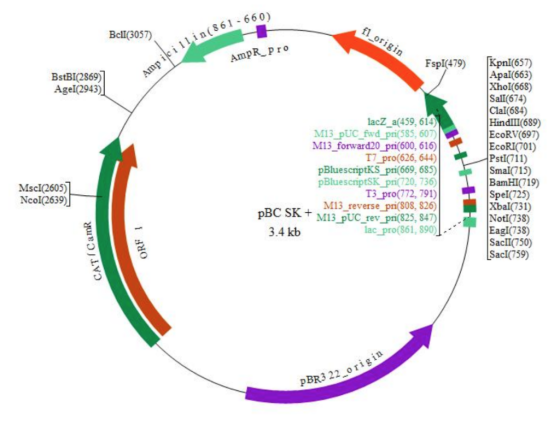
If the target DNA (the 3.266 Kb E. coli genomic Bam HI fragment) has the same restriction sites on each end, there are two possible orientations for the target DNA to insert into the plasmid. The following restriction enzymes would cut the 3.266 kb Bam HI genomic fragment containing the RecA gene once or twice or not at all. In the tables below, list the expected DNA fragment sizes for the two possible orientations. Round the DNA fragment sizes to the nearest 0.1 kbp. The restriction sites within the multiple cloning site (also called polylinker) are shown in the figure below.
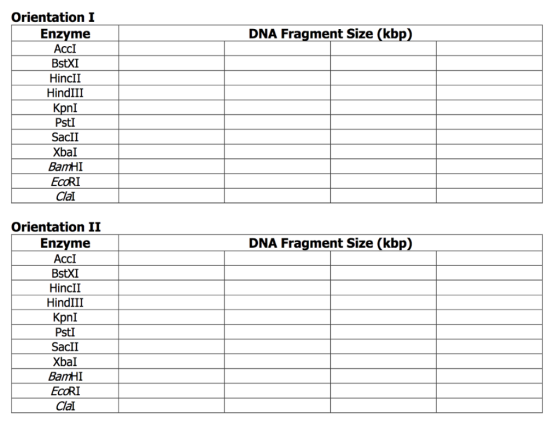
Orientation I DNA Fragment Size (kb Enzyme AccI BstXI HincII HindIII Kpnl PstI SacII Xbal BamHI EcoRI Clal Orientation II DNA Fragment Size (kbp Enzyme ACCI BstXI HincII HindIII nI PstI SacII Xbal BamHI EcoRI Clal
Homework Answers
1. Imagine that you have recently finished your undergraduate, graduate and post- doctoral studies in molecular biology. You have a modest sized lab with a limited budget. You have decided to study DNA repair and recombination in E. coli. At your request, your best friend from graduate school sends you a clone of the recA gene. She has told you that the gene is included in a 3.266 kb Bam HI genomic fragment that she has subcloned into the pBC vector (see Figure 1). However, she has never checked the orientation of the insert in the plasmid and you must determine it using restriction mapping.
2. Obtain the sequence of the E. coli Bam HI genomic fragment that contains the recA gene. As a place to start, the following link will take you to the NCBI homepage: http://www.ncbi.nlm.nih.gov/.

3. Next, let the computer generate the restriction enzyme sites for you! One possibility is going to the Saccharomyces Genome Database http://www.yeastgenome.org/ and clicking Important: Find the recA gene sequence from strain K-12. Substrain W3110on the "Analyze" tab and then selecting "Restriction Mapper". Next, paste the E. coli sequence into the "Yeast Genome Restriction Analysis" to generate a map.
4. Restriction Mapping Using the information that you obtain, draw the restriction map of the 3.266 kb fragment containing the recA gene including the following enzyme sites: Alu I, Ava II, Bgl II, Cla I, Dra I, Hind III, Pvu II, Pst I and Eco RI. The map is a horizontal line with marks indicating the position of each restriction enzyme recognition site. Mark each site with its appropriate location, relative to the 5' Bam HI site (i.e. assign the 5' Bam HI site position 1). Draw the coordinates of the recA gene onto the restriction map.
5. Determination of Target DNA
Orientation If the target DNA (the 3.266 Kb E. coli
genomic BamHI fragment in your experiment) has the same restriction
sites on each end, there are two possible orientations for the
target DNA to insert into the plasmid.

- The figure below shows the two possible plasmid maps that would result from inserting this 3.266 kb Bam HI fragment into the pBC vector. The indicated restriction enzyme sites are Bam HI and the Eco RI site in the pBC polylinker and Cla I. The pBC vector is the portion from BamHI (719) counterclockwise to BamHI (3985). BamHI (719), EcoRI (701) and Cla1 (684) refer to the restriction sites in the polylinker as shown in the pBC figure on page 5. The remainder of the map (coordinates 719 to 3985) is the 3.266 kb BamHI target DNA having the recA gene. IMPORTANT: Potential EcoRI and ClaI sites within the 3.266 kB BamHI fragment are not shown.
6. The following restriction enzymes would cut the 3.266 kb BamHI genomic fragment containing the RecA gene once or twice or not at all. In the tables below, list the expected DNA fragment sizes for the two possible orientations. In each case, the sizes of all of the fragments should be close to 6.6 kb. Round the DNA fragment sizes to the nearest 0.1 kbp. Orientation 1 and 2 refer to the orientations shown above. The restriction sites within the multiple cloning site (also called polylinker)
Add Answer to:
If the target DNA (the 3.266 Kb E. coli genomic Bam HI fragment) has the same restriction sites on each end, there are t...
Chromosomal and plasmid DNA can be cut into manageable pieces by restriction enzymes. Using agarose gel...
 Chromosomal and plasmid DNA can be cut into manageable pieces by
restriction enzymes. Using agarose gel electrophoresis, the DNA
fragments can be separated on a gel, based on their lengths. In
order to see the fragments, a stain is typically added to the gel.
The size of each fragment can be determined by comparing each one
to a DNA molecular weight marker of known size.
Below is a map of pBR22 plasmid. The position and base pair
number of the...
Chromosomal and plasmid DNA can be cut into manageable pieces by
restriction enzymes. Using agarose gel electrophoresis, the DNA
fragments can be separated on a gel, based on their lengths. In
order to see the fragments, a stain is typically added to the gel.
The size of each fragment can be determined by comparing each one
to a DNA molecular weight marker of known size.
Below is a map of pBR22 plasmid. The position and base pair
number of the...
 Chromosomal and plasmid DNA can be cut into manageable pieces by
restriction enzymes. Using agarose gel electrophoresis, the DNA
fragments can be separated on a gel, based on their lengths. In
order to see the fragments, a stain is typically added to the gel.
The size of each fragment can be determined by comparing each one
to a DNA molecular weight marker of known size.
Below is a map of pBR22 plasmid. The position and base pair
number of the...
Chromosomal and plasmid DNA can be cut into manageable pieces by
restriction enzymes. Using agarose gel electrophoresis, the DNA
fragments can be separated on a gel, based on their lengths. In
order to see the fragments, a stain is typically added to the gel.
The size of each fragment can be determined by comparing each one
to a DNA molecular weight marker of known size.
Below is a map of pBR22 plasmid. The position and base pair
number of the...
Most questions answered within 3 hours.
-
Where is the error in this code sequence?
String s1 = "Hello";
String s2 = "ello";...
asked 10 months ago -
Financial data for Joel de Paris, Inc., for last year
follow:
Joel de Paris, Inc.
Balance...
asked 10 months ago -
Consider this reaction:
Al2(SO4)3 (aq)+ BaCl3
(aq) Al2Cl6 (aq)- +
3BaSO4(s) . What is the...
asked 10 months ago -
Suppose that Savneet is considering increasing her
recent random sample from 20 car rentals to 40...
asked 10 months ago -
Trucks arrive at an unloading terminal at an average rate of 120
per hour.
Trucks arrive...
asked 10 months ago -
Why are methanol and ethanol completely soluble in water while
octanol is not very little soluble....
asked 10 months ago -
A facilities manager at a university reads in a research report
that the mean amount of...
asked 10 months ago -
When the CuSO4 is rehydrated by adding water to the anhydrous
compound, is this an endothermic...
asked 10 months ago -
A ray of sunlight is passing from diamond into crown glass; the
angle of incidence is...
asked 10 months ago -
A block of mass 0.249 kg is placed on top of a light, vertical
spring of...
asked 10 months ago -
how do the kidneys compensate in the presences of acidosis
a) trigger hyperventilate
b) reserve acid...
asked 10 months ago -
Question 501 pts
The rental rate of capital to the firm increases. Which of the
following...
asked 10 months ago