Current Population Reports presents data on the ages of married people. Ten married couples are randomly selected and ha...
Current Population Reports presents data on the ages of married people. Ten married couples are randomly selected and have the ages shown here:
Do the data suggest that the mean age of married men is greater than the mean age of married women? Test at 3% level of significance. (You may use R, again, remember to check conditions) (hint: if you look at a problem and are not sure whether you should use paired t-test or 2 sample t-test, you can check whether the data have a linear trend.)
Homework Answers

Add Answer to:
Current Population Reports presents data on the ages of married people. Ten married couples are randomly selected and ha...
The U.S. Census Bureau collects data on the ages of married people. Suppose that eight married...
The U.S. Census Bureau collects data on the ages of married people. Suppose that eight married couples are randomly selected and have the ages given in the following table. Determine the 98% confidence interval for the true mean difference between the ages of married males and married females. Let d=(age of husband)−(age of wife). Assume that the ages are normally distributed for the populations of both husbands and wives in the U.S. Husband 70 52 37 39 59 30 31...
The U.S. Census Bureau collects data on the ages of married people. Suppose that eight married...
The U.S. Census Bureau collects data on the ages of married people. Suppose that eight married couples are randomly selected and have the ages given in the following table. Determine the 80%80% confidence interval for the true mean difference between the ages of married males and married females. Let d=(age of husband)−(age of wife)d=(age of husband)−(age of wife). Assume that the ages are normally distributed for the populations of both husbands and wives in the U.S. Husband 31 48 49...
The U.S. Census Bureau collects data on the ages of married people. Suppose that eight married...
The U.S. Census Bureau collects data on the ages of married people. Suppose that eight married couples are randomly selected and have the ages given in the following table. Determine the 90% confidence interval for the true mean difference between the ages of married males and married females. Let d=(age of husband)−(age of wife). Assume that the ages are normally distributed for the populations of both husbands and wives in the U.S.: Husband: 75 41 62 38 53 27 59...
*The U.S. Census Bureau collects data on the ages of married people. Suppose that eight married...
*The U.S. Census Bureau collects data on the ages of married people. Suppose that eight married couples are randomly selected and have the ages given in the following table. Determine the 99%99% confidence interval for the true mean difference between the ages of married males and married females. Let d=(age of husband)−(age of wife). Assume that the ages are normally distributed for the populations of both husbands and wives in the U.S. Husband 26 55 58 54 49 60 64...
The population mean of ages for all females on the Titanic (survivors and non-survivors) was 25.2...
The population mean of ages for all females on the Titanic (survivors and non-survivors) was 25.2 years. Is the sample data you were given for the female ages the same as the population ages? Use a .05 level of significance. Here is the data of sample ages (It could be different from the Titanic data you have in the last question so make sure you run the data again). 38, 26, 35, 27,14, 4, 58, 14, 55, 31,15, 8, 38...
Randomly selected 20 student cars (population 1) have ages with a mean of 7 years and...
Randomly selected 20 student cars (population 1) have ages with a mean of 7 years and a standard deviation of 3.6 years, while randomly selected 22 faculty cars (population 2) have ages with a mean of 5.4 years and a standard deviation of 3.5 years. (For the purposes of this exercise, the two populations are assumed to be normally distributed.) 1. Use a 0.01 significance level to test the claim that student cars are older than faculty cars. The test...
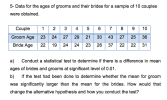
DO NOT use Excel for the question! 5- Data for the ages of grooms and their...
 DO NOT use Excel for the question!
5- Data for the ages of grooms and their brides for a sample of 10 couples were obtained. Couple 12345 6 78910 Groom Age 23 24 27 29 21 30 43 27 25 36 Bride Age22192424232637 222231 a) Conduct a statistical test to determine if there is a difference in mean ages of brides and grooms at significant level of 0.01. b) If the test had been done to determine whether the mean...
DO NOT use Excel for the question!
5- Data for the ages of grooms and their brides for a sample of 10 couples were obtained. Couple 12345 6 78910 Groom Age 23 24 27 29 21 30 43 27 25 36 Bride Age22192424232637 222231 a) Conduct a statistical test to determine if there is a difference in mean ages of brides and grooms at significant level of 0.01. b) If the test had been done to determine whether the mean...
(1 point) Randomly selected 20 student cars (population 1) have ages with a mean of 8...
 (1 point) Randomly selected 20 student cars (population 1) have ages with a mean of 8 years and a standard deviation of 3.4 years, while randomly selected 22 faculty cars (population 2) have ages with a mean of 5.7 years and a standard deviation of 3.3 years. (For the purposes of this exercise, the two populations are assumed to be normally distributed.) Use a 0.03 significance level to test the claim that student cars are older than faculty cars The...
WBWK7-Sects7.8and8.1-8.4: Problem 6 Prev Up Next 2 pts) Ten randomly selected people took an lQ test...
 WBWK7-Sects7.8and8.1-8.4: Problem 6 Prev Up Next 2 pts) Ten randomly selected people took an lQ test A, and next day they took a very similar IQ test B. Their scores are shown in the table below. Person 12 345 67 8 9 10 Test A 93 104 100 103 90 108 123 82 74 114 Test B 196 108 102 108 87 107 1228172 119 1. Consider (Test A - Test B). Use a 0.01 significance level to test the...
(1 point) Randomly selected 20 student cars (population 1) have ages with a mean of 7.8...
 (1 point) Randomly selected 20 student cars (population 1) have ages with a mean of 7.8 years and a standard deviation of 3.4 years, while randomly selected 22 faculty cars (population 2) have ages with a mean of 5.2 years and a standard deviation of 3.5 years. (For the purposes of this exercise, the two populations are assumed to be normally distributed.) 1. Use a 0.04 significance level to test the claim that student cars are older than faculty cars....
 DO NOT use Excel for the question!
5- Data for the ages of grooms and their brides for a sample of 10 couples were obtained. Couple 12345 6 78910 Groom Age 23 24 27 29 21 30 43 27 25 36 Bride Age22192424232637 222231 a) Conduct a statistical test to determine if there is a difference in mean ages of brides and grooms at significant level of 0.01. b) If the test had been done to determine whether the mean...
DO NOT use Excel for the question!
5- Data for the ages of grooms and their brides for a sample of 10 couples were obtained. Couple 12345 6 78910 Groom Age 23 24 27 29 21 30 43 27 25 36 Bride Age22192424232637 222231 a) Conduct a statistical test to determine if there is a difference in mean ages of brides and grooms at significant level of 0.01. b) If the test had been done to determine whether the mean...
 (1 point) Randomly selected 20 student cars (population 1) have ages with a mean of 8 years and a standard deviation of 3.4 years, while randomly selected 22 faculty cars (population 2) have ages with a mean of 5.7 years and a standard deviation of 3.3 years. (For the purposes of this exercise, the two populations are assumed to be normally distributed.) Use a 0.03 significance level to test the claim that student cars are older than faculty cars The...
 WBWK7-Sects7.8and8.1-8.4: Problem 6 Prev Up Next 2 pts) Ten randomly selected people took an lQ test A, and next day they took a very similar IQ test B. Their scores are shown in the table below. Person 12 345 67 8 9 10 Test A 93 104 100 103 90 108 123 82 74 114 Test B 196 108 102 108 87 107 1228172 119 1. Consider (Test A - Test B). Use a 0.01 significance level to test the...
 (1 point) Randomly selected 20 student cars (population 1) have ages with a mean of 7.8 years and a standard deviation of 3.4 years, while randomly selected 22 faculty cars (population 2) have ages with a mean of 5.2 years and a standard deviation of 3.5 years. (For the purposes of this exercise, the two populations are assumed to be normally distributed.) 1. Use a 0.04 significance level to test the claim that student cars are older than faculty cars....
Most questions answered within 3 hours.
-
Where is the error in this code sequence?
String s1 = "Hello";
String s2 = "ello";...
asked 11 months ago -
Financial data for Joel de Paris, Inc., for last year
follow:
Joel de Paris, Inc.
Balance...
asked 11 months ago -
Consider this reaction:
Al2(SO4)3 (aq)+ BaCl3
(aq) Al2Cl6 (aq)- +
3BaSO4(s) . What is the...
asked 11 months ago -
Suppose that Savneet is considering increasing her
recent random sample from 20 car rentals to 40...
asked 11 months ago -
Trucks arrive at an unloading terminal at an average rate of 120
per hour.
Trucks arrive...
asked 11 months ago -
Why are methanol and ethanol completely soluble in water while
octanol is not very little soluble....
asked 11 months ago -
A facilities manager at a university reads in a research report
that the mean amount of...
asked 11 months ago -
When the CuSO4 is rehydrated by adding water to the anhydrous
compound, is this an endothermic...
asked 11 months ago -
A ray of sunlight is passing from diamond into crown glass; the
angle of incidence is...
asked 11 months ago -
A block of mass 0.249 kg is placed on top of a light, vertical
spring of...
asked 11 months ago -
how do the kidneys compensate in the presences of acidosis
a) trigger hyperventilate
b) reserve acid...
asked 11 months ago -
Question 501 pts
The rental rate of capital to the firm increases. Which of the
following...
asked 11 months ago