A uniform horizontal beam OA, of length a and
weight w per unit length, is clamped horizontally
at O and freely supported at A. The transverse
displacement y of the beam is governed by the
differential equation
where x is the distance along the beam measured
from O, R is the reaction at A, and E and I are
physical constants. At O the boundary conditions
are y(0) = 0 and . Solve the
differential equation. What is the boundary
condition at A? Use this boundary condition to
determine the reaction R. Hence find the maximum
transverse displacement of the beam.
How to answer this question without using MATLAB?

Homework Answers

![3)-下 16 to d to be maximum, dy a-x-a) a-X).te»am] +彋a (a-a+x) (a+Q-x)-0 χ-o įgaeoluhon-for this; but it gives mnimum Value or](http://img.homeworklib.com/images/ce181ffb-c9fd-482c-9fdd-f470963bbbe4.png?x-oss-process=image/resize,w_560)

Add Answer to:
A uniform horizontal beam OA, of length a and weight w per unit length, is clamped horizontally at O and freely supporte...
1. A uniform horizontal beam OA, of length a and weight w per unit length, is...
 1. A uniform horizontal beam OA, of length a and weight w per unit length, is clamped horizontally at O and freely supported at A. The transverse displacement y of the beam is governed by the differential equation d2y El dx2 w(a x)- R(a - x) where x is the distance along the beam measured from O, R is the reaction at A, and E and I are physical constants. At O the boundary conditions are dy (0) = 0....
3. Determine the shape of the deflection curve of a uniform horizontal beam of length L and weight per unit length...
 3. Determine the shape of the deflection curve of a uniform horizontal beam of length L and weight per unit length w that is fixed (horizontally) at the right end a1 and simply supported at the left end z = 0.
3. Determine the shape of the deflection curve of a uniform horizontal beam of length L and weight per unit length w that is fixed (horizontally) at the right end a1 and simply supported at the left end z...
3. Determine the shape of the deflection curve of a uniform horizontal beam of length L and weight per unit length w that is fixed (horizontally) at the right end a1 and simply supported at the left end z = 0.
3. Determine the shape of the deflection curve of a uniform horizontal beam of length L and weight per unit length w that is fixed (horizontally) at the right end a1 and simply supported at the left end z...
the shape of the deflection curve of a uniform horizontal beam of length I 5 and weight per unit length w that is s...
 the shape of the deflection curve of a uniform horizontal beam of length I 5 and weight per unit length w that is simply supported at both ends z 0 and
the shape of the deflection curve of a uniform horizontal beam of length I 5 and weight per unit length w that is simply supported at both ends z 0 and
the shape of the deflection curve of a uniform horizontal beam of length I 5 and weight per unit length w that is simply supported at both ends z 0 and
3. A uniform horizontal beam of length 8.00m and weight 150N is attiched to a wail...
 3. A uniform horizontal beam of length 8.00m and weight 150N is attiched to a wail by a pin connection. Its 47.0P with the far end is supported by a cable that makes an angle of horizontal. A 700 N man stands 2.00m from the wall. (4pts) a) Draw a free body diagram for the beam (6pts) b) Determine the tension in the cable. (6pts) c) Determine the horizontal and vertical components of the reaction force exernte by the wall...
Problem 2: Hanging cable A cable of uniform mass per unit length p(x)-ρ constant, hangs freely fr...
 Problem 2: Hanging cable A cable of uniform mass per unit length p(x)-ρ constant, hangs freely from the ceiling as shown in the figure. Assume that the cable possesses no flexural stiffness. Derive the equation of motion for small horizontal vibrations y(x, t) of the cable as well as the associated boundary conditions.
Problem 2: Hanging cable A cable of uniform mass per unit length p(x)-ρ constant, hangs freely from the ceiling as shown in the figure. Assume that the...
Problem 2: Hanging cable A cable of uniform mass per unit length p(x)-ρ constant, hangs freely from the ceiling as shown in the figure. Assume that the cable possesses no flexural stiffness. Derive the equation of motion for small horizontal vibrations y(x, t) of the cable as well as the associated boundary conditions.
Problem 2: Hanging cable A cable of uniform mass per unit length p(x)-ρ constant, hangs freely from the ceiling as shown in the figure. Assume that the...
ans all parts please 15) (10 Points) Consider a horizontal beam of length L. with uniform...
 ans all parts please
15) (10 Points) Consider a horizontal beam of length L. with uniform cross-section and made out of uniform material. It is resting on the x-axis, with one end at the origin. It is acted upon by a vertical force it's own weight in this simple version). The deflection of the beam at any point x,for 0 <=<L.is given by Ely) = w, where E, I, ware constants. E is the Young's modulus of elasticity of the...
ans all parts please
15) (10 Points) Consider a horizontal beam of length L. with uniform cross-section and made out of uniform material. It is resting on the x-axis, with one end at the origin. It is acted upon by a vertical force it's own weight in this simple version). The deflection of the beam at any point x,for 0 <=<L.is given by Ely) = w, where E, I, ware constants. E is the Young's modulus of elasticity of the...
Question. 4 (20%) A uniformly loaded beam of length "L" is supported at both ends. The deflection y(x) is a function of horizontal position x and is given by the differential equation on...
 Question. 4 (20%) A uniformly loaded beam of length "L" is supported at both ends. The deflection y(x) is a function of horizontal position x and is given by the differential equation on dEl d1 Beat dE 4() Assume q(x) is constant. Determine the equation for y(x) in terms of different variables. Hint: Use laplace transform. Below are boundary conditions: (L)ono dene y"(o) o no deflection at x= 0 and L no bending moment at x 0 and L y...
1. Consider a cable, under tension T, loaded under its own weight per unit length W;...
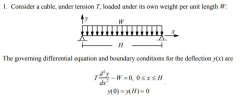 1. Consider a cable, under tension T, loaded under its own weight per unit length W; The governing differential equation and boundary conditions for the deflection y) are d'v y(0)=y(H)=0
Problem 5: A cantilever beam AB of length L supports a uniform load of intensity q...
 Problem 5: A cantilever beam AB of length L supports a uniform load of intensity q (see figure) has a fixed support at A and spring support at B with rotational stiffness kR. Rotation at B, OB results in a reaction moment MB*Rx θ8. Beginning with the second-order differential equation of the deflection curve (the bending-moment equation), find rotation GB and di the end B. (Hint- You will need third boundary condition so read the problem statement carefully) (20 points)...
 1. A uniform horizontal beam OA, of length a and weight w per unit length, is clamped horizontally at O and freely supported at A. The transverse displacement y of the beam is governed by the differential equation d2y El dx2 w(a x)- R(a - x) where x is the distance along the beam measured from O, R is the reaction at A, and E and I are physical constants. At O the boundary conditions are dy (0) = 0....
 3. Determine the shape of the deflection curve of a uniform horizontal beam of length L and weight per unit length w that is fixed (horizontally) at the right end a1 and simply supported at the left end z = 0.
3. Determine the shape of the deflection curve of a uniform horizontal beam of length L and weight per unit length w that is fixed (horizontally) at the right end a1 and simply supported at the left end z...
3. Determine the shape of the deflection curve of a uniform horizontal beam of length L and weight per unit length w that is fixed (horizontally) at the right end a1 and simply supported at the left end z = 0.
3. Determine the shape of the deflection curve of a uniform horizontal beam of length L and weight per unit length w that is fixed (horizontally) at the right end a1 and simply supported at the left end z...
 the shape of the deflection curve of a uniform horizontal beam of length I 5 and weight per unit length w that is simply supported at both ends z 0 and
the shape of the deflection curve of a uniform horizontal beam of length I 5 and weight per unit length w that is simply supported at both ends z 0 and
the shape of the deflection curve of a uniform horizontal beam of length I 5 and weight per unit length w that is simply supported at both ends z 0 and
 3. A uniform horizontal beam of length 8.00m and weight 150N is attiched to a wail by a pin connection. Its 47.0P with the far end is supported by a cable that makes an angle of horizontal. A 700 N man stands 2.00m from the wall. (4pts) a) Draw a free body diagram for the beam (6pts) b) Determine the tension in the cable. (6pts) c) Determine the horizontal and vertical components of the reaction force exernte by the wall...
 Problem 2: Hanging cable A cable of uniform mass per unit length p(x)-ρ constant, hangs freely from the ceiling as shown in the figure. Assume that the cable possesses no flexural stiffness. Derive the equation of motion for small horizontal vibrations y(x, t) of the cable as well as the associated boundary conditions.
Problem 2: Hanging cable A cable of uniform mass per unit length p(x)-ρ constant, hangs freely from the ceiling as shown in the figure. Assume that the...
Problem 2: Hanging cable A cable of uniform mass per unit length p(x)-ρ constant, hangs freely from the ceiling as shown in the figure. Assume that the cable possesses no flexural stiffness. Derive the equation of motion for small horizontal vibrations y(x, t) of the cable as well as the associated boundary conditions.
Problem 2: Hanging cable A cable of uniform mass per unit length p(x)-ρ constant, hangs freely from the ceiling as shown in the figure. Assume that the...
 ans all parts please
15) (10 Points) Consider a horizontal beam of length L. with uniform cross-section and made out of uniform material. It is resting on the x-axis, with one end at the origin. It is acted upon by a vertical force it's own weight in this simple version). The deflection of the beam at any point x,for 0 <=<L.is given by Ely) = w, where E, I, ware constants. E is the Young's modulus of elasticity of the...
ans all parts please
15) (10 Points) Consider a horizontal beam of length L. with uniform cross-section and made out of uniform material. It is resting on the x-axis, with one end at the origin. It is acted upon by a vertical force it's own weight in this simple version). The deflection of the beam at any point x,for 0 <=<L.is given by Ely) = w, where E, I, ware constants. E is the Young's modulus of elasticity of the...
 Question. 4 (20%) A uniformly loaded beam of length "L" is supported at both ends. The deflection y(x) is a function of horizontal position x and is given by the differential equation on dEl d1 Beat dE 4() Assume q(x) is constant. Determine the equation for y(x) in terms of different variables. Hint: Use laplace transform. Below are boundary conditions: (L)ono dene y"(o) o no deflection at x= 0 and L no bending moment at x 0 and L y...
 1. Consider a cable, under tension T, loaded under its own weight per unit length W; The governing differential equation and boundary conditions for the deflection y) are d'v y(0)=y(H)=0
 Problem 5: A cantilever beam AB of length L supports a uniform load of intensity q (see figure) has a fixed support at A and spring support at B with rotational stiffness kR. Rotation at B, OB results in a reaction moment MB*Rx θ8. Beginning with the second-order differential equation of the deflection curve (the bending-moment equation), find rotation GB and di the end B. (Hint- You will need third boundary condition so read the problem statement carefully) (20 points)...
Most questions answered within 3 hours.
-
Where is the error in this code sequence?
String s1 = "Hello";
String s2 = "ello";...
asked 11 months ago -
Financial data for Joel de Paris, Inc., for last year
follow:
Joel de Paris, Inc.
Balance...
asked 11 months ago -
Consider this reaction:
Al2(SO4)3 (aq)+ BaCl3
(aq) Al2Cl6 (aq)- +
3BaSO4(s) . What is the...
asked 11 months ago -
Suppose that Savneet is considering increasing her
recent random sample from 20 car rentals to 40...
asked 11 months ago -
Trucks arrive at an unloading terminal at an average rate of 120
per hour.
Trucks arrive...
asked 11 months ago -
Why are methanol and ethanol completely soluble in water while
octanol is not very little soluble....
asked 11 months ago -
A facilities manager at a university reads in a research report
that the mean amount of...
asked 11 months ago -
When the CuSO4 is rehydrated by adding water to the anhydrous
compound, is this an endothermic...
asked 11 months ago -
A ray of sunlight is passing from diamond into crown glass; the
angle of incidence is...
asked 11 months ago -
A block of mass 0.249 kg is placed on top of a light, vertical
spring of...
asked 11 months ago -
how do the kidneys compensate in the presences of acidosis
a) trigger hyperventilate
b) reserve acid...
asked 11 months ago -
Question 501 pts
The rental rate of capital to the firm increases. Which of the
following...
asked 11 months ago