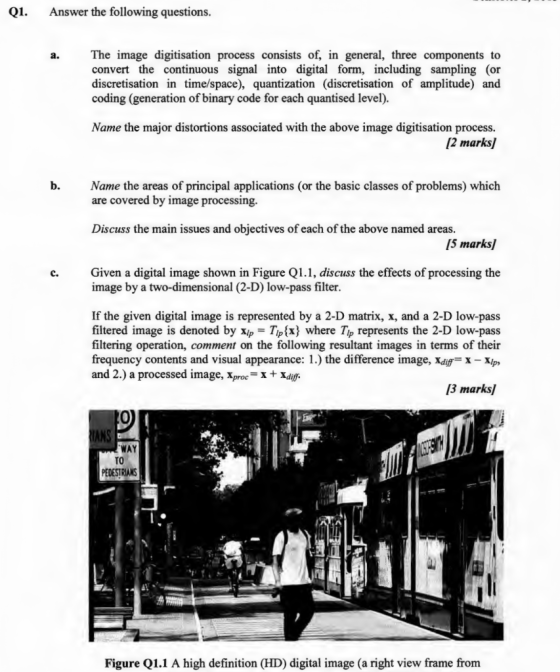
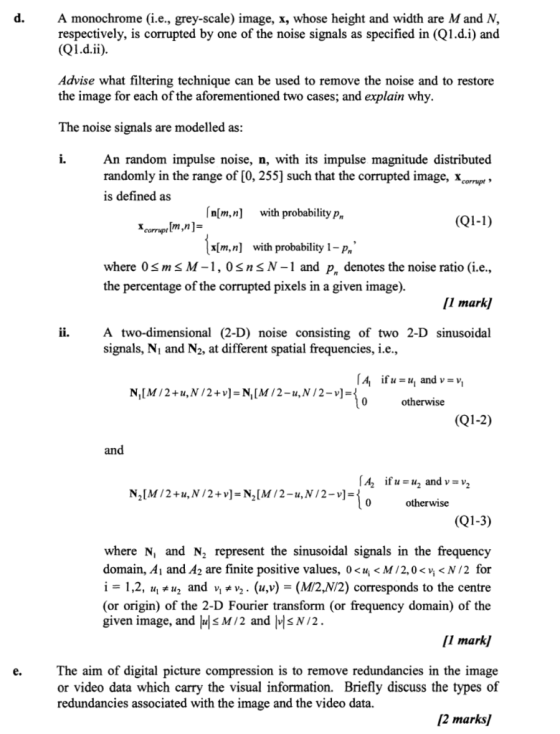
d. A monochrome (i.e., grey-scale) image, x, whose height and width are M and N respectively, is corrupted by one of the noise signals as specified in (Q1.d.i) and (Q1.d.ii) Advise what filtering technique can be used to remove the noise and to restore the image for each of the aforementioned two cases; and explain why. The noise signals are modelled as: i. An random impulse noise, n, with its impulse magnitude distributed randomly in the range of [0, 255] such that the corrupted image, xorrupt ?, is defined as (n[m,n] with probability Pm (Q1-1) Хсоmтрr Lm,n )- m,n] with probability 1-P where 0sms M-1, 0S»SN -1 and p. denotes the noise ratio (i.e., the percentage of the corrupted pixels in a given image) [I mark A two-di ii. sional (2-D) noise consisting of two 2-D sinusoidal signals, N1 and N2, at different spatial frequencies, i.e., A N,[M/2+u,N/2+v] = N}[M/2-u, N/2-v]={ ifu=u, and v = v otherwise (Q1-2 and Aifuu, and v= v2 ,N/2- ]={0 N2IM/2+u, N/2+v]=N2[M/2-u,N otherwise (Q1-3) where N and n2 represent the sinusoidal signals in the frequency domain, A1 and A2 are finite positive values, 0
Homework Answers
Applications of Image Processing
Visual information is the most important type of information
perceived, processed and
interpreted by the human brain. One third of the cortical area of
the human brain is dedicated
to visual information processing.
Digital image processing, as a computer-based technology, carries
out automatic processing,
manipulation and interpretation of such visual information, and it
plays an increasingly
important role in many aspects of our daily life, as well as in a
wide variety of disciplines and
fields in science and technology, with applications such as
television, photography, robotics,
remote sensing, medical diagnosis and industrial inspection.
• Computerized photography (e.g., Photoshop)
• Space image processing (e.g., Hubble space telescope images,
interplanetary probe
images)
• Medical/Biological image processing (e.g., interpretation of
X-ray images, blood/cellular
microscope images)
• Automatic character recognition (zip code, license plate
recognition)
• Finger print/face/iris recognition
• Remote sensing: aerial and satellite image interpretations
• Reconnaissance
• Industrial applications (e.g., product inspection/sorting)
objectives of image processing
Understand differences between computer vision and image
processing.
Know the basic components of an image processing system.
Understand the basics of the human visual system as they relate to
image processing; including spatial frequency resolution and
brightness adaption.
Understand how images are represented; including optical images,
analog images, and digital images. Understand image types such as
binary images, gray-scale images, color and multi-spectral
images.
Know the key concepts in image file formats.
Understand the model for an image analysis process.
Understand why preprocessing is performed and know about image
geometry, convolution masks, image algebra and basic spatial
filters.
Understand image quantization in both the spatial and brightness
domains.
Understand how discrete transforms work; including concepts of
basis images, orthogonality, orthonormality, separability and
reversibility.
Know about the 2-D Fourier, discrete cosine, Walsh-Hadamard and
wavelet transforms; including implied symmetry, phase, circular
convolution, vector inner and outer products and filtering.
Know why log remapping is necessary for viewing spectral image
data.
Understand lowpass, highpass, bandpass, notch filters; including
ideal and non-ideal filters such as the Butterworth.
Non-Trivial world - Consider Segmentation problem !
Accuracy - You will never get satisfied with the results obtained !
(I have never heard 100% results in Image processing)
Hard Coded / No generic solutions - Consider a filtering problem or
a contrast enhancement problem which needs to be solved generic but
varies according to many factors (source, kernel, methods, etc)
resulting in hard coding.
Diversified - More number of ways and many possible solutions for a
problem. For instance you need boundary of a object -> start
with edge detection (you have around 5 edge detection algorithms)
and end up somewhere near skeletonization or distance
transform.
All-Time Research - Start to work an application -> it is
obvious in IP you are not going to attain 100% accuracy ->
continue to improve the accuracy !
Etc ...Etc ... ( end of thinking capability :-P )
Some of well deserved researches are (personally I have used /
known to me)
1. Viola Jones Face detection ( This undergoes all the above
mentioned issues - But still outperforms other methods
available)
2. HOG -Human / Pedestrian Detection
3. Convolution neural networks - Think Facebook uses this method
for its Face recognition which surpassed human capabilities
4. Part Based Models - Improved method of (2)Hog features for Human
/ Pedestrian detection
Add Answer to:
Answer the following questions Q1. The image digitisation process consists of, in general, three components to convert...
Question 4 (a) Find the DFT of the series x[n)-(0.2,1,1,0.2), and sketch the magnitude of the resulting spectral components [10 marks] (b) For a discrete impulse response, h[n], that is symmetric...
 Question 4 (a) Find the DFT of the series x[n)-(0.2,1,1,0.2), and sketch the magnitude of the resulting spectral components [10 marks] (b) For a discrete impulse response, h[n], that is symmetric about the origin, the spectral coefficients of the signal, H(k), can be obtained by use of the DFT He- H(k)- H-(N-1)/2 Conversely, if the spectral coefficients, H(k), are known (and are even and symmetrical about k-0), the original signal, h[n], can be reconstituted using the inverse DFT 1 (N-D/2...
question 2 and 3 () Describe analog and digital signals in terms of Noise and interference...
 question 2 and 3
() Describe analog and digital signals in terms of Noise and interference tolerance 2 Marks Eachl Bandwidth m) Power consumption (iv) Impedance (b) Sute real life examples of stochastic and deterministic [3 Marks (c) Differentiate between impulse response and frequency response of an LTI system [4 Marks] Question Two Find the fourier transform of the following functions and sketch the diagrams. [3 Marks Each] O eftirect(3U4) (i) x 2recut-2) (1) y(t)=x(t)e (iv) (t)-(-3) (v) n(t)rect(t/3)*y(t)cost Question...
question 2 and 3
() Describe analog and digital signals in terms of Noise and interference tolerance 2 Marks Eachl Bandwidth m) Power consumption (iv) Impedance (b) Sute real life examples of stochastic and deterministic [3 Marks (c) Differentiate between impulse response and frequency response of an LTI system [4 Marks] Question Two Find the fourier transform of the following functions and sketch the diagrams. [3 Marks Each] O eftirect(3U4) (i) x 2recut-2) (1) y(t)=x(t)e (iv) (t)-(-3) (v) n(t)rect(t/3)*y(t)cost Question...
QUESTION 1 Characterise the following systems as being either causal on anticausal: yn)-ePyn-1)+u...
 QUESTION 1 Characterise the following systems as being either causal on anticausal: yn)-ePyn-1)+u/n), where u/h) is the unit step and B is an arbitrary constant (B>0), Take y-1)-0. Answer with either causal or 'anticausal only QUESTION 2 For the following system: yn) -yn-1Va -x(n), for a 0.9, find y(10), assuming y(n) - o, for ns -1.Hint: find a closed form for yin) and use it to find the required output sample. (xin)-1 for n>-0) QUESTION 3 A filter has the...
can you please solve this problem step by step, thank you!! 1. Consider a DSB-SC signal...
 can you please solve this problem step by step, thank
you!!
1. Consider a DSB-SC signal with noise passes through a demodulator shown below. ViC0) 2(0) но но 0) The input signal plus noise is v,(t)-5,() + n'(t) where 5,0): Am(1)cos2r/rt, m(1) cos 2π/J is the message signal with f-</м , carrier frequency is f> fe , and noise n' (r) has power spectral density function G,じ)= η . The local carrier is v,(1)s 2 cosZrw. The carrier filter is...
can you please solve this problem step by step, thank
you!!
1. Consider a DSB-SC signal with noise passes through a demodulator shown below. ViC0) 2(0) но но 0) The input signal plus noise is v,(t)-5,() + n'(t) where 5,0): Am(1)cos2r/rt, m(1) cos 2π/J is the message signal with f-</м , carrier frequency is f> fe , and noise n' (r) has power spectral density function G,じ)= η . The local carrier is v,(1)s 2 cosZrw. The carrier filter is...
Could you please provide explanations for each answer? Thank you very much! The Zonama cho-e is a smart device that needs to receive voice signals in small room with an echo (i.e., reverberation clar...
 Could you please provide explanations for each answer? Thank you
very much!
The Zonama cho-e is a smart device that needs to receive voice signals in small room with an echo (i.e., reverberation clarity The goal is to see if a digital filter can provide needed Given that receiving signals in the presence of an echo is a commonplace and practical task, this question looks at a means of understanding and potentially overcoming the echo with a series of filters....
Could you please provide explanations for each answer? Thank you
very much!
The Zonama cho-e is a smart device that needs to receive voice signals in small room with an echo (i.e., reverberation clarity The goal is to see if a digital filter can provide needed Given that receiving signals in the presence of an echo is a commonplace and practical task, this question looks at a means of understanding and potentially overcoming the echo with a series of filters....
Question 2 (50 points]: Continuous-Time Signals Given the following continuous-time signal (t). (t) 5t (a) [4%]...
 Question 2 (50 points]: Continuous-Time Signals Given the following continuous-time signal (t). (t) 5t (a) [4%] What is the fundamental period (i.e., T) and fundamental frequency (ie, wo) of (+)? (b) [8%] Calculate the time average, average power and total energy of x(t). Is x(t) an energy signal? Explain. (c) [8%] Calculate the Fourier series coefficients of (t), i.e., {x}. [Hint: You can make use of the result in Q1(a).] (d) [8%] What is the percentage of power loss if...
LMS project Using the notes discussed in class: Implementing the LMS Algorithm First generate some signals clear all c...
 LMS project Using the notes discussed in class: Implementing the LMS Algorithm First generate some signals clear all close al1: Generate signals for testing the LMS Algorithm 1000 Fs Sampling frequency Sample time 1/Fs 10000: = L Length of signal S Time vector (0:L-1) *T ; Sum of a 50 Hz sinusoid and a 120 Hz sinusoid 0.7 sin (2*pi*50*t); inuside X d+ 10 randn (size (t)); Sinusoids 5O0000000L plus noise fiqure (1) plot (Fs*t (1:150),x (1:1500)) title('Signal Corrupted with...
LMS project Using the notes discussed in class: Implementing the LMS Algorithm First generate some signals...
 LMS project Using the notes discussed in class: Implementing the LMS Algorithm First generate some signals clear all close al1: Generate signals for testing the LMS Algorithm 1000 Fs Sampling frequency Sample time 1/Fs 10000: = L Length of signal S Time vector (0:L-1) *T ; Sum of a 50 Hz sinusoid and a 120 Hz sinusoid 0.7 sin (2*pi*50*t); inuside X d+ 10 randn (size (t)); Sinusoids 5O0000000L plus noise fiqure (1) plot (Fs*t (1:150),x (1:1500)) title('Signal Corrupted with...
Q1. (a) The velocity components of a certain two-dimensional flow field are claimed to be given...
 Q1. (a) The velocity components of a certain two-dimensional flow field are claimed to be given by u =-Cy and v = Cx , where is a constant. (i) Does this velocity distribution satisfy continuity? If yes, what is the stream function y? (8 marks) (ii) Analyse whether the flow is rotational or irrotational. What is the velocity potential o ? (4 marks) (iii) Sketch several y and © lines (if exist) of the flow field. Briefly explain how you...
Make sure you show all working and describe each step in your calculations. 1. A signum function ...
 signals and communications 2
Make sure you show all working and describe each step in your calculations. 1. A signum function is defined as sgn(t) = { 1、12 0 1 t<0 Plot and express this function in terms of the unit-step function. 5 marks/ Determine and plot the even and odd parts of the signal 2. x(t) (te-3 +2)u(t). 5 marks 3. If prove that y[n-m] = x[n-m] * h[n]. 5 marks 4. Assuming α > 0, plot the signal...
signals and communications 2
Make sure you show all working and describe each step in your calculations. 1. A signum function is defined as sgn(t) = { 1、12 0 1 t<0 Plot and express this function in terms of the unit-step function. 5 marks/ Determine and plot the even and odd parts of the signal 2. x(t) (te-3 +2)u(t). 5 marks 3. If prove that y[n-m] = x[n-m] * h[n]. 5 marks 4. Assuming α > 0, plot the signal...
 Question 4 (a) Find the DFT of the series x[n)-(0.2,1,1,0.2), and sketch the magnitude of the resulting spectral components [10 marks] (b) For a discrete impulse response, h[n], that is symmetric about the origin, the spectral coefficients of the signal, H(k), can be obtained by use of the DFT He- H(k)- H-(N-1)/2 Conversely, if the spectral coefficients, H(k), are known (and are even and symmetrical about k-0), the original signal, h[n], can be reconstituted using the inverse DFT 1 (N-D/2...
 question 2 and 3
() Describe analog and digital signals in terms of Noise and interference tolerance 2 Marks Eachl Bandwidth m) Power consumption (iv) Impedance (b) Sute real life examples of stochastic and deterministic [3 Marks (c) Differentiate between impulse response and frequency response of an LTI system [4 Marks] Question Two Find the fourier transform of the following functions and sketch the diagrams. [3 Marks Each] O eftirect(3U4) (i) x 2recut-2) (1) y(t)=x(t)e (iv) (t)-(-3) (v) n(t)rect(t/3)*y(t)cost Question...
question 2 and 3
() Describe analog and digital signals in terms of Noise and interference tolerance 2 Marks Eachl Bandwidth m) Power consumption (iv) Impedance (b) Sute real life examples of stochastic and deterministic [3 Marks (c) Differentiate between impulse response and frequency response of an LTI system [4 Marks] Question Two Find the fourier transform of the following functions and sketch the diagrams. [3 Marks Each] O eftirect(3U4) (i) x 2recut-2) (1) y(t)=x(t)e (iv) (t)-(-3) (v) n(t)rect(t/3)*y(t)cost Question...
 QUESTION 1 Characterise the following systems as being either causal on anticausal: yn)-ePyn-1)+u/n), where u/h) is the unit step and B is an arbitrary constant (B>0), Take y-1)-0. Answer with either causal or 'anticausal only QUESTION 2 For the following system: yn) -yn-1Va -x(n), for a 0.9, find y(10), assuming y(n) - o, for ns -1.Hint: find a closed form for yin) and use it to find the required output sample. (xin)-1 for n>-0) QUESTION 3 A filter has the...
 can you please solve this problem step by step, thank
you!!
1. Consider a DSB-SC signal with noise passes through a demodulator shown below. ViC0) 2(0) но но 0) The input signal plus noise is v,(t)-5,() + n'(t) where 5,0): Am(1)cos2r/rt, m(1) cos 2π/J is the message signal with f-</м , carrier frequency is f> fe , and noise n' (r) has power spectral density function G,じ)= η . The local carrier is v,(1)s 2 cosZrw. The carrier filter is...
can you please solve this problem step by step, thank
you!!
1. Consider a DSB-SC signal with noise passes through a demodulator shown below. ViC0) 2(0) но но 0) The input signal plus noise is v,(t)-5,() + n'(t) where 5,0): Am(1)cos2r/rt, m(1) cos 2π/J is the message signal with f-</м , carrier frequency is f> fe , and noise n' (r) has power spectral density function G,じ)= η . The local carrier is v,(1)s 2 cosZrw. The carrier filter is...
 Could you please provide explanations for each answer? Thank you
very much!
The Zonama cho-e is a smart device that needs to receive voice signals in small room with an echo (i.e., reverberation clarity The goal is to see if a digital filter can provide needed Given that receiving signals in the presence of an echo is a commonplace and practical task, this question looks at a means of understanding and potentially overcoming the echo with a series of filters....
Could you please provide explanations for each answer? Thank you
very much!
The Zonama cho-e is a smart device that needs to receive voice signals in small room with an echo (i.e., reverberation clarity The goal is to see if a digital filter can provide needed Given that receiving signals in the presence of an echo is a commonplace and practical task, this question looks at a means of understanding and potentially overcoming the echo with a series of filters....
 Question 2 (50 points]: Continuous-Time Signals Given the following continuous-time signal (t). (t) 5t (a) [4%] What is the fundamental period (i.e., T) and fundamental frequency (ie, wo) of (+)? (b) [8%] Calculate the time average, average power and total energy of x(t). Is x(t) an energy signal? Explain. (c) [8%] Calculate the Fourier series coefficients of (t), i.e., {x}. [Hint: You can make use of the result in Q1(a).] (d) [8%] What is the percentage of power loss if...
 LMS project Using the notes discussed in class: Implementing the LMS Algorithm First generate some signals clear all close al1: Generate signals for testing the LMS Algorithm 1000 Fs Sampling frequency Sample time 1/Fs 10000: = L Length of signal S Time vector (0:L-1) *T ; Sum of a 50 Hz sinusoid and a 120 Hz sinusoid 0.7 sin (2*pi*50*t); inuside X d+ 10 randn (size (t)); Sinusoids 5O0000000L plus noise fiqure (1) plot (Fs*t (1:150),x (1:1500)) title('Signal Corrupted with...
 LMS project Using the notes discussed in class: Implementing the LMS Algorithm First generate some signals clear all close al1: Generate signals for testing the LMS Algorithm 1000 Fs Sampling frequency Sample time 1/Fs 10000: = L Length of signal S Time vector (0:L-1) *T ; Sum of a 50 Hz sinusoid and a 120 Hz sinusoid 0.7 sin (2*pi*50*t); inuside X d+ 10 randn (size (t)); Sinusoids 5O0000000L plus noise fiqure (1) plot (Fs*t (1:150),x (1:1500)) title('Signal Corrupted with...
 Q1. (a) The velocity components of a certain two-dimensional flow field are claimed to be given by u =-Cy and v = Cx , where is a constant. (i) Does this velocity distribution satisfy continuity? If yes, what is the stream function y? (8 marks) (ii) Analyse whether the flow is rotational or irrotational. What is the velocity potential o ? (4 marks) (iii) Sketch several y and © lines (if exist) of the flow field. Briefly explain how you...
 signals and communications 2
Make sure you show all working and describe each step in your calculations. 1. A signum function is defined as sgn(t) = { 1、12 0 1 t<0 Plot and express this function in terms of the unit-step function. 5 marks/ Determine and plot the even and odd parts of the signal 2. x(t) (te-3 +2)u(t). 5 marks 3. If prove that y[n-m] = x[n-m] * h[n]. 5 marks 4. Assuming α > 0, plot the signal...
signals and communications 2
Make sure you show all working and describe each step in your calculations. 1. A signum function is defined as sgn(t) = { 1、12 0 1 t<0 Plot and express this function in terms of the unit-step function. 5 marks/ Determine and plot the even and odd parts of the signal 2. x(t) (te-3 +2)u(t). 5 marks 3. If prove that y[n-m] = x[n-m] * h[n]. 5 marks 4. Assuming α > 0, plot the signal...
Most questions answered within 3 hours.
-
Where is the error in this code sequence?
String s1 = "Hello";
String s2 = "ello";...
asked 10 months ago -
Financial data for Joel de Paris, Inc., for last year
follow:
Joel de Paris, Inc.
Balance...
asked 10 months ago -
Consider this reaction:
Al2(SO4)3 (aq)+ BaCl3
(aq) Al2Cl6 (aq)- +
3BaSO4(s) . What is the...
asked 10 months ago -
Suppose that Savneet is considering increasing her
recent random sample from 20 car rentals to 40...
asked 10 months ago -
Trucks arrive at an unloading terminal at an average rate of 120
per hour.
Trucks arrive...
asked 10 months ago -
Why are methanol and ethanol completely soluble in water while
octanol is not very little soluble....
asked 10 months ago -
A facilities manager at a university reads in a research report
that the mean amount of...
asked 10 months ago -
When the CuSO4 is rehydrated by adding water to the anhydrous
compound, is this an endothermic...
asked 10 months ago -
A ray of sunlight is passing from diamond into crown glass; the
angle of incidence is...
asked 10 months ago -
A block of mass 0.249 kg is placed on top of a light, vertical
spring of...
asked 10 months ago -
how do the kidneys compensate in the presences of acidosis
a) trigger hyperventilate
b) reserve acid...
asked 10 months ago -
Question 501 pts
The rental rate of capital to the firm increases. Which of the
following...
asked 10 months ago