
Homework Answers
Add Answer to:
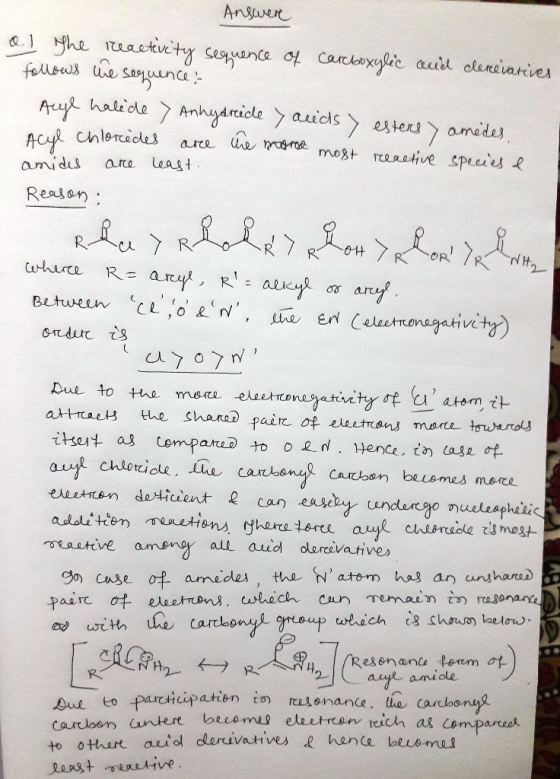
The reactivity sequence of carboxylic acid derivatives (acyl halides, anhydrides, acids, esters, amides) changes with t...
_15. The class least reactive towards acyl substitution is a. carboxylates b. esters c. acid anhydrides...
 _15. The class least reactive towards acyl substitution is a. carboxylates b. esters c. acid anhydrides d. carboxylic acids e. acid halides f. amides _ 16. Acetals protect aldehyde carbonyl groups from all of the following except: a. acidic conditions b. nucleophiles c. organometallics H h O d. basic conditions are. hydride reduction
Answer the following questions with only one answer a. Carboxylic acid derivatives cannot be hydrolyzed to...
 Answer the following questions with only one answer a. Carboxylic acid derivatives cannot be hydrolyzed to produce carboxylic acids b. Lithium aluminum (tri-butoxy)hydride will convert acid chlorides to ketones c. Amides have more resonance stability than esters d. Nitriles are less basic than primary amines e. Grignard reagents contain polar covalent carbon-magnesium bonds f. Anhydrides are more reactive than esters in nucleophilic acyl substitution reactions g. Acid chlorides undergo nucleophilic acyl substitution reactions h. Nitriles have an sp hybridized Nitrogen...
Which of the following statements is NOT true about acid anhydrides? A. Acid anhydrides are more...
Which of the following statements is NOT true about acid anhydrides? A. Acid anhydrides are more reactive than esters but less reactive than acyl chlorides. B. An acid anhydride reacts with water to form an ester product. C. Acid anhydrides eliminate a carboxylate ion as a leaving group. D. An acid anhydride is considered to have a better leaving group (i.e. weaker base) than the leaving groups of esters, carboxylic acids, and amides. A B C D
True or false: a) The electron-withdrawing substituents do not impact the acidity of carboxylic acids. b)...
True or false: a) The electron-withdrawing substituents do not impact the acidity of carboxylic acids. b) Hydrolysis of nitriles is a method to synthesize carboxylic acid. c) The order of reactivity of carboxylic acid derivatives is as follow: Acyl chloride > Acid anhydride > Ester > Amide. d) SOCl2, PCl3 and PCl5 are three types of special reagents to convert carboxylic acid to acyl chloride. e) Acyl chlorides are the most reactive common acyl derivatives, and can be used to...
Why do esters, carboxylic acids and amides undergo acyl substitution but aldehydes and ketones cannot?
Why do esters, carboxylic acids and amides undergo acyl substitution but aldehydes and ketones cannot?
Why are acyl chlorides the most reactive of all the carboxylic acid derivatives? A. Acyl chlorides...
Why are acyl chlorides the most reactive of all the carboxylic acid derivatives? A. Acyl chlorides have the best leaving group of all the derivatives B. The leaving group of an acyl chloride is the strongest base of all the derivatives C. Acyl chlorides have more resonance structures than the other derivatives D. Acyl chlorides have higher boiling points than the other derivatives A B C D
Spid deri 7. What is the order of DECREASING reactivity toward nucleophilic acyl substitution for these...
 Spid deri 7. What is the order of DECREASING reactivity toward nucleophilic acyl substitution for these carboxylic acid derivatives (most reactive first)? 9. Using your knowledge of organic chemistry, what is the order from most reactive to least reactive of these esters toward a nucleophile? och la NHCH I NHCH 1 2 (a) II, IV, III, I (b) I, II, III, IV (a) 1 > 2 > 3 (b) 3 >1 > 2 (c) 2 > 3 > 1 >2...
1. Acid chiorides have the general structure shown below They are prepared from carboxylic acids using....
 1. Acid chiorides have the general structure shown below They are prepared from carboxylic acids using. eg. thiony chloride (SOC) SOC2 Acid chlorides are very reactive and an effective way to transfer an acyl group (R-CO)H to make esters or amides. a. Acyl groups are named after the corresponding carboxylic acid parent: Carboxylic Acid Acyl Chloride ethanoic acid ethanoyl chloride propanoic acid propanoyl chloride benzoic acid benzoyl chloride Name the acyl chlorides below: Acyl chlorides are very reactive molecules, reacting...
Questions 12-20 are true and false! (12) Hydrolysis of nitriles is a method to synthesize carboxylic...
 Questions 12-20 are true and false!
(12) Hydrolysis of nitriles is a method to synthesize carboxylic acid. (13) The order of reactivity of carboxylic acid derivatives is as follow: Acyl chloride > Acid anhydride > Ester > Amide. (14) SOCI2, PC13 and PCls are three types of special reagents to convert carboxylic acid to acyl chloride (15) Acyl chlorides are the most reactive common acyl derivatives, and can be used to synthesize anhydride, ester, and amide. (16) Acyl chloride is...
Questions 12-20 are true and false!
(12) Hydrolysis of nitriles is a method to synthesize carboxylic acid. (13) The order of reactivity of carboxylic acid derivatives is as follow: Acyl chloride > Acid anhydride > Ester > Amide. (14) SOCI2, PC13 and PCls are three types of special reagents to convert carboxylic acid to acyl chloride (15) Acyl chlorides are the most reactive common acyl derivatives, and can be used to synthesize anhydride, ester, and amide. (16) Acyl chloride is...
он он te Acetyl adenosyl phosphate A sum Table 21.1. nclature rules for carboxylic acid derivativ...
 он он te Acetyl adenosyl phosphate A sum Table 21.1. nclature rules for carboxylic acid derivatives is given in able 21.1 Nomenclature of Carboxylic Acid Derivatives Functional group Structure Name ending -ic acid (-carboxylic acid) Carboxylic acid -oyl halide (-carbonyl halide) 0 Acid halide anhydride Acid anhydride -amide (-carboxamide Amide -oate (-carboxylate) Ester RT 、NH2 (NHR, NR2) -thioate (-carbothioate) Thioester -oyl phosphate 0 Acyl phosphate 3.) List the functional groups shown in table 21.1 on page 817 in order of...
 _15. The class least reactive towards acyl substitution is a. carboxylates b. esters c. acid anhydrides d. carboxylic acids e. acid halides f. amides _ 16. Acetals protect aldehyde carbonyl groups from all of the following except: a. acidic conditions b. nucleophiles c. organometallics H h O d. basic conditions are. hydride reduction
 Answer the following questions with only one answer a. Carboxylic acid derivatives cannot be hydrolyzed to produce carboxylic acids b. Lithium aluminum (tri-butoxy)hydride will convert acid chlorides to ketones c. Amides have more resonance stability than esters d. Nitriles are less basic than primary amines e. Grignard reagents contain polar covalent carbon-magnesium bonds f. Anhydrides are more reactive than esters in nucleophilic acyl substitution reactions g. Acid chlorides undergo nucleophilic acyl substitution reactions h. Nitriles have an sp hybridized Nitrogen...
 Spid deri 7. What is the order of DECREASING reactivity toward nucleophilic acyl substitution for these carboxylic acid derivatives (most reactive first)? 9. Using your knowledge of organic chemistry, what is the order from most reactive to least reactive of these esters toward a nucleophile? och la NHCH I NHCH 1 2 (a) II, IV, III, I (b) I, II, III, IV (a) 1 > 2 > 3 (b) 3 >1 > 2 (c) 2 > 3 > 1 >2...
 1. Acid chiorides have the general structure shown below They are prepared from carboxylic acids using. eg. thiony chloride (SOC) SOC2 Acid chlorides are very reactive and an effective way to transfer an acyl group (R-CO)H to make esters or amides. a. Acyl groups are named after the corresponding carboxylic acid parent: Carboxylic Acid Acyl Chloride ethanoic acid ethanoyl chloride propanoic acid propanoyl chloride benzoic acid benzoyl chloride Name the acyl chlorides below: Acyl chlorides are very reactive molecules, reacting...
 Questions 12-20 are true and false!
(12) Hydrolysis of nitriles is a method to synthesize carboxylic acid. (13) The order of reactivity of carboxylic acid derivatives is as follow: Acyl chloride > Acid anhydride > Ester > Amide. (14) SOCI2, PC13 and PCls are three types of special reagents to convert carboxylic acid to acyl chloride (15) Acyl chlorides are the most reactive common acyl derivatives, and can be used to synthesize anhydride, ester, and amide. (16) Acyl chloride is...
Questions 12-20 are true and false!
(12) Hydrolysis of nitriles is a method to synthesize carboxylic acid. (13) The order of reactivity of carboxylic acid derivatives is as follow: Acyl chloride > Acid anhydride > Ester > Amide. (14) SOCI2, PC13 and PCls are three types of special reagents to convert carboxylic acid to acyl chloride (15) Acyl chlorides are the most reactive common acyl derivatives, and can be used to synthesize anhydride, ester, and amide. (16) Acyl chloride is...
 он он te Acetyl adenosyl phosphate A sum Table 21.1. nclature rules for carboxylic acid derivatives is given in able 21.1 Nomenclature of Carboxylic Acid Derivatives Functional group Structure Name ending -ic acid (-carboxylic acid) Carboxylic acid -oyl halide (-carbonyl halide) 0 Acid halide anhydride Acid anhydride -amide (-carboxamide Amide -oate (-carboxylate) Ester RT 、NH2 (NHR, NR2) -thioate (-carbothioate) Thioester -oyl phosphate 0 Acyl phosphate 3.) List the functional groups shown in table 21.1 on page 817 in order of...
Most questions answered within 3 hours.
-
Where is the error in this code sequence?
String s1 = "Hello";
String s2 = "ello";...
asked 10 months ago -
Financial data for Joel de Paris, Inc., for last year
follow:
Joel de Paris, Inc.
Balance...
asked 10 months ago -
Consider this reaction:
Al2(SO4)3 (aq)+ BaCl3
(aq) Al2Cl6 (aq)- +
3BaSO4(s) . What is the...
asked 10 months ago -
Suppose that Savneet is considering increasing her
recent random sample from 20 car rentals to 40...
asked 10 months ago -
Trucks arrive at an unloading terminal at an average rate of 120
per hour.
Trucks arrive...
asked 10 months ago -
Why are methanol and ethanol completely soluble in water while
octanol is not very little soluble....
asked 10 months ago -
A facilities manager at a university reads in a research report
that the mean amount of...
asked 10 months ago -
When the CuSO4 is rehydrated by adding water to the anhydrous
compound, is this an endothermic...
asked 10 months ago -
A ray of sunlight is passing from diamond into crown glass; the
angle of incidence is...
asked 10 months ago -
A block of mass 0.249 kg is placed on top of a light, vertical
spring of...
asked 10 months ago -
how do the kidneys compensate in the presences of acidosis
a) trigger hyperventilate
b) reserve acid...
asked 10 months ago -
Question 501 pts
The rental rate of capital to the firm increases. Which of the
following...
asked 10 months ago