
Homework Answers
Add Answer to:
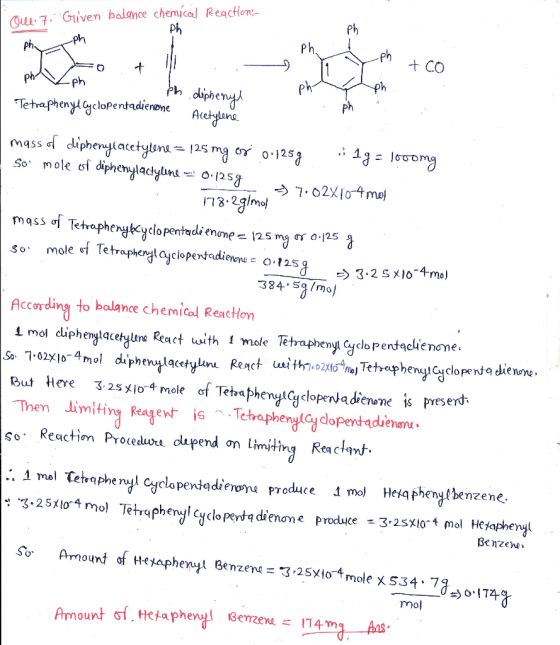
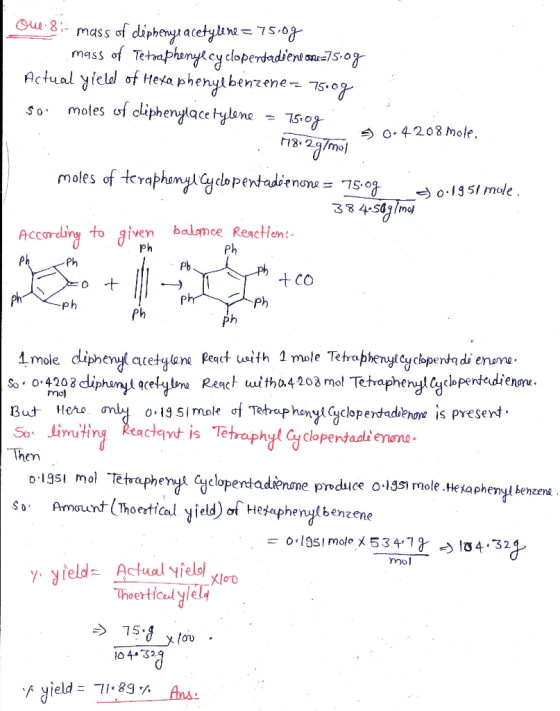
7. Calculate the maximum amount of hexaphenylbenzene (molar mass = 534.7 g/mol) possible (theoretical yield) when 1...
How to calculate theoretical yield benzil in the hexaphenylbenzene experiment, with 0.753 g of benzoin produced.(molecular...
How to calculate theoretical yield benzil in the hexaphenylbenzene experiment, with 0.753 g of benzoin produced.(molecular weight of benzil is 210.28 and amount used 100ml.) Then theoretical yield of tetraphenylcyclopentadienon with 0.264 g of benzil product. (molecular weight of tetraphenylcyclopentadienone is 384.48 and used 100 mg)
The molar mass of AB is 75.0 g/mol, the molar mass of AC is 60.0 g/mol,...
The molar mass of AB is 75.0 g/mol, the molar mass of AC is 60.0 g/mol, and the molar mass of B is 50.0 g/mol. What is the theoretical yield (in grams) of AC from the reaction of 28.0 g of AB?
monog . What is the theoretical yield (grams) of Cr when 40.0 g of Cr2O3 reacts...
 monog . What is the theoretical yield (grams) of Cr when 40.0 g of Cr2O3 reacts with 8.0 x1 atoms of Al? Al2O3 is the other product. Molar mass Cr2O3 = 151.9904 g/mol 18.0 x 10²³ a. (2 points) Write the BALANCED chemical reaction - balance the formulas too points) What is the theoretical vield (grams)of Cr when 40.0 g of Cr2O3 reacts with 8.0 x 10²³ atoms of All Alo, is the other product. b. (2 Points) If you...
What is the theoretical yield (in grams) of phosphorus pentachloride when 3.85 g of phosphorus reacts...
 What is the theoretical yield (in grams) of phosphorus
pentachloride when 3.85 g of phosphorus reacts with 25.8 g of
chlorine according to the following reaction:
P4 (s) + 10 Cl2 (g) → 4
PCl5 (l)
Use the correct number of significant figures, fill in the
number ONLY!
lan 4 15 What is the mass of excess reactant (in grams) that remains after the limiting reagent produces the maximum amount of phosphorus pentachloride possible upon the reaction of 4.69 g...
What is the theoretical yield (in grams) of phosphorus
pentachloride when 3.85 g of phosphorus reacts with 25.8 g of
chlorine according to the following reaction:
P4 (s) + 10 Cl2 (g) → 4
PCl5 (l)
Use the correct number of significant figures, fill in the
number ONLY!
lan 4 15 What is the mass of excess reactant (in grams) that remains after the limiting reagent produces the maximum amount of phosphorus pentachloride possible upon the reaction of 4.69 g...
Calculate the theoretical yield of C2H5Cl when 125 g of C2H6 reacts with 216 g of...
Calculate the theoretical yield of C2H5Cl when 125 g of C2H6 reacts with 216 g of Cl2, assuming that C2H6 and Cl2 react only to form C2H5Cl and HCl.
•Theoretical yield of aspirin: Theoretical yield= mass salicylic acid used*( 1 ??? ?7?6?3 ? ?7?6?3 ( (1...
•Theoretical yield of aspirin: Theoretical yield= mass salicylic acid used*( 1 ??? ?7?6?3 ? ?7?6?3 ( (1 mol C7H6O3)/( g C7H6O3) )*(1 ??? ?9?8?41 ??? ?7?6?3(1 mol C9H8O4)/(1 mol C7H6O3))( ? ?9?8?41 ??? ?9?8?4( g C9H8O4)/(1 mol C9H8O4)) **The molar masses of the salicylic acid and the acetylsalicylic acid will need to be calculated using the periodic table before finding the theoretical yield. % yield of aspirin % yield= actual yield/theoretical yield * 100 The actual yield would be the observed mass...
How would you calculate % yield of intermediate A and the final product diphenylacetylene? The mass...
 How would you calculate % yield of intermediate A and the
final product diphenylacetylene? The mass of intermediate A
collected during the experiment was 74 mg and the mass of the
crystals (diphenylacetylene) was .162 g which is not feasible
however it is due to error as the filter paper wasn’t completely
dry yet. Included are pictures of all the chemicals used as well as
the procedure so you can see what was added to the reaction.
Addition: I pyridinium...
How would you calculate % yield of intermediate A and the
final product diphenylacetylene? The mass of intermediate A
collected during the experiment was 74 mg and the mass of the
crystals (diphenylacetylene) was .162 g which is not feasible
however it is due to error as the filter paper wasn’t completely
dry yet. Included are pictures of all the chemicals used as well as
the procedure so you can see what was added to the reaction.
Addition: I pyridinium...
When 780 g of benzene (Molar mass = 78 g/mol) reacts with 750 mL of concentrated...
When 780 g of benzene (Molar mass = 78 g/mol) reacts with 750 mL of concentrated HNO3 (16 M) and 750 mL of H2SO4 (18 M), 1000 g of nitrobenzene (molar mass = 123 g/mol) and 250 g of an unknown compound with a high boiling point are obtained. c. Give the name of the most probable side product with the high melting point. Explain why. e. Supposing the crystalline compound (250 g) has the formula C6H4N2O4, calculate the yield...
Please help me obtain the theoretical yield and percent yield! DATA: Substance Quantity Molar Mass (g/mol)...
 Please help me obtain the
theoretical yield and percent yield!
DATA: Substance Quantity Molar Mass (g/mol) 192 Experimental amounts -N/A 3,4-dichloronitrobenzene Product 0.150g -N/A -NA 0.104g Substance Experimental 0.104g Product Product + 1-methoxy-2- chloro-4-nitrobenzene Product + 1,2- dimethoxy-4- nitrobenzene CALCULATIONS: Important calculations for this experiment: • Theoretical yield: Percent yield:
Please help me obtain the
theoretical yield and percent yield!
DATA: Substance Quantity Molar Mass (g/mol) 192 Experimental amounts -N/A 3,4-dichloronitrobenzene Product 0.150g -N/A -NA 0.104g Substance Experimental 0.104g Product Product + 1-methoxy-2- chloro-4-nitrobenzene Product + 1,2- dimethoxy-4- nitrobenzene CALCULATIONS: Important calculations for this experiment: • Theoretical yield: Percent yield:
Exact mass of sodium bicarbonate: 2.110g Molar mass of sodium bicarbonate: 84.007 g/mol Molar mas...
 Exact mass of sodium bicarbonate: 2.110g
Molar mass of sodium bicarbonate: 84.007 g/mol
Molar mass of sodium acetate: 82.034 g/mol
After you have recorded and any other glassware you have used. All waste can go down the sink. the mass of the beaker after the reaction, you may rinse out the beaker 10. CALCULATIONS: a) Rewrite the balanced chemical equation here Calculate the theoretical amount of sodium acetate that should be formed in the reaction (follow steps 1-3 below). b)...
Exact mass of sodium bicarbonate: 2.110g
Molar mass of sodium bicarbonate: 84.007 g/mol
Molar mass of sodium acetate: 82.034 g/mol
After you have recorded and any other glassware you have used. All waste can go down the sink. the mass of the beaker after the reaction, you may rinse out the beaker 10. CALCULATIONS: a) Rewrite the balanced chemical equation here Calculate the theoretical amount of sodium acetate that should be formed in the reaction (follow steps 1-3 below). b)...
 monog . What is the theoretical yield (grams) of Cr when 40.0 g of Cr2O3 reacts with 8.0 x1 atoms of Al? Al2O3 is the other product. Molar mass Cr2O3 = 151.9904 g/mol 18.0 x 10²³ a. (2 points) Write the BALANCED chemical reaction - balance the formulas too points) What is the theoretical vield (grams)of Cr when 40.0 g of Cr2O3 reacts with 8.0 x 10²³ atoms of All Alo, is the other product. b. (2 Points) If you...
 What is the theoretical yield (in grams) of phosphorus
pentachloride when 3.85 g of phosphorus reacts with 25.8 g of
chlorine according to the following reaction:
P4 (s) + 10 Cl2 (g) → 4
PCl5 (l)
Use the correct number of significant figures, fill in the
number ONLY!
lan 4 15 What is the mass of excess reactant (in grams) that remains after the limiting reagent produces the maximum amount of phosphorus pentachloride possible upon the reaction of 4.69 g...
What is the theoretical yield (in grams) of phosphorus
pentachloride when 3.85 g of phosphorus reacts with 25.8 g of
chlorine according to the following reaction:
P4 (s) + 10 Cl2 (g) → 4
PCl5 (l)
Use the correct number of significant figures, fill in the
number ONLY!
lan 4 15 What is the mass of excess reactant (in grams) that remains after the limiting reagent produces the maximum amount of phosphorus pentachloride possible upon the reaction of 4.69 g...
 How would you calculate % yield of intermediate A and the
final product diphenylacetylene? The mass of intermediate A
collected during the experiment was 74 mg and the mass of the
crystals (diphenylacetylene) was .162 g which is not feasible
however it is due to error as the filter paper wasn’t completely
dry yet. Included are pictures of all the chemicals used as well as
the procedure so you can see what was added to the reaction.
Addition: I pyridinium...
How would you calculate % yield of intermediate A and the
final product diphenylacetylene? The mass of intermediate A
collected during the experiment was 74 mg and the mass of the
crystals (diphenylacetylene) was .162 g which is not feasible
however it is due to error as the filter paper wasn’t completely
dry yet. Included are pictures of all the chemicals used as well as
the procedure so you can see what was added to the reaction.
Addition: I pyridinium...
 Please help me obtain the
theoretical yield and percent yield!
DATA: Substance Quantity Molar Mass (g/mol) 192 Experimental amounts -N/A 3,4-dichloronitrobenzene Product 0.150g -N/A -NA 0.104g Substance Experimental 0.104g Product Product + 1-methoxy-2- chloro-4-nitrobenzene Product + 1,2- dimethoxy-4- nitrobenzene CALCULATIONS: Important calculations for this experiment: • Theoretical yield: Percent yield:
Please help me obtain the
theoretical yield and percent yield!
DATA: Substance Quantity Molar Mass (g/mol) 192 Experimental amounts -N/A 3,4-dichloronitrobenzene Product 0.150g -N/A -NA 0.104g Substance Experimental 0.104g Product Product + 1-methoxy-2- chloro-4-nitrobenzene Product + 1,2- dimethoxy-4- nitrobenzene CALCULATIONS: Important calculations for this experiment: • Theoretical yield: Percent yield:
 Exact mass of sodium bicarbonate: 2.110g
Molar mass of sodium bicarbonate: 84.007 g/mol
Molar mass of sodium acetate: 82.034 g/mol
After you have recorded and any other glassware you have used. All waste can go down the sink. the mass of the beaker after the reaction, you may rinse out the beaker 10. CALCULATIONS: a) Rewrite the balanced chemical equation here Calculate the theoretical amount of sodium acetate that should be formed in the reaction (follow steps 1-3 below). b)...
Exact mass of sodium bicarbonate: 2.110g
Molar mass of sodium bicarbonate: 84.007 g/mol
Molar mass of sodium acetate: 82.034 g/mol
After you have recorded and any other glassware you have used. All waste can go down the sink. the mass of the beaker after the reaction, you may rinse out the beaker 10. CALCULATIONS: a) Rewrite the balanced chemical equation here Calculate the theoretical amount of sodium acetate that should be formed in the reaction (follow steps 1-3 below). b)...
Most questions answered within 3 hours.
-
Where is the error in this code sequence?
String s1 = "Hello";
String s2 = "ello";...
asked 10 months ago -
Financial data for Joel de Paris, Inc., for last year
follow:
Joel de Paris, Inc.
Balance...
asked 10 months ago -
Consider this reaction:
Al2(SO4)3 (aq)+ BaCl3
(aq) Al2Cl6 (aq)- +
3BaSO4(s) . What is the...
asked 10 months ago -
Suppose that Savneet is considering increasing her
recent random sample from 20 car rentals to 40...
asked 10 months ago -
Trucks arrive at an unloading terminal at an average rate of 120
per hour.
Trucks arrive...
asked 10 months ago -
Why are methanol and ethanol completely soluble in water while
octanol is not very little soluble....
asked 10 months ago -
A facilities manager at a university reads in a research report
that the mean amount of...
asked 10 months ago -
When the CuSO4 is rehydrated by adding water to the anhydrous
compound, is this an endothermic...
asked 10 months ago -
A ray of sunlight is passing from diamond into crown glass; the
angle of incidence is...
asked 10 months ago -
A block of mass 0.249 kg is placed on top of a light, vertical
spring of...
asked 10 months ago -
how do the kidneys compensate in the presences of acidosis
a) trigger hyperventilate
b) reserve acid...
asked 10 months ago -
Question 501 pts
The rental rate of capital to the firm increases. Which of the
following...
asked 10 months ago