After being accelerated to a speed of 1.13×10⁵ , the particle enters a uniform magnetic field of strength 0.900 and tr...
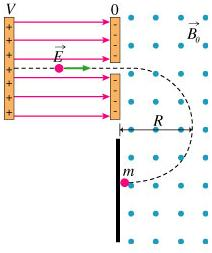
After being accelerated to a speed of1.13×105 m/s, the particle enters a uniform magnetic field of strength 0.900 T and travels in a circle of radius 34.0 cm (determined by observing where it hits the screen as shown in the figure). The results of this experiment allow one to find m/q.
Find the ratio m/q for this particle.
Homework Answers
The concepts used in this problem are magnetic force and the centripetal force. The ratio of mass to the charge can be calculated using the expressions of magnetic force and the centripetal force.
Centripetal Force:
The linear acceleration is the rate of change of linear velocity but the rate of change of tangential velocity is the centripetal acceleration. The centripetal acceleration makes an object to move in a curved path. The force acts in this motion is centripetal force
The expression for centripetal force is:
Here, is the mass, is the centripetal acceleration, is the velocity and is the radial distance.
Magnetic force:
The magnetic force is perpendicular to the magnetic field and the velocity of the charge. The magnitude of magnetic force is given by:
Here, is the charge, is the velocity, is the magnetic field and is the angle between velocity and the magnetic field.
The forces acting on the system are magnetic force and centripetal force, both the force should be balanced.
Here, the velocity vector is perpendicular to the magnetic field vector. So, angle is .
Substitute for .
The ratio of mass to the charge is:
Substitute for , for and for .
The equation is further simplified as:
Ans:
The ratio of mass to the charge of a particle is .
Add Answer to:
After being accelerated to a speed of 1.13×10⁵ , the particle enters a uniform magnetic field of strength 0.900 and tr...
After being accelerated to a speed of 1.35×10⁵ m/s , the particle enters a uniform magnetic...
After being accelerated to a speed of 1.35×10⁵ m/s , the particle enters a uniform magnetic field of strength 0.900 T and travels in a circle of radius 30.0 cm (determined by observing where it hits the screen as shown in the figure). The results of this experiment allow one to find m/q. Find the ratio m/q for this particle.
After being accelerated to a speed of 1.72×10⁵ m/sm/s , the particle enters a uniform magnetic...
After being accelerated to a speed of 1.72×10⁵ m/sm/s , the particle enters a uniform magnetic field of strength 0.800 TT and travels in a circle of radius 31.0 cmcm (determined by observing where it hits the screen as shown in the figure). The results of this experiment allow one to find m/qm/q. Find the ratio m/qm/q for this particle.
After being accelerated to a speed of 1.11x10 m/s, the particle enters a uniform magnetic field of strength 0.700 T
 J.J. Thomson is best known for his discoveries about the nature of cathode rays. His other important contribution was the invention, together with one of his students, of the mass spectrometer, a device that measures the ratio of mass m to positive) charge q of an ion. The spectrometer consists of two regions as shown in the figure. (Figure 1) In the first region an electric field accelerates the ion and in the second the ion follows a circular are in...
J. J. Thomson is best known for his discoveries about the nature of cathode rays.
 Mass SpectrometerJ. J. Thomson is best known for his discoveries about the nature of
cathode rays. Another important contribution of his was the
invention, together with one of his students, of the mass
spectrometer. The ratio of mass m to (positive) charge q of an ion may be accurately determined in a mass
spectrometer. In essence, the spectrometer consists of two regions:
one that accelerates the ion through a potential difference V and a second that measures its radius of curvature in...
Mass SpectrometerJ. J. Thomson is best known for his discoveries about the nature of
cathode rays. Another important contribution of his was the
invention, together with one of his students, of the mass
spectrometer. The ratio of mass m to (positive) charge q of an ion may be accurately determined in a mass
spectrometer. In essence, the spectrometer consists of two regions:
one that accelerates the ion through a potential difference V and a second that measures its radius of curvature in...
A proton enters a region of constant magnetic field, perpendicular to the fie and after being...
 A proton enters a region of constant magnetic field, perpendicular to the fie and after being accelerated from rest by an electric field through an electric potential difference of - 350 V. Determine the magnitude of the magnetic field, if the proton travels in a circular path with a radius of 21 cm. mt As shown in the figure below, when a charged particle enters a region of magnetic field traveling in a direction perpendicular to the field, it will...
A proton enters a region of constant magnetic field, perpendicular to the field and after being...
 A proton enters a region of constant magnetic field, perpendicular to the field and after being accelerated from rest by an electric field through an electrical potential difference of 470 V. Determine the magnitude of the magnetic field, if the proton travels in a circular path with a radius of 22 cm. 1.42e-3 How can you determine the speed at which the proton enters the region of constant magnetic field? What force provides the centripetal force that causes the proton...
A proton enters a region of constant magnetic field, perpendioular to the field and after being...
 A proton enters a region of constant magnetic field, perpendioular to the field and after being accelerated from rest by an electric fneld through an electrical potential difference of 360 V. Determine the magnitude of the magnetic field, if the proton travels in a circular path with radius of 30 cm. Addiional Materials
A proton of speed v = 6 x 10⁵ m/s enters a region of uniform magnetic...
 A proton of speed v = 6 x 10⁵ m/s enters a region of uniform magnetic field of B = 0.5 T at an angle of $ = 60° to the magnetic field. In the region of the magnetic field the proton describes a helical path with radius R and pitch p (distance between loops). Find R and p.
Proton is accelerated to 90% of speed of light. Proton then enters magnetic field and moves...
Proton is accelerated to 90% of speed of light. Proton then enters magnetic field and moves in the circle with the radius of 10m. a) What is the magnitude of the field? b) What is the period of revolution of the proton?
3. Circular Motion in a Magnetic Field See Figure 2. A particle of charge +e and...
 3. Circular Motion in a Magnetic Field See Figure 2. A particle of charge +e and mass m is accelerated from rest by a potential difference V. The particle then enters a region of uniform magnetic field B perpendicular to the velocity. The particle will undergo uniform circular motion. It instead, the charge is doubled and the mass is quadrupled, while keeping both the potential difference and strength of the magnetic field the same, i) how does the radius of...
 A proton enters a region of constant magnetic field, perpendicular to the fie and after being accelerated from rest by an electric field through an electric potential difference of - 350 V. Determine the magnitude of the magnetic field, if the proton travels in a circular path with a radius of 21 cm. mt As shown in the figure below, when a charged particle enters a region of magnetic field traveling in a direction perpendicular to the field, it will...
 A proton enters a region of constant magnetic field, perpendicular to the field and after being accelerated from rest by an electric field through an electrical potential difference of 470 V. Determine the magnitude of the magnetic field, if the proton travels in a circular path with a radius of 22 cm. 1.42e-3 How can you determine the speed at which the proton enters the region of constant magnetic field? What force provides the centripetal force that causes the proton...
 A proton enters a region of constant magnetic field, perpendioular to the field and after being accelerated from rest by an electric fneld through an electrical potential difference of 360 V. Determine the magnitude of the magnetic field, if the proton travels in a circular path with radius of 30 cm. Addiional Materials
 A proton of speed v = 6 x 10⁵ m/s enters a region of uniform magnetic field of B = 0.5 T at an angle of $ = 60° to the magnetic field. In the region of the magnetic field the proton describes a helical path with radius R and pitch p (distance between loops). Find R and p.
 3. Circular Motion in a Magnetic Field See Figure 2. A particle of charge +e and mass m is accelerated from rest by a potential difference V. The particle then enters a region of uniform magnetic field B perpendicular to the velocity. The particle will undergo uniform circular motion. It instead, the charge is doubled and the mass is quadrupled, while keeping both the potential difference and strength of the magnetic field the same, i) how does the radius of...
Most questions answered within 3 hours.
-
Where is the error in this code sequence?
String s1 = "Hello";
String s2 = "ello";...
asked 11 months ago -
Financial data for Joel de Paris, Inc., for last year
follow:
Joel de Paris, Inc.
Balance...
asked 11 months ago -
Consider this reaction:
Al2(SO4)3 (aq)+ BaCl3
(aq) Al2Cl6 (aq)- +
3BaSO4(s) . What is the...
asked 11 months ago -
Suppose that Savneet is considering increasing her
recent random sample from 20 car rentals to 40...
asked 11 months ago -
Trucks arrive at an unloading terminal at an average rate of 120
per hour.
Trucks arrive...
asked 11 months ago -
Why are methanol and ethanol completely soluble in water while
octanol is not very little soluble....
asked 11 months ago -
A facilities manager at a university reads in a research report
that the mean amount of...
asked 11 months ago -
When the CuSO4 is rehydrated by adding water to the anhydrous
compound, is this an endothermic...
asked 11 months ago -
A ray of sunlight is passing from diamond into crown glass; the
angle of incidence is...
asked 11 months ago -
A block of mass 0.249 kg is placed on top of a light, vertical
spring of...
asked 11 months ago -
how do the kidneys compensate in the presences of acidosis
a) trigger hyperventilate
b) reserve acid...
asked 11 months ago -
Question 501 pts
The rental rate of capital to the firm increases. Which of the
following...
asked 11 months ago