1. Give a condition that is necessary but not sufficient for an undirected graph to have an Eulerian Path. Justify your...
1. Give a condition that is necessary but not sufficient for an undirected graph to have an Eulerian Path. Justify your answer.
2. Give a condition that is sufficient but not necessary for an undirected graph not to have an Eulerian Cycle. Justify your answer.
Homework Answers


Add Answer to:
1. Give a condition that is necessary but not sufficient for an undirected graph to have an Eulerian Path. Justify your...
Give a condition that is sufficient but not necessary for an undirected graph not to have an Eulerian Cycle. Justify you...
Give a condition that is sufficient but not necessary for an undirected graph not to have an Eulerian Cycle. Justify your answer.
1- Give an example (by drawing or by describing) of the following undirected graphs (a) A...
1- Give an example (by drawing or by describing) of the following undirected graphs (a) A graph where the degree in each vertex is even and the total number of edges is odd (b) A graph that does not have an eulerian cycle. An eulerian cycle is a cycle where every edge of the graph is visited exactly once. (c) A graph that does not have any cycles and the maximum degree of a node is 2 (minimum degree can...
Given an undirected connected graph, give an efficient algorithm for generating a path that traverses each...
 Given an undirected connected graph, give an efficient algorithm for generating a path that traverses each edge exactly twice. Explain the order of your algorith
Look up the definition of a biconnected undirected graph on Wikipedia. Give a one sentence definition based on induced sub-graphs. Start your definition with “An undirected graph G = (V, E) is biconne...
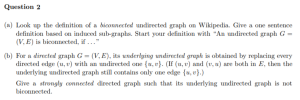 Look up the definition of a biconnected undirected graph on
Wikipedia. Give a one sentence definition based on induced
sub-graphs. Start your definition with “An undirected graph G = (V,
E) is biconnected, if . . . ” (b) For a directed graph G = (V, E),
its underlying undirected graph is obtained by replacing every
directed edge (u, v) with an undirected one {u, v}. (If (u, v) and
(v, u) are both in E, then the underlying undirected...
Look up the definition of a biconnected undirected graph on
Wikipedia. Give a one sentence definition based on induced
sub-graphs. Start your definition with “An undirected graph G = (V,
E) is biconnected, if . . . ” (b) For a directed graph G = (V, E),
its underlying undirected graph is obtained by replacing every
directed edge (u, v) with an undirected one {u, v}. (If (u, v) and
(v, u) are both in E, then the underlying undirected...
Prove the claim. Consider an undirected graph G with minimum degree δ(G) ≥ 2. Then G...
Prove the claim. Consider an undirected graph G with minimum degree δ(G) ≥ 2. Then G has a path of length δ(G) and a cycle with at least δ(G) + 1 vertices.
Reachability. You are given a connected undirected graph G = (V, E ) as an adjacency...
Reachability. You are given a connected undirected graph G = (V, E ) as an adjacency list. The graph G might not be connected. You want to fill-in a two-dimensional array R[,] so that R[u,v] is 1 if there is a path from vertex u to vertex v. If no such path exists, then R[u,v] is 0. From this two-dimensional array, you can determine whether vertex u is reachable from vertex v in O(1) time for any pair of vertices...
Consider the following undirected weighted graph where you want to find a path from A to...
Consider the following undirected weighted graph where you want to find a path from A to G. A / \ B --- C \ / \ G --- H Weights (costs) of the edges are W(AB) = 1; W(AC) = 3; W(BC) = 1; W(BG) = 9; W(CG) = 5; W(CH) = 2; W(GH) = 1, and the heuristic estimates (h(n)) to the goal node, G, are h(A) = 5, h(B) = 4, h(C) = 1, h(G) = 0, h(H)...
Which of the following is/are a necessary condition for market efficiency? 1. Sufficient liquidity 2. Low...
Which of the following is/are a necessary condition for market efficiency? 1. Sufficient liquidity 2. Low trading costs 3. A large number of profit-seeking investors A Only 1 B Only 3 C 1 and 3 D 2 and 3 E All three
Say that we have an undirected graph G(V, E) and a pair of vertices s, t and a vertex v that we call a a desired middle vertex . We wish to find out if there exists a simple path (every vertex appears...
Say that we have an undirected graph G(V, E) and a pair of vertices s, t and a vertex v that we call a a desired middle vertex . We wish to find out if there exists a simple path (every vertex appears at most once) from s to t that goes via v. Create a flow network by making v a source. Add a new vertex Z as a sink. Join s, t with two directed edges of capacity...
Let's say that m is the number of edges in an undirected graph. 1. Show that...
Let's say that m is the number of edges in an undirected graph. 1. Show that if the degree of every vertex is at least k, then the graph has a simple path of length at least k. 2. Show that every graph has a subgraph with minimum degree m/n. Hint: iteratively remove all vertex of degree strictly smaller than m/n. 3. Show that any graph has a path of length at least m/n. Use the two claims proven in...
 Given an undirected connected graph, give an efficient algorithm for generating a path that traverses each edge exactly twice. Explain the order of your algorith
 Look up the definition of a biconnected undirected graph on
Wikipedia. Give a one sentence definition based on induced
sub-graphs. Start your definition with “An undirected graph G = (V,
E) is biconnected, if . . . ” (b) For a directed graph G = (V, E),
its underlying undirected graph is obtained by replacing every
directed edge (u, v) with an undirected one {u, v}. (If (u, v) and
(v, u) are both in E, then the underlying undirected...
Look up the definition of a biconnected undirected graph on
Wikipedia. Give a one sentence definition based on induced
sub-graphs. Start your definition with “An undirected graph G = (V,
E) is biconnected, if . . . ” (b) For a directed graph G = (V, E),
its underlying undirected graph is obtained by replacing every
directed edge (u, v) with an undirected one {u, v}. (If (u, v) and
(v, u) are both in E, then the underlying undirected...
Most questions answered within 3 hours.
-
Where is the error in this code sequence?
String s1 = "Hello";
String s2 = "ello";...
asked 10 months ago -
Financial data for Joel de Paris, Inc., for last year
follow:
Joel de Paris, Inc.
Balance...
asked 10 months ago -
Consider this reaction:
Al2(SO4)3 (aq)+ BaCl3
(aq) Al2Cl6 (aq)- +
3BaSO4(s) . What is the...
asked 10 months ago -
Suppose that Savneet is considering increasing her
recent random sample from 20 car rentals to 40...
asked 10 months ago -
Trucks arrive at an unloading terminal at an average rate of 120
per hour.
Trucks arrive...
asked 10 months ago -
Why are methanol and ethanol completely soluble in water while
octanol is not very little soluble....
asked 10 months ago -
A facilities manager at a university reads in a research report
that the mean amount of...
asked 10 months ago -
When the CuSO4 is rehydrated by adding water to the anhydrous
compound, is this an endothermic...
asked 10 months ago -
A ray of sunlight is passing from diamond into crown glass; the
angle of incidence is...
asked 10 months ago -
A block of mass 0.249 kg is placed on top of a light, vertical
spring of...
asked 10 months ago -
how do the kidneys compensate in the presences of acidosis
a) trigger hyperventilate
b) reserve acid...
asked 10 months ago -
Question 501 pts
The rental rate of capital to the firm increases. Which of the
following...
asked 10 months ago