Convert the below C code to basic MIPS. Please leave comments for explanation #include <stdio.h> int main(void) {...
Convert the below C code to basic MIPS. Please leave comments for explanation
#include <stdio.h>
int main(void)
{
printf("Insert two numbers\n");
int a,b;
scanf("%d",&a);
scanf("%d",&b);
a=a<<2;
b=b<<2;
printf("%d&%d\n",a,b);
return 0;
}
Homework Answers
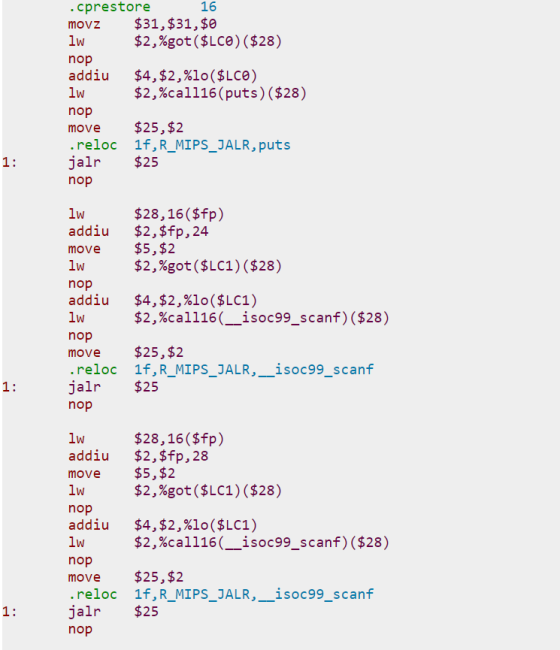
Code in MIPS :
.file   1 ""
        .section .mdebug.abi32
        .previous
        .nan    legacy
        .module fp=32
        .module nooddspreg
        .abicalls
        .rdata
        .align  2
$LC0:
        .ascii  "Insert two numbers\000"
        .align  2
$LC1:
        .ascii  "%d\000"
        .align  2
$LC2:
        .ascii  "%d&%d\012\000"
        .text
        .align  2
        .globl  main
        .set    nomips16
        .set    nomicromips
        .ent    main
        .type   main, @function
main:
        .frame  $fp,40,$31              # vars= 8, regs= 2/0, args= 16, gp= 8
        .mask   0xc0000000,-4
        .fmask  0x00000000,0
        .set    noreorder
        .cpload $25
        .set    nomacro
        addiu   $sp,$sp,-40
        sw      $31,36($sp)
        sw      $fp,32($sp)
        move    $fp,$sp
        .cprestore      16
        movz    $31,$31,$0
        lw      $2,%got($LC0)($28)
        nop
        addiu   $4,$2,%lo($LC0)
        lw      $2,%call16(puts)($28)
        nop
        move    $25,$2
        .reloc  1f,R_MIPS_JALR,puts
1:      jalr    $25
        nop

        lw      $28,16($fp)
        addiu   $2,$fp,24
        move    $5,$2
        lw      $2,%got($LC1)($28)
        nop
        addiu   $4,$2,%lo($LC1)
        lw      $2,%call16(__isoc99_scanf)($28)
        nop
        move    $25,$2
        .reloc  1f,R_MIPS_JALR,__isoc99_scanf
1:      jalr    $25
        nop

        lw      $28,16($fp)
        addiu   $2,$fp,28
        move    $5,$2
        lw      $2,%got($LC1)($28)
        nop
        addiu   $4,$2,%lo($LC1)
        lw      $2,%call16(__isoc99_scanf)($28)
        nop
        move    $25,$2
        .reloc  1f,R_MIPS_JALR,__isoc99_scanf
1:      jalr    $25
        nop

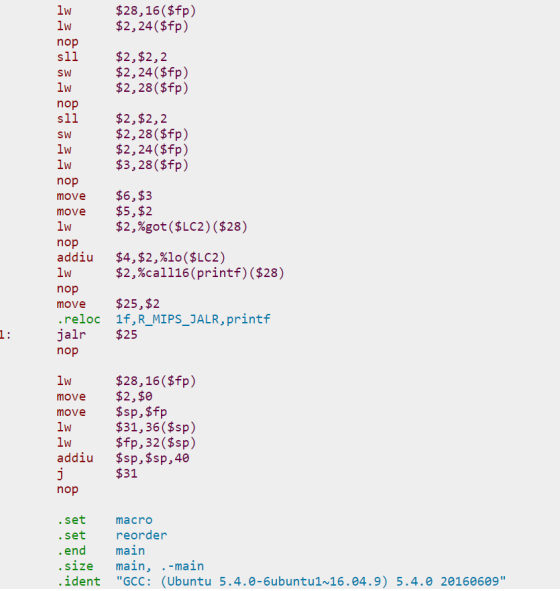
        lw      $28,16($fp)
        lw      $2,24($fp)
        nop
        sll     $2,$2,2
        sw      $2,24($fp)
        lw      $2,28($fp)
        nop
        sll     $2,$2,2
        sw      $2,28($fp)
        lw      $2,24($fp)
        lw      $3,28($fp)
        nop
        move    $6,$3
        move    $5,$2
        lw      $2,%got($LC2)($28)
        nop
        addiu   $4,$2,%lo($LC2)
        lw      $2,%call16(printf)($28)
        nop
        move    $25,$2
        .reloc  1f,R_MIPS_JALR,printf
1:      jalr    $25
        nop

        lw      $28,16($fp)
        move    $2,$0
        move    $sp,$fp
        lw      $31,36($sp)
        lw      $fp,32($sp)
        addiu   $sp,$sp,40
        j       $31
        nop

        .set    macro
        .set    reorder
        .end    main
        .size   main, .-main
        .ident  "GCC: (Ubuntu 5.4.0-6ubuntu1~16.04.9) 5.4.0 20160609"
images:

Add Answer to:
Convert the below C code to basic MIPS. Please leave comments for explanation #include <stdio.h> int main(void) {...
Convert the below C code to basic MIPS. Leave comments for explanation please #include <stdio.h> int main(void) {...
Convert the below C code to basic MIPS. Leave comments for explanation please #include <stdio.h> int main(void) { printf("Insert two numbers\n"); int a,b,c; scanf("%d",&a); scanf("%d",&b); c=a|b; printf("%d|%d=%d\n",a,b,c); return 0; }
Convert the below C code to basic MIPS. The result of this code should be a^b...
Convert the below C code to basic MIPS. The result of this code should be a^b of the two numbers that you input. For example if you input the numbers 3 and 5 you should get a result of 3^5=6 #include int main(void) { printf("Insert two numbers\n"); int a,b,c; scanf("%d",&a); scanf("%d",&b); c=a^b; printf("%d^%d=%d\n",a,b,c); return 0; }
Convert the below C code to basic MIPS. The result of this code should ask for...
Convert the below C code to basic MIPS. The result of this code should ask for two numbers to be inputed and give the answer. For example if 3 and 5 are inputed then the final answer should be as follows: 3&5=1, 3|5=7, 3^5=6, << = 12&20, >> = 0&1, and finally ~ = -4&-6. Please run the code yourself before you upload it to make sure it works. Start the code with .data. Thank you so much. #include <stdio.h>...
Fix the errors in C code #include <stdio.h> #include <stdlib.h> void insertAt(int *, int); void Delete(int...
Fix the errors in C code #include <stdio.h> #include <stdlib.h> void insertAt(int *, int); void Delete(int *); void replaceAt(int *, int, int); int isEmpty(int *, int); int isFull(int *, int); void removeAt(int *, int); void printList(int *, int); int main() { int *a; int arraySize=0,l=0,loc=0; int choice; while(1) { printf("\n Main Menu"); printf("\n 1.Create list\n 2.Insert element at particular position\n 3.Delete list.\n4. Remove an element at given position \n 5.Replace an element at given position\n 6. Check the size of...
Solve using C programming 3. lf you are given this code. #include <stdio.h> int main() int...
 Solve using C programming
3. lf you are given this code. #include <stdio.h> int main() int var1, var2; int sum; printf("Enter number 1:\n "); scanf("%d",&var1); printf("Enter number 2:In ); scanf("%d",&var2); sum-var1+var2; printf ("Vnsum of two entered numbers : %d", //printf ("Output: %d", res); sum); return e; Modify this code by creating a function called "addition". Make the arguments of the functions numberl and number 2. Add the two values in the function. Return a value called "result". Print "result" in...
Solve using C programming
3. lf you are given this code. #include <stdio.h> int main() int var1, var2; int sum; printf("Enter number 1:\n "); scanf("%d",&var1); printf("Enter number 2:In ); scanf("%d",&var2); sum-var1+var2; printf ("Vnsum of two entered numbers : %d", //printf ("Output: %d", res); sum); return e; Modify this code by creating a function called "addition". Make the arguments of the functions numberl and number 2. Add the two values in the function. Return a value called "result". Print "result" in...
i need flowchart for the following c code #include <stdio.h> int main() { int n,...
i need flowchart for the following c code #include <stdio.h> int main() { int n, i, sum = 0; printf("Enter an integer: "); scanf("%d",&n); i = 1; while ( i <=n ) { sum += i; ++i; } printf("Sum = %d",sum); return 0; }
Convert this C program to Js (Java script) from Visual Studio Code #include<stdio.h> int main(){ char...
Convert this C program to Js (Java script) from Visual Studio Code #include<stdio.h> int main(){ char firstName[100]; char lastName[100]; printf("Enter Your Full Name: \n"); scanf("%s %s", firstName, lastName); printf("First Name: %s\n", firstName); printf("Last Name: %s\n", lastName); return 0; }
PUT INTO PYTHON CODE #include <stdio.h> #include <float.h> int main(void) { float a = 1; float...
PUT INTO PYTHON CODE #include <stdio.h> #include <float.h> int main(void) { float a = 1; float b = 0.5; float c = a + b; int bits = 0; while (c != a) { bits = bits + 1; b = b / 2; c = a + b; } printf("%d\n",bits); return 0; }
MIPS assembly language Covert this code to MIPS: #include <stdio.h> int function (int a) int main)i...
 MIPS assembly language
Covert this code to MIPS: #include <stdio.h> int function (int a) int main)i int x=5 ; int y: y function(x); printf "yd",y); return 0; int function (int a) return 3*a+5; Assumptions: . Place arguments in $a0-$a3 . Place return values in $vO-$v1 Return address saved automatically in $ra . lgnore the stack for this example. (Thus, the function will destroy registers used by calling function
MIPS assembly language
Covert this code to MIPS: #include <stdio.h> int function (int a) int main)i int x=5 ; int y: y function(x); printf "yd",y); return 0; int function (int a) return 3*a+5; Assumptions: . Place arguments in $a0-$a3 . Place return values in $vO-$v1 Return address saved automatically in $ra . lgnore the stack for this example. (Thus, the function will destroy registers used by calling function
Complete this program in C #include<stdio.h> int main(void) { int sumA(__, __); int answer; //the two...
Complete this program in C #include<stdio.h> int main(void) { int sumA(__, __); int answer; //the two parameters are start and end addresses of intA[] answer = sumA(......); printf("..........", intA); printf("The sum of integers in intA is %d.\n", answer); return 0; } //the two parameters of sumA(__, __) are start and end addresses of intA[] int sumA(..........) { ……………………. return ............. }
 Solve using C programming
3. lf you are given this code. #include <stdio.h> int main() int var1, var2; int sum; printf("Enter number 1:\n "); scanf("%d",&var1); printf("Enter number 2:In ); scanf("%d",&var2); sum-var1+var2; printf ("Vnsum of two entered numbers : %d", //printf ("Output: %d", res); sum); return e; Modify this code by creating a function called "addition". Make the arguments of the functions numberl and number 2. Add the two values in the function. Return a value called "result". Print "result" in...
Solve using C programming
3. lf you are given this code. #include <stdio.h> int main() int var1, var2; int sum; printf("Enter number 1:\n "); scanf("%d",&var1); printf("Enter number 2:In ); scanf("%d",&var2); sum-var1+var2; printf ("Vnsum of two entered numbers : %d", //printf ("Output: %d", res); sum); return e; Modify this code by creating a function called "addition". Make the arguments of the functions numberl and number 2. Add the two values in the function. Return a value called "result". Print "result" in...
 MIPS assembly language
Covert this code to MIPS: #include <stdio.h> int function (int a) int main)i int x=5 ; int y: y function(x); printf "yd",y); return 0; int function (int a) return 3*a+5; Assumptions: . Place arguments in $a0-$a3 . Place return values in $vO-$v1 Return address saved automatically in $ra . lgnore the stack for this example. (Thus, the function will destroy registers used by calling function
MIPS assembly language
Covert this code to MIPS: #include <stdio.h> int function (int a) int main)i int x=5 ; int y: y function(x); printf "yd",y); return 0; int function (int a) return 3*a+5; Assumptions: . Place arguments in $a0-$a3 . Place return values in $vO-$v1 Return address saved automatically in $ra . lgnore the stack for this example. (Thus, the function will destroy registers used by calling function
Most questions answered within 3 hours.
-
Where is the error in this code sequence?
String s1 = "Hello";
String s2 = "ello";...
asked 11 months ago -
Financial data for Joel de Paris, Inc., for last year
follow:
Joel de Paris, Inc.
Balance...
asked 11 months ago -
Consider this reaction:
Al2(SO4)3 (aq)+ BaCl3
(aq) Al2Cl6 (aq)- +
3BaSO4(s) . What is the...
asked 11 months ago -
Suppose that Savneet is considering increasing her
recent random sample from 20 car rentals to 40...
asked 11 months ago -
Trucks arrive at an unloading terminal at an average rate of 120
per hour.
Trucks arrive...
asked 11 months ago -
Why are methanol and ethanol completely soluble in water while
octanol is not very little soluble....
asked 11 months ago -
A facilities manager at a university reads in a research report
that the mean amount of...
asked 11 months ago -
When the CuSO4 is rehydrated by adding water to the anhydrous
compound, is this an endothermic...
asked 11 months ago -
A ray of sunlight is passing from diamond into crown glass; the
angle of incidence is...
asked 11 months ago -
A block of mass 0.249 kg is placed on top of a light, vertical
spring of...
asked 11 months ago -
how do the kidneys compensate in the presences of acidosis
a) trigger hyperventilate
b) reserve acid...
asked 11 months ago -
Question 501 pts
The rental rate of capital to the firm increases. Which of the
following...
asked 11 months ago