
Homework Answers
Add Answer to:
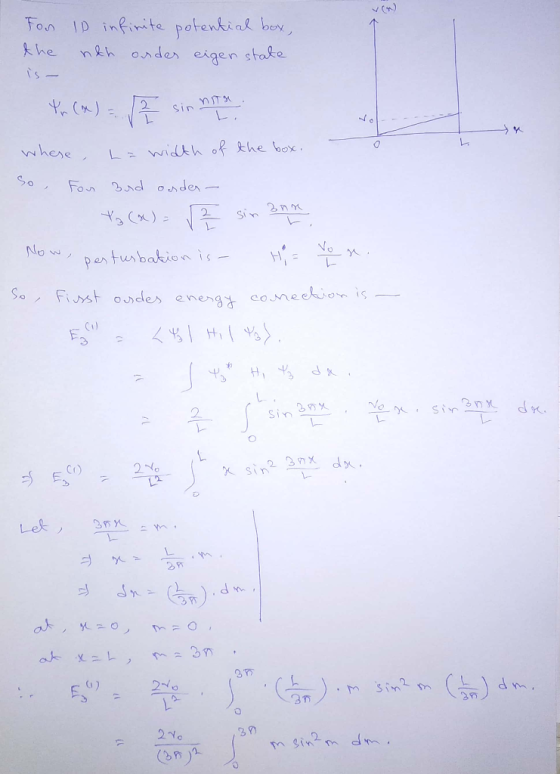
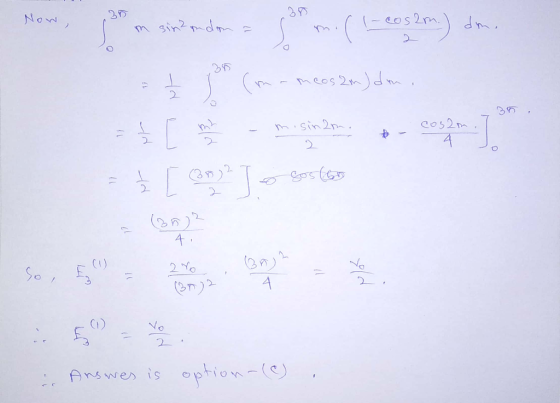
X. The first energy correction E) to the 3rd Perturbation of Infinite Square Well. Consider this perturbation to the 1D...
Q4. Consider the 1D infinite square-well potential shown in the figure below. V(x) O0 Position (a)...
 Q4. Consider the 1D infinite square-well potential shown in the figure below. V(x) O0 Position (a) State the time-independent Schrödinger equation within the region 0<x<L for a particle with positive energy E 2 marks] (b) The wavefunction for 0<x< L can be written in the general form y(x) = Asin kx + B cos kx. Show that the normalised wavefunction for the 1D infinite potential well becomes 2sn'n? ?snT/where ( "1,2,3 ! where ( n = 1,2,5, ). [4 marks]...
4. 3D Infinite Square Well Perturbation (20 pts) Consider the three-dimensional infinite cubic well: otherwise The stationary states are where n, ny, and n, are integers. The corresponding allowed en...
 4. 3D Infinite Square Well Perturbation (20 pts) Consider the three-dimensional infinite cubic well: otherwise The stationary states are where n, ny, and n, are integers. The corresponding allowed energies are Now let us introduce the perturbation otherwise a) Find the first-order correction to the ground state energy b) Find the first-order correction to the first excited state
4. 3D Infinite Square Well Perturbation (20 pts) Consider the three-dimensional infinite cubic well: otherwise The stationary states are where n, ny,...
4. 3D Infinite Square Well Perturbation (20 pts) Consider the three-dimensional infinite cubic well: otherwise The stationary states are where n, ny, and n, are integers. The corresponding allowed energies are Now let us introduce the perturbation otherwise a) Find the first-order correction to the ground state energy b) Find the first-order correction to the first excited state
4. 3D Infinite Square Well Perturbation (20 pts) Consider the three-dimensional infinite cubic well: otherwise The stationary states are where n, ny,...
Please answer a,b and c. Now, consider a 1-d infinite square well of width a, between...
 Please answer a,b and c.
Now, consider a 1-d infinite square well of width a, between x = 0 and a, such that V(x) = 0 for 0<x<a and too elsewhere. A perturbation is then added to it so that V(x) = V. for 0 <x <a/2, and the same as before elsewhere. In other words, a flat bump of width a/2 and height V. in the left half of the well. (a) (5 pts) Carefully sketch the potential and...
Please answer a,b and c.
Now, consider a 1-d infinite square well of width a, between x = 0 and a, such that V(x) = 0 for 0<x<a and too elsewhere. A perturbation is then added to it so that V(x) = V. for 0 <x <a/2, and the same as before elsewhere. In other words, a flat bump of width a/2 and height V. in the left half of the well. (a) (5 pts) Carefully sketch the potential and...
An infinite square well and a finite square well in 1D with equal width. The potential...
 An infinite square well and a finite square well in 1D with
equal width. The potential energies of these wells are
Infinite square well: V(x)=0, from 0 < x < a, also V(x) =
, elsewhere
Finite square well: V(x)= 0, from 0 < x < a, also V(x) =
,
elsewhere
The ground state of both systems have identical particles.
Without solving the energies of ground states, determine which
particle has the higher energy and explain why?
An infinite square well and a finite square well in 1D with
equal width. The potential energies of these wells are
Infinite square well: V(x)=0, from 0 < x < a, also V(x) =
, elsewhere
Finite square well: V(x)= 0, from 0 < x < a, also V(x) =
,
elsewhere
The ground state of both systems have identical particles.
Without solving the energies of ground states, determine which
particle has the higher energy and explain why?
There is a 1-d infinite square well of width a, between x = 0 and a....
There is a 1-d infinite square well of width a, between x = 0 and a. We also know that V(x) = 0 for 0<x<a and +∞ elsewhere. Then we add a perturbation to it so that V(x) = ?_0 for 0 < x < a/2, and the same as before elsewhere. That is, a flat bump of width a/2 and height ?_0 in the left half of the well. Please answer following 3 questions. 1) Sketch the potential and...
Consider an infinite 1D square well with a length L with a particl of mass M...
 Consider an infinite 1D square well with a length L with a particl of mass M trapped inside. (a) Calculate the expectation values(x), (2,2), (p), and (pay for the ground state where n 1. Note that the first three quantities may be calculate by using symmetry argu- ments, or by appealing to the fact that the kinetic energy is known exactly. On the other hand, to find (2) one will need to evaluate an integral. (b) Calculate ΔΧ-V(22)-(zy2 and ΔΙΕ...
Problem 3: Time-Independent Perturbation Theory Consider the particle in a 1D box of size L, as...
 Problem 3: Time-Independent Perturbation Theory Consider the particle in a 1D box of size L, as in Fig. 3. A perturbation of the form. V,δ ((x-2)2-a2) with a < L is applied to the unperturbed Hamiltonian of the 1D particle in a box (solutions on the equation sheet). Here V is a constant with units of energy. Remember the following propertics of the Dirac delta function m,f(x)6(x-a)dx f(a) 6(az) が(z) = = ds( dz E, or Ψ(x)-En 10 0.0 0.2...
4. (20 points). 5-function perturbation. Consider a particle in a one-dimensional infinite square well with boundaries...
 4. (20 points). 5-function perturbation. Consider a particle in a one-dimensional infinite square well with boundaries at x--a and x-a. We introduce the following δ-function perturbation at V'(x) 00(z). a. Compute the first-order corrections to the energies of the particle induced by the perturbation b. Recall that you solved this problem exactly in problem set 4 (Griffiths 2.43). Compare your perturbation theory result to the exact solution
2. Calculate th first order energy shift for the first three states of the infinite square...
 2. Calculate th first order energy shift for the first three states of the infinite square for 0-x-L. well in one dimension due to a ramp-shaped perturbation: V(r)- Use the following unperturbed eigenstates for the square well: Solution: The first order corrections for each state is given by E -(vn) 1, n°)), and there- fore: Sinn what happens to the sin4? 2 Vo L2 LL14
4. (20 points). δ. unction perturbation. Consider a particle in a one-dimensional infinite square well with...
 4. (20 points). δ. unction perturbation. Consider a particle in a one-dimensional infinite square well with boundaries at -a and-a. We introduce the following 6-function perturbation at x=0: a. Compute the first-order corrections to the energies of the particle induced by the ν' perturbation b. Recall that you solved this problem exactly in problem set 4 (Griffiths 2.43). Compare your perturbation theory result to the exact solution.
 Q4. Consider the 1D infinite square-well potential shown in the figure below. V(x) O0 Position (a) State the time-independent Schrödinger equation within the region 0<x<L for a particle with positive energy E 2 marks] (b) The wavefunction for 0<x< L can be written in the general form y(x) = Asin kx + B cos kx. Show that the normalised wavefunction for the 1D infinite potential well becomes 2sn'n? ?snT/where ( "1,2,3 ! where ( n = 1,2,5, ). [4 marks]...
 4. 3D Infinite Square Well Perturbation (20 pts) Consider the three-dimensional infinite cubic well: otherwise The stationary states are where n, ny, and n, are integers. The corresponding allowed energies are Now let us introduce the perturbation otherwise a) Find the first-order correction to the ground state energy b) Find the first-order correction to the first excited state
4. 3D Infinite Square Well Perturbation (20 pts) Consider the three-dimensional infinite cubic well: otherwise The stationary states are where n, ny,...
4. 3D Infinite Square Well Perturbation (20 pts) Consider the three-dimensional infinite cubic well: otherwise The stationary states are where n, ny, and n, are integers. The corresponding allowed energies are Now let us introduce the perturbation otherwise a) Find the first-order correction to the ground state energy b) Find the first-order correction to the first excited state
4. 3D Infinite Square Well Perturbation (20 pts) Consider the three-dimensional infinite cubic well: otherwise The stationary states are where n, ny,...
 Please answer a,b and c.
Now, consider a 1-d infinite square well of width a, between x = 0 and a, such that V(x) = 0 for 0<x<a and too elsewhere. A perturbation is then added to it so that V(x) = V. for 0 <x <a/2, and the same as before elsewhere. In other words, a flat bump of width a/2 and height V. in the left half of the well. (a) (5 pts) Carefully sketch the potential and...
Please answer a,b and c.
Now, consider a 1-d infinite square well of width a, between x = 0 and a, such that V(x) = 0 for 0<x<a and too elsewhere. A perturbation is then added to it so that V(x) = V. for 0 <x <a/2, and the same as before elsewhere. In other words, a flat bump of width a/2 and height V. in the left half of the well. (a) (5 pts) Carefully sketch the potential and...
 An infinite square well and a finite square well in 1D with
equal width. The potential energies of these wells are
Infinite square well: V(x)=0, from 0 < x < a, also V(x) =
, elsewhere
Finite square well: V(x)= 0, from 0 < x < a, also V(x) =
,
elsewhere
The ground state of both systems have identical particles.
Without solving the energies of ground states, determine which
particle has the higher energy and explain why?
An infinite square well and a finite square well in 1D with
equal width. The potential energies of these wells are
Infinite square well: V(x)=0, from 0 < x < a, also V(x) =
, elsewhere
Finite square well: V(x)= 0, from 0 < x < a, also V(x) =
,
elsewhere
The ground state of both systems have identical particles.
Without solving the energies of ground states, determine which
particle has the higher energy and explain why?
 Consider an infinite 1D square well with a length L with a particl of mass M trapped inside. (a) Calculate the expectation values(x), (2,2), (p), and (pay for the ground state where n 1. Note that the first three quantities may be calculate by using symmetry argu- ments, or by appealing to the fact that the kinetic energy is known exactly. On the other hand, to find (2) one will need to evaluate an integral. (b) Calculate ΔΧ-V(22)-(zy2 and ΔΙΕ...
 Problem 3: Time-Independent Perturbation Theory Consider the particle in a 1D box of size L, as in Fig. 3. A perturbation of the form. V,δ ((x-2)2-a2) with a < L is applied to the unperturbed Hamiltonian of the 1D particle in a box (solutions on the equation sheet). Here V is a constant with units of energy. Remember the following propertics of the Dirac delta function m,f(x)6(x-a)dx f(a) 6(az) が(z) = = ds( dz E, or Ψ(x)-En 10 0.0 0.2...
 4. (20 points). 5-function perturbation. Consider a particle in a one-dimensional infinite square well with boundaries at x--a and x-a. We introduce the following δ-function perturbation at V'(x) 00(z). a. Compute the first-order corrections to the energies of the particle induced by the perturbation b. Recall that you solved this problem exactly in problem set 4 (Griffiths 2.43). Compare your perturbation theory result to the exact solution
 2. Calculate th first order energy shift for the first three states of the infinite square for 0-x-L. well in one dimension due to a ramp-shaped perturbation: V(r)- Use the following unperturbed eigenstates for the square well: Solution: The first order corrections for each state is given by E -(vn) 1, n°)), and there- fore: Sinn what happens to the sin4? 2 Vo L2 LL14
 4. (20 points). δ. unction perturbation. Consider a particle in a one-dimensional infinite square well with boundaries at -a and-a. We introduce the following 6-function perturbation at x=0: a. Compute the first-order corrections to the energies of the particle induced by the ν' perturbation b. Recall that you solved this problem exactly in problem set 4 (Griffiths 2.43). Compare your perturbation theory result to the exact solution.
Most questions answered within 3 hours.
-
Where is the error in this code sequence?
String s1 = "Hello";
String s2 = "ello";...
asked 10 months ago -
Financial data for Joel de Paris, Inc., for last year
follow:
Joel de Paris, Inc.
Balance...
asked 10 months ago -
Consider this reaction:
Al2(SO4)3 (aq)+ BaCl3
(aq) Al2Cl6 (aq)- +
3BaSO4(s) . What is the...
asked 10 months ago -
Suppose that Savneet is considering increasing her
recent random sample from 20 car rentals to 40...
asked 10 months ago -
Trucks arrive at an unloading terminal at an average rate of 120
per hour.
Trucks arrive...
asked 10 months ago -
Why are methanol and ethanol completely soluble in water while
octanol is not very little soluble....
asked 10 months ago -
A facilities manager at a university reads in a research report
that the mean amount of...
asked 10 months ago -
When the CuSO4 is rehydrated by adding water to the anhydrous
compound, is this an endothermic...
asked 10 months ago -
A ray of sunlight is passing from diamond into crown glass; the
angle of incidence is...
asked 10 months ago -
A block of mass 0.249 kg is placed on top of a light, vertical
spring of...
asked 10 months ago -
how do the kidneys compensate in the presences of acidosis
a) trigger hyperventilate
b) reserve acid...
asked 10 months ago -
Question 501 pts
The rental rate of capital to the firm increases. Which of the
following...
asked 10 months ago