
Homework Answers
First step is to calculate the number of moles of magnesium bromide and silver nitrate.
For magnesium bromide,
For silver nitrate,
Limiting reagent is defined as that reagent which is completely reacted during a reaction. Thus during a reaction, the limiting reagent will be the one which is present in smaller amount.
Here since the number of moles of magnesium bromide is less than that of silver nitrate, the limiting reagent will be magnesium bromide.
An excess reagent is the one which is present in excess after the formation of the product. Here the excess reagent is silver nitrate.
This is expressed using the ICE table,
| MgBr2(s) | + | 2AgNO3(aq) | Mg(NO3)2(aq) | + | 2AgBr(s) | ||
| I | 0.271 moles | 0.588 moles | 0 moles | 0 moles | |||
| C | -0.271 moles | -2 |
0 moles | 0 moles | |||
| E | 0 moles | 0.046 moles | 0.271 moles | 0.542 moles |
Thus the moles of excess reactant present in the vessel after the completion of the reaction is 0.046 moles of silver nitrate.
Mass in gram is calculated as,
Add Answer to:
6. (16 points) Magnesium bromide reacts with silver nitrate to form silver bromide (solid) and magnesium sulfate (a...
6. (16 points) Magnesium bromide reacts with silver nitrate to form silver bromide (solid) and magnesium...
 6. (16 points) Magnesium bromide reacts with silver nitrate to form silver bromide (solid) and magnesium sulfate (aq). A mixture of 50.0 8 of magnesium bromide (MM 184.1 g/mol) and 100 g of silver nitrate (MM- 169.9 g/mol) is allowed to react. Identify the limiting reactant and determine the mass of the excess reactant present in the vessel when the reaction is complete, Do by ICE Method Type of reaction Double displacement 2015 MgBra (5) + 2 AgNO,(aq) > Mg(NO)2(aq)...
molecular equation for the reaction of magnesium metal with aqueous silver nitrate > magnesium + silver...
 molecular equation for the reaction of magnesium metal with aqueous
silver nitrate
> magnesium + silver nitrate Mg(s) + 2AgNO, (aq) → Mg(NO3)2(aq) + 2Ag(s) copper(11) nitrate silver Cu(NO3)2(aq) Ag(s) silver nitrate AgNO,(aq) Write the molecular equation for the reaction of magnesium metal with aqueous silver nitrate. Include physical states. molecular equation: ABUS Write the net ionic equation for the reaction of magnesium metal with aqueous silver nitrate. Include physical states. net ionic equation:
molecular equation for the reaction of magnesium metal with aqueous
silver nitrate
> magnesium + silver nitrate Mg(s) + 2AgNO, (aq) → Mg(NO3)2(aq) + 2Ag(s) copper(11) nitrate silver Cu(NO3)2(aq) Ag(s) silver nitrate AgNO,(aq) Write the molecular equation for the reaction of magnesium metal with aqueous silver nitrate. Include physical states. molecular equation: ABUS Write the net ionic equation for the reaction of magnesium metal with aqueous silver nitrate. Include physical states. net ionic equation:
Given that 50.0 mL of 0.100 M magnesium bromide reacts with 13.9 mL of silver nitrate...
Given that 50.0 mL of 0.100 M magnesium bromide reacts with 13.9 mL of silver nitrate solution according to the unbalanced equation MgBr2 + AgNO3 = AgBr + Mg(NO3)2 (a) What is the molarity of the AgNO3 solution? (b) What is the mass of AgBr precipitate?
3a) Copper metal reacts with silver nitrate to form silver metal and copper nitrate according to...
3a) Copper metal reacts with silver nitrate to form silver metal and copper nitrate according to the following equation; Balance the equation __Cu + __AgNO3 ---> __Ag + Cu(NO3)2 3b) You have 7.55 grams of each reactant, which is the limiting reagent? Show work to validate answer 3c)From the limiting reagent determined in 3b, calculate the grams of Ag that can be made.
Double Replacement potassium carbonate (aq) + silver nitrate (aq) → potassium nitrate (aq) + silver carbonate...
 Double Replacement potassium carbonate (aq) + silver nitrate (aq) → potassium nitrate (aq) + silver carbonate (s) K2CO3(aq) + AgNO, (ag) - potassium carbonate (aq) + copper (II) nitrate (aq) potassium nitrate (aq) + copper (II) carbonate (8) K,CO, (aq) + _Cu(NO, ),(aq) potassium carbonate (aq) + aluminum nitrate (aq) + potassium nitrate (aq) + aluminum carbonate (3) K.CO; (aq) + _Al(NO3) (aq) - sodium phosphate (aq) + silver nitrate (aq) sodium nitrate (aq) + silver phosphate (8) Na, PO...
What is the molarity of aqueous silver nitrate if 50.0 mL of AgNO 3 reacts with...
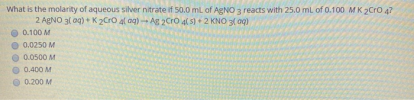 What is the molarity of aqueous silver nitrate if 50.0 mL of AgNO 3 reacts with 25.0 mL of 0.100 M K 2 CrO 4? 2 AgNO 3( aq) +K 2 CrO 4(aq) -- Ag 2CrO 4(s) + 2 KNO 3(aq) 0.100 M 0.0250 M 0.0500 M 0.400 M 0.200 M
When silver nitrate reacts with barium chloride, silver chloride and barium nitrate are formed. 2AgNO_3(aq) +...
 When silver nitrate reacts with barium chloride, silver chloride and barium nitrate are formed. 2AgNO_3(aq) + BaCl_2(aq) rightarrow 2AgCl + Ba(NO_3)_2 What is the limiting reactant with 10.8 g of silver nitrate reacts with 15.0 g of barium chloride? What is the theoretical yield of the AgCl (in grams)? Limiting Reactant: How many grams of the excess reactant reacted? If the actual yield of AgCl was 9.314 g, what would the percent yield be? Is the percent yield reasonable? Explain...
Solutions of sodium carbonate and silver nitrate reacts to form silver carbonate and sodium nitrate. A...
 Solutions of sodium carbonate and silver nitrate reacts to form silver carbonate and sodium nitrate. A solution containing 2.35 g of sodium carbonate is mixed with one containing 12.8 g of silver nitrate. Show your work. Pay close attention to significant figures and units. Use 4 significant figures for the masses. Answers without work will receive a grade of 0 pts a) Write the chemical equation 2.359 Nalo 2 (sodem corrono b) Balanced the molecular equation c) Write the net...
Silver nitrate, AgNOs, reacts with iron(III) chloride, FeCl3,to give silver chloride, AgCl, and iron(III) nitrate, Fe(NO3)....
 Silver nitrate, AgNOs, reacts with iron(III) chloride, FeCl3,to give silver chloride, AgCl, and iron(III) nitrate, Fe(NO3). A solution containing 18.0 g of AgNO, was mixed with a solution containing 32.4 g of FeCls. How many grams of which reactant remains after the reaction is over?
Magnesium (used in the manufacture of light alloys) reacts with iron(III) chloride to form magnesium chloride...
Magnesium (used in the manufacture of light alloys) reacts with iron(III) chloride to form magnesium chloride and iron. 3Mg(s) + 2FeCl₃(s) → 3MgCl₂(s) + 2Fe(s) A mixture of 41.0 g of magnesium ( mm= 24.31 g/mol) and 171 g of iron(III) chloride ( mm= 162.2 g/mol) is allowed to react. MMof MgCl2=105.216 g/mol. 1. What is the limiting reactant? 2. how many grams of excess reactants will remain? 3. How many grams of MgCl2 will be formed? 4. If 142...
 6. (16 points) Magnesium bromide reacts with silver nitrate to form silver bromide (solid) and magnesium sulfate (aq). A mixture of 50.0 8 of magnesium bromide (MM 184.1 g/mol) and 100 g of silver nitrate (MM- 169.9 g/mol) is allowed to react. Identify the limiting reactant and determine the mass of the excess reactant present in the vessel when the reaction is complete, Do by ICE Method Type of reaction Double displacement 2015 MgBra (5) + 2 AgNO,(aq) > Mg(NO)2(aq)...
 molecular equation for the reaction of magnesium metal with aqueous
silver nitrate
> magnesium + silver nitrate Mg(s) + 2AgNO, (aq) → Mg(NO3)2(aq) + 2Ag(s) copper(11) nitrate silver Cu(NO3)2(aq) Ag(s) silver nitrate AgNO,(aq) Write the molecular equation for the reaction of magnesium metal with aqueous silver nitrate. Include physical states. molecular equation: ABUS Write the net ionic equation for the reaction of magnesium metal with aqueous silver nitrate. Include physical states. net ionic equation:
molecular equation for the reaction of magnesium metal with aqueous
silver nitrate
> magnesium + silver nitrate Mg(s) + 2AgNO, (aq) → Mg(NO3)2(aq) + 2Ag(s) copper(11) nitrate silver Cu(NO3)2(aq) Ag(s) silver nitrate AgNO,(aq) Write the molecular equation for the reaction of magnesium metal with aqueous silver nitrate. Include physical states. molecular equation: ABUS Write the net ionic equation for the reaction of magnesium metal with aqueous silver nitrate. Include physical states. net ionic equation:
 Double Replacement potassium carbonate (aq) + silver nitrate (aq) → potassium nitrate (aq) + silver carbonate (s) K2CO3(aq) + AgNO, (ag) - potassium carbonate (aq) + copper (II) nitrate (aq) potassium nitrate (aq) + copper (II) carbonate (8) K,CO, (aq) + _Cu(NO, ),(aq) potassium carbonate (aq) + aluminum nitrate (aq) + potassium nitrate (aq) + aluminum carbonate (3) K.CO; (aq) + _Al(NO3) (aq) - sodium phosphate (aq) + silver nitrate (aq) sodium nitrate (aq) + silver phosphate (8) Na, PO...
 What is the molarity of aqueous silver nitrate if 50.0 mL of AgNO 3 reacts with 25.0 mL of 0.100 M K 2 CrO 4? 2 AgNO 3( aq) +K 2 CrO 4(aq) -- Ag 2CrO 4(s) + 2 KNO 3(aq) 0.100 M 0.0250 M 0.0500 M 0.400 M 0.200 M
 When silver nitrate reacts with barium chloride, silver chloride and barium nitrate are formed. 2AgNO_3(aq) + BaCl_2(aq) rightarrow 2AgCl + Ba(NO_3)_2 What is the limiting reactant with 10.8 g of silver nitrate reacts with 15.0 g of barium chloride? What is the theoretical yield of the AgCl (in grams)? Limiting Reactant: How many grams of the excess reactant reacted? If the actual yield of AgCl was 9.314 g, what would the percent yield be? Is the percent yield reasonable? Explain...
 Solutions of sodium carbonate and silver nitrate reacts to form silver carbonate and sodium nitrate. A solution containing 2.35 g of sodium carbonate is mixed with one containing 12.8 g of silver nitrate. Show your work. Pay close attention to significant figures and units. Use 4 significant figures for the masses. Answers without work will receive a grade of 0 pts a) Write the chemical equation 2.359 Nalo 2 (sodem corrono b) Balanced the molecular equation c) Write the net...
 Silver nitrate, AgNOs, reacts with iron(III) chloride, FeCl3,to give silver chloride, AgCl, and iron(III) nitrate, Fe(NO3). A solution containing 18.0 g of AgNO, was mixed with a solution containing 32.4 g of FeCls. How many grams of which reactant remains after the reaction is over?
Most questions answered within 3 hours.
-
Where is the error in this code sequence?
String s1 = "Hello";
String s2 = "ello";...
asked 10 months ago -
Financial data for Joel de Paris, Inc., for last year
follow:
Joel de Paris, Inc.
Balance...
asked 10 months ago -
Consider this reaction:
Al2(SO4)3 (aq)+ BaCl3
(aq) Al2Cl6 (aq)- +
3BaSO4(s) . What is the...
asked 10 months ago -
Suppose that Savneet is considering increasing her
recent random sample from 20 car rentals to 40...
asked 10 months ago -
Trucks arrive at an unloading terminal at an average rate of 120
per hour.
Trucks arrive...
asked 10 months ago -
Why are methanol and ethanol completely soluble in water while
octanol is not very little soluble....
asked 10 months ago -
A facilities manager at a university reads in a research report
that the mean amount of...
asked 10 months ago -
When the CuSO4 is rehydrated by adding water to the anhydrous
compound, is this an endothermic...
asked 10 months ago -
A ray of sunlight is passing from diamond into crown glass; the
angle of incidence is...
asked 10 months ago -
A block of mass 0.249 kg is placed on top of a light, vertical
spring of...
asked 10 months ago -
how do the kidneys compensate in the presences of acidosis
a) trigger hyperventilate
b) reserve acid...
asked 10 months ago -
Question 501 pts
The rental rate of capital to the firm increases. Which of the
following...
asked 10 months ago