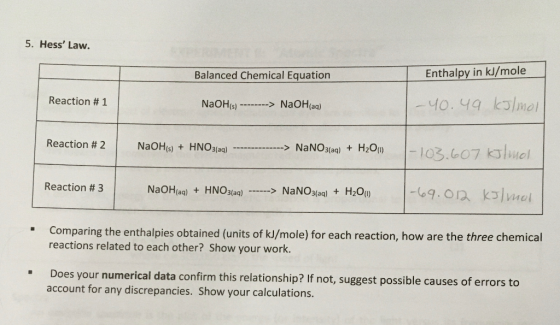
Comparing the enthalpies obtained for each reaction, how are the three chemical reactions related to each other?
Also, does the data confirm this relationship?
Homework Answers
Answer :
Relationship between the reaction :
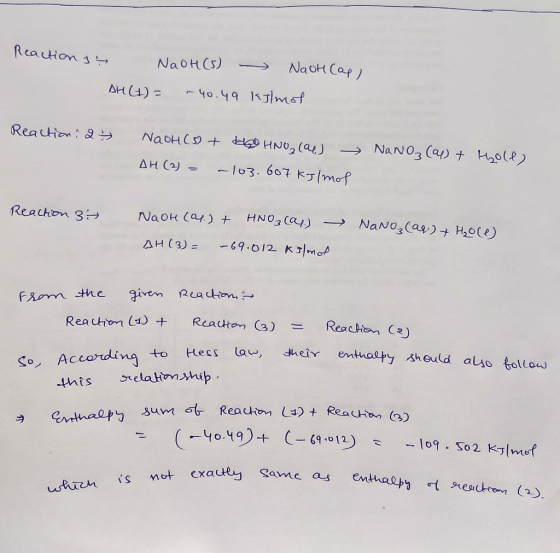
Reaction (1) + Reaction (3) = Reaction (2)
If we add 1 and 3rd reaction , we will get reaction (2) .
But when same relationship is applied on enthalpy data , so numerical data wouldn't confirm this relationship . There is a small discrepancy of approx 6KJ/mol is observed.
Reason may be : Temperature fluctuations , instrument error , error in recording the data , calibration error .
Add Answer to:
Comparing the enthalpies obtained for each reaction, how are the three chemical reactions related to each other? Also, d...
Consider the following chemical reaction. NH3(g) + 2 O2(g) → HNO3(aq) + H2O(l) Calculate the change...
Consider the following chemical reaction. NH3(g) + 2 O2(g) → HNO3(aq) + H2O(l) Calculate the change in enthalpy (ΔH) for this reaction, using Hess' law and the enthalpy changes for the reactions given below. (1a) 4 NH3(g) + 5 O2(g) → 4 NO(g) + 6 H2O(l); ΔH = −1166.0 kJ/mol (2a) 2 NO(g) + O2(g) → 2 NO2(g); ΔH = −116.2 kJ/mol (3a) 3 NO2(g) + H2O(l) → 2 HNO3(aq) + NO(g); ΔH = −137.3 kJ/mol
1. Provide balanced chemical equations for each of the chemical reactions that you performed. [Reaction (2b)...
1. Provide balanced chemical equations for each of the chemical reactions that you performed. [Reaction (2b) is omitted here.] (1a) _______ Pb(NO3)2 (aq) + ________ K2CrO4 (aq) → ________ KNO3 (aq) + ________ PbCrO4 (s) (1b) _______ Pb(NO3)2 (aq) + ________ Na2SO4 (aq) → ________ NaNO3 (aq) + ________ PbSO4 (s) (2a) _______ HCl (aq) + ________ Mg (s) → ________ MgCl2 (aq) + ________ H2 (g) (2c) _____ HC2H3O2 (aq) + ______NaHCO3 (s) → ______ NaC2H3O2 (aq) + _____...
POST LABORATORY QUESTIONS 1. a. For the neutralization reaction that you carried out between HCl(aq) and...
 POST LABORATORY QUESTIONS 1. a. For the neutralization reaction that you carried out between HCl(aq) and NaOH (ag). how many moles of NaCl(aq) were produced? b. For the neutralization reaction that you carried out between HCl(aq) and NaOH() how many moles of NaCl(aq) were produced? 2. Calculate AHan for the neutralization of HCl(aq) and NaOH(aq) in kilojoules per mol of NaCl b. Calculate A Hexn for the neutralization of HCl (aq) and NaOH(s) in kilojoules per mol of NaCl 3....
How do I approach this? The temperature are in degrees Celcius btw. Thank you! Reaction 1:...
 How do I approach this? The temperature are in degrees Celcius
btw. Thank you!
Reaction 1: The dissolving of solid sodium hydroxide in water. NaOH(s) ---> Nat(aq) + OH"(aq) + heat (x1 kJ) Reaction 2: The reaction of solid sodium hydroxide with dilute hydrochloric acid. NaOH(s) + H+ (aq) + Cl'(aq) ---> Nat(aq) + Cl(aq) + H2O + heat (x2 kJ) Reaction 3: The reaction of a sodium hydroxide solution with dilute hydrochloric acid solution. Na*(aq) + OH"(aq) + H+...
How do I approach this? The temperature are in degrees Celcius
btw. Thank you!
Reaction 1: The dissolving of solid sodium hydroxide in water. NaOH(s) ---> Nat(aq) + OH"(aq) + heat (x1 kJ) Reaction 2: The reaction of solid sodium hydroxide with dilute hydrochloric acid. NaOH(s) + H+ (aq) + Cl'(aq) ---> Nat(aq) + Cl(aq) + H2O + heat (x2 kJ) Reaction 3: The reaction of a sodium hydroxide solution with dilute hydrochloric acid solution. Na*(aq) + OH"(aq) + H+...
A critical reaction in the production of energy to do work or drive chemical reactions in...
 A critical reaction in the production of energy to do work or
drive chemical reactions in biological systems is the hydrolysis of
adenosine triphosphate, ATP, to adenosine diphosphate, ADP, as
described by the reaction.....
Thank you!!!
A critical reaction in the production of energy to do work or drive chemical reactions in biological systems is the hydrolysis of adenosine triphosphate, ATP, to adenosine diphosphate, ADP, as described by the reaction ATP(aq) + H2O(1) ADP(aq) + HPO2 (aq) in a biological...
A critical reaction in the production of energy to do work or
drive chemical reactions in biological systems is the hydrolysis of
adenosine triphosphate, ATP, to adenosine diphosphate, ADP, as
described by the reaction.....
Thank you!!!
A critical reaction in the production of energy to do work or drive chemical reactions in biological systems is the hydrolysis of adenosine triphosphate, ATP, to adenosine diphosphate, ADP, as described by the reaction ATP(aq) + H2O(1) ADP(aq) + HPO2 (aq) in a biological...
Given the three reactions that you will measure (below) with the reaction enthalpies reported in the...
 Given the three reactions that you will measure (below) with the reaction enthalpies reported in the literature, use Hess's Law to predict the enthalpy of dissolution of the target reaction. Explain how you will manipulate the equations and report your final value. 1: Ca(NO3)2* 4H2O(5) → Ca2+ (aq) +2 NO3- (aq) + 4H2O(1) Arxn = 30.3 mol 2: Na2CO3(s) +2 Na + (aq) + CO32-(aq) AHrxn=-26.7 mol AH rxn = 16.7 3: Ca(NO3)2 + 4H2O(5) + Na2CO3(5) → CaCO3(s) +...
a) Calculate the enthalpy of the reaction 2NO(g)+O2(g)→2NO2(g) given the following reactions and enthalpies of formation:...
a) Calculate the enthalpy of the reaction 2NO(g)+O2(g)→2NO2(g) given the following reactions and enthalpies of formation: 12N2(g)+O2(g)→NO2(g), ΔfH∘A=33.2 kJ mol−1 12N2(g)+12O2(g)→NO(g), ΔfH∘B=90.2 kJ mol−1 Express your answer with the appropriate units. b) Calculate the enthalpy of the reaction 4B(s)+3O2(g)→2B2O3(s) given the following pertinent information: B2O3(s)+3H2O(g)→3O2(g)+B2H6(g), ΔrH∘A=+2035 kJ mol−1 2B(s)+3H2(g)→B2H6(g), ΔrH∘B=+36 kJ mol−1 H2(g)+12O2(g)→H2O(l), ΔrH∘C=−285 kJ mol−1 H2O(l)→H2O(g), ΔrH∘D=+44 kJ mol−1
Part A Several reactions and their standard reaction enthalpies at 298.15 K are given here: AH...
 Part A Several reactions and their standard reaction enthalpies at 298.15 K are given here: AH (kJ · mol-?) CaC2 (s) + 2H2O(1) + Ca(OH)2 (s) + C2H2 (g) –127.9 Ca(s) + O2(g) → Cao(s) CaO(s) +H2O(1) + Ca(OH)2(s) -65.2 -635.1 The standard enthalpies of combustion of graphite and C2H2(g) are –393.51 and — 1299.58 kJ · mol-? respectively. Calculate the standard enthalpy of formation of CaC2(s) at 25°C. Express your answer to one decimal place and include the appropriate...
(6 pts.) Using Hess’s Law and the values for Standard Enthalpies of Formation from the table...
(6 pts.) Using Hess’s Law and the values for Standard Enthalpies of Formation from the table provided, calculate the enthalpy of reaction ΔH°rxn (in kJ) for each of the following reactions: Standard Enthalpies of Formation substance ΔHf° in kJ/mol Mg(s) 0 MgO(s) -601.6 HCl(aq) -167.2 MgCl2(aq) -801.2 H2(g) 0 H2O(l) -285.8 Reaction #1: Mg (s) + 2HCl (aq) è MgCl2 (aq) + H2 (g) Reaction #2: MgO (s) + 2HCl (aq) è MgCl2 (aq) + H2O (l) 2. (4 pts.)...
In this experiment, you will determine and compare the quantity of heat energy released in three exothermic chemical rea...
In this experiment, you will determine and compare the quantity of heat energy released in three exothermic chemical reactions through application of Hess’s law. Reaction 1: NaOH(s) → Na+(aq) + OH-(aq) + x1 kJ Reaction 2: NaOH(s) + HCl(aq) → H2O(l) + Na+(aq) + OH-(aq) + x2 kJ Reaction 3: NaOH(aq) + HCl(aq) → H2O(l) + Na+(aq) + OH-(aq) + x3 kJ In order to accurately measure the heat released in each reaction, we will be using a calorimeter. As...
 POST LABORATORY QUESTIONS 1. a. For the neutralization reaction that you carried out between HCl(aq) and NaOH (ag). how many moles of NaCl(aq) were produced? b. For the neutralization reaction that you carried out between HCl(aq) and NaOH() how many moles of NaCl(aq) were produced? 2. Calculate AHan for the neutralization of HCl(aq) and NaOH(aq) in kilojoules per mol of NaCl b. Calculate A Hexn for the neutralization of HCl (aq) and NaOH(s) in kilojoules per mol of NaCl 3....
 How do I approach this? The temperature are in degrees Celcius
btw. Thank you!
Reaction 1: The dissolving of solid sodium hydroxide in water. NaOH(s) ---> Nat(aq) + OH"(aq) + heat (x1 kJ) Reaction 2: The reaction of solid sodium hydroxide with dilute hydrochloric acid. NaOH(s) + H+ (aq) + Cl'(aq) ---> Nat(aq) + Cl(aq) + H2O + heat (x2 kJ) Reaction 3: The reaction of a sodium hydroxide solution with dilute hydrochloric acid solution. Na*(aq) + OH"(aq) + H+...
How do I approach this? The temperature are in degrees Celcius
btw. Thank you!
Reaction 1: The dissolving of solid sodium hydroxide in water. NaOH(s) ---> Nat(aq) + OH"(aq) + heat (x1 kJ) Reaction 2: The reaction of solid sodium hydroxide with dilute hydrochloric acid. NaOH(s) + H+ (aq) + Cl'(aq) ---> Nat(aq) + Cl(aq) + H2O + heat (x2 kJ) Reaction 3: The reaction of a sodium hydroxide solution with dilute hydrochloric acid solution. Na*(aq) + OH"(aq) + H+...
 A critical reaction in the production of energy to do work or
drive chemical reactions in biological systems is the hydrolysis of
adenosine triphosphate, ATP, to adenosine diphosphate, ADP, as
described by the reaction.....
Thank you!!!
A critical reaction in the production of energy to do work or drive chemical reactions in biological systems is the hydrolysis of adenosine triphosphate, ATP, to adenosine diphosphate, ADP, as described by the reaction ATP(aq) + H2O(1) ADP(aq) + HPO2 (aq) in a biological...
A critical reaction in the production of energy to do work or
drive chemical reactions in biological systems is the hydrolysis of
adenosine triphosphate, ATP, to adenosine diphosphate, ADP, as
described by the reaction.....
Thank you!!!
A critical reaction in the production of energy to do work or drive chemical reactions in biological systems is the hydrolysis of adenosine triphosphate, ATP, to adenosine diphosphate, ADP, as described by the reaction ATP(aq) + H2O(1) ADP(aq) + HPO2 (aq) in a biological...
 Given the three reactions that you will measure (below) with the reaction enthalpies reported in the literature, use Hess's Law to predict the enthalpy of dissolution of the target reaction. Explain how you will manipulate the equations and report your final value. 1: Ca(NO3)2* 4H2O(5) → Ca2+ (aq) +2 NO3- (aq) + 4H2O(1) Arxn = 30.3 mol 2: Na2CO3(s) +2 Na + (aq) + CO32-(aq) AHrxn=-26.7 mol AH rxn = 16.7 3: Ca(NO3)2 + 4H2O(5) + Na2CO3(5) → CaCO3(s) +...
 Part A Several reactions and their standard reaction enthalpies at 298.15 K are given here: AH (kJ · mol-?) CaC2 (s) + 2H2O(1) + Ca(OH)2 (s) + C2H2 (g) –127.9 Ca(s) + O2(g) → Cao(s) CaO(s) +H2O(1) + Ca(OH)2(s) -65.2 -635.1 The standard enthalpies of combustion of graphite and C2H2(g) are –393.51 and — 1299.58 kJ · mol-? respectively. Calculate the standard enthalpy of formation of CaC2(s) at 25°C. Express your answer to one decimal place and include the appropriate...
Most questions answered within 3 hours.
-
Where is the error in this code sequence?
String s1 = "Hello";
String s2 = "ello";...
asked 1 year ago -
Financial data for Joel de Paris, Inc., for last year
follow:
Joel de Paris, Inc.
Balance...
asked 1 year ago -
Consider this reaction:
Al2(SO4)3 (aq)+ BaCl3
(aq) Al2Cl6 (aq)- +
3BaSO4(s) . What is the...
asked 1 year ago -
Suppose that Savneet is considering increasing her
recent random sample from 20 car rentals to 40...
asked 1 year ago -
Trucks arrive at an unloading terminal at an average rate of 120
per hour.
Trucks arrive...
asked 1 year ago -
Why are methanol and ethanol completely soluble in water while
octanol is not very little soluble....
asked 1 year ago -
A facilities manager at a university reads in a research report
that the mean amount of...
asked 1 year ago -
When the CuSO4 is rehydrated by adding water to the anhydrous
compound, is this an endothermic...
asked 1 year ago -
A ray of sunlight is passing from diamond into crown glass; the
angle of incidence is...
asked 1 year ago -
A block of mass 0.249 kg is placed on top of a light, vertical
spring of...
asked 1 year ago -
how do the kidneys compensate in the presences of acidosis
a) trigger hyperventilate
b) reserve acid...
asked 1 year ago -
Question 501 pts
The rental rate of capital to the firm increases. Which of the
following...
asked 1 year ago