![Consider the system given by the input/output relationship 1.14. 32 1 2] n31+ 1 63 4 16 [Is- ]x+ [- u]x (a) When xn] is equal](http://img.homeworklib.com/images/07d3e669-1e85-44c6-b533-4c926fe956e8.png?x-oss-process=image/resize,w_560)
Homework Answers

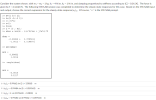
MATLAB code is given below in bold letters.
clc;
close all;
clear all;
% define n
n = 0 : 69;
% define the filter h[n] as follows
h = 32/63*[1 1/2 1/4 1/8 1/16 1/32];
% define the input x[n]
x = 5*sin(n*pi/10+pi/4);
% compute y[n] using filter command
y = filter(h,1,x);
% plot the output
figure;
stem(n,y,'fill');grid on;
xlabel('n');title('y[n]');

Add Answer to:
Consider the system given by the input/output relationship 1.14. 32 1 2] n31+ 1 63 4...
5.16. Given the following difference equation with the input-output relationship of a certain initially relaxed system...
 5.16. Given the following difference equation with the input-output relationship of a certain initially relaxed system (all initial conditions are zero), y(n)-0.6y(n - 1+0.25y(n - 2) -x(n) +x(n- 1) a. find the impulse response sequence y(n) due to the impulse sequence o(n): b. find the output response of the system when the unit step function u(n is applied
Mouzey bighalsledsystems tionne 907 octet Acone s ona 27/0 y the 13. The input-output relationship of an LTI system...
 Mouzey bighalsledsystems tionne 907 octet Acone s ona 27/0 y the 13. The input-output relationship of an LTI system is deseribed by the difference squation: n]+0.5y[n-1]-xn], Try to figure out two possible unit impulse responses for such a system. Then state which unit impulse response comresponding to tomer les modules com a stable system. 2, b) x,(2)=z" +62 452 | > 1 14) Find the inverse z-transform of the following signals a) X(E)(-2 XI-2) :-5 c) X2(E)-0.5:)1-0.5 )0. <2 15....
Consider the system shown, with mi·m2·1kg, k1" 4 N/m.k2" 1 N/m. and damping proportional to stiff...
 Consider the system shown, with mi·m2·1kg, k1" 4 N/m.k2" 1 N/m. and damping proportional to stiffness according to [C]·0.01 [K]. The force is given by f-4 sin(2t) N. The following MATLAB session was completed to determine the steady-state responses for this case. Based on the MATLAB input and output, choose the correct expression for the steady-state response (x1ss Of course, ">>" is the MATLAB prompt. >> m= [ 1 0:0 1]; >- [O Fo] xbar- -0.994840.0595631 -1.0012-0.0198971 >> abs (xbar)...
Name: 10. [8 points] Consider a discrete-time LTI system with input x[n] and out- put y[n]....
 Name: 10. [8 points] Consider a discrete-time LTI system with input x[n] and out- put y[n]. When the input signal x[n] = (6)" is applied to the system, the output signal is y[n] = 0 for all n When the input signal xn] (3)" u[n] is applied to the system, the output signal is y[n] = A 8[n] + 2 (5)" u[n] for all n, where A is a constant number a) Find A. b) Find the impulse response of...
5) An N-point moving-average (running-average) system has the following input-output relation shi...
 5) An N-point moving-average (running-average) system has the following input-output relation ship: N-1 a) Is the N-point moving-average system causal? b) Obtain the expression for the impulse response h[n] and sketch hin. c) Given the input sequence [n] below with 100 elements where the values of the index n change between 0 and 99: r-[21 22 22 21 18 19 21 20 19 23 23 22 23 25 27 30 31.5 32 33 32 28 29 28 29 30 32...
Consider a first-order system with input x(t) and output y(t). Let the time constant be the...
 Consider a first-order system with input x(t) and output y(t). Let the time constant be the part of your birth date in the format of day, month (ddmm) in microseconds. Complete the following steps: 1. Write the differential equation representing the system. 2. Derive the transfer function H(s). A Note: Label all graphs appropriately. ddmm 3. Use H(s) with MATLAB to complete the following actions: • Find the poles are zeros. • Find the step response. • Find the impulse...
Question 1-4 is about the following mechanical system: Data: ki-20 [N/m] b-2 [Ns/m] k2# 10 [N/m] m2 At) mi Question 1 X...
 Question 1-4 is about the following mechanical system: Data: ki-20 [N/m] b-2 [Ns/m] k2# 10 [N/m] m2 At) mi Question 1 X1(s) Develop the symbolic transfer function G1(s)2 F(s) 1.1 Determine the differential equation, that this transfer function describe 1.2 Question 2 Sketch the step response for G1(s), using Matlab and explain the process 2.1 Sketch the pole /zero diagram for the transfer function G1(s) and reflect on the relation between the step response and the pole /zero diagram 2.2...
are integers and 91 and 92 are 5. Consider the system diagram show in Fig. 2...
 are integers and 91 and 92 are 5. Consider the system diagram show in Fig. 2 for a digital filter. Assume N and M real-valued. (a) Use the diagram to write the difference equation that relates the input to the output. And use the difference equation to write the transfer function for the filter. No Matlab needed. (b) Assume N = 3, M = 5, 91 = 0.5 and 92 = 0.9. Write a Matlab function (call it "ece125filter”) that...
(2) Consider the causal discrete-time LTI system with an input r (n) and an output y(n)...
 (2) Consider the causal discrete-time LTI system with an input r (n) and an output y(n) as shown in Figure 1, where K 6 (constant), system #1 is described by its impulse response: h(n) = -36(n) + 0.48(n- 1)+8.26(n-2), and system # 2 has the difference equation given by: y(n)+0.1y(n-1)+0.3y(n-2)- 2a(n). (a) Determine the corresponding difference equation of the system #1. Hence, write its fre- quency response. (b) Find the frequency response of system #2. 1 system #1 system #2...
 5.16. Given the following difference equation with the input-output relationship of a certain initially relaxed system (all initial conditions are zero), y(n)-0.6y(n - 1+0.25y(n - 2) -x(n) +x(n- 1) a. find the impulse response sequence y(n) due to the impulse sequence o(n): b. find the output response of the system when the unit step function u(n is applied
 Mouzey bighalsledsystems tionne 907 octet Acone s ona 27/0 y the 13. The input-output relationship of an LTI system is deseribed by the difference squation: n]+0.5y[n-1]-xn], Try to figure out two possible unit impulse responses for such a system. Then state which unit impulse response comresponding to tomer les modules com a stable system. 2, b) x,(2)=z" +62 452 | > 1 14) Find the inverse z-transform of the following signals a) X(E)(-2 XI-2) :-5 c) X2(E)-0.5:)1-0.5 )0. <2 15....
 Consider the system shown, with mi·m2·1kg, k1" 4 N/m.k2" 1 N/m. and damping proportional to stiffness according to [C]·0.01 [K]. The force is given by f-4 sin(2t) N. The following MATLAB session was completed to determine the steady-state responses for this case. Based on the MATLAB input and output, choose the correct expression for the steady-state response (x1ss Of course, ">>" is the MATLAB prompt. >> m= [ 1 0:0 1]; >- [O Fo] xbar- -0.994840.0595631 -1.0012-0.0198971 >> abs (xbar)...
 Name: 10. [8 points] Consider a discrete-time LTI system with input x[n] and out- put y[n]. When the input signal x[n] = (6)" is applied to the system, the output signal is y[n] = 0 for all n When the input signal xn] (3)" u[n] is applied to the system, the output signal is y[n] = A 8[n] + 2 (5)" u[n] for all n, where A is a constant number a) Find A. b) Find the impulse response of...
 5) An N-point moving-average (running-average) system has the following input-output relation ship: N-1 a) Is the N-point moving-average system causal? b) Obtain the expression for the impulse response h[n] and sketch hin. c) Given the input sequence [n] below with 100 elements where the values of the index n change between 0 and 99: r-[21 22 22 21 18 19 21 20 19 23 23 22 23 25 27 30 31.5 32 33 32 28 29 28 29 30 32...
 Consider a first-order system with input x(t) and output y(t). Let the time constant be the part of your birth date in the format of day, month (ddmm) in microseconds. Complete the following steps: 1. Write the differential equation representing the system. 2. Derive the transfer function H(s). A Note: Label all graphs appropriately. ddmm 3. Use H(s) with MATLAB to complete the following actions: • Find the poles are zeros. • Find the step response. • Find the impulse...
 Question 1-4 is about the following mechanical system: Data: ki-20 [N/m] b-2 [Ns/m] k2# 10 [N/m] m2 At) mi Question 1 X1(s) Develop the symbolic transfer function G1(s)2 F(s) 1.1 Determine the differential equation, that this transfer function describe 1.2 Question 2 Sketch the step response for G1(s), using Matlab and explain the process 2.1 Sketch the pole /zero diagram for the transfer function G1(s) and reflect on the relation between the step response and the pole /zero diagram 2.2...
 are integers and 91 and 92 are 5. Consider the system diagram show in Fig. 2 for a digital filter. Assume N and M real-valued. (a) Use the diagram to write the difference equation that relates the input to the output. And use the difference equation to write the transfer function for the filter. No Matlab needed. (b) Assume N = 3, M = 5, 91 = 0.5 and 92 = 0.9. Write a Matlab function (call it "ece125filter”) that...
 (2) Consider the causal discrete-time LTI system with an input r (n) and an output y(n) as shown in Figure 1, where K 6 (constant), system #1 is described by its impulse response: h(n) = -36(n) + 0.48(n- 1)+8.26(n-2), and system # 2 has the difference equation given by: y(n)+0.1y(n-1)+0.3y(n-2)- 2a(n). (a) Determine the corresponding difference equation of the system #1. Hence, write its fre- quency response. (b) Find the frequency response of system #2. 1 system #1 system #2...
Most questions answered within 3 hours.
-
Where is the error in this code sequence?
String s1 = "Hello";
String s2 = "ello";...
asked 10 months ago -
Financial data for Joel de Paris, Inc., for last year
follow:
Joel de Paris, Inc.
Balance...
asked 10 months ago -
Consider this reaction:
Al2(SO4)3 (aq)+ BaCl3
(aq) Al2Cl6 (aq)- +
3BaSO4(s) . What is the...
asked 10 months ago -
Suppose that Savneet is considering increasing her
recent random sample from 20 car rentals to 40...
asked 10 months ago -
Trucks arrive at an unloading terminal at an average rate of 120
per hour.
Trucks arrive...
asked 10 months ago -
Why are methanol and ethanol completely soluble in water while
octanol is not very little soluble....
asked 10 months ago -
A facilities manager at a university reads in a research report
that the mean amount of...
asked 10 months ago -
When the CuSO4 is rehydrated by adding water to the anhydrous
compound, is this an endothermic...
asked 10 months ago -
A ray of sunlight is passing from diamond into crown glass; the
angle of incidence is...
asked 10 months ago -
A block of mass 0.249 kg is placed on top of a light, vertical
spring of...
asked 10 months ago -
how do the kidneys compensate in the presences of acidosis
a) trigger hyperventilate
b) reserve acid...
asked 10 months ago -
Question 501 pts
The rental rate of capital to the firm increases. Which of the
following...
asked 10 months ago