
Homework Answers
Add Answer to:
Possibly useful equations: Electric force: F-kqqz/? Force from E field: F=qE Electric potential: V - kq/r...
E-kg/ Possibly useful equations: Electric force: F kqyr Force from E field: F gE Electric potential:...
 E-kg/ Possibly useful equations: Electric force: F kqyr Force from E field: F gE Electric potential: - kg/r PE-V Mag Fld near wire: B - .I/2 FqBsine k=9x10" Nm2/C2 = 4x x 10-7 N/A 1) A. What is the electric potential 2.5x10 m away from a proton (e-1.6x10°C)? B. A helium nucleus contains two protons, with typical separation of 2.5x10m. What is the electric potential energy due to the two protons? 2) A bare helium nucleus (2 protons, 2 neutrons,...
(Connection between E and V in a parallel plate capacitor) We observe that the electric field...
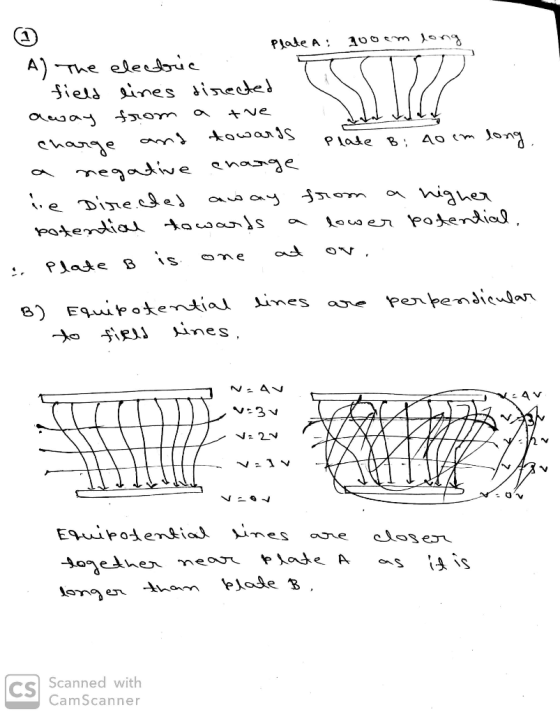
(Connection between E and V in a parallel plate capacitor) We observe that the electric field between the parallel plates of area A, and containing charge Q is uniform, i.e. the E-lines are parallel and E = Q/(εoA). (i) Describe the equipotential lines between the plates. (ii) Draw lines of potential 2.25 V, 4.50 V and 7.25 V between a parallel plate capacitor with potential difference between the plates, ΔVC = 9.00 V
3. A parallel plate capacitor with the potential difference (OV to the left and +200 V...
 3. A parallel plate capacitor with the potential difference (OV to the left and +200 V to the right plate) applied as shown below. An electron is shot with an initial speed of 1.2 x 10 m/s through a small hole as shown. Mass of the electron = 9.1 x 10⁻⁹ kg ov 200 v Electron 4.0 mm (a) Draw the electric field vectors (solid line) within the capacitor (b) Draw with dotted lines (approximately) the 50 V, 100 V,...
The electric potential V in the space between two flat parallel plates 1 and 2 is...
The electric potential V in the space between two flat parallel plates 1 and 2 is given (in volts) by V = 2200x2, where x (in meters) is the perpendicular distance from plate 1. At x = 1.7 cm, (a) what is the magnitude of the electric field and (b) is the field directed toward or away from plate 1?
For a and b below, roughly where is the electric field zero? Mark with an E....
 For a and b below, roughly where is the electric field zero?
Mark with an E. Roughly where is the potential zero? Mark with a V.
(If is nowhere near the charges, indicate this.) (Be sure to be
clear if it's just one point, or something else.) Then sketch the
electric field lines (solid) and equipotential lines (dotted)
around the two point charges.
а. ь.
For a and b below, roughly where is the electric field zero?
Mark with an E. Roughly where is the potential zero? Mark with a V.
(If is nowhere near the charges, indicate this.) (Be sure to be
clear if it's just one point, or something else.) Then sketch the
electric field lines (solid) and equipotential lines (dotted)
around the two point charges.
а. ь.
A positive charge Q, located at the origin, produces an electric potential V = kQ/r at...
A positive charge Q, located at the origin, produces an electric potential V = kQ/r at point r. A point charge q is moved from 4r to r. The increase in its electric potential energy is Question 19 options: a) 2kQq/(3r). b) kQq/(2r). c) kQq/(4r). d) kQq/(3r). e) kQq/r. f) 3kQq/(4r).
A positive charge Q, located at the origin, produces an electric potential V = kQ/r at...
A positive charge Q, located at the origin, produces an electric potential V = kQ/r at point r. A point charge q is moved from 4r to r. The increase in its electric potential energy is Question 19 options: a) 2kQq/(3r). b) kQq/(2r). c) kQq/(4r). d) kQq/(3r). e) kQq/r. f) 3kQq/(4r).
Chapter 24, Problem 036 Incorrect. The electric potential V in the space between two flat parallel...
 Chapter 24, Problem 036 Incorrect. The electric potential V in the space between two flat parallel plates 1 and 2 is given (in volts) by V 1600x2, where x (in meters) is the perpendicular distance from plate 1. At x - 1.7 cm, (a) what is the magnitude of the electrnic field and (b) is the field directed toward or away rom plate 1? N/C (b)'raiay from plate ▼ the tolerance is +/-2% E PROBLEM
Consider two points in an electric field. The potential at point 1, V1 is 22 V. The potential at point 2, V2 is 168 V.
Consider two points in an electric field. The potential at point 1, V1 is 22 V. The potential at point 2, V2 is 168 V. An electron at rest at point I is accelerated by the electric field to point 2. Part (a) Write an equation for the change of electric potential energy ΔU of the electron in terms of the symbols given.Select from the variables below to write your expression. Note that all variables may not be required. Part (b) Find...
Page #4 Physics Il caline lab: Electric Field & Elecric Potential Part I: Electric Field Open...
 Page #4 Physics Il caline lab: Electric Field & Elecric Potential Part I: Electric Field Open the PHET simulation "Charges and Fields". Add positive and negative charges as shown in the diagram below. Draw appropriate electric field lines around and in between the two charges. Use the tools available in the software and then draw manually. Where is the electric field the largest? (label the point #1 in your diagram) 2. Where is the electric field equal to zero? (label...
 E-kg/ Possibly useful equations: Electric force: F kqyr Force from E field: F gE Electric potential: - kg/r PE-V Mag Fld near wire: B - .I/2 FqBsine k=9x10" Nm2/C2 = 4x x 10-7 N/A 1) A. What is the electric potential 2.5x10 m away from a proton (e-1.6x10°C)? B. A helium nucleus contains two protons, with typical separation of 2.5x10m. What is the electric potential energy due to the two protons? 2) A bare helium nucleus (2 protons, 2 neutrons,...
 3. A parallel plate capacitor with the potential difference (OV to the left and +200 V to the right plate) applied as shown below. An electron is shot with an initial speed of 1.2 x 10 m/s through a small hole as shown. Mass of the electron = 9.1 x 10⁻⁹ kg ov 200 v Electron 4.0 mm (a) Draw the electric field vectors (solid line) within the capacitor (b) Draw with dotted lines (approximately) the 50 V, 100 V,...
 For a and b below, roughly where is the electric field zero?
Mark with an E. Roughly where is the potential zero? Mark with a V.
(If is nowhere near the charges, indicate this.) (Be sure to be
clear if it's just one point, or something else.) Then sketch the
electric field lines (solid) and equipotential lines (dotted)
around the two point charges.
а. ь.
For a and b below, roughly where is the electric field zero?
Mark with an E. Roughly where is the potential zero? Mark with a V.
(If is nowhere near the charges, indicate this.) (Be sure to be
clear if it's just one point, or something else.) Then sketch the
electric field lines (solid) and equipotential lines (dotted)
around the two point charges.
а. ь.
 Chapter 24, Problem 036 Incorrect. The electric potential V in the space between two flat parallel plates 1 and 2 is given (in volts) by V 1600x2, where x (in meters) is the perpendicular distance from plate 1. At x - 1.7 cm, (a) what is the magnitude of the electrnic field and (b) is the field directed toward or away rom plate 1? N/C (b)'raiay from plate ▼ the tolerance is +/-2% E PROBLEM
 Page #4 Physics Il caline lab: Electric Field & Elecric Potential Part I: Electric Field Open the PHET simulation "Charges and Fields". Add positive and negative charges as shown in the diagram below. Draw appropriate electric field lines around and in between the two charges. Use the tools available in the software and then draw manually. Where is the electric field the largest? (label the point #1 in your diagram) 2. Where is the electric field equal to zero? (label...
Most questions answered within 3 hours.
-
Where is the error in this code sequence?
String s1 = "Hello";
String s2 = "ello";...
asked 10 months ago -
Financial data for Joel de Paris, Inc., for last year
follow:
Joel de Paris, Inc.
Balance...
asked 10 months ago -
Consider this reaction:
Al2(SO4)3 (aq)+ BaCl3
(aq) Al2Cl6 (aq)- +
3BaSO4(s) . What is the...
asked 10 months ago -
Suppose that Savneet is considering increasing her
recent random sample from 20 car rentals to 40...
asked 10 months ago -
Trucks arrive at an unloading terminal at an average rate of 120
per hour.
Trucks arrive...
asked 10 months ago -
Why are methanol and ethanol completely soluble in water while
octanol is not very little soluble....
asked 10 months ago -
A facilities manager at a university reads in a research report
that the mean amount of...
asked 10 months ago -
When the CuSO4 is rehydrated by adding water to the anhydrous
compound, is this an endothermic...
asked 10 months ago -
A ray of sunlight is passing from diamond into crown glass; the
angle of incidence is...
asked 10 months ago -
A block of mass 0.249 kg is placed on top of a light, vertical
spring of...
asked 10 months ago -
how do the kidneys compensate in the presences of acidosis
a) trigger hyperventilate
b) reserve acid...
asked 10 months ago -
Question 501 pts
The rental rate of capital to the firm increases. Which of the
following...
asked 10 months ago