
Homework Answers


Add Answer to:
4) A simple amplifier is modeled as shown in the figure below. Find the current in...
Circuit Analysis The circuit shown in Figure Q3 is a block diagram of an amplifier with...
 Circuit Analysis
The circuit shown in Figure Q3 is a block diagram of an amplifier with a negative feedback. Given that Is 100 uA, IF 99 HA and Vo = 5V. For Figure Q3: (a) Determine the gain without feedback (Ax), gain with feedback (AF) and feedback factor (B), including the units Name the amplifier and feedback topology used. (b) + Zo RL Zi Vo AxIi ZAF ZoF
The circuit shown in Figure Q3 is a block diagram of an...
Circuit Analysis
The circuit shown in Figure Q3 is a block diagram of an amplifier with a negative feedback. Given that Is 100 uA, IF 99 HA and Vo = 5V. For Figure Q3: (a) Determine the gain without feedback (Ax), gain with feedback (AF) and feedback factor (B), including the units Name the amplifier and feedback topology used. (b) + Zo RL Zi Vo AxIi ZAF ZoF
The circuit shown in Figure Q3 is a block diagram of an...
| 100% Q1. (a) A common-emitter amplifier is shown in Figure Q1(a). Explain why the resistor...
 | 100% Q1. (a) A common-emitter amplifier is shown in Figure Q1(a). Explain why the resistor Rs can be used to stabilise the DC biasing. Also, indicate the role of Cci and Cca. 17 marks) +Vcc Ri Cc2 Rs Cc CE RL Vo R2 RE Vs Figure Q1(a) (b) In amplifier design using negative feedback, the desirable properties are obtained at the expense of what? [2 marks] (c) A negative-fecdback amplifier has closed-loop gain A 100, and an open-loop gain...
4. The amplifier shown below has Rsig-RL 1kQ. Rc 1kQ, RB 47 kQ. β 100, Cc1 a) Find the dc collect...
 4. The amplifier shown below has Rsig-RL 1kQ. Rc 1kQ, RB 47 kQ. β 100, Cc1 a) Find the dc collector current of the transistor b) Find gm and IT c) Neglecting ro, find the midband voltage gain from base to collector (neglect the effect of RB) d) Use the gain obtained in part (c) to find the component of Rin that arises as a result of RB. Hence find Rin. e) Find the overall gain at midband f) Find...
For the simple differential amplifier shown below, a) Calculate the differential gain, Av , of th...
 For the simple differential amplifier shown below,
a) Calculate the differential gain, Av , of the circuit
b) Calculate the common-mode gain, ACM, of the
circuit and compute CMRR
c) The common-mode gain can be reduced by replacing the resistor
RE, with a constant current source. Design a current
source that is not dependent on Beta linearly to
replace RE, transistors of the same characteristics as
Q1 and Q2, and resistors of your choice
*(Q1, Q2 = 120; ro =...
For the simple differential amplifier shown below,
a) Calculate the differential gain, Av , of the circuit
b) Calculate the common-mode gain, ACM, of the
circuit and compute CMRR
c) The common-mode gain can be reduced by replacing the resistor
RE, with a constant current source. Design a current
source that is not dependent on Beta linearly to
replace RE, transistors of the same characteristics as
Q1 and Q2, and resistors of your choice
*(Q1, Q2 = 120; ro =...
Requires 100% correct answer along with pspice 10.24 A transconductance amplifier with negative feedback is shown...
 Requires 100% correct answer along with pspice
10.24 A transconductance amplifier with negative feedback is shown in Fig. P10.24. The amplifier has an open-loop P transconductance of A 50 x 103 A/V, an input resistance of R 25 k!2, and an output resistance of Ro-50 k2. The feedback circuit has RF 2.5 kS2. The source resistance is Rs 1 k, and the load resistance is RL-500 Ω. Determine (a) the input resistance Ri,-vs/is, (b) the output resistance Rof, and (c)...
Requires 100% correct answer along with pspice
10.24 A transconductance amplifier with negative feedback is shown in Fig. P10.24. The amplifier has an open-loop P transconductance of A 50 x 103 A/V, an input resistance of R 25 k!2, and an output resistance of Ro-50 k2. The feedback circuit has RF 2.5 kS2. The source resistance is Rs 1 k, and the load resistance is RL-500 Ω. Determine (a) the input resistance Ri,-vs/is, (b) the output resistance Rof, and (c)...
please show steps, and solve asap BEE 433 Electronic Circuit Design Problem Set #1 Due date:...
 please show steps, and solve asap
BEE 433 Electronic Circuit Design Problem Set #1 Due date: Answer the following problems and Circle the answers. 1.1 (Fig. 1.1 from the textbook) In the voltage amplifier circuit of Fig. 1.1, let vs = 100 mV, Rs = 100 k 52, Vi = 75 mV, RL = 10 S2, and vo = 2 V. If connecting a 30-S2 resistance in parallel with RL drops vo to 1.8 V, find Ri, A., and R....
please show steps, and solve asap
BEE 433 Electronic Circuit Design Problem Set #1 Due date: Answer the following problems and Circle the answers. 1.1 (Fig. 1.1 from the textbook) In the voltage amplifier circuit of Fig. 1.1, let vs = 100 mV, Rs = 100 k 52, Vi = 75 mV, RL = 10 S2, and vo = 2 V. If connecting a 30-S2 resistance in parallel with RL drops vo to 1.8 V, find Ri, A., and R....
Q1. For the cascade amplifier circuit shown in Fig (1): a) What are the functions of the capacitors C, C2 and C3? And w...
 Q1. For the cascade amplifier circuit shown in Fig (1): a) What are the functions of the capacitors C, C2 and C3? And what are the functions of the capacitors Cs and CE? b) What are the functions of the resistors RD and Rc? c) Draw the DC biasing circuits for each stage. d) Find loa, VGsa, VDs and gm for the JFET stage (you may use either mathematical or graphical methods) e) Calculate l, Ic, le and Ve for...
1) Consider the 2-stage amplifier shown in the figure below. Both transistors have β-100 and oper...
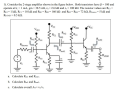 1) Consider the 2-stage amplifier shown in the figure below. Both transistors have β-100 and operate at lc-1 mA, gm-38.5 ms, r,-2.6 kΩ and ro-100 kΩ. The resistor values are RE,- RE2-1 k(2, Rc,-10 kΩ and RB,-RB3-160 kΩ and RB2-R 34-72 k(2, Rsource-5 kΩ and RLOAD 0.5 k(2. BB2 BB1 in2 Rc1 RinR Rsource Rout RLOAD B2 RE2 E1 a. Calculate Rinl and Rout b. Calculate Rin2 and Rout2. c. Calculate overall Av Vo/vs
1) Consider the 2-stage amplifier shown...
1) Consider the 2-stage amplifier shown in the figure below. Both transistors have β-100 and operate at lc-1 mA, gm-38.5 ms, r,-2.6 kΩ and ro-100 kΩ. The resistor values are RE,- RE2-1 k(2, Rc,-10 kΩ and RB,-RB3-160 kΩ and RB2-R 34-72 k(2, Rsource-5 kΩ and RLOAD 0.5 k(2. BB2 BB1 in2 Rc1 RinR Rsource Rout RLOAD B2 RE2 E1 a. Calculate Rinl and Rout b. Calculate Rin2 and Rout2. c. Calculate overall Av Vo/vs
1) Consider the 2-stage amplifier shown...
1. For the cascade amplifier of the figure, calculate the polarization voltages and current colle...
 For the cascade amplifier of the figure, calculate the
polarization voltages
Please clarity answer, thanks!!
1. For the cascade amplifier of the figure, calculate the polarization voltages and current collector of each stage. Also, calculate the voltage gain for each stage and the total voltage gain for cascade amplifier. 2. Repeat the previous steps using a load resistance of 2.2 kΩ 3. Calculate the input and output impedances for the cascade amplifier and the cutoff frequencies (fi) for the cascade...
For the cascade amplifier of the figure, calculate the
polarization voltages
Please clarity answer, thanks!!
1. For the cascade amplifier of the figure, calculate the polarization voltages and current collector of each stage. Also, calculate the voltage gain for each stage and the total voltage gain for cascade amplifier. 2. Repeat the previous steps using a load resistance of 2.2 kΩ 3. Calculate the input and output impedances for the cascade amplifier and the cutoff frequencies (fi) for the cascade...
15 Vcc RC 5k C2 R1 4.7k Vout 4H C1 Q1 2210 RL in 2k 50...
 15 Vcc RC 5k C2 R1 4.7k Vout 4H C1 Q1 2210 RL in 2k 50 71? RE 2.2k CE R2 2.5k SINEO AC 0.02 15? ·model 2210 NPN (Bf=100) Figure 1 A simple common emitter amplifier circuit. Note the ac source has a magnitude of 20 mV. NOTE: Only the 'full' schematics are requested below, not the ac small signal models. You may use the equations derived in lecture (or from the text); there is no requirement to rederive...
 Circuit Analysis
The circuit shown in Figure Q3 is a block diagram of an amplifier with a negative feedback. Given that Is 100 uA, IF 99 HA and Vo = 5V. For Figure Q3: (a) Determine the gain without feedback (Ax), gain with feedback (AF) and feedback factor (B), including the units Name the amplifier and feedback topology used. (b) + Zo RL Zi Vo AxIi ZAF ZoF
The circuit shown in Figure Q3 is a block diagram of an...
Circuit Analysis
The circuit shown in Figure Q3 is a block diagram of an amplifier with a negative feedback. Given that Is 100 uA, IF 99 HA and Vo = 5V. For Figure Q3: (a) Determine the gain without feedback (Ax), gain with feedback (AF) and feedback factor (B), including the units Name the amplifier and feedback topology used. (b) + Zo RL Zi Vo AxIi ZAF ZoF
The circuit shown in Figure Q3 is a block diagram of an...
 | 100% Q1. (a) A common-emitter amplifier is shown in Figure Q1(a). Explain why the resistor Rs can be used to stabilise the DC biasing. Also, indicate the role of Cci and Cca. 17 marks) +Vcc Ri Cc2 Rs Cc CE RL Vo R2 RE Vs Figure Q1(a) (b) In amplifier design using negative feedback, the desirable properties are obtained at the expense of what? [2 marks] (c) A negative-fecdback amplifier has closed-loop gain A 100, and an open-loop gain...
 4. The amplifier shown below has Rsig-RL 1kQ. Rc 1kQ, RB 47 kQ. β 100, Cc1 a) Find the dc collector current of the transistor b) Find gm and IT c) Neglecting ro, find the midband voltage gain from base to collector (neglect the effect of RB) d) Use the gain obtained in part (c) to find the component of Rin that arises as a result of RB. Hence find Rin. e) Find the overall gain at midband f) Find...
 For the simple differential amplifier shown below,
a) Calculate the differential gain, Av , of the circuit
b) Calculate the common-mode gain, ACM, of the
circuit and compute CMRR
c) The common-mode gain can be reduced by replacing the resistor
RE, with a constant current source. Design a current
source that is not dependent on Beta linearly to
replace RE, transistors of the same characteristics as
Q1 and Q2, and resistors of your choice
*(Q1, Q2 = 120; ro =...
For the simple differential amplifier shown below,
a) Calculate the differential gain, Av , of the circuit
b) Calculate the common-mode gain, ACM, of the
circuit and compute CMRR
c) The common-mode gain can be reduced by replacing the resistor
RE, with a constant current source. Design a current
source that is not dependent on Beta linearly to
replace RE, transistors of the same characteristics as
Q1 and Q2, and resistors of your choice
*(Q1, Q2 = 120; ro =...
 Requires 100% correct answer along with pspice
10.24 A transconductance amplifier with negative feedback is shown in Fig. P10.24. The amplifier has an open-loop P transconductance of A 50 x 103 A/V, an input resistance of R 25 k!2, and an output resistance of Ro-50 k2. The feedback circuit has RF 2.5 kS2. The source resistance is Rs 1 k, and the load resistance is RL-500 Ω. Determine (a) the input resistance Ri,-vs/is, (b) the output resistance Rof, and (c)...
Requires 100% correct answer along with pspice
10.24 A transconductance amplifier with negative feedback is shown in Fig. P10.24. The amplifier has an open-loop P transconductance of A 50 x 103 A/V, an input resistance of R 25 k!2, and an output resistance of Ro-50 k2. The feedback circuit has RF 2.5 kS2. The source resistance is Rs 1 k, and the load resistance is RL-500 Ω. Determine (a) the input resistance Ri,-vs/is, (b) the output resistance Rof, and (c)...
 please show steps, and solve asap
BEE 433 Electronic Circuit Design Problem Set #1 Due date: Answer the following problems and Circle the answers. 1.1 (Fig. 1.1 from the textbook) In the voltage amplifier circuit of Fig. 1.1, let vs = 100 mV, Rs = 100 k 52, Vi = 75 mV, RL = 10 S2, and vo = 2 V. If connecting a 30-S2 resistance in parallel with RL drops vo to 1.8 V, find Ri, A., and R....
please show steps, and solve asap
BEE 433 Electronic Circuit Design Problem Set #1 Due date: Answer the following problems and Circle the answers. 1.1 (Fig. 1.1 from the textbook) In the voltage amplifier circuit of Fig. 1.1, let vs = 100 mV, Rs = 100 k 52, Vi = 75 mV, RL = 10 S2, and vo = 2 V. If connecting a 30-S2 resistance in parallel with RL drops vo to 1.8 V, find Ri, A., and R....
 Q1. For the cascade amplifier circuit shown in Fig (1): a) What are the functions of the capacitors C, C2 and C3? And what are the functions of the capacitors Cs and CE? b) What are the functions of the resistors RD and Rc? c) Draw the DC biasing circuits for each stage. d) Find loa, VGsa, VDs and gm for the JFET stage (you may use either mathematical or graphical methods) e) Calculate l, Ic, le and Ve for...
 1) Consider the 2-stage amplifier shown in the figure below. Both transistors have β-100 and operate at lc-1 mA, gm-38.5 ms, r,-2.6 kΩ and ro-100 kΩ. The resistor values are RE,- RE2-1 k(2, Rc,-10 kΩ and RB,-RB3-160 kΩ and RB2-R 34-72 k(2, Rsource-5 kΩ and RLOAD 0.5 k(2. BB2 BB1 in2 Rc1 RinR Rsource Rout RLOAD B2 RE2 E1 a. Calculate Rinl and Rout b. Calculate Rin2 and Rout2. c. Calculate overall Av Vo/vs
1) Consider the 2-stage amplifier shown...
1) Consider the 2-stage amplifier shown in the figure below. Both transistors have β-100 and operate at lc-1 mA, gm-38.5 ms, r,-2.6 kΩ and ro-100 kΩ. The resistor values are RE,- RE2-1 k(2, Rc,-10 kΩ and RB,-RB3-160 kΩ and RB2-R 34-72 k(2, Rsource-5 kΩ and RLOAD 0.5 k(2. BB2 BB1 in2 Rc1 RinR Rsource Rout RLOAD B2 RE2 E1 a. Calculate Rinl and Rout b. Calculate Rin2 and Rout2. c. Calculate overall Av Vo/vs
1) Consider the 2-stage amplifier shown...
 For the cascade amplifier of the figure, calculate the
polarization voltages
Please clarity answer, thanks!!
1. For the cascade amplifier of the figure, calculate the polarization voltages and current collector of each stage. Also, calculate the voltage gain for each stage and the total voltage gain for cascade amplifier. 2. Repeat the previous steps using a load resistance of 2.2 kΩ 3. Calculate the input and output impedances for the cascade amplifier and the cutoff frequencies (fi) for the cascade...
For the cascade amplifier of the figure, calculate the
polarization voltages
Please clarity answer, thanks!!
1. For the cascade amplifier of the figure, calculate the polarization voltages and current collector of each stage. Also, calculate the voltage gain for each stage and the total voltage gain for cascade amplifier. 2. Repeat the previous steps using a load resistance of 2.2 kΩ 3. Calculate the input and output impedances for the cascade amplifier and the cutoff frequencies (fi) for the cascade...
 15 Vcc RC 5k C2 R1 4.7k Vout 4H C1 Q1 2210 RL in 2k 50 71? RE 2.2k CE R2 2.5k SINEO AC 0.02 15? ·model 2210 NPN (Bf=100) Figure 1 A simple common emitter amplifier circuit. Note the ac source has a magnitude of 20 mV. NOTE: Only the 'full' schematics are requested below, not the ac small signal models. You may use the equations derived in lecture (or from the text); there is no requirement to rederive...
Most questions answered within 3 hours.
-
Where is the error in this code sequence?
String s1 = "Hello";
String s2 = "ello";...
asked 10 months ago -
Financial data for Joel de Paris, Inc., for last year
follow:
Joel de Paris, Inc.
Balance...
asked 10 months ago -
Consider this reaction:
Al2(SO4)3 (aq)+ BaCl3
(aq) Al2Cl6 (aq)- +
3BaSO4(s) . What is the...
asked 10 months ago -
Suppose that Savneet is considering increasing her
recent random sample from 20 car rentals to 40...
asked 10 months ago -
Trucks arrive at an unloading terminal at an average rate of 120
per hour.
Trucks arrive...
asked 10 months ago -
Why are methanol and ethanol completely soluble in water while
octanol is not very little soluble....
asked 10 months ago -
A facilities manager at a university reads in a research report
that the mean amount of...
asked 10 months ago -
When the CuSO4 is rehydrated by adding water to the anhydrous
compound, is this an endothermic...
asked 10 months ago -
A ray of sunlight is passing from diamond into crown glass; the
angle of incidence is...
asked 10 months ago -
A block of mass 0.249 kg is placed on top of a light, vertical
spring of...
asked 10 months ago -
how do the kidneys compensate in the presences of acidosis
a) trigger hyperventilate
b) reserve acid...
asked 10 months ago -
Question 501 pts
The rental rate of capital to the firm increases. Which of the
following...
asked 10 months ago