
Homework Answers
Add Answer to:
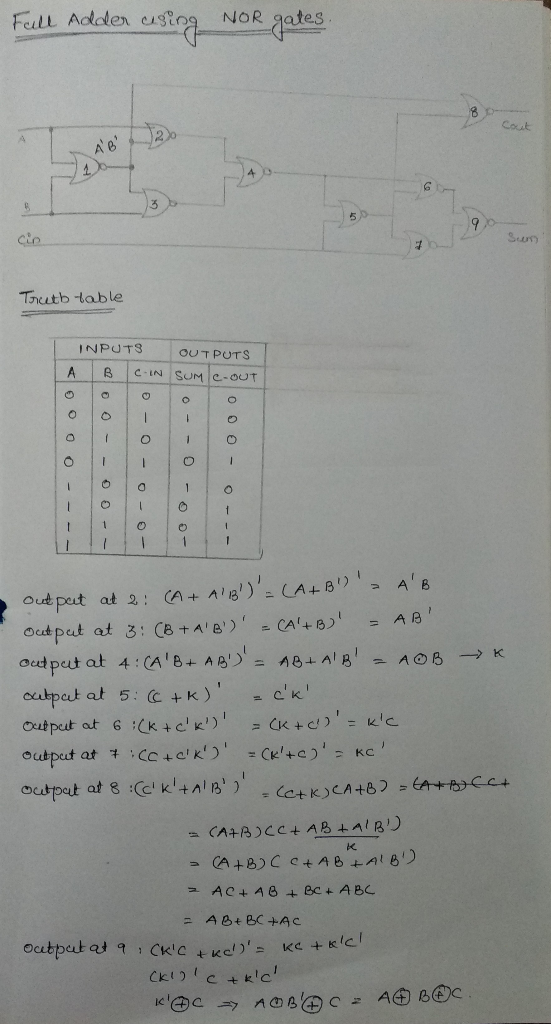
Tim Question 1 Atte 20 pts 2H 24 Design a 1-bit Full Adder using NOR gates...
Stuoymae Campus 20 pts Question 2 XYo Y) in which inputs X are connect to two...
 Stuoymae Campus 20 pts Question 2 XYo Y) in which inputs X are connect to two 4-bit Design a 4-bit Full Adder with inputs (Xo registers via four 2-to-1 Multiplexers and inputs Y are connected to two other 4-bit registers via four 2-to-1 Multiplexers. In this case assume that Carry in is always zero (and is therefore pull down) and that the register outputs 4-bits at a time. Make sure to show the proper connections between Ful adder, MUXS, and...
Design a 4-bit Full Adder with inputs (X0...X3, Y0...Y3.), in which inputs X are connect to...
Design a 4-bit Full Adder with inputs (X0...X3, Y0...Y3.), in which inputs X are connect to two 4-bit registers via four 2-to-1 Multiplexers and inputs Y are connected to two other 4-bit registers via four 2-to-1 Multiplexers. In this case, assume that Carry in is always zero (and is therefore pull down) and that the register outputs 4-bits at a time. Please make sure to show the proper connections between Full adder, MUXS, and registers.
4. Design a 4-bit Adder / Subtractor. Follow the steps given below. (a) Write the VHDL...
 4. Design a 4-bit Adder / Subtractor. Follow the steps given below. (a) Write the VHDL code for a 1-bit Full Adder. The VHDL code must include an entity and an architecture. (b) Draw the circuit diagram for a 4-bit Adder / Subtractor. The circuit diagram may include the following logic elements: 1-bit Full Adders (shown as a block with inputs and outputs) Any 2-input logic gates Multiplexers Do not draw the logic circuit for the 1-bit Full Adder.
In quartus prime Implement a 4-bit adder/subtractor using structural VHDL. The circuit will have two 4-bit...
In quartus prime Implement a 4-bit adder/subtractor using structural VHDL. The circuit will have two 4-bit data inputs (A and B), a control line (add /sub), a 4-bit sum output (S), a carry-out bit (Cout), and an overflow flag. You need two VHDL files (fulladd.vhd) and (hybrid.vhd) to implement the design. VHDL code, fulladd.vhd, will implement a single-bit full adder. The VHDL file, hybrid.vhd, will create four instances of the single-bit full adder. Four XOR gates will be needed to...
Design an 8-bit full adder using Verilog (Use only 1-bit full adders). Write the design code,...
Design an 8-bit full adder using Verilog (Use only 1-bit full adders). Write the design code, test-bench code of it, and test your design with six inputs. Note: Only use Verilog to design 8-bit full adder.
8/8pts Question 1 Using block diagram of 1-bit full adders create a 3-bit parallel adder (show...
 8/8pts Question 1 Using block diagram of 1-bit full adders create a 3-bit parallel adder (show all the connections between the adders and proper outputs Logic Q1jpg 4/9 pts Question 2 Consider your design, if the inputs to be added were 100, and 111, what will be the resulting sum output (Express the resulting sum in binary and base 8 using the least number of bits)? What will be the carry output (Express it only in binary using the least...
20 pts Question 3 Design a two's complement circuit using inverters and 1-bit Full Adders. Perform...
 20 pts Question 3 Design a two's complement circuit using inverters and 1-bit Full Adders. Perform the two's complement of 1210 with your circuit and provide your answer in base 10 and base 2 Upload Choose a File
20 pts Question 3 Design a two's complement circuit using inverters and 1-bit Full Adders. Perform the two's complement of 1210 with your circuit and provide your answer in base 10 and base 2 Upload Choose a File
20 pts Question 3 Design a two's complement circuit using inverters and 1-bit Full Adders. Perform the two's complement of 1210 with your circuit and provide your answer in base 10 and base 2 Upload Choose a File
2. Design a 1 bit full adder (inputs:A,B,CARRY_IN - outputs:SUM,CARRY_OUT) using: (a) basic CMOS gates: inverter,...
 2. Design a 1 bit full adder (inputs:A,B,CARRY_IN - outputs:SUM,CARRY_OUT) using: (a) basic CMOS gates: inverter, NOR and NAND gates (b) complex CMOS logic gates and inverters (c) compare the difference in transistor counts (d) assuming all transistors are the same size and kn'= kp', which version of the function do you expect to be faster? Why?
design a 1-bit full adder using a two level OR-AND circuit. Show truth tables, detail logic...
design a 1-bit full adder using a two level OR-AND circuit. Show truth tables, detail logic gate circuit design and boolean expression
For number 2 you can use exclusive-OR gates, but do not use multiplexers. 1. Design a...
 For number 2 you can use
exclusive-OR gates, but do not use multiplexers.
1. Design a 4-bit adder/subtractor using only full adders and EXCLUSIVE- OR gates. Do not use any multiplexers. 2. Design a combinational circuit using a minimum number of Full adders, and logic gates which will perform A plus B or minus B (A and B are signed numbers), depending on a mode select input, M. If M=0, addition is carried out; if M1, subtraction is carried out....
For number 2 you can use
exclusive-OR gates, but do not use multiplexers.
1. Design a 4-bit adder/subtractor using only full adders and EXCLUSIVE- OR gates. Do not use any multiplexers. 2. Design a combinational circuit using a minimum number of Full adders, and logic gates which will perform A plus B or minus B (A and B are signed numbers), depending on a mode select input, M. If M=0, addition is carried out; if M1, subtraction is carried out....
 Stuoymae Campus 20 pts Question 2 XYo Y) in which inputs X are connect to two 4-bit Design a 4-bit Full Adder with inputs (Xo registers via four 2-to-1 Multiplexers and inputs Y are connected to two other 4-bit registers via four 2-to-1 Multiplexers. In this case assume that Carry in is always zero (and is therefore pull down) and that the register outputs 4-bits at a time. Make sure to show the proper connections between Ful adder, MUXS, and...
 4. Design a 4-bit Adder / Subtractor. Follow the steps given below. (a) Write the VHDL code for a 1-bit Full Adder. The VHDL code must include an entity and an architecture. (b) Draw the circuit diagram for a 4-bit Adder / Subtractor. The circuit diagram may include the following logic elements: 1-bit Full Adders (shown as a block with inputs and outputs) Any 2-input logic gates Multiplexers Do not draw the logic circuit for the 1-bit Full Adder.
 8/8pts Question 1 Using block diagram of 1-bit full adders create a 3-bit parallel adder (show all the connections between the adders and proper outputs Logic Q1jpg 4/9 pts Question 2 Consider your design, if the inputs to be added were 100, and 111, what will be the resulting sum output (Express the resulting sum in binary and base 8 using the least number of bits)? What will be the carry output (Express it only in binary using the least...
 20 pts Question 3 Design a two's complement circuit using inverters and 1-bit Full Adders. Perform the two's complement of 1210 with your circuit and provide your answer in base 10 and base 2 Upload Choose a File
20 pts Question 3 Design a two's complement circuit using inverters and 1-bit Full Adders. Perform the two's complement of 1210 with your circuit and provide your answer in base 10 and base 2 Upload Choose a File
20 pts Question 3 Design a two's complement circuit using inverters and 1-bit Full Adders. Perform the two's complement of 1210 with your circuit and provide your answer in base 10 and base 2 Upload Choose a File
 2. Design a 1 bit full adder (inputs:A,B,CARRY_IN - outputs:SUM,CARRY_OUT) using: (a) basic CMOS gates: inverter, NOR and NAND gates (b) complex CMOS logic gates and inverters (c) compare the difference in transistor counts (d) assuming all transistors are the same size and kn'= kp', which version of the function do you expect to be faster? Why?
 For number 2 you can use
exclusive-OR gates, but do not use multiplexers.
1. Design a 4-bit adder/subtractor using only full adders and EXCLUSIVE- OR gates. Do not use any multiplexers. 2. Design a combinational circuit using a minimum number of Full adders, and logic gates which will perform A plus B or minus B (A and B are signed numbers), depending on a mode select input, M. If M=0, addition is carried out; if M1, subtraction is carried out....
For number 2 you can use
exclusive-OR gates, but do not use multiplexers.
1. Design a 4-bit adder/subtractor using only full adders and EXCLUSIVE- OR gates. Do not use any multiplexers. 2. Design a combinational circuit using a minimum number of Full adders, and logic gates which will perform A plus B or minus B (A and B are signed numbers), depending on a mode select input, M. If M=0, addition is carried out; if M1, subtraction is carried out....
Most questions answered within 3 hours.
-
Where is the error in this code sequence?
String s1 = "Hello";
String s2 = "ello";...
asked 10 months ago -
Financial data for Joel de Paris, Inc., for last year
follow:
Joel de Paris, Inc.
Balance...
asked 10 months ago -
Consider this reaction:
Al2(SO4)3 (aq)+ BaCl3
(aq) Al2Cl6 (aq)- +
3BaSO4(s) . What is the...
asked 10 months ago -
Suppose that Savneet is considering increasing her
recent random sample from 20 car rentals to 40...
asked 10 months ago -
Trucks arrive at an unloading terminal at an average rate of 120
per hour.
Trucks arrive...
asked 10 months ago -
Why are methanol and ethanol completely soluble in water while
octanol is not very little soluble....
asked 10 months ago -
A facilities manager at a university reads in a research report
that the mean amount of...
asked 10 months ago -
When the CuSO4 is rehydrated by adding water to the anhydrous
compound, is this an endothermic...
asked 10 months ago -
A ray of sunlight is passing from diamond into crown glass; the
angle of incidence is...
asked 10 months ago -
A block of mass 0.249 kg is placed on top of a light, vertical
spring of...
asked 10 months ago -
how do the kidneys compensate in the presences of acidosis
a) trigger hyperventilate
b) reserve acid...
asked 10 months ago -
Question 501 pts
The rental rate of capital to the firm increases. Which of the
following...
asked 10 months ago