An air capacitor is madeby using two flat plates, each with area A, separated by a...
Homework Answers
Add Answer to:
An air capacitor is madeby using two flat plates, each with
area A, separated by a...
A capacitor is made by using two plates, each with area A and separated by a...
A capacitor is made by using two plates, each with area A and separated by a distance d. The upper plate has a positive charge +Q and the lower plate has a negative charge -Q. Then an insulating slab with electricity permitivity e= 4.5e0, having thickness a, with the same shape and size as the plates is inserted between them, parallel to the plates and not touching either plate. a) Find an expression for the electric field at any point...
Capacitors. A solid conducting slab is inserted between the plates of a charged capacitor, separated at...
Capacitors. A solid conducting slab is inserted between the plates of a charged capacitor, separated at a distance d. The slab thickness is 50% of the plates spacing, with area that of the plates. (a) what happens to the capacitance (Hint: the thickness of the field region is reduced with the introduced slab) (b) What happens to the stored energy is the capacitor is isolated?
4. Capacitors. A solid conducting slab is inserted between the plates of a charged capacitor, separated...
 4. Capacitors. A solid conducting slab is inserted between the plates of a charged capacitor, separated at a distance d. The slab thickness is 50% of the plates spacing, with area that of the plates. (a) what happens to the capacitance (Hint: the thickness of the field region is reduced with the introduced slab) (b) What happens to the stored energy is the capacitor is isolated?
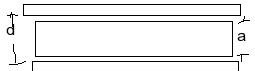
In parallel plate capacitors, the area of one plate is A and the two conductor plates...
 In parallel plate capacitors, the area of one plate is A and the
two conductor plates are separated from each other by d. At the
center of the two conductor plates, a metal plate of thickness a
and not charged was inserted. (The dielectric of the empty space is
air (? 0)
(a) Determine the capacitance of this device. (5)
(b) If a metal plate with a thickness of almost zero is
inserted, this metal plate appears to have no...
In parallel plate capacitors, the area of one plate is A and the
two conductor plates are separated from each other by d. At the
center of the two conductor plates, a metal plate of thickness a
and not charged was inserted. (The dielectric of the empty space is
air (? 0)
(a) Determine the capacitance of this device. (5)
(b) If a metal plate with a thickness of almost zero is
inserted, this metal plate appears to have no...
To make a parallel plate capacitor, you have available two flat plates of aluminum (area-130 cm"),...
 To make a parallel plate capacitor, you have available two flat plates of aluminum (area-130 cm"), a sheet of paper (thickness-0.10 mm, K-35), a sheet of glass (thickness- 2.0 mm,K-7.0), and a slab of paraffin (thickness-10.0 mm, K-2.0). (a) What is the largest capacitance possible using one of these dielectrics? nF (b) What is the smallest? pF
A parallel-plate capacitor has plates of area 0.13 m2 and a separation of 1.9 cm. A battery...
A parallel-plate capacitor has plates of area 0.13 m2 and a separation of 1.9 cm. A battery charges the plates to a potential difference of 150 V and is then disconnected. A dielectric slab of thickness 9.3 mm and dielectric constant 4.0 is then placed symmetrically between the plates. (a) What is the capacitance before the slab is inserted? (b) What is the capacitance with the slab in place? What is the free charge q (c) before and (d) after the slab is inserted? What is the magnitude of the...
You have two flat metal plates, each of area 1.37 m2, with which to construct a...
 You have two flat metal plates, each of area 1.37 m2,
with which to construct a parallel-plate capacitor.
(a) If the capacitance of the device is to be
0.766 F, what must be the separation between the plates?
(b) Could this capacitor actually be
constructed?
You have two flat metal plates, each of area 1.37 m², with which to construct a parallel-plate capacitor. (a) If the capacitance of the device is to be 0.766 F, what must be the separation...
You have two flat metal plates, each of area 1.37 m2,
with which to construct a parallel-plate capacitor.
(a) If the capacitance of the device is to be
0.766 F, what must be the separation between the plates?
(b) Could this capacitor actually be
constructed?
You have two flat metal plates, each of area 1.37 m², with which to construct a parallel-plate capacitor. (a) If the capacitance of the device is to be 0.766 F, what must be the separation...
Two parallel plates, each having area A- 2737cm are connected to the terminals of a battery...
 Two parallel plates, each having area A- 2737cm are connected to the terminals of a battery of voltage Vb 6 V as shown. The plates are separated by a distance d 0.38cm. You may assume (contrary to the drawing) that the separation between the plates is small compared to a linear dimension of the plate 1) What is C, the capacitance of this parallel plate capacitor? Submit 2) What is Q, the charge stored on the top plate of the...
An air-filled capacitor is made from two flat parallel plates 1.4 mm apart. The inside area...
An air-filled capacitor is made from two flat parallel plates 1.4 mm apart. The inside area of each plate is 8.8 cm2. a) What is the capacitance of this set of plates (in pF) b) If the region between the plates is filled with a material whose dielectric constant is 6.6, what is the new capacitance (in pF)? 2) A parallel-plate capacitor with only air between its plates is charged by connecting the capacitor to a battery. The capacitor is...
An air-filled capacitor consists of two parallel plates, each with an area of 7.6 cm2, separated...
 An air-filled capacitor consists of two parallel plates, each with an area of 7.6 cm2, separated by a distance of (a ) If a 15.0 V potential difference is applied to these plates, calculate the electric field between the plates. (b) What is the surface charge density? (c) What is the capacitance? (d) Find the charge on each plate. kV/m nC/m2
 4. Capacitors. A solid conducting slab is inserted between the plates of a charged capacitor, separated at a distance d. The slab thickness is 50% of the plates spacing, with area that of the plates. (a) what happens to the capacitance (Hint: the thickness of the field region is reduced with the introduced slab) (b) What happens to the stored energy is the capacitor is isolated?
 In parallel plate capacitors, the area of one plate is A and the
two conductor plates are separated from each other by d. At the
center of the two conductor plates, a metal plate of thickness a
and not charged was inserted. (The dielectric of the empty space is
air (? 0)
(a) Determine the capacitance of this device. (5)
(b) If a metal plate with a thickness of almost zero is
inserted, this metal plate appears to have no...
In parallel plate capacitors, the area of one plate is A and the
two conductor plates are separated from each other by d. At the
center of the two conductor plates, a metal plate of thickness a
and not charged was inserted. (The dielectric of the empty space is
air (? 0)
(a) Determine the capacitance of this device. (5)
(b) If a metal plate with a thickness of almost zero is
inserted, this metal plate appears to have no...
 To make a parallel plate capacitor, you have available two flat plates of aluminum (area-130 cm"), a sheet of paper (thickness-0.10 mm, K-35), a sheet of glass (thickness- 2.0 mm,K-7.0), and a slab of paraffin (thickness-10.0 mm, K-2.0). (a) What is the largest capacitance possible using one of these dielectrics? nF (b) What is the smallest? pF
 You have two flat metal plates, each of area 1.37 m2,
with which to construct a parallel-plate capacitor.
(a) If the capacitance of the device is to be
0.766 F, what must be the separation between the plates?
(b) Could this capacitor actually be
constructed?
You have two flat metal plates, each of area 1.37 m², with which to construct a parallel-plate capacitor. (a) If the capacitance of the device is to be 0.766 F, what must be the separation...
You have two flat metal plates, each of area 1.37 m2,
with which to construct a parallel-plate capacitor.
(a) If the capacitance of the device is to be
0.766 F, what must be the separation between the plates?
(b) Could this capacitor actually be
constructed?
You have two flat metal plates, each of area 1.37 m², with which to construct a parallel-plate capacitor. (a) If the capacitance of the device is to be 0.766 F, what must be the separation...
 Two parallel plates, each having area A- 2737cm are connected to the terminals of a battery of voltage Vb 6 V as shown. The plates are separated by a distance d 0.38cm. You may assume (contrary to the drawing) that the separation between the plates is small compared to a linear dimension of the plate 1) What is C, the capacitance of this parallel plate capacitor? Submit 2) What is Q, the charge stored on the top plate of the...
 An air-filled capacitor consists of two parallel plates, each with an area of 7.6 cm2, separated by a distance of (a ) If a 15.0 V potential difference is applied to these plates, calculate the electric field between the plates. (b) What is the surface charge density? (c) What is the capacitance? (d) Find the charge on each plate. kV/m nC/m2
Most questions answered within 3 hours.
-
Where is the error in this code sequence?
String s1 = "Hello";
String s2 = "ello";...
asked 11 months ago -
Financial data for Joel de Paris, Inc., for last year
follow:
Joel de Paris, Inc.
Balance...
asked 11 months ago -
Consider this reaction:
Al2(SO4)3 (aq)+ BaCl3
(aq) Al2Cl6 (aq)- +
3BaSO4(s) . What is the...
asked 11 months ago -
Suppose that Savneet is considering increasing her
recent random sample from 20 car rentals to 40...
asked 11 months ago -
Trucks arrive at an unloading terminal at an average rate of 120
per hour.
Trucks arrive...
asked 11 months ago -
Why are methanol and ethanol completely soluble in water while
octanol is not very little soluble....
asked 11 months ago -
A facilities manager at a university reads in a research report
that the mean amount of...
asked 11 months ago -
When the CuSO4 is rehydrated by adding water to the anhydrous
compound, is this an endothermic...
asked 11 months ago -
A ray of sunlight is passing from diamond into crown glass; the
angle of incidence is...
asked 11 months ago -
A block of mass 0.249 kg is placed on top of a light, vertical
spring of...
asked 11 months ago -
how do the kidneys compensate in the presences of acidosis
a) trigger hyperventilate
b) reserve acid...
asked 11 months ago -
Question 501 pts
The rental rate of capital to the firm increases. Which of the
following...
asked 11 months ago