A completely closed cubical box with sides of length 15 cm contains three charges. The first...
A completely closed cubical box with sides of length 15 cm
contains three charges. The first is 7.4 µC, the second is -4.3 µC,
and the third is 2.7 µC. What is the electric flux through the
surface of the whole box?
Homework Answers

Add Answer to:
A completely closed cubical box with sides of length 15 cm
contains three charges. The first...
Three charges are at the corners of a rectangle of sides 4.0 cm and 6.0 cm....
Three charges are at the corners of a rectangle of sides 4.0 cm and 6.0 cm. The charges at the top corners are both 2.0 µC (they are separated by 4.0 cm) and the third charge at the bottom left corner is – 3.0 µC. Calculate the electric field in the middle of the rectangle.
(10 points) a) Two through the box? charges Qi and Q2 are inside a closed cubical...
 (10 points) a) Two through the box? charges Qi and Q2 are inside a closed cubical box of side a. What is the net outward flux iv. (Qi + Q)/(4a) b) As two positive charges are brought closer together i. the repulsive force between them will decrease in magnitude ii. the repulsive force between them will increase in magnitude ii. the attractive force between them wil decrease in magnitude iv. the attractive force between them will increase in magnitude v....
1: True or false- There is a cubical Gaussian surface with sides of 10.0 cm in...
1: True or false- There is a cubical Gaussian surface with sides of 10.0 cm in length. This Gaussian cube exists in a uniform electric field produced by a charged plane some distance away. The electric flux, F, through this surface has a value of zero. 2: Choose ALL of the geometries in which Gauss' law can be applied. In other words, choose all the geometries that you can build to use Gauss' law. •Sphere •Cylinder •Parallelogram •Pyramid •Octogon •Cube...
Given: The total electric flux from a cubical box 5.00 cm on a side is 2.25×10³...
Given: The total electric flux from a cubical box 5.00 cm on a side is 2.25×10³ N⋅m2/C . A. What charge is enclosed by the box? B. What is the total electric flux through ONE face of the cube? (assume the charge is in the center of the cube)?
A cubical Gaussian surface surrounds three positive charges, each has a charge q11 = +4.00 ×...
 A cubical Gaussian surface surrounds three positive charges,
each has a charge q11 = +4.00 × 10⁻¹²
C, and two negative charges, each has a charge q22 = −2.60
× 10-12 C as the drawing shows. What is
the electric flux passing through the surface?(The permittivity of
free space ε00 = 8.85×10⁻¹²C²/(N.m²))
A cubical Gaussian surface surrounds three positive charges,
each has a charge q11 = +4.00 × 10⁻¹²
C, and two negative charges, each has a charge q22 = −2.60
× 10-12 C as the drawing shows. What is
the electric flux passing through the surface?(The permittivity of
free space ε00 = 8.85×10⁻¹²C²/(N.m²))
In Fig. 16-61, two objects, O1 and O2 have charges +1.0 µC and -1.9 µC, respectively,...
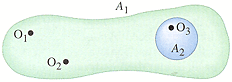 In Fig. 16-61, two objects, O1
and O2 have charges +1.0 µC and -1.9 µC, respectively, and a third
object, O3, is electrically neutral.
Figure 16-61
(a) What is the electric flux through the surface
A1 that encloses all three objects?
(b) What is the electric flux through the surface
A2 that encloses the third object only?
O2.
In Fig. 16-61, two objects, O1
and O2 have charges +1.0 µC and -1.9 µC, respectively, and a third
object, O3, is electrically neutral.
Figure 16-61
(a) What is the electric flux through the surface
A1 that encloses all three objects?
(b) What is the electric flux through the surface
A2 that encloses the third object only?
O2.
The total electric flux from a cubical box of side 25.0 cm is 1.85×10³ N⋅m2/C ....
The total electric flux from a cubical box of side 25.0 cm is 1.85×10³ N⋅m2/C . Part A What charge is enclosed by the box? Express your answer to three significant figures and include the appropriate units.
Three charges are placed on the x axis. The position of two of the charges are...
Three charges are placed on the x axis. The position of two of the charges are listed q1 = 5.0 nC is at x = 0 cm q2 = -9.0 nC is at x = 8 cm Assume the charges do not move from their appointed positions. a) At what values of x can a third charge (q3 = 5 nC) be placed so that the force on it = 0 N? If there is more than one answer for...
The net electric flux through a cubic box with sides that are 25.0 cm long is...
The net electric flux through a cubic box with sides that are 25.0 cm long is 4.70×10³ N⋅m2/C . What charge ? is enclosed by the box?
The net electric flux through a cubic box with sides that are 25.0 cm long is...
 The net electric flux through a cubic box with sides that are 25.0 cm long is 4850 N. m2/C, what charge Q is enclosed by the box?
 (10 points) a) Two through the box? charges Qi and Q2 are inside a closed cubical box of side a. What is the net outward flux iv. (Qi + Q)/(4a) b) As two positive charges are brought closer together i. the repulsive force between them will decrease in magnitude ii. the repulsive force between them will increase in magnitude ii. the attractive force between them wil decrease in magnitude iv. the attractive force between them will increase in magnitude v....
 A cubical Gaussian surface surrounds three positive charges,
each has a charge q11 = +4.00 × 10⁻¹²
C, and two negative charges, each has a charge q22 = −2.60
× 10-12 C as the drawing shows. What is
the electric flux passing through the surface?(The permittivity of
free space ε00 = 8.85×10⁻¹²C²/(N.m²))
A cubical Gaussian surface surrounds three positive charges,
each has a charge q11 = +4.00 × 10⁻¹²
C, and two negative charges, each has a charge q22 = −2.60
× 10-12 C as the drawing shows. What is
the electric flux passing through the surface?(The permittivity of
free space ε00 = 8.85×10⁻¹²C²/(N.m²))
 In Fig. 16-61, two objects, O1
and O2 have charges +1.0 µC and -1.9 µC, respectively, and a third
object, O3, is electrically neutral.
Figure 16-61
(a) What is the electric flux through the surface
A1 that encloses all three objects?
(b) What is the electric flux through the surface
A2 that encloses the third object only?
O2.
In Fig. 16-61, two objects, O1
and O2 have charges +1.0 µC and -1.9 µC, respectively, and a third
object, O3, is electrically neutral.
Figure 16-61
(a) What is the electric flux through the surface
A1 that encloses all three objects?
(b) What is the electric flux through the surface
A2 that encloses the third object only?
O2.
 The net electric flux through a cubic box with sides that are 25.0 cm long is 4850 N. m2/C, what charge Q is enclosed by the box?
Most questions answered within 3 hours.
-
Where is the error in this code sequence?
String s1 = "Hello";
String s2 = "ello";...
asked 10 months ago -
Financial data for Joel de Paris, Inc., for last year
follow:
Joel de Paris, Inc.
Balance...
asked 10 months ago -
Consider this reaction:
Al2(SO4)3 (aq)+ BaCl3
(aq) Al2Cl6 (aq)- +
3BaSO4(s) . What is the...
asked 10 months ago -
Suppose that Savneet is considering increasing her
recent random sample from 20 car rentals to 40...
asked 10 months ago -
Trucks arrive at an unloading terminal at an average rate of 120
per hour.
Trucks arrive...
asked 10 months ago -
Why are methanol and ethanol completely soluble in water while
octanol is not very little soluble....
asked 10 months ago -
A facilities manager at a university reads in a research report
that the mean amount of...
asked 10 months ago -
When the CuSO4 is rehydrated by adding water to the anhydrous
compound, is this an endothermic...
asked 10 months ago -
A ray of sunlight is passing from diamond into crown glass; the
angle of incidence is...
asked 10 months ago -
A block of mass 0.249 kg is placed on top of a light, vertical
spring of...
asked 10 months ago -
how do the kidneys compensate in the presences of acidosis
a) trigger hyperventilate
b) reserve acid...
asked 10 months ago -
Question 501 pts
The rental rate of capital to the firm increases. Which of the
following...
asked 10 months ago