In the figure, two particles are launched from the origin of the coordinate system at time...
In the figure, two particles are launched from the origin of the
coordinate system at time t = 0. Particle 1 of mass
m1 = 5.80 g is shot directly along the
x axis (on a frictionless floor), where it moves with a
constant speed of 10.7 m/s. Particle 2 of mass
m2 = 1.80 g is shot with a velocity of
magnitude 25.0 m/s, at an upward angle such that it always stays
directly above particle 1 during its flight. (a)
What is the maximum height Hmax reached by the
com of the two-particle system? In unit-vector notation, what are
the (b) velocity and (c)
acceleration of the com when the com reaches
Hmax?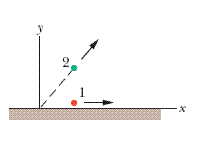
Homework Answers

Add Answer to:
In the figure, two particles are launched from the origin of the coordinate system at time...
In the figure, two particles are launched from the origin of the coordinate system at time...
 In the figure, two particles are launched from the origin of the coordinate system at time t = 0. Particle 1 of mass m1 = 3.20 g is shot directly along the x axis (on a frictionless floor), where it moves with a constant speed of 10.3 m/s. Particle 2 of mass m2 = 3.00 g is shot with a velocity of magnitude 19.2 m/s, at an upward angle such that it always stays directly above particle 1 during its...
Question 1 In the figure, two particles are launched from the origin of the coordinate system...
 Question 1 In the figure, two particles are launched from the origin of the coordinate system at time t = 0. Particle 1 of mass my - 5.20 g is shot directly along the x axis (on a frictionless floor), where it moves with a constant speed of 10.4 m/s. Particle 2 of mass m2 - 3.80 g is shot with a velocity of magnitude 17.0 m/s, at an upward angle such that it always stays directly above particle 1...
Three particles are located in a coordinate system as shown in the figure below. The acceleration...
 Three particles are located in a coordinate system as shown in
the figure below. The acceleration of gravity is 9.8 m/s 2 . The
mass 8 kg is located at the origin, the mass 8 kg is located on the
x coordinate, and the mass 7 kg is located on the y coordinate.Find
the distance of the center of gravity from the origin. Answer in
units of m.
7 kg 8 kg 8 k g 12 m
Three particles are located in a coordinate system as shown in
the figure below. The acceleration of gravity is 9.8 m/s 2 . The
mass 8 kg is located at the origin, the mass 8 kg is located on the
x coordinate, and the mass 7 kg is located on the y coordinate.Find
the distance of the center of gravity from the origin. Answer in
units of m.
7 kg 8 kg 8 k g 12 m
PLEASE ANSWER COMPLETELY A projectile of mass m launched vertically upward from the origin (0,0) with...
 PLEASE ANSWER COMPLETELY
A projectile of mass m launched vertically upward from the origin (0,0) with an initial velocity of vo explodes into three pieces when it reaches its maximum height of 490.0 m. Immediately after the explosion, one piece with mass m/4 is observed to have velocity v 3vot vo/2 y, and a second piece also of mass m/4 is observed to have velocity v Vox (a) What is the velocity v of the third piece immediately after the...
PLEASE ANSWER COMPLETELY
A projectile of mass m launched vertically upward from the origin (0,0) with an initial velocity of vo explodes into three pieces when it reaches its maximum height of 490.0 m. Immediately after the explosion, one piece with mass m/4 is observed to have velocity v 3vot vo/2 y, and a second piece also of mass m/4 is observed to have velocity v Vox (a) What is the velocity v of the third piece immediately after the...
A system consists of two particles of mass mi and m2 interacting with an interaction potential...
 A system consists of two particles of mass mi and m2 interacting with an interaction potential V(r) that depends only on the relative distancer- Iri-r2l between the particles, where r- (ri,/i,21) and r2 22,ひ2,22 are the coordinates of the two particles in three dimensions (3D) (a) /3 pointsl Show that for such an interaction potential, the Hamiltonian of the system H- am▽ri _ 2m2 ▽22 + V(r) can be, put in the form 2M where ▽ and ▽ are the...
EXPLORE A projectile is launched with a launch angle of 30° with respect to the horizontal...
EXPLORE A projectile is launched with a launch angle of 30° with respect to the horizontal direction and with an initial speed of 40 m/s. (A) How do the vertical and horizontal components of the projectile's velocity vary with time? (B) How long does it remain in flight? (C) For a given launch speed, what launch angle produces the longest time of flight? CONCEPTUALIZE Consider the projectile to be a point mass that starts with an initial velocity, upward and...
A system consists of two particles. At t = 0 one particle is at the origin; the other, which has a mass of 0.50 kg, is...
A system consists of two particles. At t = 0 one particle is at the origin; the other, which has a mass of 0.50 kg, is on the y-axis at y = 6.0m. At t = 0 the center of mass of the system is on the y-axis at y = 2.4m. The velocity of the center of mass is given by ( 0.75 m/s3) t2i^Find the total mass of the system.Find the acceleration of the center of mass at...
A system consists of two particles. At t = 0 one particle is at the origin; the other, which has a mass of 0.50 kg, is o...
A system consists of two particles. At t = 0 one particle is at the origin; the other, which has a mass of 0.50 kg, is on the y-axis at y = 6.0 m. At t = 0 the center of mass of the system is on the y-axis at y = 2.4 m. The velocity of the center of mass is given by ( 0.75 m/s}^3 ) t^2 \hat i. A)Find the total mass of the system B)Find the...
EXPLORE A projectile is launched with a launch angle of 30° with respect to the horizontal...
 EXPLORE A projectile is launched with a launch angle of 30° with respect to the horizontal direction and with an initial speed of 10 m/s. s0 (A) How do the vertical and horizontal components of the projectile's velocity vary with time? 40 35 (B) How long does it remain in flight? 25 (C) For a given launch speed, what launch angle produces the longest time of flight? 15 10 toy CONCEPTUALIZE Consider the projectile to be a point mass that...
QUESTION The ways that mechanical energy is lost from the system in this experiment include: (Select...
 QUESTION The ways that mechanical energy is lost from the system in this experiment include: (Select all that apply.) friction in the mechanisms emission of sound waves energy loss from the change in height of the block thermal energy loss due to air drag friction to bring the bullet to a stop relative to the ground PRACTICE IT Use the worked example above to help you solve this problem. The ballistic pendulum (Figure a) is a device used to measure...
 In the figure, two particles are launched from the origin of the coordinate system at time t = 0. Particle 1 of mass m1 = 3.20 g is shot directly along the x axis (on a frictionless floor), where it moves with a constant speed of 10.3 m/s. Particle 2 of mass m2 = 3.00 g is shot with a velocity of magnitude 19.2 m/s, at an upward angle such that it always stays directly above particle 1 during its...
 Question 1 In the figure, two particles are launched from the origin of the coordinate system at time t = 0. Particle 1 of mass my - 5.20 g is shot directly along the x axis (on a frictionless floor), where it moves with a constant speed of 10.4 m/s. Particle 2 of mass m2 - 3.80 g is shot with a velocity of magnitude 17.0 m/s, at an upward angle such that it always stays directly above particle 1...
 Three particles are located in a coordinate system as shown in
the figure below. The acceleration of gravity is 9.8 m/s 2 . The
mass 8 kg is located at the origin, the mass 8 kg is located on the
x coordinate, and the mass 7 kg is located on the y coordinate.Find
the distance of the center of gravity from the origin. Answer in
units of m.
7 kg 8 kg 8 k g 12 m
Three particles are located in a coordinate system as shown in
the figure below. The acceleration of gravity is 9.8 m/s 2 . The
mass 8 kg is located at the origin, the mass 8 kg is located on the
x coordinate, and the mass 7 kg is located on the y coordinate.Find
the distance of the center of gravity from the origin. Answer in
units of m.
7 kg 8 kg 8 k g 12 m
 PLEASE ANSWER COMPLETELY
A projectile of mass m launched vertically upward from the origin (0,0) with an initial velocity of vo explodes into three pieces when it reaches its maximum height of 490.0 m. Immediately after the explosion, one piece with mass m/4 is observed to have velocity v 3vot vo/2 y, and a second piece also of mass m/4 is observed to have velocity v Vox (a) What is the velocity v of the third piece immediately after the...
PLEASE ANSWER COMPLETELY
A projectile of mass m launched vertically upward from the origin (0,0) with an initial velocity of vo explodes into three pieces when it reaches its maximum height of 490.0 m. Immediately after the explosion, one piece with mass m/4 is observed to have velocity v 3vot vo/2 y, and a second piece also of mass m/4 is observed to have velocity v Vox (a) What is the velocity v of the third piece immediately after the...
 A system consists of two particles of mass mi and m2 interacting with an interaction potential V(r) that depends only on the relative distancer- Iri-r2l between the particles, where r- (ri,/i,21) and r2 22,ひ2,22 are the coordinates of the two particles in three dimensions (3D) (a) /3 pointsl Show that for such an interaction potential, the Hamiltonian of the system H- am▽ri _ 2m2 ▽22 + V(r) can be, put in the form 2M where ▽ and ▽ are the...
 EXPLORE A projectile is launched with a launch angle of 30° with respect to the horizontal direction and with an initial speed of 10 m/s. s0 (A) How do the vertical and horizontal components of the projectile's velocity vary with time? 40 35 (B) How long does it remain in flight? 25 (C) For a given launch speed, what launch angle produces the longest time of flight? 15 10 toy CONCEPTUALIZE Consider the projectile to be a point mass that...
 QUESTION The ways that mechanical energy is lost from the system in this experiment include: (Select all that apply.) friction in the mechanisms emission of sound waves energy loss from the change in height of the block thermal energy loss due to air drag friction to bring the bullet to a stop relative to the ground PRACTICE IT Use the worked example above to help you solve this problem. The ballistic pendulum (Figure a) is a device used to measure...
Most questions answered within 3 hours.
-
Where is the error in this code sequence?
String s1 = "Hello";
String s2 = "ello";...
asked 10 months ago -
Financial data for Joel de Paris, Inc., for last year
follow:
Joel de Paris, Inc.
Balance...
asked 10 months ago -
Consider this reaction:
Al2(SO4)3 (aq)+ BaCl3
(aq) Al2Cl6 (aq)- +
3BaSO4(s) . What is the...
asked 10 months ago -
Suppose that Savneet is considering increasing her
recent random sample from 20 car rentals to 40...
asked 10 months ago -
Trucks arrive at an unloading terminal at an average rate of 120
per hour.
Trucks arrive...
asked 10 months ago -
Why are methanol and ethanol completely soluble in water while
octanol is not very little soluble....
asked 10 months ago -
A facilities manager at a university reads in a research report
that the mean amount of...
asked 10 months ago -
When the CuSO4 is rehydrated by adding water to the anhydrous
compound, is this an endothermic...
asked 10 months ago -
A ray of sunlight is passing from diamond into crown glass; the
angle of incidence is...
asked 10 months ago -
A block of mass 0.249 kg is placed on top of a light, vertical
spring of...
asked 10 months ago -
how do the kidneys compensate in the presences of acidosis
a) trigger hyperventilate
b) reserve acid...
asked 10 months ago -
Question 501 pts
The rental rate of capital to the firm increases. Which of the
following...
asked 10 months ago