if you had 100grqms of eqch reactant , would the reaction always consume totally all the...
Homework Answers

Add Answer to:
if you had 100grqms of eqch reactant , would the reaction always consume totally all the...
Assume instructions for conducting a reaction tell you to start with a certain amount of reactant...
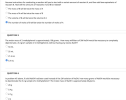 Assume instructions for conducting a reaction tell you to start with a certain amount of reactant A, and then add two equivalents of reactant B. How will the amounts of reactants A and B be related? The mass of B will be twice the mass of A The mass of A will be twice the mass of B The volume of B will be twice the volume of A The number of moles of B will be twice the number...
QUESTION 9 In a chemical reaction, the reactant remaining after all of the other reactants has...
 QUESTION 9 In a chemical reaction, the reactant remaining after all of the other reactants has been used up is referred to Excess reactant Limiting reactant Primary reactant Primary product QUESTION 10 Calculate the mass of hydrogen(H2) formed when 0.927 moles of aluminum(Al) reacts with excess hydrochloric acid (HCI) 0.41 g 1.2g 1.8g 2.8g 0.92 g
Q4. Suppose a reaction were to happen in an open container in a lab. During the...
 Q4. Suppose a reaction were to happen in an open container in a lab. During the reaction, the scientist observes the chemicals bubble, and produce a gas. During the analysis the scientist notices that the reactants weighed 20 g when he started, and the product weighed 18 g. Explain what happened. 1. His chemical reaction defied the law of conservation of mass 2. The product destroyed mass during the reaction 3. The reactants created matter during the reaction 4. The...
When a strong acid-strong base neutralization reaction is also a limiting reactant situation, the leftover reactant...
When a strong acid-strong base neutralization reaction is also a limiting reactant situation, the leftover reactant will determine your final solution pH. Remember that a limiting reactant indicates that you will run out of one reactant first. Considering the reaction of potassium hydroxide and hydrobromic acid, notice that if you have excess acid leftover it would react with water to produce H3O+ ions in solution: HBr + H2O → Br- + H3O+ If you have excess base left over, it...
In a chemical reaction, the reactant that limits the amount of product that can be formed...
 In a chemical reaction, the reactant that limits the amount of product that can be formed is called the limiting reactant (or limiting reagent). The reaction will stop when all of the limiting reactant is consumed. In the sandwich example, bread was our limiting reactant. The reactant or reactants in a chemical reaction that remain when a reaction stops when the limiting reactant is completely consumed are called the excess reactant(s). The excess reactant(s) remain because there is nothing with...
Objective Find the ratio of moles of reactant to moles of a product for the reaction...
Objective Find the ratio of moles of reactant to moles of a product for the reaction below. Compare mass and mole amounts of reactants to determine the amount of products that can be/are made. Background Chemical reactions are represented by balanced chemical equations. Proper interpretation of an equation provides a great deal of information about the reaction it represents and about the substances involved in the reaction. For example, the coefficients in a balanced equation indicate the number of moles...
Why would removing a reactant from a reaction cause equilibrium to shift to the right instead...
Why would removing a reactant from a reaction cause equilibrium to shift to the right instead of left?
combined in the reaction
If 0.10 mole of SiO2 and 0.20 mole HF are combined in the reactionSiO2 + 4HF => SiF4 + 2H2Owhich of these statements is FALSE?A. HF is the limiting reactant.B. Some SiO2 will be left over.C. The theoretical yield of SiF4 is 0.10 mole.D. More HF would be needed to ensure that all the reactants are used up.E. The theoretical yield of H2O will be 0.10 mole.
which reactant is limiting? which reactant is in excess? actual yield of NaCl, show the calculation...
 which reactant is limiting?
which reactant is in excess?
actual yield of NaCl, show the calculation
percent yield of NaCl, show calculation
Data 50.00 g Mass of beaker: Mass of beaker and sample (NaHCO3): Mass of sample (NaHCO3): s1.00 g 49.57 g 49.57 g Mass of beaker and residue first heating: Mass of beaker and residue second heating: Mass of beaker and residue third heating (if required): Mass of residue: g 0.43 g mL Volume of concentrated HCl added: Calculations...
which reactant is limiting?
which reactant is in excess?
actual yield of NaCl, show the calculation
percent yield of NaCl, show calculation
Data 50.00 g Mass of beaker: Mass of beaker and sample (NaHCO3): Mass of sample (NaHCO3): s1.00 g 49.57 g 49.57 g Mass of beaker and residue first heating: Mass of beaker and residue second heating: Mass of beaker and residue third heating (if required): Mass of residue: g 0.43 g mL Volume of concentrated HCl added: Calculations...
3. Consider a reaction in which hydrogen (H2) and oxygen (02) react to form water (H2)...
 3. Consider a reaction in which hydrogen (H2) and oxygen (02) react to form water (H2) By mass, the mixture of reactants is 1 part hydrogen and 6 parts oxygen Write the chemical reaction showing reactant and products including any left over oxygen or hydrogen Calculate the equivalence ratio for this reaction a. b.
 Assume instructions for conducting a reaction tell you to start with a certain amount of reactant A, and then add two equivalents of reactant B. How will the amounts of reactants A and B be related? The mass of B will be twice the mass of A The mass of A will be twice the mass of B The volume of B will be twice the volume of A The number of moles of B will be twice the number...
 QUESTION 9 In a chemical reaction, the reactant remaining after all of the other reactants has been used up is referred to Excess reactant Limiting reactant Primary reactant Primary product QUESTION 10 Calculate the mass of hydrogen(H2) formed when 0.927 moles of aluminum(Al) reacts with excess hydrochloric acid (HCI) 0.41 g 1.2g 1.8g 2.8g 0.92 g
 Q4. Suppose a reaction were to happen in an open container in a lab. During the reaction, the scientist observes the chemicals bubble, and produce a gas. During the analysis the scientist notices that the reactants weighed 20 g when he started, and the product weighed 18 g. Explain what happened. 1. His chemical reaction defied the law of conservation of mass 2. The product destroyed mass during the reaction 3. The reactants created matter during the reaction 4. The...
 In a chemical reaction, the reactant that limits the amount of product that can be formed is called the limiting reactant (or limiting reagent). The reaction will stop when all of the limiting reactant is consumed. In the sandwich example, bread was our limiting reactant. The reactant or reactants in a chemical reaction that remain when a reaction stops when the limiting reactant is completely consumed are called the excess reactant(s). The excess reactant(s) remain because there is nothing with...
 which reactant is limiting?
which reactant is in excess?
actual yield of NaCl, show the calculation
percent yield of NaCl, show calculation
Data 50.00 g Mass of beaker: Mass of beaker and sample (NaHCO3): Mass of sample (NaHCO3): s1.00 g 49.57 g 49.57 g Mass of beaker and residue first heating: Mass of beaker and residue second heating: Mass of beaker and residue third heating (if required): Mass of residue: g 0.43 g mL Volume of concentrated HCl added: Calculations...
which reactant is limiting?
which reactant is in excess?
actual yield of NaCl, show the calculation
percent yield of NaCl, show calculation
Data 50.00 g Mass of beaker: Mass of beaker and sample (NaHCO3): Mass of sample (NaHCO3): s1.00 g 49.57 g 49.57 g Mass of beaker and residue first heating: Mass of beaker and residue second heating: Mass of beaker and residue third heating (if required): Mass of residue: g 0.43 g mL Volume of concentrated HCl added: Calculations...
 3. Consider a reaction in which hydrogen (H2) and oxygen (02) react to form water (H2) By mass, the mixture of reactants is 1 part hydrogen and 6 parts oxygen Write the chemical reaction showing reactant and products including any left over oxygen or hydrogen Calculate the equivalence ratio for this reaction a. b.
Most questions answered within 3 hours.
-
Where is the error in this code sequence?
String s1 = "Hello";
String s2 = "ello";...
asked 10 months ago -
Financial data for Joel de Paris, Inc., for last year
follow:
Joel de Paris, Inc.
Balance...
asked 10 months ago -
Consider this reaction:
Al2(SO4)3 (aq)+ BaCl3
(aq) Al2Cl6 (aq)- +
3BaSO4(s) . What is the...
asked 10 months ago -
Suppose that Savneet is considering increasing her
recent random sample from 20 car rentals to 40...
asked 10 months ago -
Trucks arrive at an unloading terminal at an average rate of 120
per hour.
Trucks arrive...
asked 10 months ago -
Why are methanol and ethanol completely soluble in water while
octanol is not very little soluble....
asked 10 months ago -
A facilities manager at a university reads in a research report
that the mean amount of...
asked 10 months ago -
When the CuSO4 is rehydrated by adding water to the anhydrous
compound, is this an endothermic...
asked 10 months ago -
A ray of sunlight is passing from diamond into crown glass; the
angle of incidence is...
asked 10 months ago -
A block of mass 0.249 kg is placed on top of a light, vertical
spring of...
asked 10 months ago -
how do the kidneys compensate in the presences of acidosis
a) trigger hyperventilate
b) reserve acid...
asked 10 months ago -
Question 501 pts
The rental rate of capital to the firm increases. Which of the
following...
asked 10 months ago