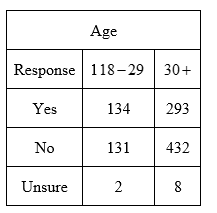
Do you think global warming will have an impact on you during your lifetime? A CBS News/New York Times poll of 1000 adults in the United States asked this question (CBS News website, December, 2014). Consider the responses by age groups shown below.

(Incase you can't see the above image)
Response --- 18-29 --- 30+
Yes ------------ 134 ------293
No ------------- 131 ------432
Unsure -------- 2 -----------8
a. What is the probability that a respondent 18-29 years of age thinks that global warming will not pose a serious threat during his/her lifetime (to 4 decimals)?
b. What is the probability that a respondent 30+ years of age thinks that global warming will not pose a serious threat during his/her lifetime (to 4 decimals)?
c. For a randomly selected respondent, what is the probability that a respondent answers yes (to 3 decimals)?
d. Based on the survey results, does there appear to be a difference between ages 18-29 and 30+ regarding concern over global warming?
Homework Answers
Probability:
The ratio of the number of favorable outcomes to certain event and the total number of possible outcomes is called as the probability of an event.
Complementary events:
Complementary of an event represents not happening of that event. That is, if an event A is defined, then complement of event A is not occurring of event A.
The probability of an event is defined as,
Compliment rule:
Formula for finding the value of is,
(a)
The probability that a respondent 18-29 years of age thinks that global warming will not pose a serious threat during his/her lifetime is obtained below:
From the given information, in an Age group 18-29 134 responded that yes, 131 responded that No and 2 were responded that unsure. In age group 293 were responded that yes, 432 were responded that No and 8 were responded that Unsure.
The required probability is,
(b)
The probability that a respondent 30+ years of age thinks that global warming will not pose a serious threat during his/her lifetime is obtained below:
The required probability is,
(c)
The probability that a respondent answers yes is obtained below:
The required probability is,
(d)
The difference between ages 18-29 and 30+ regarding concern over global warming is obtained below:
The probability that a respondent 18-29 years of age thinks that global warming will not pose a serious threat during his/her lifetime is,
The probability that a respondent 30+ years of age thinks that global warming will not pose a serious threat during his/her lifetime is,
Difference is,
There is a difference between ages 18-29 and 30+ regarding concern over global warming.
Ans: Part aThe probability that a respondent 18-29 years of age thinks that global warming will not pose a serious threat during his/her lifetime is 0.4906.
Part bThe probability that a respondent 30+ years of age thinks that global warming will not pose a serious threat during his/her lifetime is 0.5894.
Part cThe probability that a respondent answers yes 0.427.
Part dYes. There is a difference between ages 18-29 and 30+ regarding concern over global warming.
Add Answer to:
Do you think global warming will have an impact on you during
your lifetime? A CBS...
Do you think global warming will have an impact on you during your lifetime? A poll...
 Do you think global warming will have an impact on you during your lifetime? A poll of 1,000 adults asked this question. Consider the responses by age groups shown below Age Response 18-29 30+ Yes 287 140 No 137 426 Unsure 2 What is the probability that a respondent 18-29 years of age thinks that global warming will not pose a serious threat during his/her lifetime? (Round your answer to four decimal places.) (a) 0481 (b) What is the probability...
A. Issues [1] In addition to damages for one year's notice period, can a trial judge...
 A. Issues [1] In addition to damages for one year's notice period, can a trial judge award significant damages for the mere fact of an employee's dismissal, or for the stigma that that dismissal brings? Or for the employer thereafter competing with the ex-employee for the clients, before the ex-employee has got a new job? B. Basic Facts [2] This is an appeal from 2009 ABQB 591 (CanLII), 473 A.R. 254. [3] Usually a judgment recites facts before law. But...
Evaluate the arical writ the response in which you state your agreement or disagreement with writer...
 Evaluate the arical
writ the response in which you state your agreement or disagreement
with writer up un these questions guidelines
1) can empathy lead us astrary? how
2) our heart will always go out to the baby in the well, its a
measure of our humanity. but empathy will have to yield to reason
if humanity is to have a future can empathy yield to reason?
how?
thank you
The Baby in the Well: The Case against Empathy* -Paul...
Evaluate the arical
writ the response in which you state your agreement or disagreement
with writer up un these questions guidelines
1) can empathy lead us astrary? how
2) our heart will always go out to the baby in the well, its a
measure of our humanity. but empathy will have to yield to reason
if humanity is to have a future can empathy yield to reason?
how?
thank you
The Baby in the Well: The Case against Empathy* -Paul...
 Do you think global warming will have an impact on you during your lifetime? A poll of 1,000 adults asked this question. Consider the responses by age groups shown below Age Response 18-29 30+ Yes 287 140 No 137 426 Unsure 2 What is the probability that a respondent 18-29 years of age thinks that global warming will not pose a serious threat during his/her lifetime? (Round your answer to four decimal places.) (a) 0481 (b) What is the probability...
 A. Issues [1] In addition to damages for one year's notice period, can a trial judge award significant damages for the mere fact of an employee's dismissal, or for the stigma that that dismissal brings? Or for the employer thereafter competing with the ex-employee for the clients, before the ex-employee has got a new job? B. Basic Facts [2] This is an appeal from 2009 ABQB 591 (CanLII), 473 A.R. 254. [3] Usually a judgment recites facts before law. But...
 Evaluate the arical
writ the response in which you state your agreement or disagreement
with writer up un these questions guidelines
1) can empathy lead us astrary? how
2) our heart will always go out to the baby in the well, its a
measure of our humanity. but empathy will have to yield to reason
if humanity is to have a future can empathy yield to reason?
how?
thank you
The Baby in the Well: The Case against Empathy* -Paul...
Evaluate the arical
writ the response in which you state your agreement or disagreement
with writer up un these questions guidelines
1) can empathy lead us astrary? how
2) our heart will always go out to the baby in the well, its a
measure of our humanity. but empathy will have to yield to reason
if humanity is to have a future can empathy yield to reason?
how?
thank you
The Baby in the Well: The Case against Empathy* -Paul...
Most questions answered within 3 hours.
-
Where is the error in this code sequence?
String s1 = "Hello";
String s2 = "ello";...
asked 10 months ago -
Financial data for Joel de Paris, Inc., for last year
follow:
Joel de Paris, Inc.
Balance...
asked 10 months ago -
Consider this reaction:
Al2(SO4)3 (aq)+ BaCl3
(aq) Al2Cl6 (aq)- +
3BaSO4(s) . What is the...
asked 10 months ago -
Suppose that Savneet is considering increasing her
recent random sample from 20 car rentals to 40...
asked 10 months ago -
Trucks arrive at an unloading terminal at an average rate of 120
per hour.
Trucks arrive...
asked 10 months ago -
Why are methanol and ethanol completely soluble in water while
octanol is not very little soluble....
asked 10 months ago -
A facilities manager at a university reads in a research report
that the mean amount of...
asked 10 months ago -
When the CuSO4 is rehydrated by adding water to the anhydrous
compound, is this an endothermic...
asked 10 months ago -
A ray of sunlight is passing from diamond into crown glass; the
angle of incidence is...
asked 10 months ago -
A block of mass 0.249 kg is placed on top of a light, vertical
spring of...
asked 10 months ago -
how do the kidneys compensate in the presences of acidosis
a) trigger hyperventilate
b) reserve acid...
asked 10 months ago -
Question 501 pts
The rental rate of capital to the firm increases. Which of the
following...
asked 10 months ago